2016 JEEP GRAND CHEROKEE oil temperature
[x] Cancel search: oil temperaturePage 11 of 117

•Fuel meets minimum requirement
• System not disabled from previous remote start event
• Vehicle security alarm not active
• Water In Fuel Indicator Light is not illuminated
• “Wait To Start” telltale is not illuminated
WARNING!
•Do not start or run an engine in a closed garage or
confined area. Exhaust gas contains Carbon Mon-
oxide (CO) which is odorless and colorless. Carbon
Monoxide is poisonous and can cause serious in-
jury or death when inhaled.
• Keep Remote Keyless Entry (RKE) transmitters
away from children. Operation of the Remote Start
System, windows, door locks or other controls
could cause serious injury or death.
ENGINE BREAK-IN RECOMMENDATIONS
The diesel engine does not require a break-in period due
to its construction. Normal operation is allowed, provid-
ing the following recommendations are followed:
• Warm up the engine before placing it under load.
• Do not operate the engine at idle for prolonged
periods.
• Use the appropriate transmission gear to prevent
engine lugging.
• Observe vehicle oil pressure and temperature indica-
tors.
• Check the coolant and oil levels frequently.
• Vary throttle position at highway speeds when carry-
ing or towing significant weight.
2
THINGS TO KNOW BEFORE STARTING YOUR VEHICLE 9
Page 39 of 117
•Engine Oil Pressure telltale is not illuminated.
• Voltmeter operation:
The voltmeter may show a gauge fluctuation at various
engine temperatures. This is caused by the glow plug
heating system. The number of cycles and the length of
the cycling operation is controlled by the engine control
module. Glow plug heater operation can run for several
minutes, once the heater operation is complete the volt-
meter needle will stabilize.
Cold Weather Precautions
Operation in ambient temperature below 32°F (0°C) may
require special considerations. The following charts sug-
gest these options:
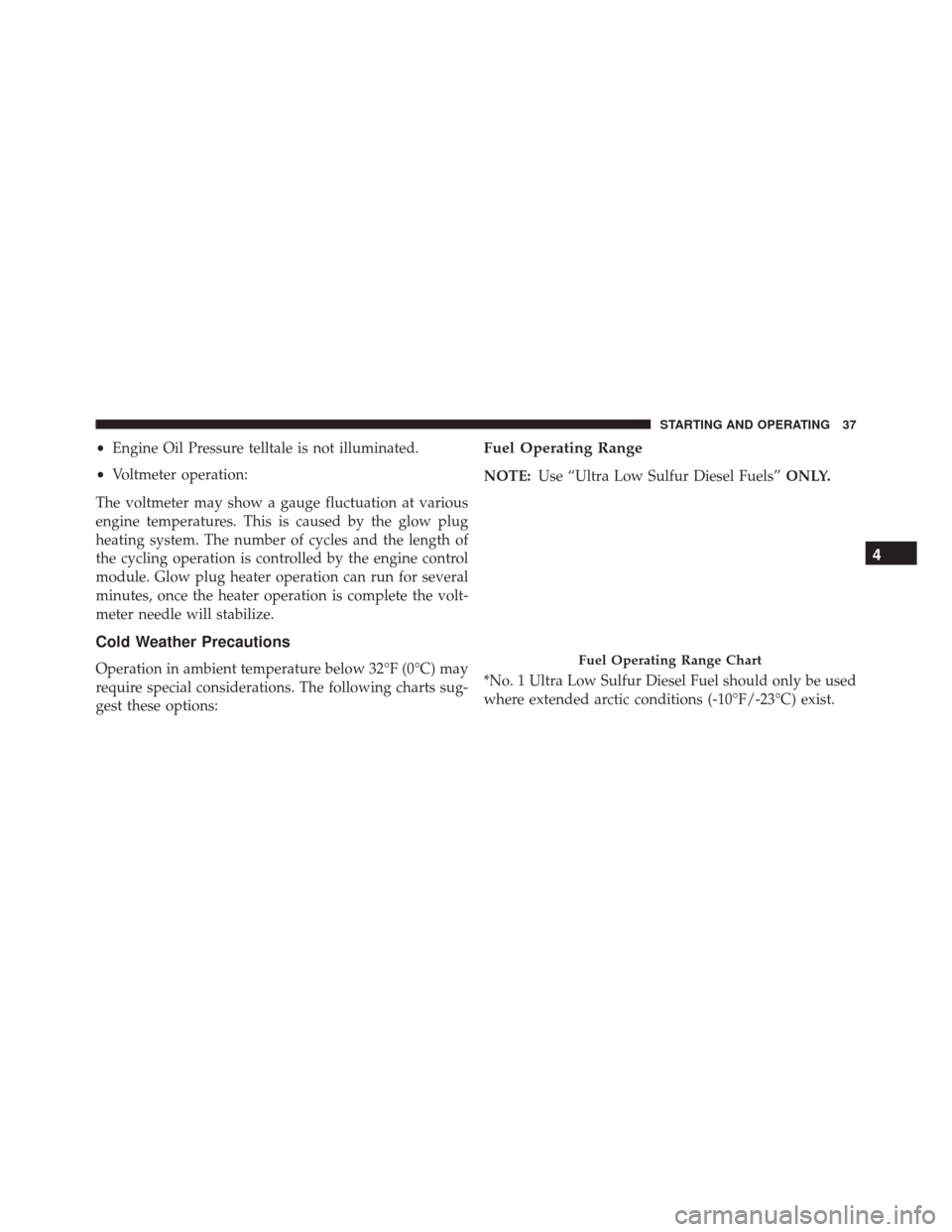
Fuel Operating Range
NOTE: Use “Ultra Low Sulfur Diesel Fuels” ONLY.
*No. 1 Ultra Low Sulfur Diesel Fuel should only be used
where extended arctic conditions (-10°F/-23°C) exist.
Fuel Operating Range Chart
4
STARTING AND OPERATING 37
Page 40 of 117
NOTE:
•Use of Climatized Ultra Low Sulfur Diesel Fuel or
Number 1 Ultra Low Sulfur Diesel Fuel results in a
noticeable decrease in fuel economy.
• Climatized Ultra Low Sulfur Diesel Fuel is a blend of
Number 2 Ultra Low Sulfur and Number 1 Ultra Low
Sulfur Diesel Fuels which reduces the temperature at
which wax crystals form in fuel.
• The fuel grade should be clearly marked on the pump
at the fuel station.
• The engine requires the use of “Ultra Low Sulfur
Diesel Fuel”. Use of incorrect fuel could result in
engine and exhaust system damage. Refer to “Fuel
Requirements” in “Starting And Operating” for fur-
ther information. •
Commercially available fuel additives are not neces-
sary for the proper operation of your diesel engine.
However, if seasonably adjusted fuel is not available
and you are operating below 20°F (-6°C), MOPAR
Premium Diesel Fuel Treatment (or equivalent) may be
beneficial to avoid fuel gelling.
Engine Oil Usage
Refer to “Maintenance Procedures” in “Maintaining Your
Vehicle” for the correct engine oil viscosity.
Engine Warm-Up
Avoid full throttle operation when the engine is cold.
When starting a cold engine, bring the engine up to
operating speed slowly to allow the oil pressure to
stabilize as the engine warms up.
If temperatures are below 32°F (0°C), operate the engine
at moderate speeds for five minutes before full loads are
applied.
38 STARTING AND OPERATING
Page 41 of 117
Engine Idling
Avoid prolonged idling, long periods of idling may be
harmful to your engine because combustion chamber
temperatures can drop so low that the fuel may not burn
completely. Incomplete combustion allows carbon and
varnish to form on piston rings, cylinder head valves,
and injector nozzles. Also, the unburned fuel can enter
the crankcase, diluting the oil and causing rapid wear to
the engine.
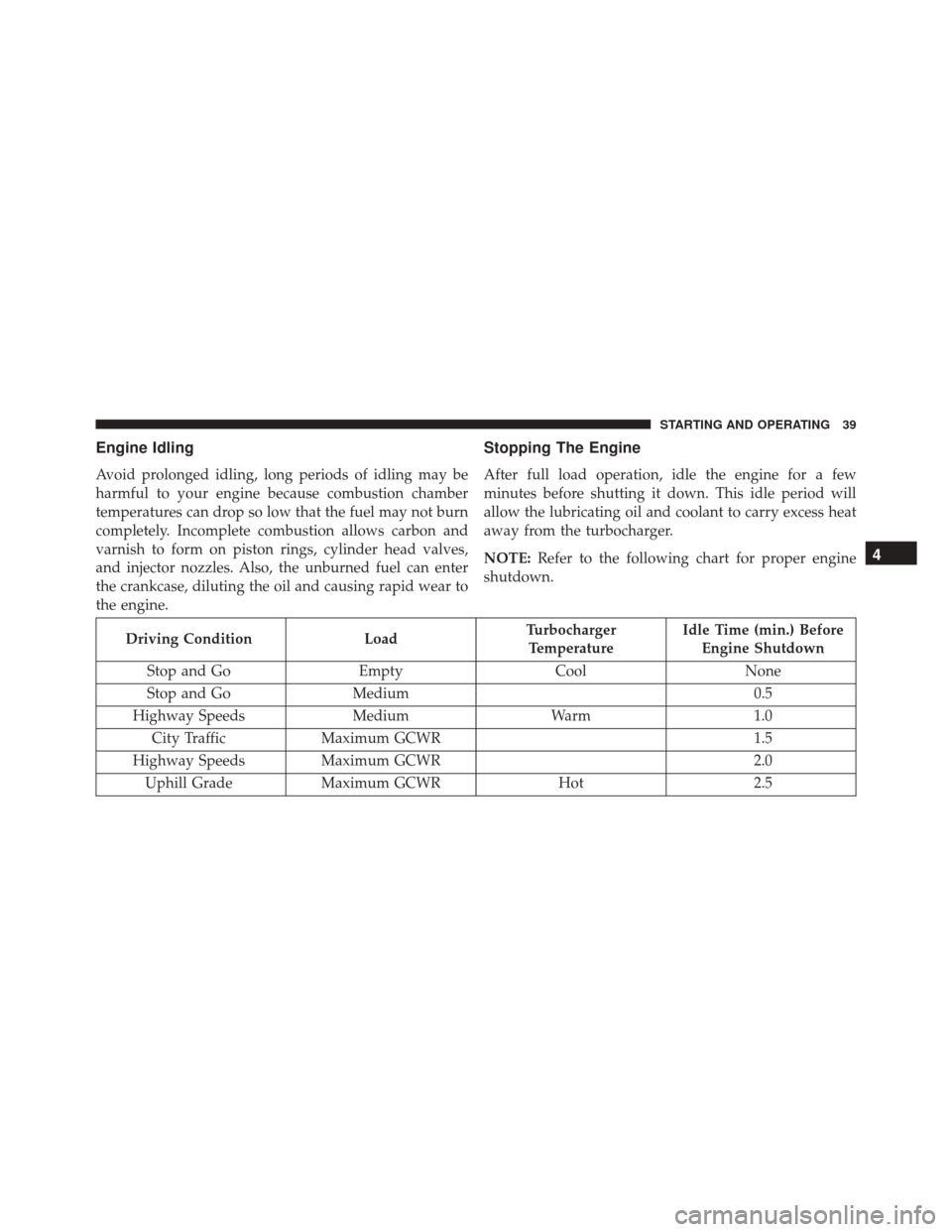
Stopping The Engine
After full load operation, idle the engine for a few
minutes before shutting it down. This idle period will
allow the lubricating oil and coolant to carry excess heat
away from the turbocharger.
NOTE:Refer to the following chart for proper engine
shutdown.
Driving Condition LoadTurbocharger
Temperature Idle Time (min.) Before
Engine Shutdown
Stop and Go EmptyCoolNone
Stop and Go Medium 0.5
Highway Speeds MediumWarm 1.0
City Traffic Maximum GCWR 1.5
Highway Speeds Maximum GCWR 2.0
Uphill Grade Maximum GCWR Hot2.5
4
STARTING AND OPERATING 39
Page 42 of 117
NOTE:Under certain conditions the engine fan will run
after the engine is turned off. These conditions are under
high load and high temperature conditions.
Cooling System Tips — Automatic Transmission
To reduce the potential for engine and transmission
overheating in high ambient temperature conditions,
take the following actions:
• City Driving — When stopped, shift the transmission
into NEUTRAL and increase engine idle speed.
• Highway Driving — Reduce your speed.
• Up Steep Hills — Select a lower transmission gear.
• Air Conditioning — Turn it off temporarily.
NOTE: If the coolant temperature is too high the A/C
will automatically turn off.
Do Not Operate The Engine With Low Oil
Pressure
If the low oil pressure warning light turns on while
driving, stop the vehicle and shut down the engine as
soon as possible. A chime will sound when the light turns
on.
NOTE: Do not operate the vehicle until the cause is
corrected. This light does not show how much oil is in the
engine. The engine oil level must be checked under the
hood.
CAUTION!
If oil pressure falls to less than normal readings, shut
the engine off immediately. Failure to do so could
result in immediate and severe engine damage.
40 STARTING AND OPERATING
Page 43 of 117
Do Not Operate The Engine With Failed Parts
All engine failures give some warning before the parts
fail. Be on the alert for changes in performance, sounds,
and visual evidence that the engine requires service.
Some important clues are:
•Engine misfiring or vibrating severely.
• Sudden loss of power.
• Unusual engine noises.
• Fuel, oil or coolant leaks.
• Sudden change, outside the normal operating range, in
the engine operating temperature.
• Excessive smoke.
• Oil pressure drop.
ENGINE BLOCK HEATER — IF EQUIPPED
The engine block heater warms engine coolant and
permits quicker starts in cold weather. Connect the heater
cord to a ground-fault interrupter protected 110–115 Volt
AC electrical outlet with a grounded, three-wire exten-
sion cord.
Its use is recommended for environments that routinely
fall below -10°F (-23°C). It should be used when the
vehicle has not been running for long periods of time and
should be plugged in two hours prior to start. Its use is
required for cold starts with temperatures under -20°F
(-28°C).
To ensure reliable starting at these temperatures, use of
an externally powered electric engine block heater (avail-
able from your authorized dealer) is recommended.
4
STARTING AND OPERATING 41
Page 76 of 117
recommended for all operating temperatures. This en-
gine oil improves low temperature starting and vehicle
fuel economy.
Materials Added To Engine Oil
The manufacturer strongly recommends against the ad-
dition of any additives (other than leak detection dyes) to
the engine oil. Engine oil is an engineered product and
its performance may be impaired by supplemental addi-
tives.
Engine Oil Filter
Refer to “Fluids, Lubricants, And Genuine Parts” in
“Maintaining Your Vehicle” for further information. The
engine oil filter should be changed at every engine oil
change.
Disposing Of Used Engine Oil And Oil Filters
Care should be taken in disposing of used engine oil and
oil filters from your vehicle. Used oil and oil filters,
indiscriminately discarded, can present a problem to the
environment. Contact your authorized dealer, service
station or governmental agency for advice on how and
where used oil and oil filters can be safely discarded in
your area.
Engine Air Cleaner Filter
Refer to the “Maintenance Schedule” for the proper
maintenance intervals.
CAUTION!
All air entering the engine intake must be filtered.
The abrasive particles in unfiltered air will cause
rapid wear to engine components.
74 MAINTAINING YOUR VEHICLE
Page 100 of 117
MAINTENANCE SCHEDULE
Your vehicle is equipped with an automatic oil change
indicator system. The oil change indicator system will
remind you that it is time to take your vehicle in for
scheduled maintenance.
Based on engine operation conditions, the oil change
indicator message will illuminate. This means that ser-
vice is required for your vehicle. Operating conditions
such as frequent short-trips, trailer tow, extremely hot or
cold ambient temperatures will influence when the “Oil
Change Required” message is displayed. Severe Operat-
ing Conditions can cause the change oil message to
illuminate as early as 3,500 miles (5,600 km) since last
reset. Have your vehicle serviced as soon as possible,
within the next 500 miles (805 km).Your authorized dealer will reset the oil change indicator
message after completing the scheduled oil change. If a
scheduled oil change is performed by someone other
than your authorized dealer, the message can be reset by
referring to the steps described under “Driver Informa-
tion Display (DID)” in “Understanding Your Instrument
Panel” for further information.
NOTE:
Under no circumstances should oil change inter-
vals exceed 10,000 miles (16,000 km) or twelve months,
whichever comes first.
98 MAINTENANCE SCHEDULE