2016 Hyundai H350 engine
[x] Cancel search: enginePage 342 of 473
6-7
What to do in an emergency
5.Start the engine of the vehicle withthe booster battery and let it run at
2,000 rpm, then start the engine of
the vehicle with the discharged
battery.
If the cause of your battery discharg-
ing is not apparent, we recommendthat the system be checked by an authorized HYUNDAI dealer.
Push-starting
Your manual transmission-equipped
vehicle should not be push-startedbecause it might damage the emis-sion control system. If your temperature gauge indicates
overheating, you experience a loss
of power, or hear loud pinging or
knocking, the engine is probably too
hot. If this happens, you should:
1.Pull off the road and stop as soon
as it is safe to do so.
2.Place the shift lever in neutral and set the parking brake. If the air con-
ditioning is on, turn it off.
3.If engine coolant is running out under the vehicle or steam is com-ing out from the hood, stop the
engine. Do not open the hood until
the coolant has stopped running
or the steaming has stopped. If
there is no visible loss of engine
coolant and no steam, leave the
engine running and check to be
sure the engine cooling fan is oper-
ating. If the fan is not running, turn
the engine off.
6
Never tow a vehicle to start it
because the sudden surge for-
ward when the engine startscould cause a collision with the
tow vehicle.
WARNING
IIFF TT HH EE EE NN GGIINN EE OO VVEERR HH EEAA TTSS
Page 343 of 473
6-8
4.Check to see if the water pump
drive belt is missing. If it is not
missing, check to see that it is
tight. If the drive belt seems to be
satisfactory, check for coolant leak-
ing from the radiator, hoses or
under the vehicle. (If the air condi-
tioning had been in use, it is nor-
mal for cold water to be draining
from it when you stop). 5.If the water pump drive belt is bro-
ken or engine coolant is leakingout, stop the engine immediately
and we recommend that you call
an authorized HYUNDAI dealer. 6.If you cannot find the cause of the
overheating, wait until the engine
temperature has returned to nor-
mal. Then, if coolant has been lost,carefully add coolant to the reser-
voir to bring the fluid level in the
reservoir up to the halfway mark.
7.Proceed with caution, keeping alert for further signs of overheat-
ing. If overheating happens again,
we recommend that you call an
authorized HYUNDAI dealer.
What to do in an emergency
While the engine is running,
keep hair, hands and clothing
away from moving parts suchas the fan and drive belts to pre-
vent injury.
WARNING
Do not remove the radiator cap
when the engine is hot. This can
allow coolant to be blown out ofthe opening and cause serious
burns.
WARNING
Serious loss of coolant indi- cates there is a leak in thecooling system and we rec-ommend that the system be
checked by an authorized
HYUNDAI dealer.
When the engine overheats
from low engine coolant, sud-
denly adding engine coolant
may cause cracks in the
engine. To prevent damage,
add engine coolant slowly insmall quantities.
CAUTION
Page 344 of 473
6-9
What to do in an emergency
6
■■Jacking instructions
The jack is provided for emergency
tire changing only.
To prevent the jack from “rattling”
while the vehicle is in motion, store it
properly and fasten the jack screw
fully.
Follow jacking instructions to reduce
the possibility of personal injury.
■■A type
Jack and tools
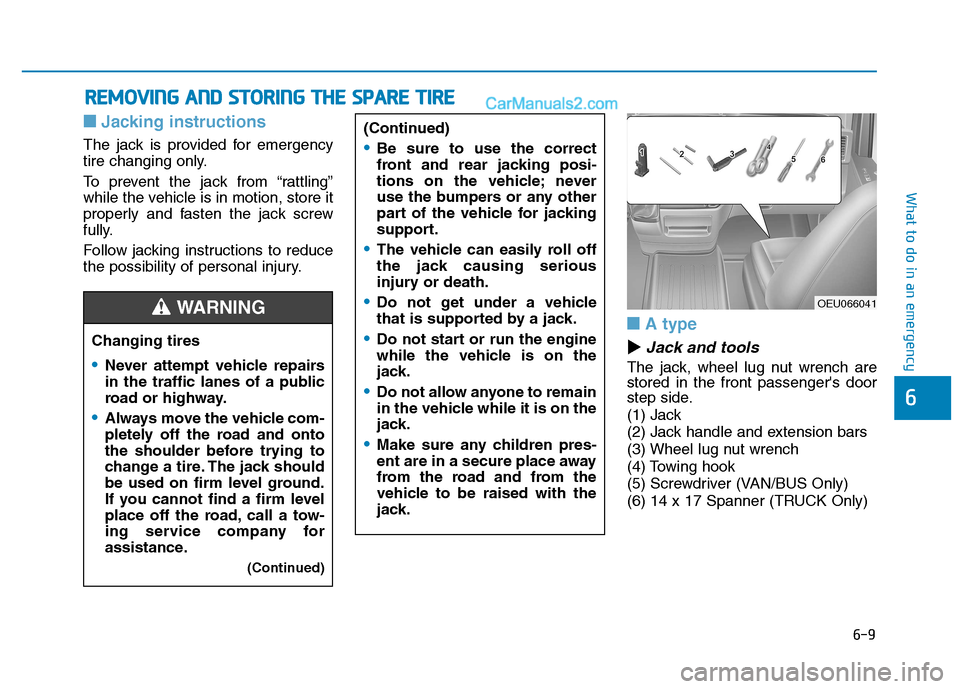
The jack, wheel lug nut wrench are stored in the front passenger's door
step side.
(1) Jack
(2) Jack handle and extension bars
(3) Wheel lug nut wrench
(4) Towing hook
(5) Screwdriver (VAN/BUS Only)
(6) 14 x 17 Spanner (TRUCK Only)
RREEMM OOVVIINN GG AA NN DD SS TT OO RRIINN GG TT HH EE SS PP AA RREE TT IIRR EE
OEU066041
Changing tires
Never attempt vehicle repairs
in the traffic lanes of a public
road or highway.
Always move the vehicle com-
pletely off the road and onto
the shoulder before trying to
change a tire. The jack should
be used on firm level ground.
If you cannot find a firm level
place off the road, call a tow-
ing service company for
assistance. (Continued)
(Continued)
Be sure to use the correct
front and rear jacking posi-
tions on the vehicle; never
use the bumpers or any other
part of the vehicle for jacking
support.
The vehicle can easily roll off
the jack causing serious
injury or death.
Do not get under a vehicle
that is supported by a jack.
Do not start or run the engine
while the vehicle is on the
jack.
Do not allow anyone to remain
in the vehicle while it is on the
jack.
Make sure any children pres-
ent are in a secure place away
from the road and from the
vehicle to be raised with the
jack.
WARNING
Page 364 of 473
7
Maintenance
7
Maintenance
Engine compartment .............................................7-3
Maintenance services ...........................................7-5Owner's responsibility ......................................................7-5
Owner maintenance precautions ..................................7-5
Engine compartment precautions (Diesel engine) ....7-7
Owner maintenance ...............................................7-8 Owner maintenance schedule ........................................7-8
Scheduled maintenance services ......................7-10 Normal maintenance schedule (for Europe) ............7-11
Normal maintenance schedule (except Europe) .....7-14
Maintenance under severe usage conditions ..........7-17
Explanation of scheduled maintenance items ..7-19
Engine oil ..............................................................7-22 Checking the engine oil level ....................................7-22
Changing the engine oil and filter ..............................7-23
Engine coolant......................................................7-24 Checking the coolant level ...........................................7-24
Changing the coolant .....................................................7-26
Brake/Clutch fluid ..............................................7-27 Checking the brake/clutch fluid level ........................7-27
Power steering fluid ............................................7-28 Checking the power steering fluid level ...................2-28
Checking the power steering hose.............................2-29
Washer fluid .........................................................7-29 Checking the washer fluid level ...............................7-29 Parking brake .......................................................7-30
Checking the parking brake .........................................7-30
Fuel filter (For diesel).........................................7-30 Draining water from fuel filter ....................................7-30
Fuel filter cartridge replacement ................................7-30
Manual transmission and rearaxle oil ..............7-31 Check and adding oil ......................................................7-31
Change the gear oil ........................................................7-31
Air cleaner ............................................................7-31 Filter replacement ...........................................................7-31
Climate control air filter .....................................7-33 Filter inspection ...............................................................7-33
Filter replacement ...........................................................7-33
Wiper blades .........................................................7-34 Blade inspection ..............................................................7-34
Blade replacement ..........................................................7-35
Battery...................................................................7-37 For best battery service................................................7-37
Battery capacity label ...................................................7-40
Battery recharging .......................................................7-40
Reset items .......................................................................7-41
Tires and wheels ..................................................7-42 Tire care ............................................................................7-42
Recommended cold tire inflation pressures.............7-42
Checking tire inflation pressure ..................................7-43
7
Page 366 of 473
7-3
7
Maintenance
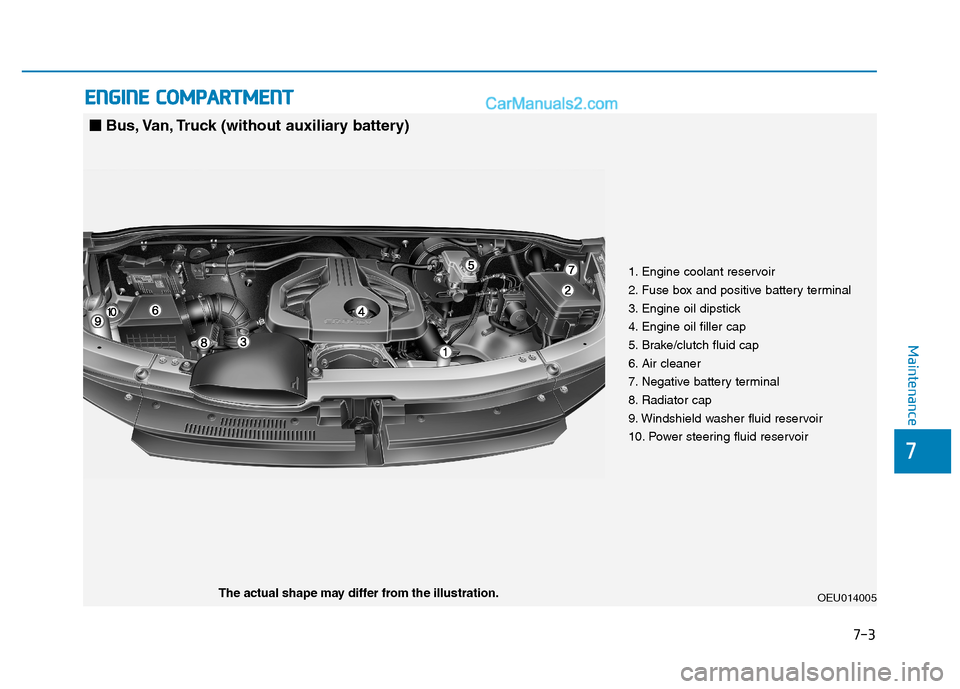
EENN GGIINN EE CC OO MM PPAA RRTTMM EENN TT
1. Engine coolant reservoir
2. Fuse box and positive battery terminal
3. Engine oil dipstick
4. Engine oil filler cap
5. Brake/clutch fluid cap
6. Air cleaner
7. Negative battery terminal
8. Radiator cap
9. Windshield washer fluid reservoir
10. Power steering fluid reservoir
OEU014005
The actual shape may differ from the illustration.
■■
Bus, Van, Truck (without auxiliary battery)
Page 367 of 473
7-4
Maintenance
OEU014006
The actual shape may differ from the illustration.
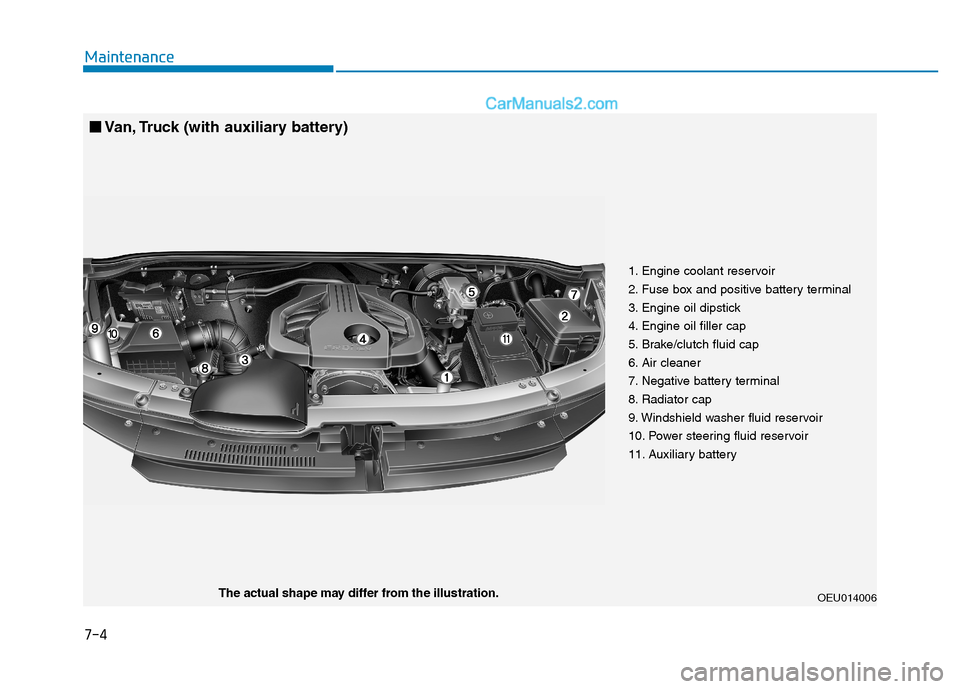
■
■
Van, Truck (with auxiliary battery)
1. Engine coolant reservoir
2. Fuse box and positive battery terminal
3. Engine oil dipstick
4. Engine oil filler cap
5. Brake/clutch fluid cap
6. Air cleaner
7. Negative battery terminal
8. Radiator cap
9. Windshield washer fluid reservoir
10. Power steering fluid reservoir
11. Auxiliary battery
Page 369 of 473
7-6
Maintenance
Maintenance work
Performing maintenance work
on a vehicle can be danger-
ous. You can be seriously
injured while performing
some maintenance proce-
dures. If you lack sufficient
knowledge and experience or
the proper tools and equip-
ment to do the work, we rec-ommend that the system be
serviced by an authorized
HYUNDAI dealer.
Working under the hood with
the engine running is danger-
ous. It becomes even more
dangerous when you wear
jewelry or loose clothing.These can become entangled
in moving parts and result in
injury.(Continued)
WARNING Continued)
Therefore, if you must run the
engine while working under
the hood, make certain that
you remove all jewelry (espe-
cially rings, bracelets, watch-
es, and necklaces) and all
neckties, scarves, and similar
loose clothing before gettingnear the engine or coolingfans.
Do not put heavy objects or
apply excessive force on top
of the engine cover (ifequipped) or fuel related
parts.
When you inspect the fuel system (fuel lines and fuel
injection devices), we recom-
mend that you contact an
authorized HYUNDAI dealer.
Do not drive long time with
the engine cover (if equipped)
removed.
When checking the engine
room, do not go near fire.
Fuel, washer fluid, etc. are
flammable oils that may cause
fire.
Before touching the battery,
ignition cables and electrical
wiring, you should disconnect
the battery "-" terminal. You
may get an electric shock
from the electric current. (Continued)
CAUTION
Page 370 of 473
7-7
7
Maintenance
Continued)
When you remove the interior
trim cover with a flat head (-)
driver, be careful not to dam-
age the cover.
Be careful when you replace
and clean bulbs to avoid
burns or electrical shock.
Engine compartment precau- tions (Diesel engine)
• Follow the safety tips providedbelow, when you are checking the engine room while the engine is
running.
- Do not touch the injector, injectorwirings, and the engine computer
while the engine is running.
- Do not remove the injector con- nector while the engine is run-ning.
- People using pacemakers must not go near the engine while the
engine is starting or running. Diesel Engine
Never work on injection system with engine running or within 30seconds after shutting off
engine. High-pressure pump,
rail, injectors and high-pressurepipes are subject to high pres-
sure even after the engine
stopped. The fuel jet produced
by fuel leaks may cause serious
injury, if it touches the body.
People using pacemakers
should not move than 30cm
closer to the ECU or wiring har-
ness within the engine room
while engine is running, sincethe high currents in the elec-
tronic engine control system
produce considerable magneticfields.
WARNING