2016 Hyundai H350 engine
[x] Cancel search: enginePage 329 of 473
5-58
Driving your vehicle
When you are ready to leave after
parking on a hill
1. With the manual transmission inNeutral, apply your brakes and
hold the brake pedal down while
you:
and
2. Slowly remove your foot from the brake pedal.
3. Drive slowly until the trailer is clear of the chocks.
4. Stop and have someone pick up and store the chocks.
Maintenance when trailer tow- ing
Your vehicle will need service more
often when you regularly pull a trail-
er. Important items to pay particularattention to include engine oil, axle
lubricant and cooling system fluid.
Brake condition is another important
item to frequently check. Each item is
covered in this manual, and the
Index will help you find them quickly.
If you’re trailering, it’s a good idea to
review these sections before you
start your trip.
Don’t forget to also maintain your
trailer and hitch. Follow the mainte-nance schedule that accompanied
your trailer and check it periodically.
Preferably, conduct the check at the
start of each day’s driving. Most
importantly, all hitch nuts and boltsshould be tight.
Parking brake
It can be dangerous to get out
of your vehicle if the parking
brake is not firmly set.
If you have left the engine run-
ning, the vehicle can move sud-
denly. You or others could be
seriously or fatally injured.
WARNING
Page 330 of 473
5-59
Driving your vehicle
5
If you do decide to pull a trail- er
Here are some important points if
you decide to pull a trailer:
Consider using a sway control. Youcan ask a hitch dealer about sway control.
Do not do any towing with your vehicle during its first 2,000 km
(1,200 miles) in order to allow the
engine to properly break in. Failure
to heed this caution may result in
serious engine or transmission
damage.
When towing a trailer, we recom- mend that you consult an author-
ized HYUNDAI dealer on addition-
al requirements such as a towingkit, etc.
Always drive your vehicle at a mod- erate speed (Max speed for stan-
dard trailer is 80 km/h (50 mph)). ❇ Special trailer 100 km/h (60
mph) is allowed but trailer need
special approval from TÜV. On a long uphill grade, do not
exceed 70 km/h (45 mph) or the
posted towing speed limit,
whichever is lower.
Fuel consumption will increase due to the additional required power to
tow trailer and additional trans-
portation weight at the trailer.
To prevent vehicle damage :
Due to higher load during
trailer usage, overheating
might occur in hot days or
during uphill driving. If the
coolant gauge indicates over-
heating, switch off the A/C
and stop the vehicle in a safe
area to cool down the engine.
When towing check transmis-
sion fluid more frequently.
If your vehicle is not equipped
with the air conditioner, youshould install a condenser fan
to improve engine perform-
ance when towing a trailer.
CAUTION
Page 335 of 473
5-64
Driving your vehicle
The following procedures can be
used to confirm that the locking dif-
ferential is functioning properly:
(1) Position the vehicle so that onewheel is on a dry paved surface
and the other on ice, snow, mud,
etc. Drive the vehicle, and
observe the operation of the lock-
ing differential. The vehicle
should not become stuck if the
differential is functioning properly.
(2) Depress the accelerator pedal
gradually, and then when traction
is good, depress it forcefully. If
the vehicle accelerates well, the
differential is functioning properly.
Information
Usually a locking differential will
operate and release automatically but
occasionally it may not release auto-
matically.
At this time you will feel the tire is
dragged when you are driving or cor-
nering. You can release it manually by
slightly turning the steering wheel
right and left while the vehicle is mov-
ing slowly.
i
Never start the engine with
the gearshift lever placed in
the forward or reverse whileone of the rear wheels is
jacked up and the other in
contact with the ground;
doing so may cause the vehi-
cle to jump forward.
If one of the rear wheels
begins to spin in mud, snow,
etc., the vehicle can some-
times be driven out bydepressing the accelerator
pedal further; however, avoid
running the engine continu-
ously at high rpm because
doing so could damage the
locking differential.
CAUTION
Page 336 of 473
What to do in an emergency
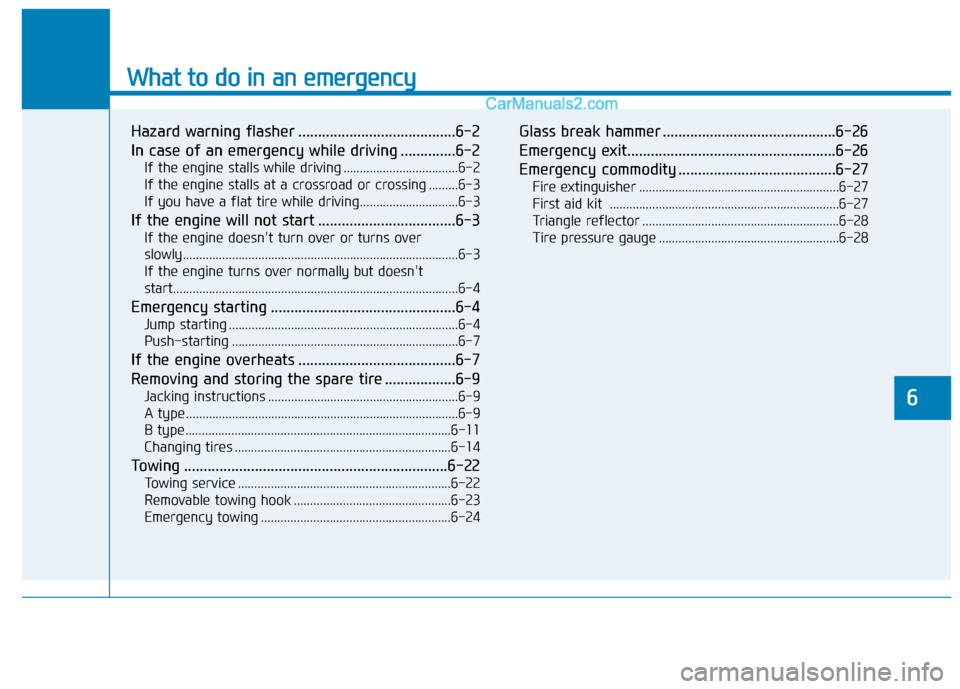
Hazard warning flasher ........................................6-2
In case of an emergency while driving ..............6-2If the engine stalls while driving ...................................6-2
If the engine stalls at a crossroad or crossing .........6-3
If you have a flat tire while driving..............................6-3
If the engine will not start ...................................6-3 If the engine doesn't turn over or turns over
slowly....................................................................................6-3
If the engine turns over normally but doesn't
start.......................................................................................6-4
Emergency starting ...............................................6-4 Jump starting ......................................................................6-4
Push-starting .....................................................................6-7
If the engine overheats ........................................6-7
Removing and storing the spare tire ..................6-9 Jacking instructions ..........................................................6-9
A type ...................................................................................6-9
B type.................................................................................6-11
Changing tires ..................................................................6-14
Towing ...................................................................6-22 Towing service .................................................................6-22
Removable towing hook ................................................6-23
Emergency towing ..........................................................6-24 Glass break hammer ............................................6-26
Emergency exit.....................................................6-26
Emergency commodity ........................................6-27
Fire extinguisher .............................................................6-27
First aid kit ......................................................................6-27
Triangle reflector ............................................................6-28
Tire pressure gauge .......................................................6-28
6
Page 337 of 473
6-2
Hazard warning flasher
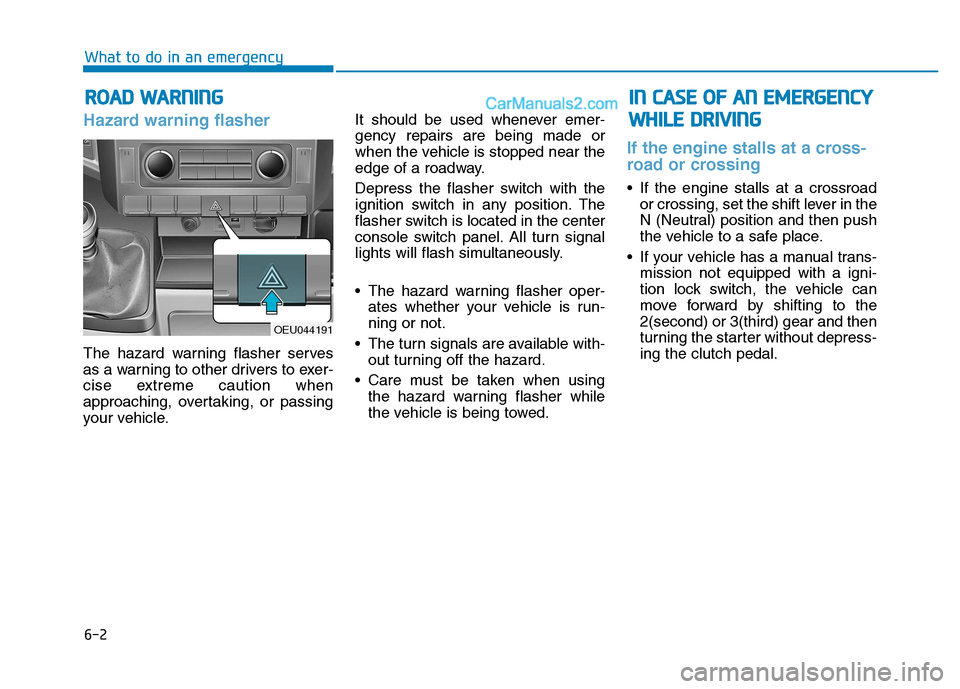
The hazard warning flasher serves
as a warning to other drivers to exer-
cise extreme caution when
approaching, overtaking, or passing
your vehicle.It should be used whenever emer-gency repairs are being made or
when the vehicle is stopped near the
edge of a roadway.
Depress the flasher switch with the
ignition switch in any position. The
flasher switch is located in the center
console switch panel. All turn signal
lights will flash simultaneously.
• The hazard warning flasher oper-
ates whether your vehicle is run- ning or not.
The turn signals are available with- out turning off the hazard.
Care must be taken when using the hazard warning flasher while
the vehicle is being towed.
If the engine stalls at a cross-
road or crossing
If the engine stalls at a crossroador crossing, set the shift lever in the
N (Neutral) position and then push
the vehicle to a safe place.
If your vehicle has a manual trans- mission not equipped with a igni-
tion lock switch, the vehicle can
move forward by shifting to the2(second) or 3(third) gear and then
turning the starter without depress-ing the clutch pedal.
RROO AADD WW AARRNN IINN GG
What to do in an emergency
I
INN CC AA SSEE OO FF AA NN EE MM EERR GG EENN CCYY
W
W HHIILL EE DD RRIIVV IINN GG
OEU044191
Page 338 of 473

6-3
What to do in an emergency
If you have a flat tire while driving
If a tire goes flat while you are driv- ing:
1.Take your foot off the acceleratorpedal and let the vehicle slow
down while driving straight ahead.
Do not apply the brakes immedi-ately or attempt to pull off the road
as this may cause a loss of control.
When the vehicle has slowed to
such a speed that it is safe to do
so, brake carefully and pull off the
road. Drive off the road as far as
possible and park on firm, level
ground. If you are on a divided
highway, do not park in the median
area between the two traffic lanes.
2.When the vehicle is stopped, turn on your emergency hazard flash-
ers, set the parking brake and put
the transmission in reverse.
3.Have all passengers get out of the vehicle. Be sure they all get out on
the side of the vehicle that is away
from traffic.
4.When changing a flat tire, follow the instruction provided later in thissection.
If engine stalls while driving
1.Reduce your speed gradually,keeping a straight line. Move cau-
tiously off the road to a safe place.
2.Turn on your emergency flashers.
3.Try to start the engine again. If your vehicle will not start, we recom-
mend that you contact an author-
ized HYUNDAI dealer.If engine doesn't turn over or
turns over slowly
1.Check the battery connections tobe sure they are clean and tight.
2.Turn on the interior light. If the light dims or goes out when you operate
the starter, the battery is dis-charged.
3.Check the starter connections to be sure they are securely tight-ened.
4.Do not push or pull the vehicle to start it. See instructions for "Jump
starting".
6
IIFF TT HH EE EE NN GGIINN EE WW IILL LL NN OO TT
S
S TT AA RRTT
If the engine will not start, do
not push or pull the vehicle to
start it. This could result in acollision or cause other dam-
age. In addition, push or pull
starting may cause the catalytic
converter to be overloaded and
create a fire hazard.
WARNING
Page 339 of 473
6-4
If engine turns over normally
but does not start
1.Check fuel level.
2.With the ignition switch in theLOCK/ OFF position, check all connectors at ignition, coil and
spark plugs. Reconnect any that
may be disconnected or loose.
3.Check the fuel line in the engine compartment.
4.If the engine still does not start, we recommend that you call an
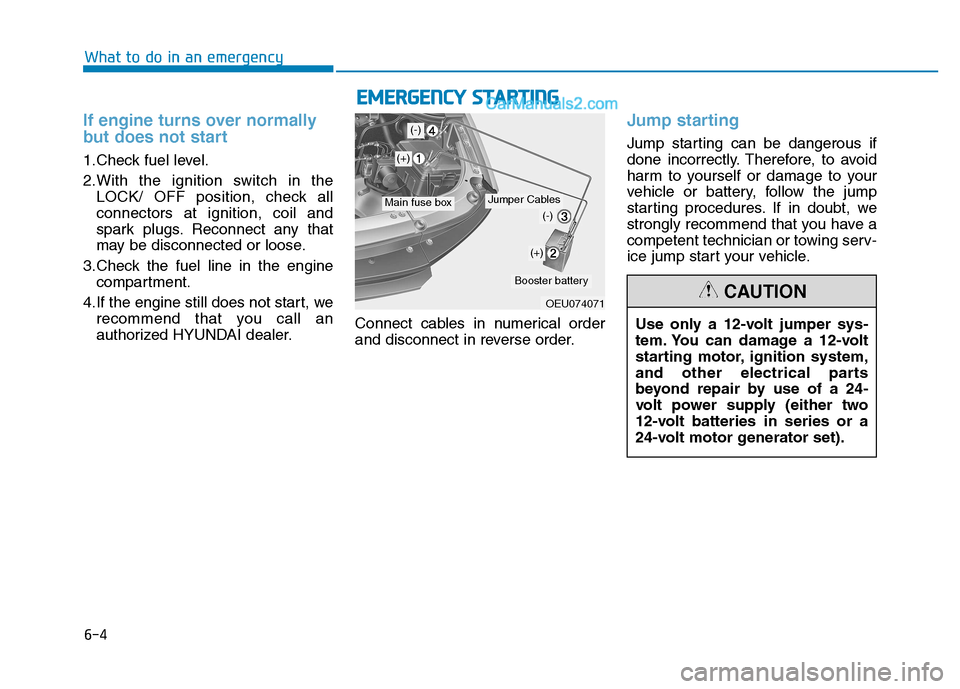
authorized HYUNDAI dealer. Connect cables in numerical order
and disconnect in reverse order.
Jump starting
Jump starting can be dangerous if
done incorrectly. Therefore, to avoid
harm to yourself or damage to your
vehicle or battery, follow the jump
starting procedures. If in doubt, we
strongly recommend that you have a
competent technician or towing serv-
ice jump start your vehicle.
What to do in an emergency
E
EMM EERR GG EENN CCYY SS TT AA RRTTIINN GG
OEU074071
Jumper CablesMain fuse box
Booster battery
Use only a 12-volt jumper sys-
tem. You can damage a 12-volt
starting motor, ignition system,
and other electrical parts
beyond repair by use of a 24-
volt power supply (either two
12-volt batteries in series or a
24-volt motor generator set).CAUTION
(+)
(+)
(-)
(-)
Page 341 of 473

6-6
What to do in an emergency
Jump starting procedure
1.Make sure the booster battery is12-volt and that its negative termi-
nal is grounded.
2.If the booster battery is in another vehicle, do not allow the vehicles totouch.
3.Turn off all unnecessary electrical loads.
4.Connect the jumper cables in the exact sequence shown in the illus-
tration. First connect one end of a
jumper cable to the positive termi-
nal of the main fuse box (1), thenconnect the other end to the posi-
tive terminal on the booster battery(2). Proceed to connect one end of the
other jumper cable to the negative
terminal of the booster battery (3),then the other end to a solid, sta-
tionary, metallic point (for example,
the engine lifting bracket) away
from the negative battery terminal
(4). Do not connect it to or near any
part that moves when the engine is
cranked.
Do not allow the jumper cables to contact anything except the correct
battery terminals or the correct
ground. Do not lean over the bat-
tery when making connections.
AGM battery (if equipped)
Absorbent Glass Matt (AGM) batteries are maintenance-free and we recommend that
the system be serviced by an
authorized HYUNDAI dealer.
For charging your AGM bat-
tery, use only fully automatic
battery chargers that are spe-
cially developed for AGM bat-teries.
When replacing the AGM bat-
tery, we recommend that you
use parts for replacement
from an authorized HYUNDAI
dealer.
Do not open or remove the
cap on top of the battery. This
may cause leaks of internal
electrolyte that could result in
severe injury.
(Continued)
(Continued)
If the AGM battery is recon-
nected or replaced, ISG func-tion will not operate immedi-
ately.
If you want to use the ISG
function, the battery sensor
needs to be calibrated for
approximately 4 hours with
the ignition off.
During the period, the dark
current must be under 100 mA.
CAUTION
Battery cables Do not connect the jumper
cable from the negative terminal
of the booster battery to thenegative terminal of the dis-
charged battery. This can cause
the discharged battery to over-
heat and crack, releasing bat-
tery acid.
CAUTION