Page 422 of 473
7-59
7
Maintenance
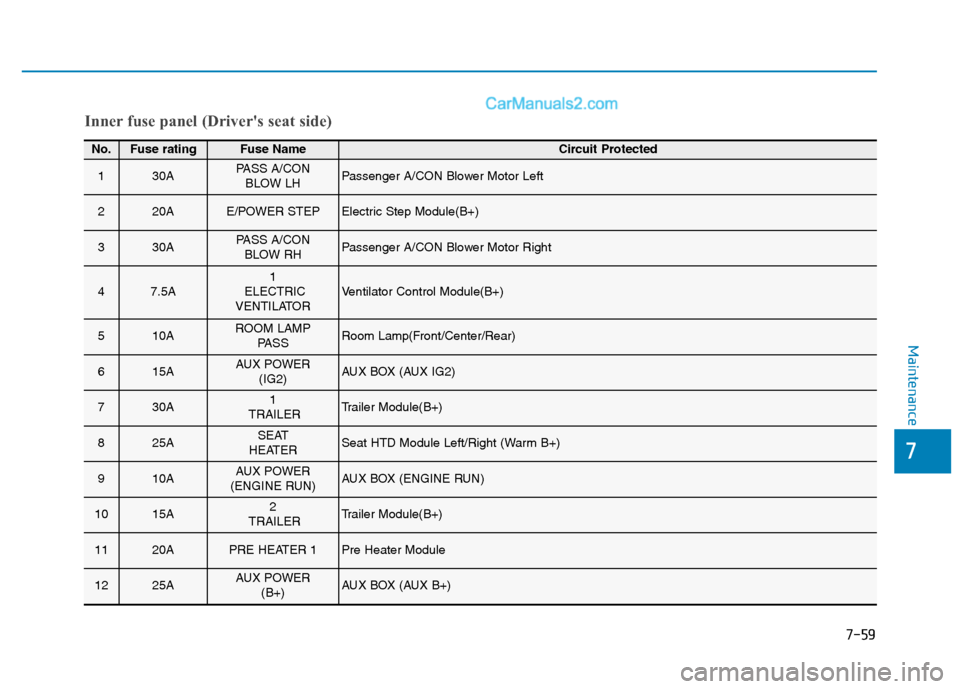
Inner fuse panel (Driver's seat side)
No.Fuse ratingFuse Name Circuit Protected
130APASS A/CONBLOW LHPassenger A/CON Blower Motor Left
220AE/POWER STEPElectric Step Module(B+)
330APASS A/CONBLOW RHPassenger A/CON Blower Motor Right
47.5A1
ELECTRIC
VENTILATORVentilator Control Module(B+)
510AROOM LAMP PASSRoom Lamp(Front/Center/Rear)
615AAUX POWER (IG2)AUX BOX (AUX IG2)
730A1
TRAILERTrailer Module(B+)
825ASEAT
HEATERSeat HTD Module Left/Right (Warm B+)
910AAUX POWER
(ENGINE RUN)AUX BOX (ENGINE RUN)
1015A2
TRAILERTrailer Module(B+)
1120APRE HEATER 1Pre Heater Module
1225AAUX POWER (B+)AUX BOX (AUX B+)
Page 425 of 473
7-62
Maintenance
Engine compartment main fuse panel
No.Fuse ratingFuse Name Circuit Protected
110A2
A/CONA/C Compressor PASS
215A4
ECUEngine Control Module (Permanent Battery (+))
310A1
A/CONA/C Compressor CAB
410A1
SENSORElectric VGT Actuator, EGR Cooling Bypass, UH_BOX(Fuel Pump Relay 'S')
510ASPARE
620A1
ECUEngine Control Module (Battery (+))
710A2
SENSORUH_BOX(A/CON1 Relay 'S', A/CON2 Relay 'S', CONDENSER FAN Relay LH,RH1/2 'S')
820A2
ECUEngine Control Module (Battery (+))
910A3
SENSORLAMBDA Sensor
107.5ABACK UP LAMPRear Combi Lamp Left/Right (Back Up), Inside Mirror (Reverse), Trailer Module (Back Up),
Vehicle Dynamic Control Module (Reverse Gear Switch), Reverse Warning Buzzer
117.5A3
ABSAnti-Lock Brake Module (IG1), Vehicle Dynamic Control Module (IG1), Steering Angle Sensor (IG1)
127.5A5
SENSORAir Flow Sensor, Engine Control Module (TERMINAL15(IG1 INPUT))
Page 426 of 473
7-63
7
Maintenance
No.Fuse ratingFuse Name Circuit Protected
137.5AINHIBITORUH_BOX(Start Inhibit Relay 'S')
1460A3
B+Smart Junction Box (B+3)
1560AVDCVehicle Dynamic Control Module (B+ Pump Motor)
1640A2
ABSAnti-Lock Brake Module (B+ Solenoid Valve), Vehicle Dynamic Control Module(B+ Solenoid
Valve)
1740A1
ABSAnti-Lock Brake Module (B+ Pump Motor)
1860A2
B+Smart Junction Box (B+2)
1980AGLOWGlow Relay Module (Plus Direct)
2050A4
B+Smart Junction Box (B+4)
2150AEMSEngine Management System Block (B+)
2215AHORNHORN
2310APTOPTO Magnetic Valve
2420AF/PUMPFuel Pump Sender (Fuel Pump Motor(+))
Page 433 of 473

7-70
Maintenance
Turn signal light/Position light
Turn signal light
1.Turn off the engine and open thehood.
2.Remove the socket from the assembly by turning the socket
counterclockwise until the tabs on
the socket align with the slots on
the assembly.
3.Remove the bulb from the socket by pressing it in and rotating it
counterclockwise until the tabs on
the bulb align with the slots in the
socket. Pull the bulb out of the
socket
4.Insert a new bulb by inserting it into the socket and rotating it until it
locks into place.
5.Install the socket in the assembly by aligning the tabs on the socket
with the slots in the assembly.
Push the socket into the assembly
and turn the socket clockwise.
Position light
If the light bulb does not operate, we recommend that the system be
checked by an authorized HYUNDAI
dealer.
Front fog light bulbs
(if equipped)
1.Remove the front bumper under cover.
2.Reach your hand into the back of the front bumper.
3.Disconnect the power connector from the socket.
4.Remove the bulb-socket from the housing by turning the socket
counter clockwise until the tabs on
the socket align with the slots onthe housing.
5.Install the new bulb-socket into the housing by aligning the tabs on the
socket with the slots in the hous-
ing. Push the socket into the hous-
ing and turn the socket clockwise.
6.Connect the power connector to the socket.
7.Reinstall the front bumper under cover.
Headlight and front fog light
aiming (for Europe)
Headlight aiming
1.Inflate the tires to the specified
pressure and remove any loads
from the vehicle except the driver,
spare tire, and tools.
OEU074061
OEU074049■■Projection type
■■MFR type
Page 443 of 473
7-80
Maintenance
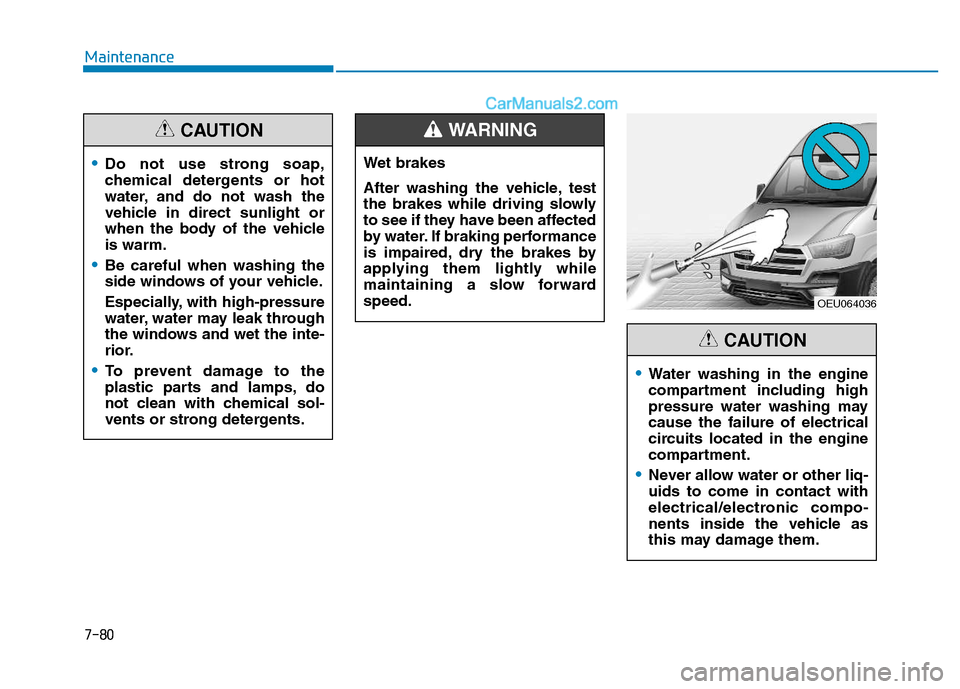
Do not use strong soap,
chemical detergents or hot
water, and do not wash the
vehicle in direct sunlight or
when the body of the vehicleis warm.
Be careful when washing the
side windows of your vehicle.
Especially, with high-pressure
water, water may leak through
the windows and wet the inte-
rior.
To prevent damage to the
plastic parts and lamps, do
not clean with chemical sol-
vents or strong detergents.
CAUTION
Wet brakes
After washing the vehicle, test
the brakes while driving slowly
to see if they have been affected
by water. If braking performance
is impaired, dry the brakes by
applying them lightly while
maintaining a slow forwardspeed.
WARNING
OEU064036
Water washing in the engine
compartment including high
pressure water washing maycause the failure of electrical
circuits located in the engine
compartment.
Never allow water or other liq- uids to come in contact with
electrical/electronic compo-
nents inside the vehicle as
this may damage them.
CAUTION
Page 450 of 473

7-87
7
Maintenance
The emission control system of your
vehicle is covered by a written limited
warranty. Please see the warranty
information contained in the Service
Passport in your vehicle.
Your vehicle is equipped with an emission control system to meet all
emission regulations. There are three emission control
systems which are as follows.
(1) Crankcase emission control sys-tem
(2) Evaporative emission control sys- tem
(3) Exhaust emission control systemIn order to assure the proper function
of the emission control systems, it is
recommended that you have your
vehicle inspected and maintained by
an authorized HYUNDAI dealer orother repair shops that use qualifiedtechnicians in accordance with the
maintenance schedule in this manu-al.1. Crankcase emission control system
The positive crankcase ventilation
system is employed to prevent air
pollution caused by blow-by gases
being emitted from the crankcase.This system supplies fresh filtered air
to the crankcase through the air
intake hose. Inside the crankcase,
the fresh air mixes with blow-by
gases, which then pass through the
PCV valve into the induction system.
2. Evaporative emission con-trol System
The Evaporative Emission Control
System is designed to prevent fuel
vapors from escaping into the atmos-
phere.
Canister
Fuel vapors generated inside the fueltank are absorbed and stored in the
onboard canister. When the engine is
running, the fuel vapors absorbed in
the canister are drawn into the surgetank through the purge control sole-
noid valve.
Purge Control Solenoid Valve
(PCSV)
The purge control solenoid valve is
controlled by the Engine Control
Module (ECM); when the engine
coolant temperature is low during
idling, the PCSV closes so that evap-
orated fuel is not taken into the
engine. After the engine warms-up
during ordinary driving, the PCSV
opens to introduce evaporated fuel to
the engine.
EE MM IISS SSIIOO NN CC OO NNTTRR OO LL SS YY SSTT EEMM
Page 451 of 473
7-88
Maintenance
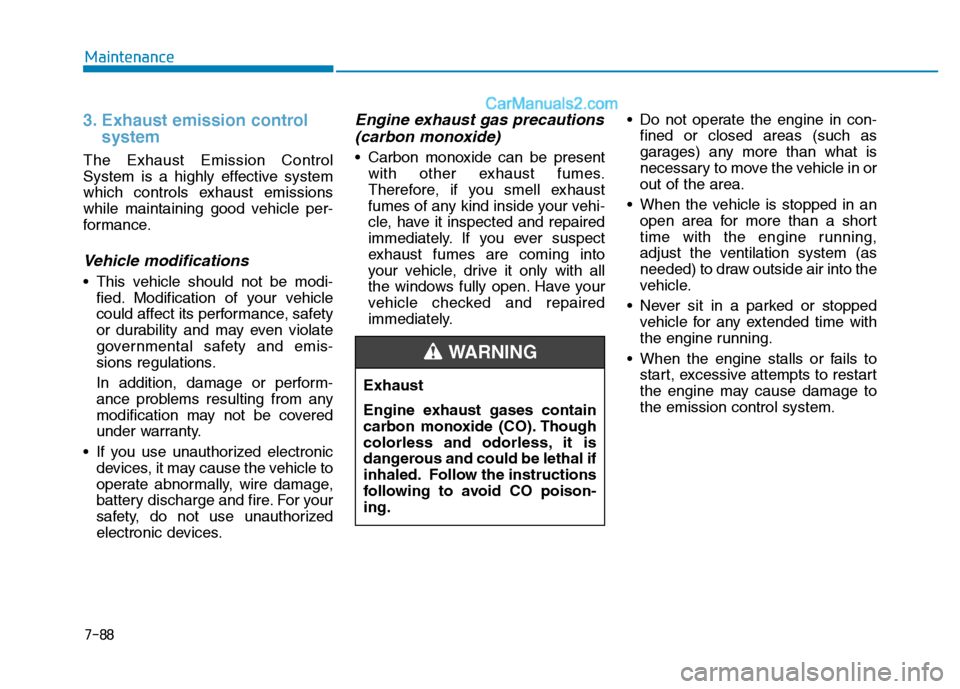
3. Exhaust emission control system
The Exhaust Emission Control
System is a highly effective system
which controls exhaust emissions
while maintaining good vehicle per-
formance.
Vehicle modifications
This vehicle should not be modi-fied. Modification of your vehicle
could affect its performance, safety
or durability and may even violate
governmental safety and emis-
sions regulations.
In addition, damage or perform-
ance problems resulting from any
modification may not be covered
under warranty.
If you use unauthorized electronic devices, it may cause the vehicle to
operate abnormally, wire damage,
battery discharge and fire. For your
safety, do not use unauthorized
electronic devices.
Engine exhaust gas precautions
(carbon monoxide)
Carbon monoxide can be present with other exhaust fumes.
Therefore, if you smell exhaust
fumes of any kind inside your vehi-
cle, have it inspected and repaired
immediately. If you ever suspect
exhaust fumes are coming into
your vehicle, drive it only with all
the windows fully open. Have your
vehicle checked and repaired
immediately. Do not operate the engine in con-
fined or closed areas (such as
garages) any more than what is
necessary to move the vehicle in orout of the area.
When the vehicle is stopped in an open area for more than a short
time with the engine running,
adjust the ventilation system (as
needed) to draw outside air into the
vehicle.
Never sit in a parked or stopped vehicle for any extended time with
the engine running.
When the engine stalls or fails to start, excessive attempts to restart
the engine may cause damage tothe emission control system.
Exhaust
Engine exhaust gases contain
carbon monoxide (CO). Though
colorless and odorless, it is
dangerous and could be lethal if
inhaled. Follow the instructions
following to avoid CO poison-ing.
WARNING
Page 452 of 473

7-89
7
Maintenance
Operating precautions for cat-alytic converters (if equipped)Your vehicle is equipped with a cat-
alytic converter emission control
device.
Therefore, the following precautions
must be observed:
Do not operate the vehicle when there are signs of engine malfunc-
tion, such as misfire or a noticeable
loss of performance.
Do not misuse or abuse the engine. Examples of misuse arecoasting with the ignition off and
descending steep grades in gear
with the ignition off.
Do not operate the engine at high idle speed for extended periods (5
minutes or more).
Do not modify or tamper with any part of the engine or emission con-
trol system. We recommend that
the system be inspected by an
authorized HYUNDAI dealer.
Avoid driving with a extremely low fuel level. Running out of fuel
cause the engine to misfire, dam-
aging the catalytic converter. Failure to observe these precautionscould result in damage to the catalyt-
ic converter and to your vehicle.
Additionally, such actions could void
your warranties.
Fire
A hot exhaust system can
ignite flammable items under
your vehicle. Do not park,
idle, or drive the vehicle over
or near flammable objects,
such as dry grass, paper,
leaves, etc.
The exhaust system and cat-
alytic system are very hotwhile the engine is running or
immediately after the engine
is turned off. Keep away from
the exhaust system and cat-
alytic, you may get burned.
Also, do not remove the heat
sink around the exhaust sys-
tem, do not seal the bottom of
the vehicle or do not coat the
vehicle for corrosion control.
It may present a fire risk under
certain conditions.
WARNING