Page 124 of 276

122
jumper_en_Chap06_Accessoires_ed01-2015
driving advice
distribution of loads: distribute the load in
the trailer so that the heaviest objects are as
close as possible to the axle and the nose
weight is close to the maximum authorised
without, however, exceeding it.
c
ooling: towing a trailer on a slope
increases the coolant temperature.
As the fan is electrically controlled, its
cooling capacity is not dependent on the
engine speed.
o
n the contrary, use a high gear to lower the
engine speed and reduce your speed.
i
n all cases, pay attention to the coolant
temperature.
tyres:
check the tyre pressures of the
towing vehicle and of the trailer, observing
the recommended pressures.
Fitting a towbar
We recommend the use of genuine
C i T roën towbars and their harnesses,
which have been tested and approved from
the design stage of your vehicle and that
the fitting of this equipment is entrusted to a
C
i T roën dealer.
These genuine towbars are compatible with
the operation of the rear parking sensors
and the reversing camera, if fitted to your
vehicle.
i
f this equipment is not fitted by a C i T roën
dealer
, it must be fitted in line with the
manufacturer's instructions.
Good practice
if the coolant temperature
warning lamp comes on, stop the
vehicle and switch off the engine
as soon as possible.
r
efer to the "Checks - Levels and
checks" section.
Brakes: towing increases the braking
distance. Drive at a moderate speed,
change down early and brake gradually. Side wind: sensitivity to side wind is
increased. Drive smoothly and at a
moderate speed. ABS: the system only controls the vehicle,
not the trailer.
r
ear parking sensors: the system is
deactivated while the vehicle is towing with a
genuine C
i T roën towbar fitted.
r
efer to the "Technical data -
i
dentification markings" section.
Transport solutions
Page 129 of 276

127
jumper_en_Chap07_Verifications_ed01-2015
On the inside
This operation must only be carried out with the
vehicle stationary and the driver's door open.
Pull the release lever on the side of the
dashboard towards you.
On the outside
raise the safety catch lever located above
the grille to the right and raise the bonnet. Before closing the bonnet, put the stay back
in its housing.
Lower the bonnet and release it at the end
of its travel. Check that the bonnet has
latched.
OPEnInG tHE BOnnEt
Do not open the bonnet in strong
winds.
When the engine is hot, handle the safety
catch and stay with care (risk of burns).
Before doing anything under the
bonnet, switch off the ignition with the
key to avoid any risk of injury resulting from
an automatic change to STA
r
T
mode of the
Stop & Start system.
cLOSInG tHE BOnnEt
Bonnet stay
Unclip the stay and tilt it to insert it in the
first notch, then the second.
Because of the presence of electrical
equipment under the bonnet, it is
recommended that exposure to water (rain,
washing, ...) be limited.
7
Under the bonnet
CHECKS
Page 136 of 276

134
jumper_en_Chap07_Verifications_ed01-2015
Low fuel level
rEF
u
ELLI
n
G
In low temperatures
In mountainous and/or cold areas, it is
advisable to use a "winter" type fuel suited
to low or minus temperatures. With Stop & Start, never refuel with
the system in ST
o
P mode; you must
switch off the ignition with the key. When the fuel tank level E
(Empty) is reached, this warning
lamp comes on.
You then have around 10 to
12 litres in the reserve, depending on the
capacity of the tank, the engine type, the
driving conditions and the profile of the road.
r
efuel without delay to avoid running out of
fuel.
The capacity of the fuel tank is
approximately 90 litres.
Fuel tanks of different capacities, 60 and
120 litres, may be fitted. The fuel tank must be filled with the engine
off.
- o pen the fuel filler flap.
-
Support the black cap with one hand.
-
With the other hand, insert the key
, then
turn it anticlockwise.
- r emove the black cap and hook it onto
the clip located on the inside of the flap.
A label affixed to the inside of the flap
reminds you of the type of fuel to be used.
When filling the fuel tank, do not continue
after the 3rd cut-off of the nozzle. This could
cause malfunctions.
-
After filling the fuel tank, lock the black
cap and close the flap.
BlueH d i and AdBlue additive
The blue cap is only present on BlueHDi
Diesel versions.
For more information, refer to the "AdBlue
additive section". To understand the significance of the
precautions mentioned on the labels,
refer to the "Quick help - Label glossary"
section.
Fuel
Page 143 of 276

141
jumper_en_Chap07_Verifications_ed01-2015
refit the filler cap
- r efit the blue cap to the tank and turn it
a 6
th of a turn clockwise, to its stop.
-
Close the filler flap.
n
ever dispose of AdBlue
® additive
bottles in the household waste. Place
them in a special container provided this
purpose or take them to your dealer.
Keep AdBlue
® out of the reach of
children, in its original container.
n
ever transfer AdBlue
® to another container:
it would loose its purity.
n
ever dilute the additive with water.
n
ever pour the additive into the Diesel fuel
tank.
recommendations on storage
never store containers or bottles of
AdBlue® in your vehicle. Freezing of the AdBlue
® additive
AdBlue® freezes at about -11°C
(12.2°
F) and deteriorates above 25°C
(77°F).
i
t is recommended that containers and
bottles be stored in a cool area and
protected from direct sunlight.
Under these conditions, the additive can be
kept for at least a year.
Additive that has been frozen can be used
once it has thawed out in ambient air. The SC
r system includes an AdBlue
®
tank heater that ensures operation of
the vehicle in normal conditions.
i
n exceptional situations, such as when the
vehicle is kept at temperatures below -15°C
(5°F) for a long period, there may be an
emission fault alert related to freezing of the
AdBlue
® additive.
Park the vehicle in an area at a more
moderate temperature for a few hours until
the additive becomes a liquid again.
The emissions warning lamp does not go off
immediately, but does so after a few miles
of driving.
Additif AdBlue®
7
CHECKS
Page 158 of 276

156
jumper_en_Chap08_Aide-rapide_ed01-2015
Parking the vehicle
Where possible, park the vehicle on level,
stable and non-slippery ground.
Apply the parking brake, switch off the
ignition and engage first gear.
Wear a high visibility vest and position the
warning triangle on the road.
You must ensure that the occupants get out
of the vehicle and wait in a safe location.
tools
These are stowed in a box located under the
front passenger seat.
-
T
urn the button a quarter of a turn then
pull the box.
-
After use, press the button then turn it a
quarter of a turn to secure the box.
A.
Long socket.
B.
Bar.
c
. Jack.
d
. Wheelbrace.
E.
Screwdriver (handle and bits).
F.
r emovable towing eye.
cHAnGInG A WHEELPneumatic suspension
i
f you vehicle is fitted with this system, you
must first activate vehicle lifting mode.
Press the two controls simultaneously for at
least 5 seconds; their indicator lamps come
on.
This mode is deactivated automatically after
changing a wheel, once the speed of the
vehicle has exceeded 3 mph (5 km/h).
The jack and the tool kit are specific to
your vehicle. Do not use them for other
purposes.
n
ever go underneath a vehicle supported
only by a jack (use an axle stand).
Puncture
Page 175 of 276
173
jumper_en_Chap09_Caracteristiques-Techniques_ed01-2015
dIMEnSIOnS
The dimensions are given in millimetres.
This model is available in 4 lengths (L1...) and 3 heights (H1...); refer to the corresponding tables:VA
n
L1L2L3L4
H1 H2 H1 H2 H2 H3 H2 H3
L
o
verall length 4
9635
4135
9986
363
H
o
verall height 2
254 2 524 2 254 2 524 2 524 2 764 2 524 2 764
A Wheelbase 3
0003
4504
035
B Front overhang 948
cr
ear overhang 1
0151
380
dOverall width (incl./excl. mirrors)2 508 / 2
050
E Width of front track 1
810
F Width of rear track 1
790
G Height of load floor 535 to 565
I Length of interior floor 2
6703
1203
7054
070
jMaximum interior load height1
662 1 932 1 662 1 932 1 932 2 172 1 932 2 172
K Maximum interior width 1
870
M
i
nterior width between wheel arches 1
422
Volume (m
3) 89.5 10 11.5 13 15 15 17
9
TECHniCAL DATA
Dimensions
Page 181 of 276
179
jumper_en_Chap09_Caracteristiques-Techniques_ed01-2015
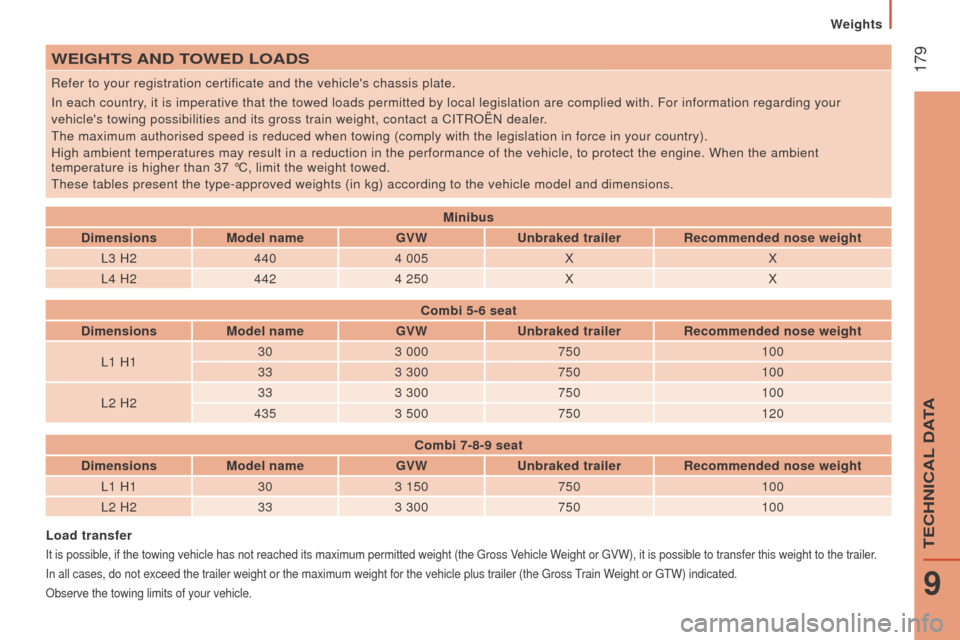
WEIGHtS And tOWE d LOA d S
refer to your registration certificate and the vehicle's chassis plate.
i
n each country, it is imperative that the towed loads permitted by local legislation a\
re complied with. For information regarding your
vehicle's towing possibilities and its gross train weight, contact a C
i T roën dealer.
The maximum authorised speed is reduced when towing (comply with the le\
gislation in force in your country).
High ambient temperatures may result in a reduction in the performance o\
f the vehicle, to protect the engine. When the ambient
temperature is higher than 37 °C, limit the weight towed.
These tables present the type-approved weights (in kg) according to th\
e vehicle model and dimensions.
Load transfer
it is possible, if the towing vehicle has not reached its maximum permitt\
ed weight (the Gross Vehicle Weight or GVW), it is possible to transfer this weight to the trailer.
i
n all cases, do not exceed the trailer weight or the maximum weight for \
the vehicle plus trailer (the Gross Train Weight or GTW) indicated.
o
bserve the towing limits of your vehicle.
Minibus
d
imensions Model name GVW
u
nbraked trailer
r
ecommended nose weight
L3 H2 4404 005 X X
L4 H2 4424 250 X X
c
ombi 5-6 seat
d
imensions Model name GVW
u
nbraked trailer
r
ecommended nose weight
L1 H1 30
3 000 750 100
33 3 300 750 100
L2 H2 33
3 300 750 100
435 3 500 750 120
c
ombi 7-8-9 seat
d
imensions Model name GVW
u
nbraked trailer
r
ecommended nose weight
L1 H1 303 150 750 100
L2 H2 333 300 750 100
Weights
9
TECHniCAL DATA
Page 182 of 276
180
jumper_en_Chap09_Caracteristiques-Techniques_ed01-2015
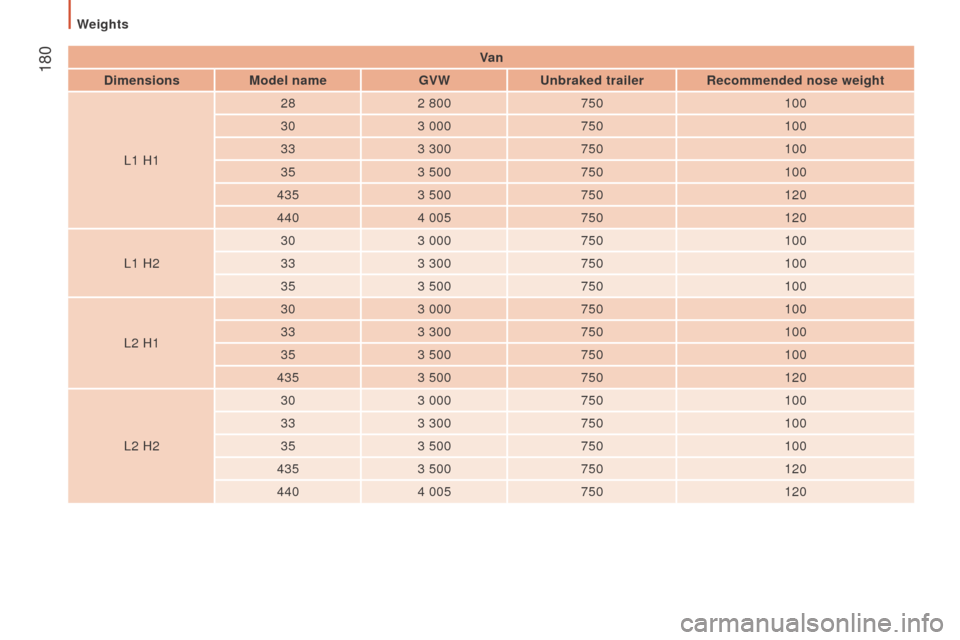
Va n
d
imensions Model name GVW
u
nbraked trailer
r
ecommended nose weight
L1 H1 28
2 800 750 100
30 3 000 750 100
33 3 300 750 100
35 3 500 750 100
435 3 500 750 120
440 4 005 750 120
L1 H2 30
3 000 750 100
33 3 300 750 100
35 3 500 750 100
L2 H1 30
3 000 750 100
33 3 300 750 100
35 3 500 750 100
435 3 500 750 120
L2 H2 30
3 000 750 100
33 3 300 750 100
35 3 500 750 100
435 3 500 750 120
440 4 005 750 120
Weights