Page 86 of 276
84
jumper_en_Chap03_Ergo-et-confort_ed01-2015
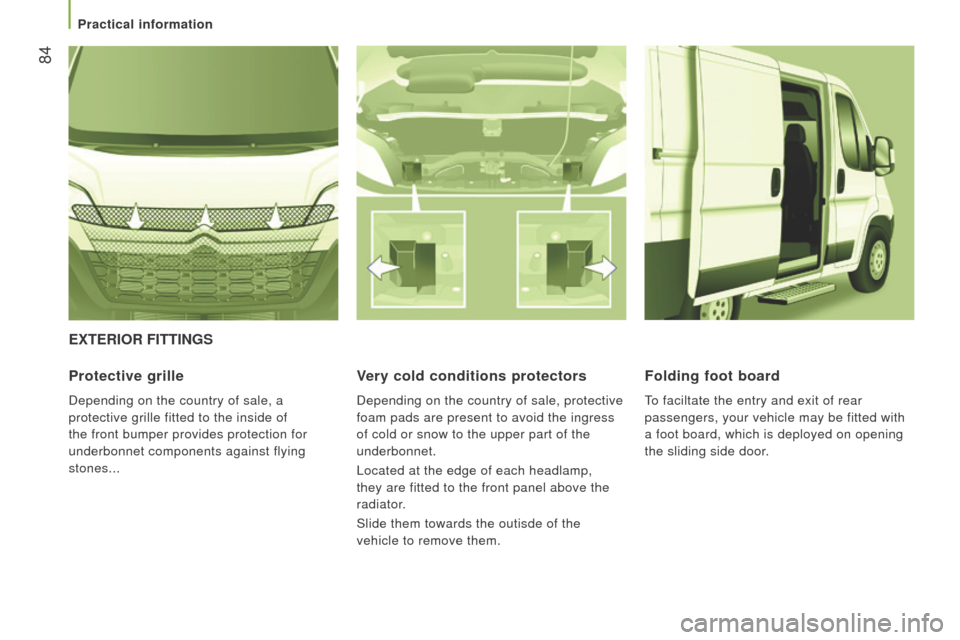
ExtErIOr FIttInGS
Protective grille
Depending on the country of sale, a
protective grille fitted to the inside of
the front bumper provides protection for
underbonnet components against flying
stones...
Very cold conditions protectors
Depending on the country of sale, protective
foam pads are present to avoid the ingress
of cold or snow to the upper part of the
underbonnet.
Located at the edge of each headlamp,
they are fitted to the front panel above the
radiator.
Slide them towards the outisde of the
vehicle to remove them.
Folding foot board
To faciltate the entry and exit of rear
passengers, your vehicle may be fitted with
a foot board, which is deployed on opening
the sliding side door.
Practical information
Page 129 of 276

127
jumper_en_Chap07_Verifications_ed01-2015
On the inside
This operation must only be carried out with the
vehicle stationary and the driver's door open.
Pull the release lever on the side of the
dashboard towards you.
On the outside
raise the safety catch lever located above
the grille to the right and raise the bonnet. Before closing the bonnet, put the stay back
in its housing.
Lower the bonnet and release it at the end
of its travel. Check that the bonnet has
latched.
OPEnInG tHE BOnnEt
Do not open the bonnet in strong
winds.
When the engine is hot, handle the safety
catch and stay with care (risk of burns).
Before doing anything under the
bonnet, switch off the ignition with the
key to avoid any risk of injury resulting from
an automatic change to STA
r
T
mode of the
Stop & Start system.
cLOSInG tHE BOnnEt
Bonnet stay
Unclip the stay and tilt it to insert it in the
first notch, then the second.
Because of the presence of electrical
equipment under the bonnet, it is
recommended that exposure to water (rain,
washing, ...) be limited.
7
Under the bonnet
CHECKS
Page 130 of 276
128
jumper_en_Chap07_Verifications_ed01-2015
1. Windscreen/headlamp wash fluid
reservoir.
2.
Power steering fluid reservoir
.
3.
Coolant header tank.
4.
Brake and clutch fluid reservoir
.
5.
Fusebox.
6.
Air filter
.
7.
Dipstick.
8.
Engine oil filler cap.
undErBOnnEt - dIESEL
E
n GI n ES
Battery connections:
+
Positive terminal.
-
n egative terminal (earth).
To understand the significance of the
precautions mentioned on the labels,
refer to the "Quick help - Glossary of
labels" section.
Under the bonnet
Page 131 of 276

129
jumper_en_Chap07_Verifications_ed01-2015
used products
Avoid prolonged contact of used oil or fluids
with the skin.
Most of these fluids are harmful to health or
indeed very corrosive.
Do not discard used oil or fluids into sewers
or onto the ground.
Take used oil to a Ci T roën dealer or
a qualified workshop (France) or to an
authorised waste disposal site.
LEVELS
These regular maintenance operations
will keep your vehicle in good running
order. Ask for advice at a C
i T roën dealer
or consult the maintenance and warranty
guide contained in the handbook pack.
To maintain the reliability of engines and
emission control systems, the use of
additives in engine oil is prohibited.
changing the brake fluid
The brake fluid must be changed at
the intervals stated, according to the
manufacturer's servicing schedule.
Use fluids recommended by the
manufacturer, which fulfil Do T4 standards.
The level must be between the MI
n and
MA
x marks on the reservoir.
i
f fluid has to be added frequently, this
indicates a failure which must be checked by
a C
i T roën dealer or a qualified workshop
as soon as possible.
If you have to remove/refit the engine
styling cover, handle it with care to
avoid damaging the fixing clips.
d
ipstick
There are two marks on
the dipstick:
Oil change
i
t is imperative that this is carried out at the
intervals specified in the manufacturer's
servicing schedule. Ask for advice at at
C
i
T
roën
dealer.
r
emove the dipstick before filling.
Check the level after filling (never exceed
the maximum mark).
Screw the cap back onto the sump before
closing the bonnet.
Viscosity selection
When topping-up, the oil selected must meet
the manufacturer's requirements.
Warning lamps
Checking by means of the warning
lamps on the instrument panel is
described in the "
r eady to go -
i
nstruments and controls" section.
A
= maximum
i
f you fill past this mark,
contact a C
i
T
roën
dealer
or a qualified workshop.
B = minimum
n
ever allow the level to fall
below this mark.
Oil level
Check the level regularly and top up between
changes. The maximum consumption is
0.5 litre per 600 miles (1
000 km). Check
the level with the vehicle level, engine cold,
using the dipstick.
Levels and checks
7
CHECKS
Page 133 of 276

131
jumper_en_Chap07_Verifications_ed01-2015
The presence of this label, in particular
with the Stop & Start system, indicates the
use of a specific 12 V lead-acid battery
with special technology and specification.
The involvement of a Ci T roën dealer
or a qualified workshop is essential when
replacing or disconnecting the battery. These operations will keep your vehicle
in good running order. Ask for advice
from a C i T roën dealer or refer to the
maintenance and warranty guide included in
the handbook pack.
cHEcKS
Battery
At the start of winter, have your battery
checked by a C i T roën dealer or a qualified
workshop.
Bleeding water from the diesel
filter
if this warning lamp comes on,
bleed the filter , or bleed regularly
each time the engine oil is
changed.
To drain the water out, unscrew the bleed
screw or the water in Diesel sensor, located
at the base of the filter. Leave open until
all of the water has been drained out. Then
tighten the bleed screw or the water sensor.
Air filter and passenger
compartment filter
A clogged passenger compartment filter
may reduce the performance of the
air conditioning system and generate
undesirable odours. The replacement
intervals for these components are given in
the maintenance and warranty guide.
Depending on the environment (dusty
atmosphere...) and the use of the vehicle
(urban driving...), change them twice as
often if necessary.
r
efer to the "Checks - Under the
bonnet" section.
HDi engines use advanced technology.
All work requires a special qualification
which is guaranteed by a C
i
T
roën
dealer
or a qualified workshop.
Levels and checks
7
CHECKS
Page 152 of 276

150
jumper_en_Chap08_Aide-rapide_ed01-2015
1 - Main beam headlamps
type
d , H7 - 55 W
-
r emove the cover by pulling on the
rubber tongue.
-
Disconnect the electrical connector
.
-
r elease the retaining spring by pressing
on the central clip.
-
Change the bulb taking care to align the
metal part with the groove on the lamp. 2 -
d ipped beam headlamps
type
d , H7 - 55 W
- r emove the cover by pulling on the
rubber tongue.
- Disconnect the electrical connector .
- r elease the retaining spring by pressing
on the central clip.
-
Change the bulb taking care to align the
metal part with the grooves on the lamp.
Front lamps
3 - direction indicators
type A
, WY 21 W - 21 W
-
r emove the cover by pulling on the
rubber tongue.
-
T
urn the bulb holder a quarter turn
anticlockwise.
-
Change the bulb.
o
pen and secure the bonnet with the stay.
To access the bulbs, reach behind the
headlamp unit.
If necessary you can remove the headlamp:
-
Depending on the country of sale,
remove the very low temperature
protection padding by sliding it towards
the outside of the vehicle.
-
Disconnect the electrical connector by
removing its locking ring.
-
r
emove the two headlamp fixing
screws.
-
Move the headlamp towards the centre
of the vehicle to extract it from its
sliders.
o
n the left hand side, take care not to
dislodge the bonnet stay.
Failed bulb or lamp
Page 170 of 276
168
jumper_en_Chap08_Aide-rapide_ed01-2015
GLOSSArY OF LABELS
This section groups together all of the texts that appear on labels pres\
ent on the vehicle.under the bonnet
A
o
riginal painting
Colour
Code
r
EF ini SH in G C o DE
B
A
ir C on D i T ion ED VEH i CLE - r 134A -
"CFC" F
r EE
QTY
r 134A (kg)
c
on
LY F or JUMP STA r
T
d
DA
n GE r
AUTo
MAT i C E n G in E r ESTA r
T
. EXT r ACT
THE KEY F
ro M DASHB o A r D WHE n
H
oo D i S o PE n ED
For the vehicle identification labels, refer to the "Technical data" section.
Precautions...
Page 184 of 276
182
jumper_en_Chap09_Caracteristiques-Techniques_ed01-2015
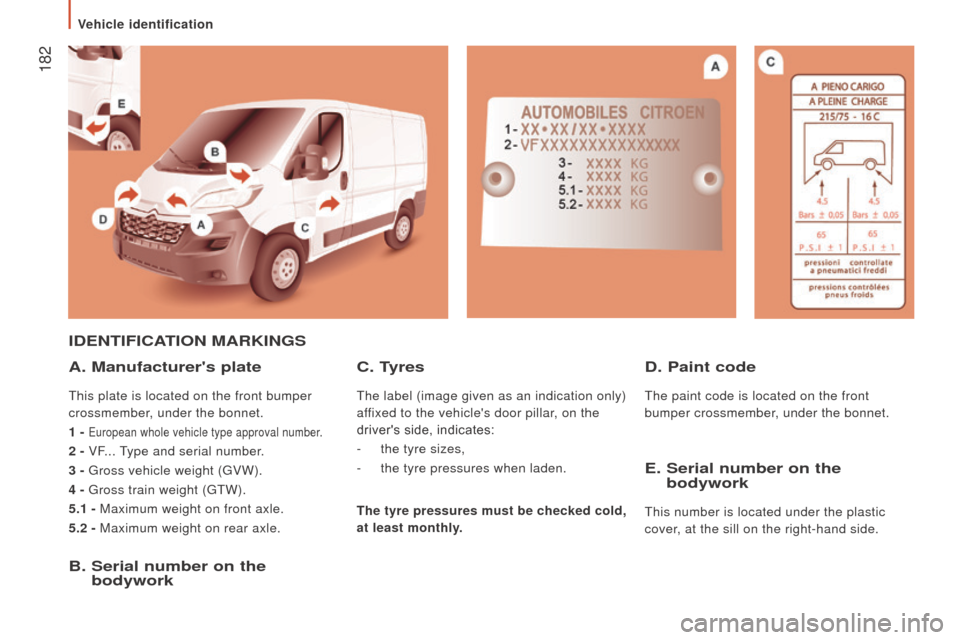
IdEntIFIcAtIO n MA r KI n GS
A. Manufacturer's plate
This plate is located on the front bumper
crossmember, under the bonnet.
1 -
European whole vehicle type approval number.
2 - VF... Type and serial number.
3 - Gross vehicle weight (GVW).
4 - Gross train weight (GTW).
5.1 - Maximum weight on front axle.
5.2 - Maximum weight on rear axle.
B. Serial number on the
bodywork
d
. Paint code
The paint code is located on the front
bumper crossmember, under the bonnet.
c. tyres
The label (image given as an indication only)
affixed to the vehicle's door pillar, on the
driver's side, indicates:
-
the tyre sizes,
-
the tyre pressures when laden.E. Serial number on the
bodywork
This number is located under the plastic
cover, at the sill on the right-hand side.t
he tyre pressures must be checked cold,
at least monthly.
Vehicle identification