2016 AUDI RS7 SPORTBACK engine
[x] Cancel search: enginePage 194 of 282
Driving and the environment
The engine and catalytic converter have to reach
their optimal
operating temperature to reduce
fuel consumption and noxious emissions effec
tively.
Just after starting, a cold engine in a mid-size car
only achieves a fuel economy of 6-8 miles per
gallon (30-40 l/100 km). After about a half a
mile, fuel economy climbs to 12 mpg (20 l/100
km). After about
2.5 miles (4 km), the engine is
at its proper operating temperature and fuel
economy has reached a normal level. So you can
see that you should avoid short trips whenever
possible.
The
outside temperature is also critical in this re
gard. Your car consumes more fuel in the winter
than in the summer .
192
Page 200 of 282

Fuel and Refueling
Fuel and Refueling
Gasoline
Fuel supply
Applies to: vehicles with gaso line engine
Using the right fuel helps keep the environment
clean and prevents engine damage.
Fuel recommendation
The fuel recommended for your vehicle is unlead
ed premium
grade gasoline . Audi recommends
using TOP TIER Detergent Gasoline with a mini
mum octane rating of 91 AKI (95 RON). For more
information on TOP TIER Detergent Gasoline,
p lea se go to the offic ial website
(www.toptiergas .com).
The recommended gasoline octane rating for
your engine can also be found on a label located
on the ins ide of the fuel filler flap . This rating
may be specified as AKI or RON.
Your vehicle may also be operated using unlead
ed regular gasoline with a minimum octane rat
ing of 87 AKl/91 RON . However, using 87 AKI/91
RON octane fuel wil l slightly reduce engine per
formance.
Use unleaded gasoline only. Unleaded gasoline
is availab le throughout the USA, Canada, and in
most European countries . We recommend that
you do not take your vehicle to areas or countries
where un leaded gaso line may not be available.
For more information on refueling your vehicle,
see
¢page 199.
Octane rating
Octane rating indicates a gasoline's ability to re
sist engine damaging "knock" caused by prema
ture ignit ion and detonation . Therefore, buying
the correct grade of gasoline is very important to
he lp prevent possible engine damage and a loss
of eng ine performance.
Gasoline most commonly used in the United
States and Canada has the following octane rat
i n gs that can usually be found on the filler pump:
- Premium Grade: 91 - 96 AKI
198
- Regular Grade: 87 - 90 AKI
Explanation of the abbreviations:
AKI = Anti Knock Index = (R +M)/2 = (RON +MON)/
2
RON = Research Octane Number
MON= Motor Octane Number.
{[) Note
-Do not use any fuel with octane ratings low
er than 87 AKI or 91 RON otherwise expen
sive engine damage wi ll occur .
- Do
not use leaded gasoline. The use of lead
ed gasoline will severely damage your vehi
cle's catalytic converter and its ability to
control exhaust emissions .
Blended gasoline
Applies to: vehicles with gasoline engine
Use of gasoline containing alcohol or MTBE
(methyl tertiary butyl ether)
You may use unleaded gasoline blended with al
cohol or MTBE (commonly referred to as oxygen
ates) if the blended mixture meets the following
criteria:
Blend of gasoline methanol (wood alcohol or
methyl alcohol)
-Anti -knock index must be 87 AKI or h igher.
- Blend must contain no more than 3% metha-
nol.
- Blend must contain more than 2% co-solvents.
Blend of gasoline and ethanol (grain alcohol or
ethyl alcohol)
- Anti-knock index must be 87 AKI or h igher .
- Blend must not contain more than 15% etha-
nol.
Blend of gasoline and MTBE
-Anti-knock index must be 87 AK I or higher .
- Blend must contain not mo re than 1S% MTBE.
Seasonally adjusted gasoline
Many gasoline grades are blended to perform es
pecially well for winter or summer dr iv ing . Dur-
i ng seasonal change-over, we suggest that you .,..
Page 201 of 282
fill up at busy gas st ations where the season al
adjustm ent is mor e likely to be made in time .
(D Note
-Me thanol f uels which do not mee t these re
quirements may ca use corros ion and dam
age to plastic and rubber components in the
fuel system .
- Do not use fuels that fai l to meet the speci
fied criter ia in this chapter.
- If you are unable to determine whether or not a particular fuel blend meets the speci
ficat ions, ask your service station or its fuel
supplier.
- Do not use fuel for which the contents can
not be identif ied.
- Fuel system damage and performance prob
lems resulting from the use of fue ls differ
ent from those specified are not the respon
s ibility of Audi and are not covered under
the New Veh icle or the Emiss ion Control
System Wa rrant ies.
- If you experience a loss of fue l economy or
driveability and performance prob lems due
to the use of one of these fuel b lends , we
recommend that you switch to unblended
fuel.
Gasoline additives
A ma jo r concern among many au to manufactur
e rs is carbon deposit build-up caused by the type
of gasoline you use.
A lthough gasoline gr ades d iffer from one manu
facturer to ano ther, they have cer tain things in
common . All gasoline grades contain substances
that can cause deposits to coll ect on v ita l eng ine
parts, such as f uel injectors and intake valves. Al
though most gasoline brands include additives to
keep engine and fuel systems clean, they are not
equally effective.
Aud i recommends using TOP TIER Detergent Gas
oline. For more informat ion on TOP TIER Deter -
,... gent Gasoline, please go to the official website
N
t3 (www .toptiergas .com) .
'SI: ....
After an extended period o f using inadeq uate
fuels, carbon deposit bui ld-ups can rob your en
gine o f peak performance.
(D Note
Damage or ma lf u nction due to poor fuel qual
ity is not covered by the A udi New Vehicle
Limited Warranty .
Refueling
Fuel filler neck
The fue l filler neck is located on the rig ht rea r
s ide panel behind the fuel filler flap .
If the power lock ing system shou ld fai l, yo u can
still open the flap manually -fo r detailed inst ruc
t io ns see c:>
page 201.
You can find the fuel tank capacity of your vehicle
i n c:>
page 260 .
The label on the inside of the fuel f iller flap tells
you the correct fuel for your vehicle. For more in
format ion about fuel spec ificat ions, see
c=> page 198 .
Your vehicle fuel tank has an on board refuelling
vapor recovery system. T his feature helps to pre
vent fuel vapors from escaping from the tank and polluting the environme nt wh ile you refuel your
vehicle . In o rder to fill the tank p roper ly w hile
pro tect ing t he e nvir onment, p lease follow th is
ref ue ling pro cedure ca re fully.
A WARNING
Under normal opera ting cond itions, neve r ca r
ry additional f uel containers in your car . Gas
canisters and other containers used to trans
port fue l can be dange rous. Such containe rs,
full or empty, may leak and could cause a fire
i n a co llision. If you must transport fuel to
use for your lawn mower, snow blower, etc .,
be ve ry ca reful and always observe local and
state laws rega rding the use, transportation
a nd stor age of su ch f uel con tainers. Make cer
t ai n t he cont ainer meets industry stand ards
(A NSI/AS TM F852 -86).
199
Page 202 of 282
Fuel and Refueling
(D Note
Never drive your vehicle until the fuel tank is
completely empty. The irregular supply of
fuel can cause misfiring. Gasoline could enter
the exhaust system and damage the catalytic
converter .
Refuelling
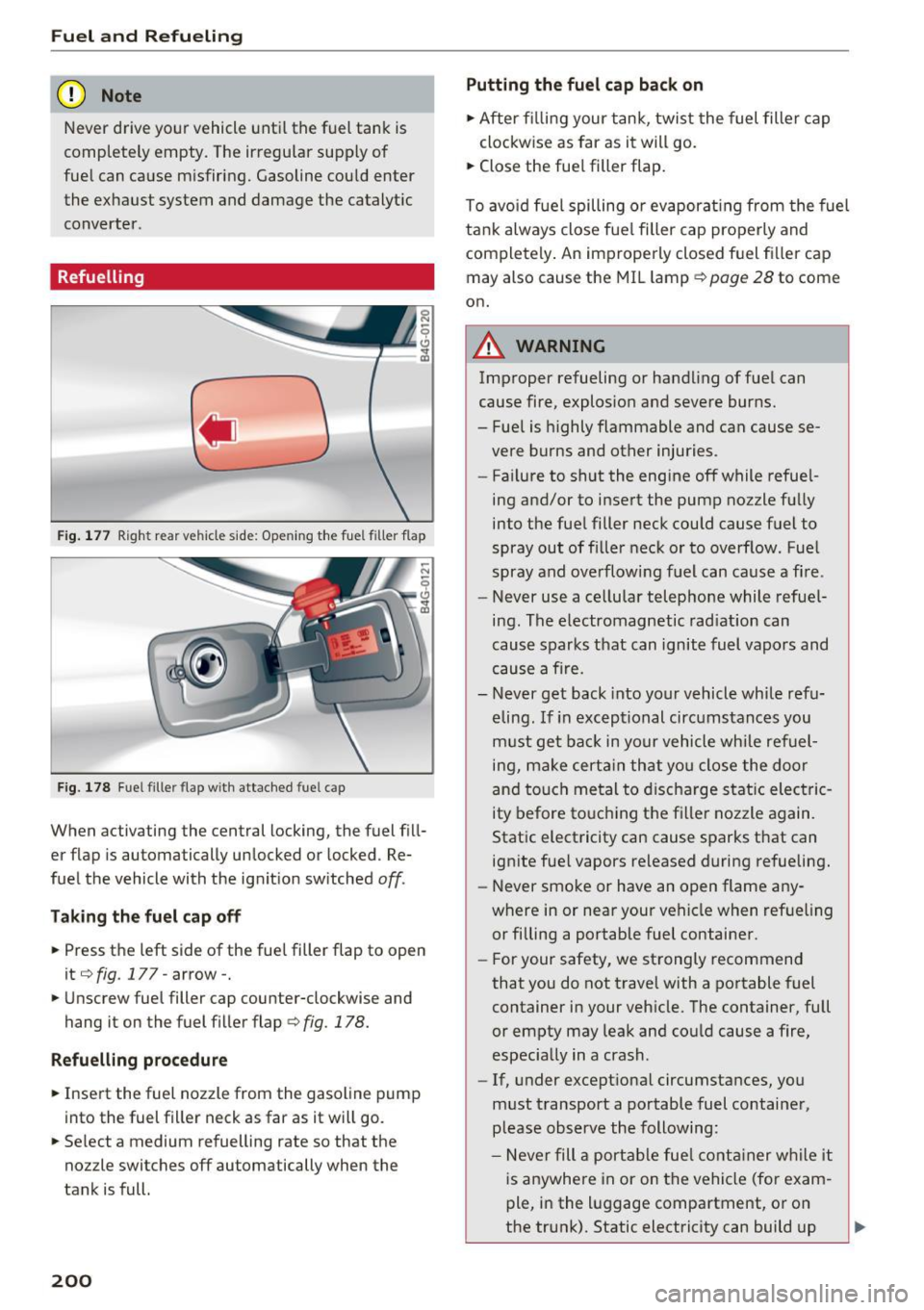
Fig. 177 Right rear vehicle side: Opening the fuel filler flap
Fig. 178 Fuel filler flap w ith attached fuel cap
When activating the central locking, the fuel fill
er flap is automatically unlocked or locked. Re
fuel the vehicle with the ignition switched
off.
Taking the fuel cap off
.. Press the left side of the fuel filler flap to open
it
9 fig. 177-arrow- .
.. Unscrew fuel filler cap counter-clockwise and
hang it on the fuel filler flap¢
fig. 178.
Refuelling procedure
.. Insert the fuel nozzle from the gasoline pump
into the fuel filler neck as far as it will go.
.. Select a medium refuelling rate so that the
nozzle switches off automatically when the
tank is full.
200
Putting the fuel cap back on
.. After filling your tank, twist the fuel filler cap
clockwise as far as it will go.
.. Close the fuel filler flap.
To avoid fuel spilling or evaporating from the fuel
tank always close fuel filler cap properly and
completely. An improperly closed fuel filler cap
may also cause the MIL lamp ¢
page 28 to come
on.
A WARNING
Improper refueling or handling of fuel can
cause fire, explosion and severe burns. -
- Fuel is highly flammable and can cause se
vere burns and other injuries .
- Failure to shut the engine off while refuel
ing and/or to insert the pump nozzle fully
into the fuel filler neck could cause fuel to
spray out of filler neck or to overflow. Fuel
spray and overflowing fuel can cause a fire.
- Never use a cellular telephone while refuel
ing. The electromagnetic radiation can
cause sparks that can ignite fuel vapors and
cause a fire.
- Never get back into your vehicle while refu
eling.
If in exceptional circumstances you
must get back in your vehicle while refuel
ing, make certain that you close the door
and touch metal to discharge static electric
ity before touching the filler nozzle again.
Static electricity can cause sparks that can
ignite fuel vapors released during refueling.
- Never smoke or have an open flame any
where in or near your vehicle when refueling
or filling a portable fuel container .
- For your safety, we strongly recommend
that you do not travel with a portable fuel
container in your vehicle. The container, full
or empty may leak and could cause a fire,
especially in a crash .
- If, under exceptional circumstances, you
must transport a portable fuel container,
please observe the following:
- Never fill a portable fuel container while it
is anywhere in or on the vehicle (for exam
ple, in the luggage compartment, or on
the trunk). Static electricity can build up
Ii>-
Page 203 of 282
while filling and can ignite fuel vapors causing a fire.
- Always place a portable fuel conta iner on
the ground before filling.
- Always keep the filler nozz le completely
inside the portab le container before and
during filling.
- If fill ing a portable container made of
metal, the filler nozzle must always be in
contact with the container . This will help
prevent static electricity from discharging
and cause a fire.
- Never spi ll fuel inside the vehicle or lug
gage compartment. Fuel vapors are h ighly
flammable.
- Always observe local and state/provincia l
laws regarding the use, storage and trans
portation of fuel containers.
- Make certa in the fuel conta iner meets in
dustry standards (ANSI/ ASTM F852-86).
CD Note
If any fuel has spilled onto the car, it should
be removed immediately to prevent damage
to the paint .
@ For the sake of the environment
As soon as the correctly operated nozzle
switches off automatically for the first t ime,
the tank is full. Do not try to add more fuel
because fuel may spill out. In addition, the
expansion space in the fuel tank will be filled -
causing the fuel to overflow when it becomes
warm and pollu te the environment.
@ Tips
- Running your engine while refuelling may
cause vapors to escape or even cause fuel to
spill out of the tank. This would then shut
off the fuel nozzle before the tank is full.
- Do not refuel your vehicle with the ignition
switched on. The fuel ga uge may otherwise
not indicate the correct fue l level after refu
elling.
- The fuel filler flap of your vehicle is not
l ocked when you lock the vehicle from the
i nside.
Fuel and Refueling
Fuel filler door emergency release
If the central locking system is faulty, the fuel
filler door can be unlocked manually.
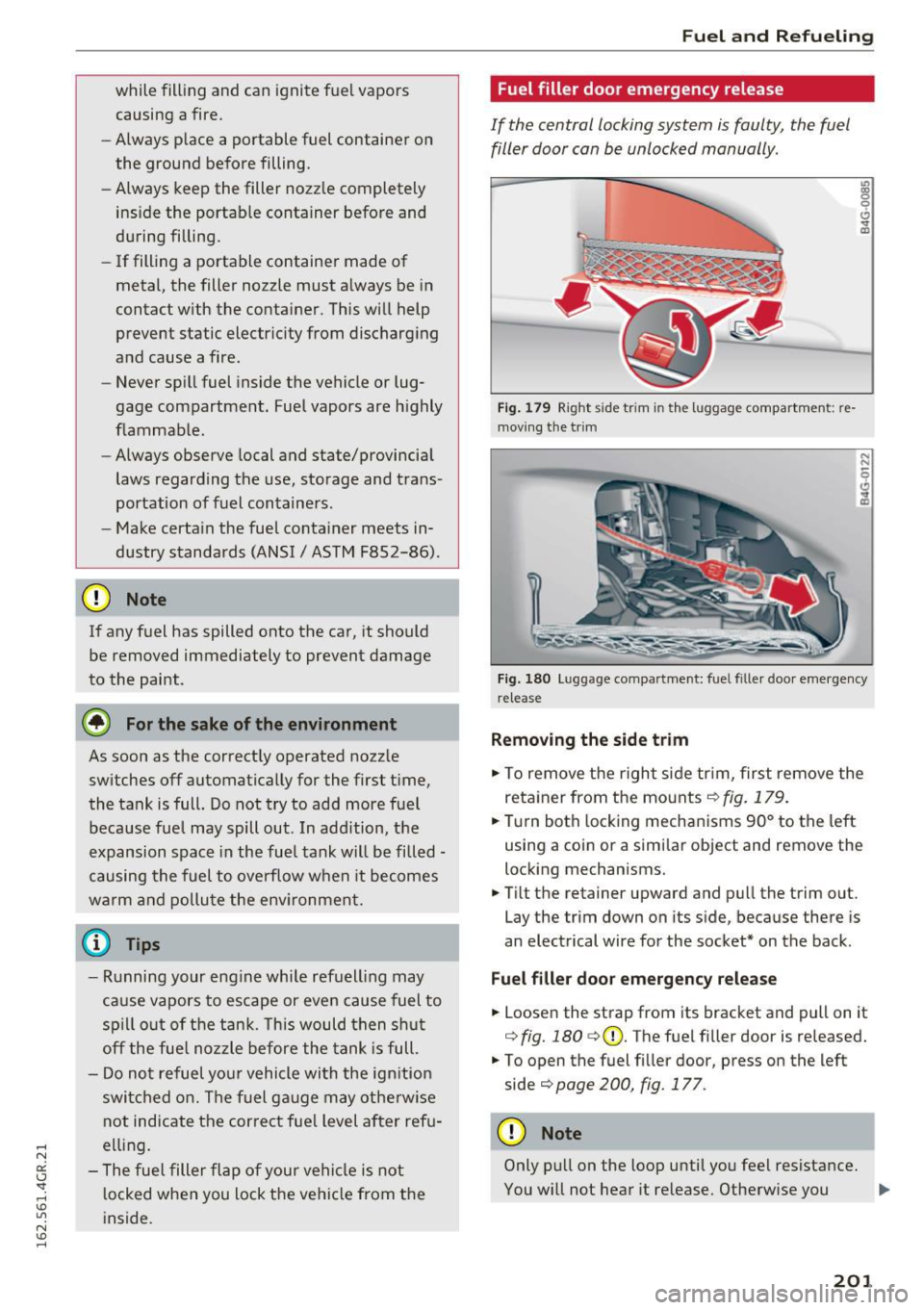
Fig. 179 Right s ide t rim in t he lu ggage compartm en t: re
moving the t rim
Fig. 180 Lu ggage compa rtment: fuel fill er door emergency
release
Removing the side trim
.,. To remove the right side tr im, first remove the
reta iner from the mounts
c:> fig. 179.
... Turn both locking mechanisms 90° to the left
using a coin or a similar object and remove the
locking mechanisms.
• Tilt the retainer upward and pull the trim out.
Lay the trim down on its side, because there is
an electrical wire for the socket* on the back .
Fuel filler door emergency release
... Loosen the strap from its bracket and pull on it
c:> fig. 180 c:>(D. The fuel filler door is released.
.,. To open the fuel filler door, press on the left
side
c:> page 200, fig. 177.
CD Note
Only pull on the loop until you feel resistance.
You w ill not hear it re lease. Otherwise you ..,.
201
Page 205 of 282
Checking and Filling Hood
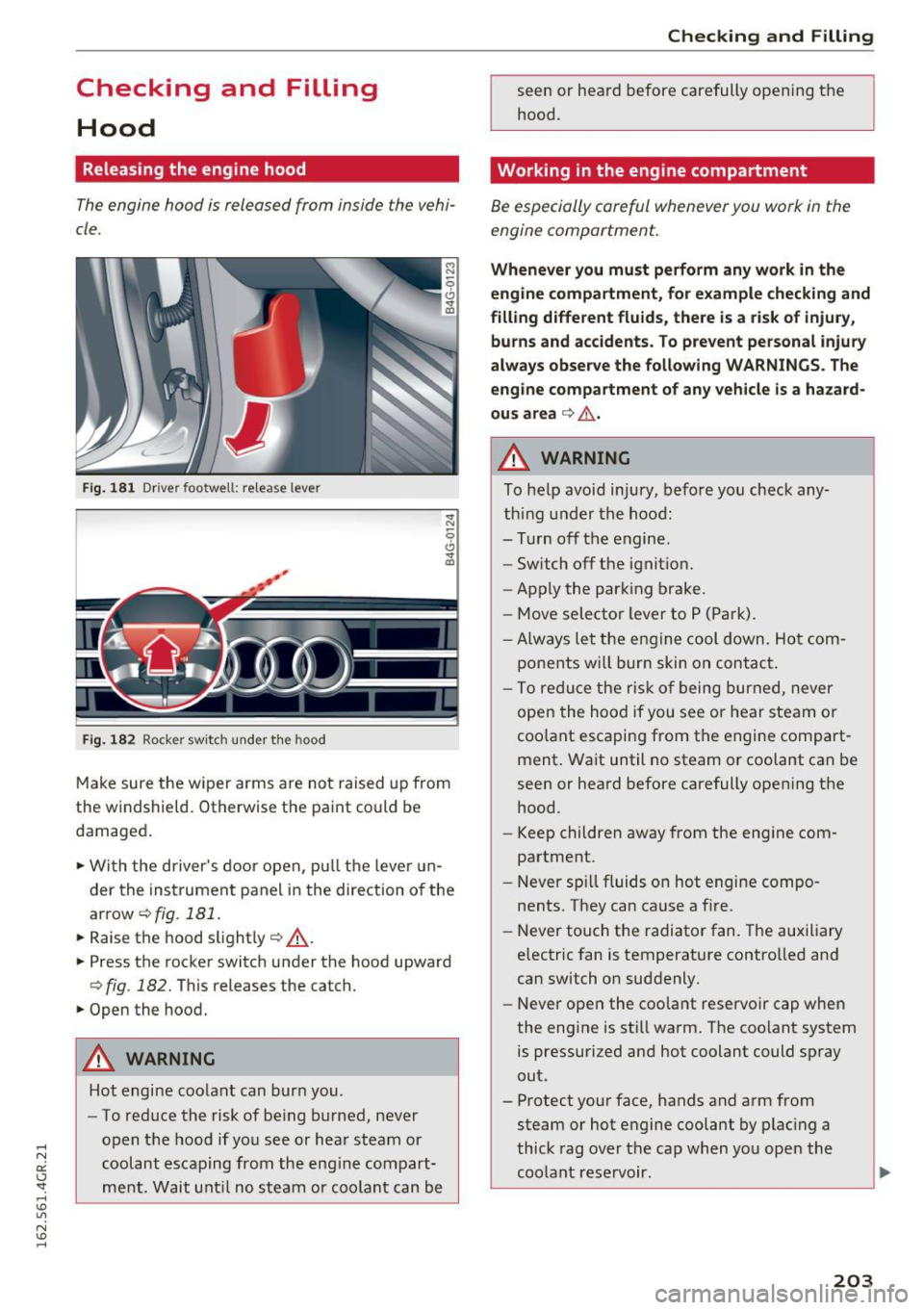
Releasing the engine hood
The engine hood is released from inside the vehi
cle .
Fig. 1 81 Dr ive r foo twell: re lease leve r
Fig. 1 82 Roc ke r sw itc h und er the hood
M ake sure the w iper arms are not raised u p from
the w indshield. Otherwise the pa int co uld be
damaged .
• Wi th the d river's door open, p ull th e leve r un
der the instrumen t panel i n the direction of the
ar row
r::;, fig. 181 .
• Raise the hood sl ight ly c:;, A -
• Press the rocker switc h under the hood upward
c;, fig . 182. This releases the catch.
• Open the hood.
_& WARNING
Hot engine coo lant can bur n you .
- To reduce the risk of be ing burned, never
open the hood if yo u se e or hear steam or
coolant escaping from the eng ine compart
me nt. W ait unt il no steam o r co olant ca n be
Checking and Filling
seen or hea rd before carefully opening the
hood .
Working in the engine compartment
Be especially careful whenever you work in the
engine compartment.
Whenever you must perf orm any work in the
engine compartment , for example checking and
filling different fluids , the re is a risk of injur y,
burn s and accidents. To prevent personal injury
always observe the following WARNINGS. The
eng ine compartment of any veh icle is a hazard
ous area
c:;, A .
_& WARNING
To he lp avoid injury, before you check any
th ing under the hoo d:
-T urn off the engine .
- Sw itch off the ignit ion.
- Apply the parking brake.
- Move selector lever to P (Pa rk).
- Always let the en gine cool down. Ho t com-
ponents wi ll burn skin on con tact .
-
-To reduce the ris k of b eing bur ned, never
open the hood if you see or hear steam o r
coo lant escaping from the engine compart
ment. Wa it until no steam or coolant can
be
seen or hea rd before carefully opening the
hood.
- Keep children away from the engine com
partment .
- Never sp ill fluids on hot engine compo
nents. They can cause a f ire.
- Never touch the radiator fan . The auxiliary
electric fan is temperature contro lled and
can switch on suddenly.
- Never open the coo lant reservoir cap when
the engine is st ill warm. The coolant system
is pressuri zed and hot coolant could sp ray
out.
- Protect your face, hands and arm from
steam or hot engine coolant by plac ing a
thick rag over the cap when yo u open the
coolant reservoir .
203
Page 206 of 282

Checking and Filling
-Do not remove the engine cover under any
circumstances . This increases the risk of
burns.
- If work on the fuel system or the electrical
system is necessary:
- Always disconnect the battery.
- Never smoke or work near heaters or open
flames . Fluids in the engine compartment
could start a fire.
- Keep an approved fire extinguisher imme
diately available .
- To avoid electrical shock and personal injury
while the engine is running or being started,
never touch:
- Ignition cables
- Other components of the high voltage
electronic ignition system.
- If you must perform a check or repair with
the engine running:
- First, fully apply the parking brake, move
selector lever to P (Park) .
- Always use extreme caution to prevent
clothing, jewelry, or long hair from get
ting caught in the radiator fan, V -belts or
other moving parts, or from contacting
hot parts. Tie back hair before starting,
and do not wear clothing that will hang or
droop into the engine.
- Minimize exposure to emission and chemi
cal hazards
,=:, .&. -
A WARNING
California Proposition 65 Warning:
- Engine exhaust, some of its constituents,
and certain vehicle components contain or
emit chemicals known to the State of Cali
fornia to cause cancer and birth defects and
reproductive harm. In addition, certain flu
ids contained in vehicles and certain prod
ucts of component wear contain or emit
204
chemicals known to the State of California
to cause cancer and birth defects or other
reproductive harm .
- Battery posts, terminals and related acces
sories contain lead and lead compounds,
chemicals known to the State of California
to cause cancer and reproductive harms .
Wash hands after handling.
(D Note
When adding fluids, always make sure that
they are poured into the proper container or
filler opening, otherwise serious damage to
vehicle systems will occur.
@ For the sake of the environment
To detect leaks in time, inspect the vehicle
floor pan from underneath regularly . If you
see spots from oil or other vehicle fluids, have
your vehicle inspected by an authorized Audi
dealer.
Closing the engine hood
.,. Pull the hood down until the pressure from the
struts is reduced.
.,. Let the hood
drop down and latch in place. Do
not try to push it shut;
it may fail to engage
¢ _& .
A WARNING
A hood that is not completely latched could
fly up and block your view while driving .
- When you close the engine hood, check it to
make sure the safety catch has properly en
gaged . The hood should be flush with the
surrounding vehicle body parts.
- If you notice while driving that the hood is
not secured properly, stop at once and close it .
-
Page 207 of 282
Checking and Filling
Engine compartment
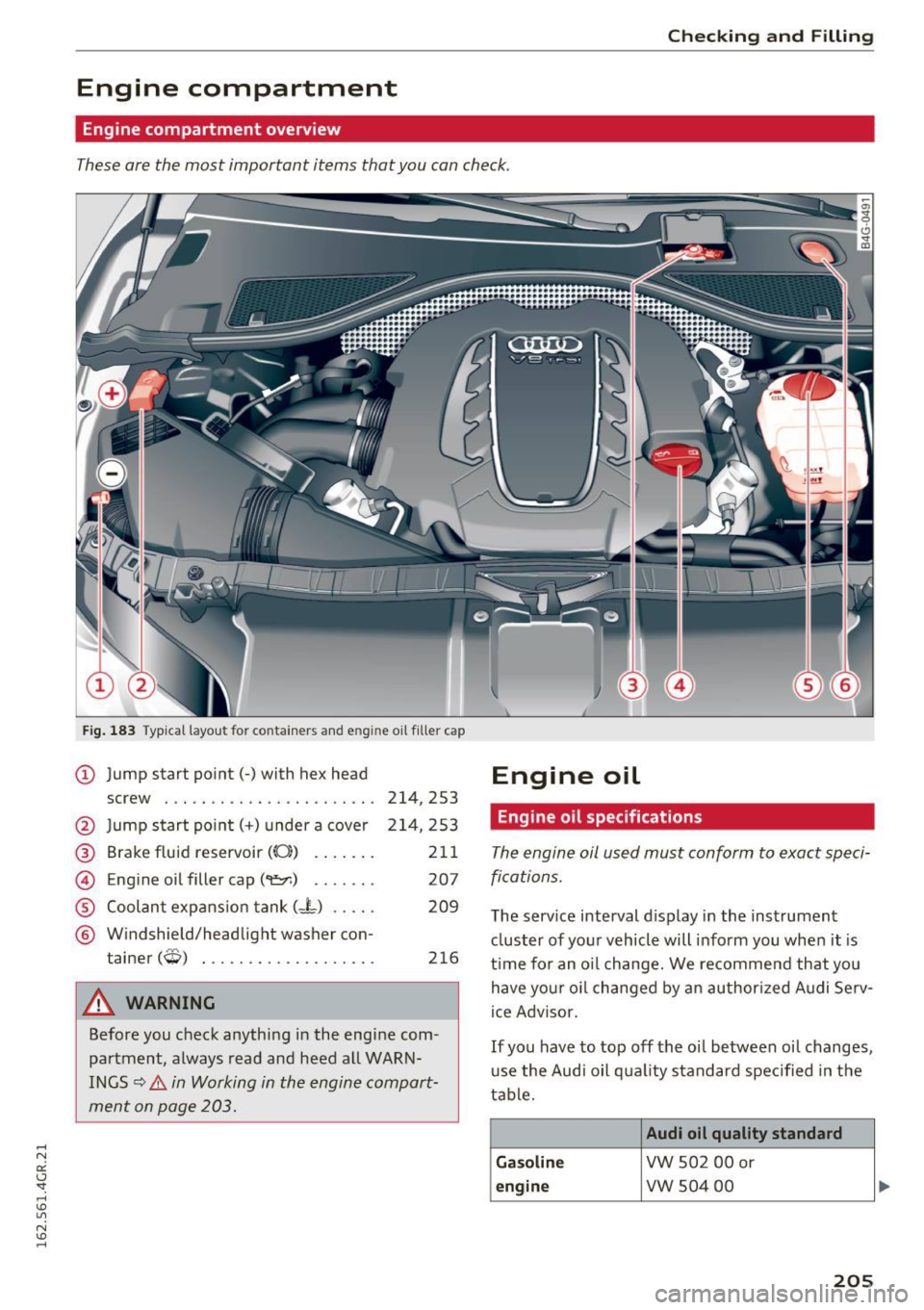
Engine compartment overview
These are the most important items that you can check.
Fig. 183 Typical layout for containers and e ngine oil fille r cap
(D Jump start point(-) with hex head Engine oil
screw . .. .... .... .... ..... .. . 214, 253
@ Jump start po int( +) under a cover 214 ,253
@ Brake fluid reservoir (0:) . . . . . . . 211
@ Eng ine oil filler cap(~) . . . . . . . 207
® Coolant expans ion tank (- L) . . . . . 209
® Windshield/headlight washer con-
tainer
(W) . . . . . . . . . . . . . . . . . . . 216
A WARNING
Before you check anything in the engine com
partment, always read and heed all WARN
INGS
¢ .&. in Working in the engine compart
ment on page 203.
Engine oil specifications
The engine oil used must conform to exact speci
fications.
The service interval display in the instrument
cluster of your vehicle will inform you when it is
t ime for an o il change. We recommend that you
have your oil changed by an authorized Audi Serv-
ice Adv isor.
If you have to top off the oi l between oil changes,
use the Audi oil quality standard specified in the
table.
Audi oil quality standard
Gasoline
VW 502 00 or
engine VW S04 00
205