2016 AUDI Q5 by hand
[x] Cancel search: by handPage 142 of 300

Driving safety
-Always put objects, for example, luggage or
other heavy items in the luggage compart
ment.
- Always secure objects in the luggage com
partment using the tie-down eyelets and
suitable straps.
A WARNING
Heavy loads will influence the way your vehi
cle handles. To help reduce the risk of a loss
of control leading to serious personal injury:
- Always keep in mind when transporting
heavy objects, that a change in the center of
gravity can also cause changes in vehicle
handling:
- Always distribute the load as evenly as
possible.
- Place heavy objects as far forward in the
luggage compartment as possible.
- Never exceed the Gross Axle Weight Rating or the Gross Vehicle Weight Rating specified
on the safety compliance sticker on the left
door jamb. Exceeding permissible weight
standards can cause the vehicle to slide and handle differently .
- Please observe information on safe driving
¢page 134.
A WARNING
To help prevent poisonous exhaust gas from
being drawn into the vehicle, always keep the
rear lid closed while driving.
- Never transport objects larger than those fitting completely into the luggage area be
cause the rear lid cannot be fully closed .
- If you absolutely must drive with the rear lid open, observe the following notes to reduce
the risk of poisoning:
- Close all windows,
- Close the Panoramic sliding sunroof*,
- Open all air outlets in the instrument pan-
el,
- Switch off the air recirculation,
- Set the fresh air fan to the highest speed .
140
A WARNING
,--
Always make sure that the doors, all win
dows, the Panoramic sliding sunroof* and the
rear lid are securely closed and locked to re
duce the risk of injury when the vehicle is not
being used .
-After closing the rear lid, always make sure
that it is properly closed and locked.
- Never leave your vehicle unattended espe
cially with the rear lid left open. A child
could crawl into the vehicle through the lug
gage compartment and close the rear lid be
coming trapped and unable to get out. Be
ing trapped in a vehicle can lead to serious
personal injury.
- Never let children play in or around the vehi
cle.
- Never let passengers ride in the luggage
compartment. Vehicle occupants must al
ways be properly restrained in one of the ve
hicle's seating positions.
(D Tips
- Air circulation helps to reduce window fog
ging. Stale air escapes to the outside
through vents in the trim panel. Be sure to keep these slots free and open .
- The tire pressure must correspond to the
load. The tire pressure is shown on the tire
pressure label. The tire pressure label is lo
cated on the driver's side B-pillar . The tire
pressure label lists the recommended cold
tire inflation pressures for the vehicle at its
maximum capacity weight and the tires that
were on your vehicle at the time it was man
ufactured. For recommended tire pressures
for normal load conditions, please see chap
ter ¢
page 245.
Tie-downs
The luggage compartment is equipped with four
tie-downs to secure luggage and other items.
Use the tie-downs to secure your cargo properly
¢page 139, Loading the luggage compartment . ..,_
Page 147 of 300

..... N
co ~ CX)
..... I.Cl U"I
..... I.Cl ..... instr
ument panel, windshield, or whatever e lse is
in the way
<=) fig. 157. This impact with the vehi
cle interior has all the energy they had just be
fore the crash.
Never rely on airbags alone for protection. Even
when they deploy, airbags provide on ly additional
protection. Airbags are not supposed to dep loy in
all kinds of accidents. A lthough your Audi is
equipped with airbags, all vehicle occupants, in
cluding the dr iver, must wear safety belts cor
rectly in order to minimize the risk of severe in
jury or death in a crash .
Remember too, that airbags will deploy only
once and that your safety belts are always there
to offer protect ion in those accidents in w hich
airbags are not supposed to deploy or when they
have already deployed. Unbelted occupants can
also be thrown o ut of the vehicle where even
more severe or fatal injur ies can occur.
It is also important for the rear passengers to
wear safety bel ts correctly . Unbelted passengers
in the rear seats endanger not only themse lves
but also the driver and other passengers
¢ fig. 158. In a frontal collision they will be
thrown forward violently, where they can hit and
injure the driver and/or front seat passenger .
Safety belts protect
People think it's possible to use the hands to
brace the body in a minor collision. It 's simply
not true!
Fig. 159 Dr iver is correctly restra ined in a sudden b raking
maneuver
Safety belts used properly can make a big differ
ence. Safety belts help to keep passengers in
their seats, gradually reduce energy levels ap-
Safety belts
plied to the body in an accident, and help prevent
the uncontrolled movement that can cause seri
ous injuries. In addition, safety belts reduce the
danger of be ing thrown out of the vehicle.
Safety belts attach passengers to the car and give
them the benefit of being slowed down more
gently or "softly" through the "give" in the safety
belts, crush zones and other safety features engi
neered into today's vehicles. By "absorbing" the
kinetic ene rgy over a longer period of time, the
safety belts make the forces on the body more
"tolerab le" and less likely to ca use injury .
Although these examples are based on a frontal collision, safety belts can also substantially re
duce the r isk of injury in ot her k inds of crashes.
So, whether you're on a long trip or just go ing to
the corner store, always buckle up and make sure
others do, too. Acc iden t statist ics show that vehi
cle occupants properly wea ring safety belts have
a lower risk of being injured and a much better
chance of surviving an accident . Properly using
safety belts also greatly increases the ability of
the supp lemental airbags to do their job in a col
lision. For this reason, wearing a safety belt is le
gally required in most count ries including much
of the United States and Canada .
Although your Aud i is equipped with airbags, you
still have to wear the safety belts provided. Front
airbags, for example, are activated only in some
frontal collisions. The front airbags are not acti
vated in all frontal collisions, in side and rear col
lisions, in roll overs or in cases where there is not
enough deceleration through impact to the front
of the vehicle. The same goes for the other airbag
systems in your Audi . So, always wear your safety
belt and make sure everybody in your vehicle is
properly restrained!
Important safety instructions about safety
belts
Safety belts must always be correctly positioned
across the strongest bones of your body.
.,. Always wear safety belts as illustrated and de
scribed in this chapter.
.,. Make sure that your safety belts are always
ready for use and are not damaged .
145
Page 152 of 300

Safety belt s
Service and disposal of safety belt preten
sioner
The safety be lt pretensioners are parts o f the
safety belts on yo ur Audi. Installing, removing,
servicing or repairing of belt pretensioners can
damage the safety belt system and prevent it
from working correctly in a collision.
There are some important things you have to know to make sure that the effectiveness of the
system w ill not be impaired and that discarded
components do not cause injury or pollute the
env ironment.
A WARNING
-
Improper care, serv icing and repair proce
dures can increase the r is k of personal injury
and death by preventing a safety be lt preten
sioner from activ ating when needed or acti
vating it unexpectedly:
- T he be lt pretensione r system can be act ivat
ed only once. If belt p retensioners have
been act ivated, the system must be re
placed.
- Never repair, adjust, or change any parts of
the safety be lt system .
- Safe ty belt systems in cl ud ing safe ty be lt
pretens ioners cannot be repaired . Special
procedures are req uired for removal, insta l
lation and disposal of this system.
- For any wor k on the safety belt system, we
strongly recommend that you see your au
thorized Aud i dea ler or q ualified technician
who has an A udi approved repair manual,
training and spec ial equ ipment necessary.
@ For the sake of the environment
Undep loyed airbag modu les and pretension
ers might be classified as Perch lorate Materi
al -specia l handling may apply, see
www.dtsc.ca.gov/hazardouswaste/perchlo rate. When the vehicle or parts of the re
straint system including airbag modules safe
t y belts with pretens io n ers are scrapped, all
app licab le laws and regulat ions m ust be ob
served. Y our authori zed Audi de aler is familiar
w ith these req uiremen ts and we recommend
150
that yo u have your dealer perform this service
for you .
Page 162 of 300

Airbag syste m
-and the head restraints have been properly ad -
justed .
Because airbags i nflate i n the blink of an eye w ith
g reat for ce, th ings you have on your lap or have
p laced on the seat cou ld become dangerous pro
jectiles, and be pushed into you if the airbag in
flates .
When an a irbag deploys, fine dus t is re leased.
This is normal and is not caused by a fire in the
vehicle . This dust is made up mostly of a powder
used to lubricate the airbags as they deploy. It
could irr itate sk in.
It is important to remember that whi le the sup
p lemental airbag system is designed to reduce
the likelihood of serious injur ies, other in juries,
for example swelling, bruising and m inor abra
sions, can also happen when airbags inflate. Air bags do not protect the arms or the lower parts
of the body . Front airbags only supplement the
three po int safety belts in some fronta l co llisions
i n which the veh icle decelerat ion is high enough
to deploy the airbags.
Fr ont airbags w ill not deploy:
- if the ignit ion is switched off when a crash oc -
curs ,
- in s ide collisions,
- in rear-end collisions,
- in rollovers,
- when the crash decelerat ion measured by the
airbag system is less than the minimum thresh
o ld needed for airbag deployment as registered
by the electronic control unit.
The front pass eng er airbag will also not
depl oy :
- when the front passenger seat is not occupied,
- when the weight on the front passenger seat as
sensed by the Advanced A irbag System indi
cates that the front airbag on the passenger
s ide has to be turned off by the electronic con
trol unit (the
PAS SENGER AIR B AG OFF light
comes on and stays on) .
A WARNING
Sitting in the wrong pos ition can increase the
r is k of se rious i njury in c rashes.
160
- To reduce the risk o f injury when the airbags
inflate, the driver and passengers must al
ways sit in an upright position, must not
lean aga inst or place any part of their body
too close to the area where the airbags are
located.
- Occupants who are unbelted, out of posit ion
or too close to the airbag can be serious ly
in ju red by an airbag as it unfolds wit h great
force in the blink of an eye r=;,
page 152.
A WARNING
A child in a rearward-fa cing child safety seat
installed on the front p assenger sea t will be
seriously injured and can be killed if the front
airbag inflates -even with an Advanced Airbag
System.
- The inflating airbag will hit the chi ld safety
seat o r infant ca rrier with great force and
w ill smash the child safety seat and child
aga inst the backrest, center a rmrest, door
or roof.
- Always install rear-fac ing ch ild safety seats
on the rear seat.
- If you must insta ll a rearwa rd facing child
safety seat on the front passenger seat be
cause of exceptional circumstances and the
PAS SENGER AIR BAG OFF light does not
come on and stay on, immediately install
the rea r-facing child safety seat in a rear
seating position and have the ai rbag system
inspected by your au thori zed Au di d ealer.
A WARNING
Objects between you and the airbag will i n
crease the r is k of injury in a crash by interfer
ing with the way the airbag unfolds or by be
ing p ushed into you as the airbag inflates .
- Never hold things in yo ur hands o r on your
lap when the vehicle is in use .
- Never transport items on or in the area of
the front passenger seat . Objects could
move into the area of the front airbags dur
ing braking or other sudden maneuver and
become dangerous projectiles that can
cause serious persona l injury if the airbags
inflate.
Page 163 of 300
-Never place or attach accessories or o ther
objects (such as cupholders, telephone
brackets, la rge, heavy o r bulky objects) on
the doors, over or n ear t he area marked
"AIRBAG" on the steering wheel, instru
ment pane l, seat backrests or between
those areas and you rself . These objects
c ou ld cause injury in a crash, especially
when the airbags inflate.
- Never re cline the front passenge r's seat to
t ransport objec ts. Items ca n also move into
the area of the side airbag o r th e fron t air
bag dur ing braki ng or i n a sudden maneu
ver . Objects near the airbags can become
projectiles and cause injury, particularly
when the seat is reclined.
A WARNING
The fine dust created when airbags deploy can
cause breathing problems for people w ith a
history of asthma or other b reathing condi
t ions .
-To reduce the risk of breathing problems, those w ith asthma or other respiratory con
ditions should get fresh air right away by
gett ing out of the veh icle o r opening w in
dows o r doo rs.
- If you are in a collision in which airbags de
ploy, wash your hand s and face wi th mild
s oa p and wa ter before eat ing .
- Be careful not to get the dust in to your eyes,
o r in to any cuts or s cratches.
- If the resid ue should ge t into yo ur eyes,
flush them with water.
Monitoring the
Advanced Airbag System
ti (USA models) / !f (Canada models)
Airbag monitoring indicator light
Two separate indicators monitor the function of
the Advanced Airbag System: the airbag moni
toring indicator light and the
PASSENGER AIR
,... BAG OFF
light. N
co
~ The Advanced Airbag System ( includ ing the elec-,...
~ tro nic cont rol un it, senso r cir cui ts and system
~ w iri ng) is monitored continuously to make s ure ....
Airb ag sys tem
that it is functioning properly whenever the igni
tion is on. Each time you turn on the ignition, the
airbag monitoring indicator light
II (USA mod
els)
; E,I (Canada models) wi ll come on for a few
seconds (self diagnostics).
The system must be in spected when the
indicator light
ffl (USA models) t E,I
(Canada models ):
- does not come on when the ignition is sw itched
on,
- does not go out a few seconds after you have
sw itched on the igni tion, or
- comes on while driving .
If an airbag system malfunction is detected, the
indicator light will first start flashing to catch the
driver's attention and then stay on continuously
to serve as a constant reminder to have the sys
tem inspected immediately.
If a malfunction occurs that turns the front air
bag on the passenger side off, the
PASSENGER
AIR BAG OFF
lig ht will come on and stay on
whenever the ignition is on .
A WARNING
f-
An airbag system that is not functioning prop-
e rly cannot provide supplemental protect io n
in a fronta l crash.
-If the a irbag ind icator light~ page 16
comes when the veh icle is being used, have
the sy stem inspec ted imme dia tely by your
author ized Audi dealer. It is possi ble th at
the air bag will inflate when it is not sup
posed to, or w ill not inflate when it should.
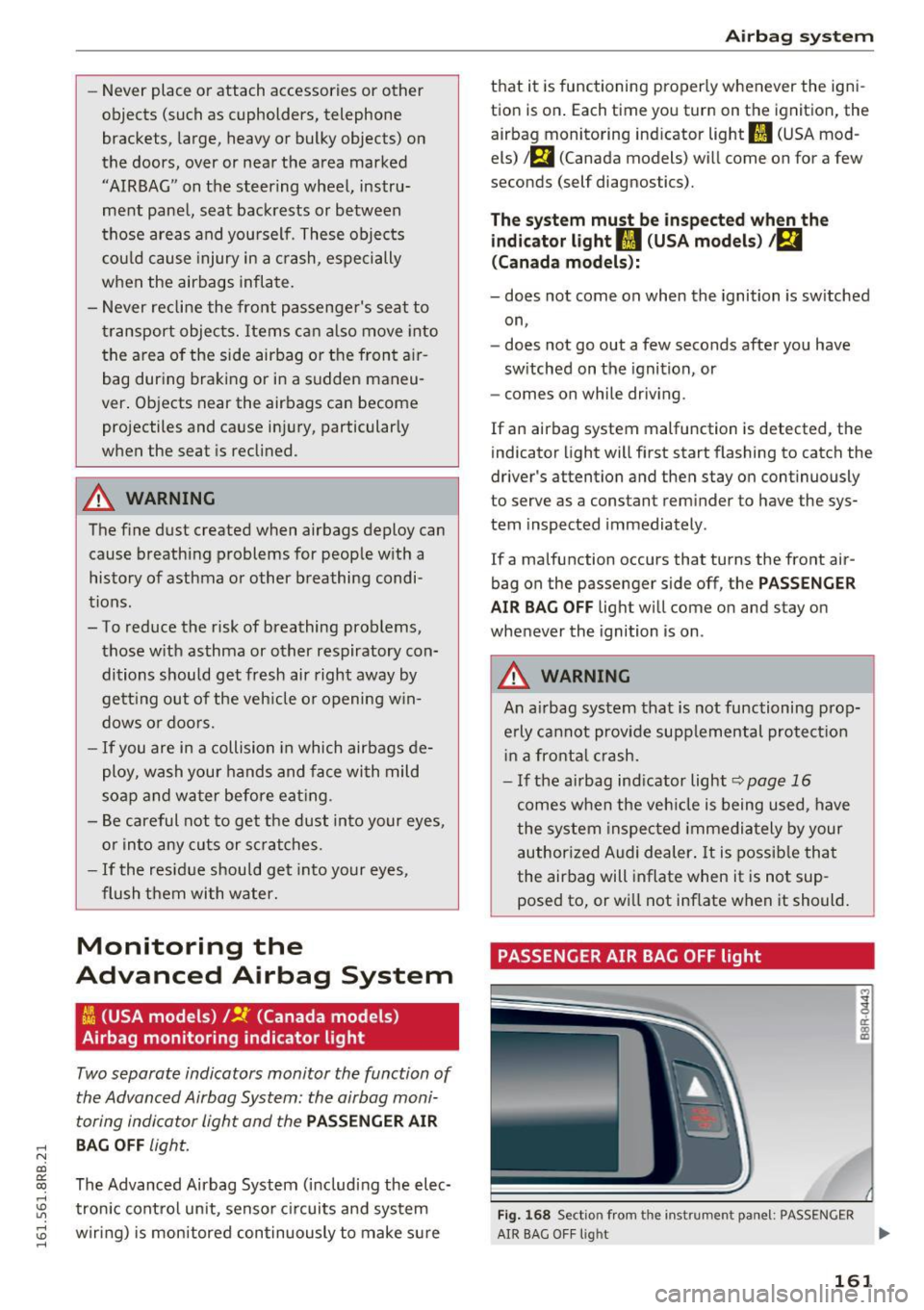
PASSENGER AIR BAG OFF light
Fig. 1 68 Sectio n from the instrument panel: PASS ENGER
i a: CX)
"'
AIR SAG O FF light ...
161
Page 165 of 300

,....,
N
co
er::
co
,....,
ly seated on the center of the seat cushion with
his or her back up against the backrest and the
backrest is not reclined
9 page 135 , Correc t
passenger seating positions,
- the adult is not taking weight off the seat by
holding on to the passenger assis t handle
above the front passenger door or suppor ting
their weight on the armrest,
- the safety bel t is being properly worn and that
there is not a lot of slack in the safety belt web
bing,
- accessory seat covers or cushions or other
things that may cause an incorrect reading or
impression on the weight-sensing mat under
the upholstery of the seat have been removed
from the front passenger seat,
- a safety belt extender has not been left in the
safety belt latch for the front passenger seat.
In addition to the
PASSENGER AIR BAG OFF
light in the center of the instrument panel, the
message
PASSENGER AIR BAG OFF or PASSEN
GER AIR BAG ON
will briefly appear in the instru
ment cluster display . This is to inform the driver
of the current front passenger airbag status.
Important safety instructions on
monitoring the Advanced Airbag System
A WARNING
An airbag system that is not functioning prop erly cannot provide supplemental protection
in a frontal crash .
- If the airbag indicator light
9 page 16
comes when the vehicle is being used, have
the system inspected immediately by your
authorized Audi dealer. It is possible that
the airbag will inflate when it is not sup
posed to, or will not inflate when it should.
A WARNING
If the front airbag inflates, a child without a
child restraint, in a rearward-facing child safe
ty seat or in a forward-facing child restraint
that has not been properly installed will be
seriously injured and can be killed.
Airbag system
-Even though your vehicle is equipped with
an Advanced Airbag System, make certain
that all children, especially 12 years and
younger, always ride on the back seat prop erly restrained for their age and size .
- Always install forward or rear-facing child
safety seats on the rear seat -even with an
Advanced Airbag System .
- If you must install a rearward-facing child
safety seat on the front passenger seat be
cause of exceptional circumstances and the
PASSENGER AIR BAG OFF light does not
appear and stay on, immediately install the
rear-facing child safety seat in a rear seating
position and have the airbag system in
spected by your authorized Audi dealer.
-A tight tether or other strap on a rearward
facing child restraint attached to the front passenger seat can put too much pressure
on the weight-sensing mat in the seat and
register more weight than is actually on the
seat . The heavier weight registered can
make the system work as though an adult
were on the seat and deploy the Advanced
Airbag when it must be suppressed causing
serious or even fatal injury to the child.
- If, in exceptional circumstances, you must
install a forward-facing child restraint on
the front passenger seat, always move the
seat into its rearmost position in the seat's
fore and aft adjustment range, as far away
from the airbag as possible. The backrest must be adjusted to an upright position .
Make sure that the
PASSENGER AIR BAG
OFF
light comes on and stays on all the time
whenever the ignition is switched on.
A WARNING
-- If the PASSENGER AIR BAG OFF light does
not go out when an adult is sitting on the
front passenger seat after taking the steps
described above, make sure the adult is
properly seated and restrained at one of the rear seating positions.
- Have the airbag system inspected by your
authorized Audi dealer before transporting
anyone on the front passenger seat.
163
Page 167 of 300

..... N
co ~ CX)
..... I.Cl U"I
..... I.Cl .....
@ For the sake of the environment
Undep loyed airbag modu les and pretension
ers might be classified as Perchlorate Materi
al -special handling may apply, see
www.dtsc .ca.gov/hazardouswaste/perchlo
rate . When the veh icle or parts of the re
straint system including airbag modules safe
ty belts with pretensioners are scrapped, all
app licable laws and regulations must be ob
served. Your authorized Audi dealer is familiar
w ith these req uirements and we recommend
that you have your dealer perform this service
for you.
Other things that can affect Advanced
Airbag performance
Changing the vehicle's suspension system can
change the way that the Advanced Airbag System
pe rforms in a crash. For examp le, using tire-r im
comb inat ions not approved by Audi, lowering the
veh icle, chang ing the stiffness of the suspens ion,
including the springs, suspension struts, shock
absorbers etc . can change the forces that are
measured by the airbag sensors and sent to the
e lectronic control unit . Some suspension changes
can, for example, increase the force levels meas
ured by the sensors and make the airbag system
deploy in crashes in wh ich it would not deploy if
the changes had not been made . Other kinds of
changes may reduce the fo rce levels measured by
the sensors and prevent the airbag from deploy ing when it should.
A WARNING
Changing the vehicle's suspension including
use of unapproved tire-rim combinations can
change Advanced Airbag performance and in
crease the risk of serious personal injury in a
crash.
- Never install suspens ion components that
do not have the same performance charac
teristics as the components or iginally instal
led on your veh icle.
- Never use tire-rim combinations that have
not been approved by Audi.
Airb ag sys tem
A WARNING
-Items stored between the safety belt buckle
and the center console can cause the sensors
i n the buckle to send the w rong information
to the electronic contro l modu le and prevent
the Advanced A irbag System from wo rking
p roperly.
- Always make sure that nothing can interfe re
with the safety belt buckles and that they
are not obstructed.
Side airbags
Description of side airbags
The airbag system con provide supplemental
protection to properly restrained occupants.
Fig. 1 69 Side a irbag locatio n in the driver 's seat
T he side airbags are located in the s ides of the
front seat backrests
r='.> fig . 169 and the rear back
rest* facing the doo rs. They are ident ified by t he
word "AIRBAG".
The si de airbag system ba sic ally con sis t s of:
- the electronic control module and external side
impact sensors
- the two a irbags located in the s ides of the front
backrests and the two airbags* located in the
rear backrest
- the airbag warning light in the instrument clus-
ter.
The airbag system is monitored electronica lly to
make certain that it is functioning proper ly at all
t imes . Each time you turn on the ignition, the a ir
bag system indicator light w ill come on for a few
seconds (self diagnostics) .
Ill-
165
Page 169 of 300

,....,
N
co
er::
co
,....,
al protection, the side airbag must inflate wit hin
a fraction of a second at very high speed and w ith
great force. The supplemental side airbag could injure you if your seating position is not proper or
upright or if items are located in the area where
the supplemental side airbag expands . This ap
p lies especially to children
c::> page 171, Child
safety.
Supp lemental side a irbags inflate be
tween the oc cupan t and the door pane l on the
side of the vehicle that is s truck in certa in side
collision
c::> fig . 170.
Although they are not a soft pi llow, they can
"c ushion" the impact and in th is way they can
h e lp to reduce the risk of injury to the upper part
of the body .
A fi ne dust may develop when the airbag deploys.
This is normal and does no t mean there is a fire
in the vehicle.
Important safety instructions on the side
airbag system
Airbags are only supplemental restraints . Always
properly wear safety belts and ride in a proper seating position.
There is a lot that yo u and your passengers must
know and act accordingly to help the safety belts
and airbags do their job to provide supp lemental
protection .
A WARNING
An inflating side airbag can cause ser ious or
fatal injury. Improperly wearing safety belts
and improper seating positions increase the
r is k of se rious personal injury and death
whenever a veh icle is being used.
- In order to reduce the r isk of injury when
the suppleme ntal s ide airbag inflates:
- Always sit in an upright position an d never
lean aga inst the area where the s upple-
mental side airbag is located .
- Never let a chi ld or anyone else rest their
head against the side trim panel in the
area where the supp lemental s ide airbag
inflates.
Airb ag sys tem
-Always make sure that safety belts a re
worn correctly,
- Do not let anyone sitting in the front seat
put their hand o r any other parts of their
body out of the window .
- Always make sure that the s ide a irbag can
inflate w ithout interference.
- Never install seat covers or replacement
upholste ry ove r the front seatbacks that
have not been specifica lly approved by
Audi.
- Never use addi tional seat cushions that
cove r the areas where the side airbags de
ploy .
- Dam age to the orig inal seat cove rs or to
the se am in the area of the s ide airbag
module must a lways be repaired immedi
ate ly by an authorized Au di dealer.
- Obje cts between you and the airbag can in
crease the r isk of injury in an accident by in
terfering with the way the airbag unfolds or
by being pushed into you as the airbag in
flates .
- Never place or attach accessor ies or other
o bjects (such as cupholders, telephone
br acket s, or even large, bul ky objec ts) on
the doors, over or near the area mar ke d
"AIRBAG" on the seat backrests .
- Such objec ts an d accessories can be come
dange rous p rojecti les and cause injury
when the supplemental side airbag de
ploys.
- Never carry any objects or pets in the de
ployment space between them and the
airbags or allow children or other passen
gers to trave l in this position.
- Always use the b uilt-in coat hooks only for
lightweight clothing. Never leave any heavy
or sharp-edged objects in the pockets that
may interfere with s ide airbag deployment
a nd can cause personal injury in an accident .
- Always p revent the side ai rbags from being
damaged by heavy objects knocking against
or hitting the s ides of the seatbac ks .
- The airbag system can only be triggered
once . If the airbag has been triggered, the
system must be replaced by an autho rized
Aud i deale rship.
167