2016 AUDI Q5 wheel
[x] Cancel search: wheelPage 163 of 300
-Never place or attach accessories or o ther
objects (such as cupholders, telephone
brackets, la rge, heavy o r bulky objects) on
the doors, over or n ear t he area marked
"AIRBAG" on the steering wheel, instru
ment pane l, seat backrests or between
those areas and you rself . These objects
c ou ld cause injury in a crash, especially
when the airbags inflate.
- Never re cline the front passenge r's seat to
t ransport objec ts. Items ca n also move into
the area of the side airbag o r th e fron t air
bag dur ing braki ng or i n a sudden maneu
ver . Objects near the airbags can become
projectiles and cause injury, particularly
when the seat is reclined.
A WARNING
The fine dust created when airbags deploy can
cause breathing problems for people w ith a
history of asthma or other b reathing condi
t ions .
-To reduce the risk of breathing problems, those w ith asthma or other respiratory con
ditions should get fresh air right away by
gett ing out of the veh icle o r opening w in
dows o r doo rs.
- If you are in a collision in which airbags de
ploy, wash your hand s and face wi th mild
s oa p and wa ter before eat ing .
- Be careful not to get the dust in to your eyes,
o r in to any cuts or s cratches.
- If the resid ue should ge t into yo ur eyes,
flush them with water.
Monitoring the
Advanced Airbag System
ti (USA models) / !f (Canada models)
Airbag monitoring indicator light
Two separate indicators monitor the function of
the Advanced Airbag System: the airbag moni
toring indicator light and the
PASSENGER AIR
,... BAG OFF
light. N
co
~ The Advanced Airbag System ( includ ing the elec-,...
~ tro nic cont rol un it, senso r cir cui ts and system
~ w iri ng) is monitored continuously to make s ure ....
Airb ag sys tem
that it is functioning properly whenever the igni
tion is on. Each time you turn on the ignition, the
airbag monitoring indicator light
II (USA mod
els)
; E,I (Canada models) wi ll come on for a few
seconds (self diagnostics).
The system must be in spected when the
indicator light
ffl (USA models) t E,I
(Canada models ):
- does not come on when the ignition is sw itched
on,
- does not go out a few seconds after you have
sw itched on the igni tion, or
- comes on while driving .
If an airbag system malfunction is detected, the
indicator light will first start flashing to catch the
driver's attention and then stay on continuously
to serve as a constant reminder to have the sys
tem inspected immediately.
If a malfunction occurs that turns the front air
bag on the passenger side off, the
PASSENGER
AIR BAG OFF
lig ht will come on and stay on
whenever the ignition is on .
A WARNING
f-
An airbag system that is not functioning prop-
e rly cannot provide supplemental protect io n
in a fronta l crash.
-If the a irbag ind icator light~ page 16
comes when the veh icle is being used, have
the sy stem inspec ted imme dia tely by your
author ized Audi dealer. It is possi ble th at
the air bag will inflate when it is not sup
posed to, or w ill not inflate when it should.
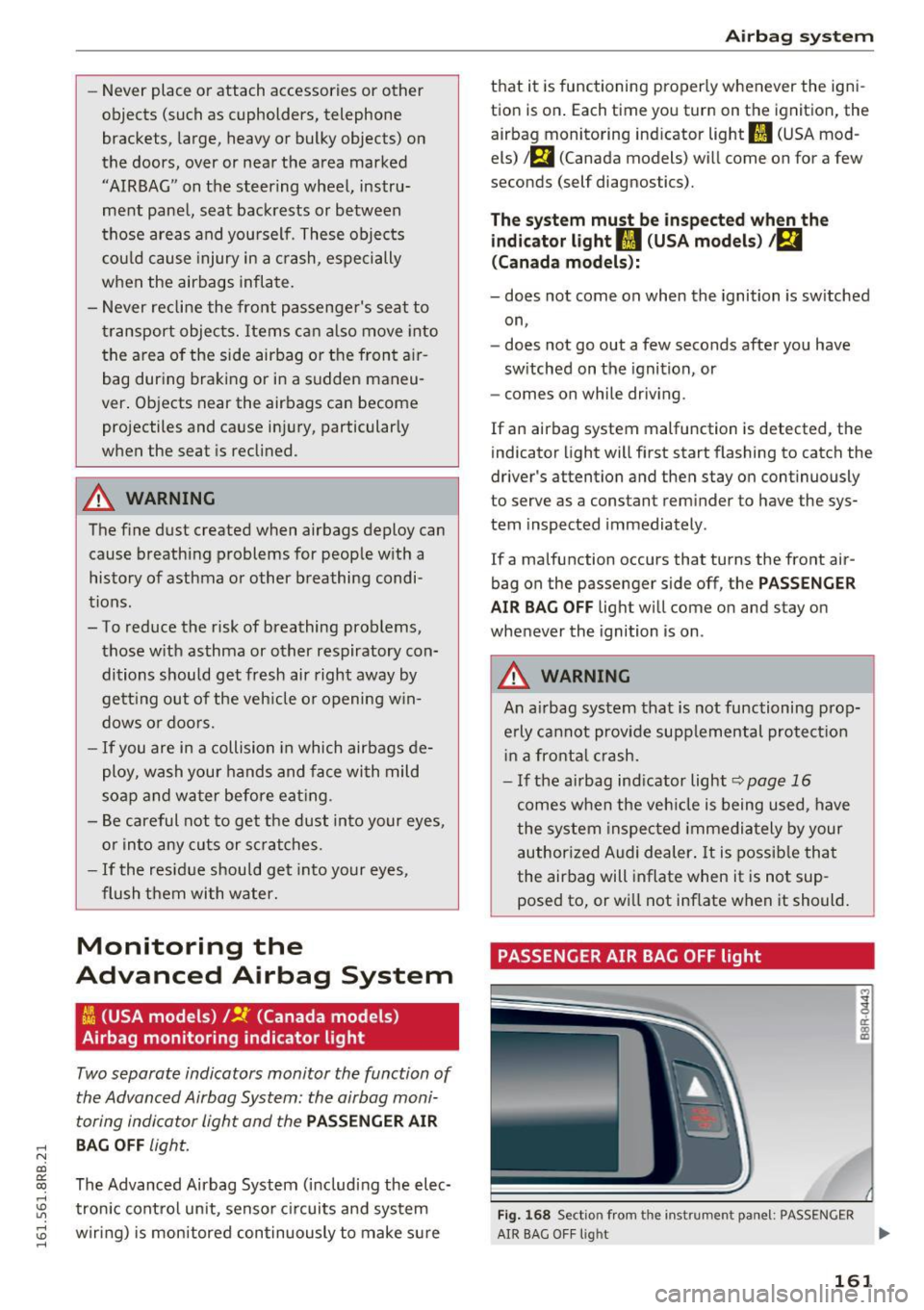
PASSENGER AIR BAG OFF light
Fig. 1 68 Sectio n from the instrument panel: PASS ENGER
i a: CX)
"'
AIR SAG O FF light ...
161
Page 166 of 300

Airbag system
(D Tips
If the weight-sensing mat in the front passen
ger seat detects an empty seat, the front air
bag on the passenger side will be turned off,
and
PASSENGER AIR BAG OFF will stay on.
Repair , care and disposal of the airbags
Parts of the airbag system are installed at many
different places on your Audi. Installing , remov
ing, servicing or repairing a part in an area of the
vehicle can damage a part of an airbag system and prevent that system from working properly in a collision.
There are some important things you have to
know to make sure that the effectiveness of the
system will not be impaired and that discarded
components do not cause injury or pollute the
environment.
A WARNING
Improper care, servicing and repair proce
dures can increase the risk of personal injury
and death by preventing an airbag from de
ploying when needed or deploying an airbag
unexpectedly:
-
- Never cover, obstruct, or change the steer
ing wheel horn pad or airbag cover or the in
strument panel or modify them in any way .
- Never attach any objects such as cupholders
or telephone mountings to the surfaces cov
ering the airbag units.
- For cleaning the horn pad or instrument panel, use only a soft, dry cloth or one mois
tened with plain water. Solvents or cleaners could damage the airbag cover or change
the stiffness or strength of the material so
that the airbag cannot deploy and protect properly.
- Never repair, adjust , or change any parts of
the airbag system.
- All work on the steering wheel, instrument
panel, front seats or electrical system (in
cluding the installation of audio equipment,
cellular telephones and CB radios, etc.)
must be performed by a qualified technician
164
who has the training and special equipment necessary.
- For any work on the airbag system, we
strongly recommend that you see your au
thorized Audi dealer or qualified workshop .
- Never modify the front bumper or parts of
the vehicle body.
- Always make sure that the side airbag can
inflate without interference:
- Never install seat covers or replacement
upholstery over the front seatbacks that
have not been specifically approved by
Audi .
- Never use additional seat cushions that
cover the areas where the side airbags in
flate.
- Damage to the original seat covers or to
the seam in the area of the side airbag
module must always be repaired immedi
ately by an authorized Audi dealer .
- The airbag system can be activated only
once . After an airbag has inflated, it must
be replaced by an authorized Audi dealer or
qualified technician who has the technical
information, training and special equipment
necessary.
- The airbag system can be deployed only
once . After an airbag has been deployed, it
must be replaced with new replacement
parts designed and approved especially for
your Audi model version. Replacement of complete airbag systems or airbag compo
nents must be performed by qualified work
shops only. Make sure that any airbag serv
ice action is entered in your Audi Warranty
& Maintenance booklet under AIRBAG RE
PLACEMENT RECORD.
- In accidents when an airbag is deployed, the
vehicle battery separates the alternator and
the starter from the vehicle electrical sys
tem for safety reasons with a pyrotechnic
circuit interrupter.
- Work on the pyrotechnic circuit interrupt
er must only be performed by a qualified
dealer - risk of an accident!
- If the vehicle or the circuit interrupter is
scrapped, all applicable safety precautions
must be followed.
llll-
Page 174 of 300

Child safety
exceptional circumstances and the
PASSENGER AIR BAG OFF light does not
come on and stay on, immediately install
the rear-facing child safety seat in a rear
seating position and have the airbag system inspected immediately by your Audi dealer .
A WARNING
If, in exceptional circumstances, you must in
stall a forward-facing child restraint on the
front passenger's seat:
- Always make sure the forward-facing seat
has been designed and certified by its man
ufacturer for use on a front seat with a pas
senger front and side airbag.
- Always follow the manufacturer's instruc
tions provided with the child safety seat or
carrier.
- Always move the passenger seat into its
rearmost position in the seat's fore and aft
adjustment range, as far away from the air
bag as possible before installing the child
restraint. The backrest must be adjusted to
an upright position.
- Always make sure that the
PASSENGER AIR
BAG OFF
light comes on and stays on all the
time whenever the ignition is switched on.
(D Tips
Always replace child restraints that were in stalled in a vehicle during a crash. Damage to
a child restraint that is not visible could cause
it to fail in another collision situation.
Advanced front airbag system and children
Your vehicle is equipped with a front "Advanced
Airbag System" in compliance with United States
Federal Motor Vehicle Safety Standard (FMVSS)
208, as well as Canada Motor Vehicle Safety
Standard (CMVSS) 208 as applicable at the time
your vehicle was manufactured.
The Advanced Airbag system in your vehicle has
been certified to meet the "low-risk" require
ments for 3- and 6-year old children on the pas
senger side and small adults on the driver side.
The low risk deployment criteria are intended to
172
reduce the risk of injury through interaction with
the airbag that can occur, for example, by being
too close to the steering wheel and instrument panel when the airbag inflates. In addition, the
system has been certified to comply with the
"suppression" requirements of the Safety Stand
ard, to turn off the front airbag for infants up to
12 months who are restrained on the front pas
senger seat in child restraints that are listed in
the Standard .
Even though your vehicle is equipped with an Ad
vanced Airbag system, all children, especially
those 12 years and younger, should always ride
in the back seat properly restrained for their age
and size. The airbag on the passenger side makes
the front seat a potentially dangerous place for a
child to ride. The front seat is not the safest place
for a child in a forward-facing child safety seat. It
can be a very dangerous place for an infant or a
larger child in a rearward-facing seat.
· Advanced Airbags and the weight-sensing
mat in the front seat
The Advanced Airbag System in your vehicle de
tects the presence of an infant or child in a child
restraint on the front passenger seat using the
weight-sensing mat in the seat cushion and the
sensor below the safety belt latch on the front
passenger seat that measures the tension on the
safety belt.
The weight-sensing mat measures total weight
of the child and the child safety seat and a child
blanket on the front passenger seat . The weight
on the front passenger seat is related to the de
sign of the child restraint and its "footprint", the
size and shape of the bottom of the child re
straint as it sits on the seat . The weight of a child
restraint and its "footprint" vary for different
kinds of child restraints and for the different
models of the same kind of child restraint of
fered by child restraint manufacturers.
The weight ranges for the individual types,
makes and models of child restraints that the
NH TSA has specified in the Safety Standard to
gether with the weight ranges of typical infants
and typical 1 year -old child have been stored in ..,.
Page 192 of 300

Intelligent Technology
shared, please see your contract with the
wireless te lecommunications provider and the
"About Aud i connect" tab in your vehicle's
MMI*:
I MENU ! button > Audi connect > About
Audi connect .
Electronic Stabilization
Control (ESC)
Description
The Electroni c Stab ili z at ion Control (ESC) re infor
ces driver safety. It reduces the r isk of slipping
and improves driving stability. ESC detects crit i
cal s ituations suc h as the vehicle overstee ring
and understeering o r the wheels sp inning. The
ve hicl e is stab ilized by applying the b rakes o r re
ducing e ngine torque . Once t he ESC is acti ve , the
i n dicator light
m bli nks in the instrument cl us
ter.
The fo llow ing sys tems a re integrated in the ESC:
Anti-lock b rake system (ABS)
ABS preve nts the wheels from lock ing up when
b raking . The veh icle can sti ll be steered even dur
i n g ha rd brak ing . Apply steady press ure to the
b rake pedal. Do no t pump t he pedal. A pulsing in
the brake pedal indicates tha t the system i s help
i n g you to br ake the vehicle .
Brake assist system
The brake assist system can decrease brak ing dis
tance . It increases brak ing power when the d river
p resses the brake pedal q uic kl y in eme rgency si t
uations . You m ust press and hold t he b rake pedal
until the situa tion is over. In vehi cles w it h ad ap
tive cruise contro l* , the brake assist system is
mo re sensit ive if the distance detected to the ve
h icle ahead is too small.
Anti -slip regulation (ASR)
A SR re duces eng ine power when the drive w heels
begin to spin and adapts the force to the roa d
conditions. This makes it easie r to sta rt, acceler
ate and drive up hi lls.
190
Electronic differential lock (EDL)
The EDL brakes wheels that are spi nning and
transfers the drive power to the other w heels .
This function is not ava ilable at higher speeds.
I n ext reme cases , ED L automat ica lly swi tches off
to help keep the b rake on the bra ke d whee l from
overheating . EDL will sw itch on again automa ti
ca lly w hen conditions have returned to normal.
Steering recommendation
The ESC he lps to stabilize the vehicle by cha ng ing
t h e s teer ing torque .
On vehicles with dynam ic steering*, ESC helps
stab il ize the steer ing in crit ica l sit uat ions .
Selective wheel torque control
Selective wheel torque cont rol is used when d riv
i ng o n curves. The front whee l on the inside of
the curve or both wheels on the i nside of the
curve are braked selectively as needed . Th is al
l ows mo re prec ise driving in c urves . The applica
ble sys tem may not a ctivate w hen d riv in g in we t
o r snowy cond it ions.
_8. WARNING
- The ESC and i ts integ ra ted systems cannot
overcome the laws of physics . This is espe
cially important on slippery or wet roads. If
the systems begin act ing to stab ilize your
veh icle, you should immediately change
your speed to matc h the road and traffic
conditions. Do no t let the increased safe ty
provided by t hese systems tempt yo u to
t ake risks. Doing so will i ncreas e th e risk of
a loss of vehicle con trol, collisi on and se ri
ou s person al injur ies .
- Always a dap t your spee d to road , traffic and
weather condi tions. The risk of los ing con
t rol of the vehicle in cr eases w hen driving
t oo f ast, es pecially throu gh curves and on
slippe ry or wet roads, and when driving too
close to ve hicles up ahea d. The ESC and its
integ rated systems cannot always prevent
col lisions - there is still a risk of accidents!
- Always accelerate w ith special ca re on even,
smooth surfaces s uch as those that are wet
o r covered with ice and snow. The drive .,..
Page 193 of 300

..... N
co ~ CX)
..... I.Cl U"I
.... I.Cl .....
wheels can spin even with these ass istance
systems that cannot always he lp to reduce
the risk of loss of vehicle control.
@ Tips
-ABS and AS R on ly work correctly when a ll
fo ur whee ls are e quipped w ith ide ntical
Switching on /off
Intelligent Technology
tires. Diff eren t tire s izes can lead to a red uc
tion i n engine po wer .
- You may hear noises when t he sy stems de
scribe d are workin g.
- Whe n in sta lling a facto ry-s up plied roo f ra ck
system o n the roof r ailing , the ESC wi ll
adapt itself to a different center of gravity .
ESC turns on automatically when you start the engine.
Fig . 18 5 Versio n A: Lowe r cente r conso le,~ OFF b utto n
The follow ing s ituations are except ions where it
may be usef ul to sw itch on offroad mode to allow
the wheels to spi n:
- Rocking the vehicle to free it when it is stuck
- Driv ing in deep snow or on loose ground
Offroad mode on
~ Q:)01_1 _ --.!'3.- -ft.
- Driving with snow chains
- Dr iving down hill wh ile braking on loose ground
- Dr iving on ro ugh te rra in when m uch of the car's
weight is lifted off the wheels (axle articula
tion)
Offroad mode off
Behavio r
The ESC and AS R stabilization f unctions Th
e fu ll sta bilization f unction of the ESC
a re limited
c:> &. .
Operation Press the 1.$ OFF I button.
Indicator II turns on.
lights
Driver mes- Stabilization
control (ESC): Offroad.
sages Wa rning! Restricted stability
A WARNING
- You should only sw itch o ffroad mode o n if
yo ur dr iv ing abilit ies a nd road cond it io ns
permit.
- The stabilization function is limited when offroa d mode is switched on. The dr iv ing
wheels co uld spi n and th e vehicle cou ld
swerve, es pec ially on s lick o r sli ppery roa d
s ur fac es. and ASR
is avai lab le again.
P ress t he
1.$ OFFI button aga in.
II turns off.
Stabilization control (ESC ): On
(D Tips
Offro ad mode ca nno t be switche d on whe n
adaptive c ruise co ntro l* is switched on.
191
Page 194 of 300

Intelligent Technology
Hill descent assist
The hill descent assist makes it possible to drive
down an incline at a constant speed .
~~,·~ ('l)ofF ___ P..1 --- fl~ IIL..~
---
Fig. 187 Top of the center conso le: hill descent assist but
ton
Fig. 188 Display: hill descent assist
.. Press the~ button in the center console
¢ fig . 187 or on the shift gate . The button will
illuminate .
" Press the button again to switch it off. The di-
ode in the button will go out .
Hill descent ass ist brakes all four wheels auto
matically in order to limit speed when driving ei
ther forwa rd o r reverse on hills with a grad e up to
approximately 50%.
When the hill descent assist is on, the current
driving speed, when your vehicle entered the in
cline is maintained.
It is only possible to switch
on the assist when driving slower than 37 mph
(60 km/h). The assist works between app roxi
mately 2 and 19 mph (4 and 30 km/h) . The driver
can increase or decrease the vehicle speed within
these limits by depressing the accelerator or
brake pedal In addition, vehicle steerability is in
creased due to the braking distribution when
driving in reverse .
192
There must be however sufficient ground adhe
sion . The hill descent assist can
not do its job if
the incline is icy or if the incl ine ground is loose
¢ &.
The system does not work at speeds between 19
and 37 mph (30 and 60 km/h). The system is
then in the ready-mode. The diode in the button
will come on . The system automatically sw itched
off when you drive faster than 37 mph (60 km/ h) . The diode will go out in this case .
Active control at a specific speed up to approxi
mately 19 mph (30 km/h) will appear in the in
strument cluster display
c:> fig. 188 . Two dashes
" •• " w ill appear in the ready mode .
Hill descent assist is automatically activated un
der the following conditions:
- the diode in the button illuminates,
- veh icle speed is below approximately 19 mph
(30 km/h)
- the incline is 10%.
& WARNING
-Always adapt your speed to the weather,
road and traffic cond itions. Do not let the
increased safety provided tempt you into
taking risks.
-
-The hill descent assist system cannot over
come the laws of phys ics. Your driving style
must always be adapted to the current road
and traffic conditions.
- The hill descent assist may not be ab le to
hold your vehicle at a constant speed under
all cond itions wh ile driving on an incline (for
example if ground under the vehicle is
loose).
Braking
What affects braking efficiency?
New brake pads
Du ring the first 2 50 miles (400 km), new brake
pads do not possess their full braking effect, they
have to be "broken in" first
c:> &. ..,_
Page 195 of 300

,....,
N
co
er::
co
,....,
The brakes on today 's au tomobiles a re still s ub
ject to wea r, depend ing la rgely on ope rating con
ditions and driving habits¢.&. . On vehicles that
ar e e ither driv en most ly in stop-and -go city traf
f ic or are driven ha rd, the brake pads should be
checked by your authorized Aud i dealer more of
ten than specified in the
Warranty & Mainte
n ance boo klet .
Failure to have your brake pads
inspected can resu lt in reduced brake perform
ance.
On steep slopes, you should use the braking ef
fect of the eng ine . This way, you prevent unnec
essary wear on the brake system . If you must use
your b rakes , do not ho ld the brakes down con tin
uously. Pump t he b rakes at intervals.
Operating noise
Noises may occur when braking depend ing on the
speed , braking force and outs ide cond itions such
as tempe rature and humidity .
Effect of water and road sa lt
In certain situations, for example a fter driving
t hrough water, in heavy ra in , after overnight con
densat ion or after washing your car, the braking
effect can be reduced by moisture or ice on the
b rake rotors and b rake pads . T he brakes must be
d ried first w ith a few careful b rake applica tions.
At highe r speeds and with the windsh ie ld w ipers
turned on, the bra ke pads press aga inst the brake
rotors for a short amount of time . Thi s occ urs at
r egular intervals wit hout the d river noticing and
p rovides for be tter br ak e response time u nder
wet conditions.
The eff ectiv eness of the brakes can be reduced
when the vehi cle is dr iven on a salt-covered road
and the brakes are not used. L ikewise, you clean
off acc umu la ted salt coat ing from b rake discs
and pads with a few ca utious applications of the
b rake ¢.&. .
Corrosion
There may be a tende ncy for d irt to b uild up on
the brake pads an d cor ros io n t o fo rm on the discs
if the ca r is not driven regular ly or only fo r sho rt
trips with little use of the brakes .
Intelligent Technology
If
the brakes are not used frequent ly, or i f co rro
sio n has formed on the discs , it is advisable to
clean off the pads and discs by braking firmly a
few times from a moderately high speed ¢ .&, .
Faults in the brake system
If you shou ld notice a sudden inc rease in brake
peda l travel, t hen one of t he two brake circ uits
may have fai led ¢
&..
Low brake fluid level
Malfunctions ca n occur i n the b rake system if the
br ak e fluid level is too low . T he brake f lu id leve l
is moni tored elect ronically .
Brake booster
The brake booster increases the press ure that
yo u generate with the b rake peda l.
It only oper
ates while the eng ine is r unning or w it h t he igni
tio n sw itched on (hybr id drive*) ¢.&, .
Brake lining wear status
Brake lining wear may be chec ked by visual in
spect io n of t he condition of the brake pads
t hr ough the openings in the wheel.
If necessary,
t h e wheel may be removed fo r th is i nspe ction
¢ page 259, Replacing wheels .
.&_ WARNING
--
-New brake pads don't have the bes t stop
p ing power an d m ust be " broken-in" d uring
the initial 250 miles (400 km). You can compensate for this by pressing the brake
pedal more firmly. This also applies later
when new pads are insta lled.
- You sho uld perform braking maneuvers for
the purpose of cleaning t he brake system
only if road condit io n s pe rmit . O ther road
users m ust not be put at r is k - you may
cause an accident!
- Before descending a steep g rade, reduce
speed and sh ift transmission into a lower
gea r or l ower dr iv ing ra nge. Do not r ide the
b rakes or hold the ped al down too long or
too often. This co uld cause t he b rakes to ge t
hot and dimi nish braking eff ic ien cy .
- Do no t "ride the br akes" by res ting you r foot
on the pedal when you do no t intend to ...,
193
Page 196 of 300

Intelligent Technology
brake. This may cause the brakes to over
heat, premature wear and increased stop
ping distance.
- Under certain climatic and operating condi
tions such as passing through water, driving
in heavy rain or after washing the vehicle,
the effectiveness of the brakes can be re duced . In winter, ice can accumulate on the
brake pads, linings, discs and drums. Care
fully apply brakes for a test. Brakes will dry
and ice coatings will be cleaned off after a
few careful brake applications.
- Driving for an extended period of time on
salt-covered roads without using your
brakes can also affect braking efficiency.
Clean off accumulated salt coating from
brake discs and pads with a few carefu l
brake app lications .
-If you damage the front spoiler, or if you in
stall a different spoiler, be sure the air flow
to the front brakes is not obstructed. Other
wise the brake system could overheat reduc ing the effectiveness of the entire brake sys
tem .
- Failure of one brake circuit will impair the
braking capability resulting in an increased
stopping distance. Avoid driving the vehicle and have it towed to the nearest author ized
Audi dealer or qualified workshop.
- Never let the vehicle roll to a stop with the
engine shut off.
- If the brake booster is not working, the
brake pedal must be pressed considerably
harder to make up for the lack of booster
assista nee.
Electromechanical power
assist, Dynamic steering
The electromechanical power assist helps the
driver when steering.
Power steering adapts electronically based on
the vehicle speed.
Indicator lights and messages
• Steering defective! Do not drive vehicle!
194 If
this indicator light turns on and stays on and
this message appears, the power steering may
have failed.
Stop the vehicle in a safe location as soon as pos
sible. Do
not continue driving . See your author
ized Audi dealer or other qualified repair facility
for ass istance .
'-r, ij Dynamic steering: System fault! You can
continue driving
If the indicator l ight turns on and the message
appears, the steering may be more difficult to
move or more sensitive than usual. The steering
may also be at an angle when driving straight.
Drive slowly to your authorized Audi dealer or
qualified workshop to have the malfunct ion cor
rected.
1 :r- ij Dynamic steering: Initializing
Audi drive select* : if the indicator light blinks and
the driver message appears, the dynamic steer i ng* is reinitial ized. After start ing the engine, the
steering wheel will move slightly . Re-initial iza
tion might be necessary if the steering wheel was
moved hard to the left and right while the vehicle
was not moving. The display turns off if the initi
alization was successful.
(D Tips
- If the . or 1:r- ij in dicato r light only stays on
for a short time, you may continue driving.
- T he dynamic steering* stab ility systems
¢ page 190 are not available in the event of
a system malfunction.
- For additional information on dynamic
steering*
¢page 119.
Driving with your
quattro
With all-wheel drive, all four wheels are driven .
General information
With all-wheel drive, power is distributed to all
four wheels. This happens automatically depend
ing on your driving style and the road conditions
at the time. See also
c> page 190. ..,.