2016 Alfa Romeo Giulia boot
[x] Cancel search: bootPage 58 of 204

Symbol What it means
AUTOMATIC TRANSMISSION FAILURE
The symbol switches on, together with a buzzer warning, to indicate that the automatic transmission is faulty.
Contact an Alfa Romeo Dealership as soon as possible.
16)
INSUFFICIENT ENGINE OIL LEVEL
The symbol switches on, along with the related message on the display, to indicate low engine oil level.
On the QV version, the level must also be checked using the dipstick below the boot (see chapter "Servicing and care").
SPEED LIMIT EXCEEDED
(where provided)
The symbol switches on when the speed limit of 75 mph (120 km/h) is exceeded.
IMPORTANT
16)Driving the vehicle with this symbol on may severely damage the gearbox, with resulting breakage. The oil may also overheat: contact with hot
engine or with exhaust components at high temperature could cause fires.
Amber symbols
Symbol What it means
ENGINE IMMOBILIZER FAILURE / BREAK-IN ATTEMPT
Engine Immobilizer system failure
The symbol switches on to report a failure of the Engine Immobilizer system.
Contact an Alfa Romeo Dealership as soon as possible.
Break-in attempt
The symbol switches on when the ignition device is moved to ON position, to indicate a possible break-in attempt detected by the
alarm system.
Electronic key not recognised
The symbol switches on when the engine is started and the electronic key is not recognized by the system.
Alarm system failure
This symbol switches on to report an alarm system failure.
56
KNOWING THE INSTRUMENT PANEL
Page 119 of 204

46)Camera operation may also be
compromised by the presence of dust,
condensation, dirt or ice on the windscreen,
by traffic conditions (e.g. vehicles that are
driving not aligned with yours, vehicle driving
in a transverse or opposite way on the same
lane, bend with a small radius of curvature),
by road surface conditions and by driving
conditions (e.g. off-road driving). Make sure
the windscreen is always clean. Use specific
detergents and clean cloths to avoid
scratching the windscreen. The camera
operation may also be limited or absent in
some driving, traffic and road surface
conditions.REAR BACK-UP CAMERA /
DYNAMIC GRIDLINES
DESCRIPTION
The Rear Back-up Camera is located on
the boot, near the opening button,
fig. 114.
115)
47)
Camera activation/deactivation
The function can be activated/
deactivated on the Connect system.
Activating the device
To access the function, on the main menu
select the following items in sequence:
"Settings", "Driver assistance" and "Rear
Back-up Camera". The following
sub-menu appears:
Active
Switch-off delay;
Grille.
Select "Activate" to activate the camera
view on the Connect system display.
Every time reverse is engaged, the
display of the Connect system, fig. 115,
shows the area around the vehicle, as
seen by the Rear Back-up Camera.
SYMBOLS AND MESSAGES ON THE
DISPLAY
If activated, the grid is positioned on the
image to highlight the width of the
vehicle and the expected reversing path
in accordance with the steering wheel
position.
A superimposed central broken line
indicates the centre of the vehicle to
facilitate parking manoeuvres or tow
hook alignment. The various coloured
areas indicate the distance from the rear
of the vehicle.
11407186S0001EM11507186S0002EM
117
Page 121 of 204

after refuelling, before removing the
dispenser, wait for at least 10 seconds in
order for the fuel to flow inside the tank;
then remove the dispenser from the
filler, close the plug and then close the
flap.
The label indicates the fuel type
(UNLEADED FUEL=petrol,
DIESEL=diesel fuel), fig. 117.Emergency fuel flap opening
In the event of an emergency the fuel flap
can be opened by operating from inside
the boot.
Proceed as follows:
open the boot and reach the
emergency opening cable placed on the
side of the fuel filler;
pull the cord to unlock the fuel flap,
open the fuel flap by pressing on it
(see the previous instructions).
IMPORTANT If the filler compartment is
washed with a high-pressure jet, keep it
at a distance of at least 10 in (20 cm).
WARNING
116)Do not apply any object/plug to the
end of the filler which is not provided for the
car. The use of non-compliant objects/plugs
could cause a pressure increase inside the
tank, resulting in dangerous situations.
117)Do not bring naked flames or lit
cigarettes near to the fuel filler: fire risk.
Keep your face away from the fuel filler to
prevent breathing in harmful vapours.
118)Do not use a mobile phone near the
refuelling pump: risk of fire.
11607206S0001EM
11707206S0002EM
119
Page 126 of 204

Light bulbs Type Power Figure reference
(1) Main beam headlights, front side lights/daylight running lights
(DRL)H1555/15W D
(1) Dipped
headlamps H7 55 W D
(1) Front direction indicators PY24W 24W B
(1) Fog lights H11 55 W E
Main beam/dipped beam headlights (Xenon gas discharge) D5S 25 W F
Main beam/dipped beam headlights (Xenon gas discharge) D3S 35 W F
Sun visor light 1.5CP 2.1W C
Glove compartment light W5W 4 W A
Boot light W5W 5 W A
Puddle lights (under door panel) W5W 5 W A
(1) Only for basic version headlight with halogen main beam/dipped beam headlights
124
IN AN EMERGENCY
Page 129 of 204

pull out the bulb-bulb holder unit from
the headlight body by turning it
anticlockwise fig. 129;
remove the bulb by sliding it off the
bulb holder
install the new bulb, making sure it is
correctly inserted in the bulb holder;
then insert the bulb, bulb holder and
connector assembly in the housing on the
headlight body and turn it clockwise,
making sure that it is locked correctly;
refit the cover by tightening the two
fixing screws.
Front light cluster with main
beam/dipped beam Xenon gas
discharge headlights
To replace the bulbs of the main beam
headlights/dipped headlights contact an
Alfa Romeo Dealership
WARNING
119)Before replacing the bulb, wait for the
exhaust ducts to cool down: DANGER OF
SCALDING!
120)Modifications or repairs to the electric
system that are not carried out properly or
do not take the system technical
specifications into account can cause
malfunctions leading to the risk of fire.
121)Halogen bulbs contain pressurised gas,
in the case of breakage they may burst
causing glass fragments to be projected
outwards.
IMPORTANT
49)Halogen bulbs must be handled holding
the metallic part only. Touching the
transparent part of the bulb with your
fingers may reduce the intensity of the
emitted light and even reduce the lifespan of
the bulb. In the event of accidental contact,
wipe the bulb with a cloth moistened with
alcohol and let the bulb dry.
REPLACING FUSES
INTRODUCTION
122) 123) 124) 125) 126)
50) 51)
Fuses protect the electrical system: they
intervene (blow) in the event of a failure
or improper action on the system.
Fuse extracting pliers
To replace a fuse, use the pliers hooked
to the boot fusebox cover fig. 130.
Grab the pliers from the upper tabs,
press them and extract the pliers pulling
upwards.
The pliers fig. 131 have two different
ends, specifically designed to remove the
different types of fuses present in the
vehicle.
1: MINI fuse;
2: J-CASE fuse.
12808026S0021EM
12908026S0022EM
13008036S0053EM
127
Page 130 of 204

After use, refit the pliers in position,
proceeding as follows:
grasp the pliers from the upper tabs;
press the pliers in their housing,
pushing downwards, until they click into
place.
FUSE LOCATION
The fuses, which can be replaced by the
user, are grouped in two boxes below the
passenger side foot board and inside the
boot.
CONTROL UNIT UNDER PASSENGER
SIDE FOOTBOARD
To access the fuses, proceed as follows:
lift the upper end of the footboard 1
fig. 132 on the passenger side, pulling it
to release the 2 buttons;
remove the panel 2 fig. 133,
extracting it downward, after unscrewing
the two fixing hooks;
the fuses are freely accessible on the
control unit.
The number identifying the electrical
component corresponding to each fuse is
shown on the control unit cover.
LUGGAGE COMPARTMENT FUSE BOX
To access the fuses, proceed as follows:
lift the load carrying plane;
remove the control unit cover fig. 134;
The number identifying the electrical
component corresponding to each fuse is
shown on the cover.
After replacing a fuse, make sure that
you have closed cover correctly.
13108036S0005EM13208036S0010EM
13308036S0011EM
13408036S0014EM
128
IN AN EMERGENCY
Page 134 of 204

WARNING
122)Never replace a fuse with another with
a higher amp rating; DANGER OF FIRE.
123)Before replacing a fuse, make sure
that the ignition device is at STOP and that
all devices are switched off and/or
disconnected.
124)Contact an Alfa Romeo Dealership if a
safety system (airbags, brakes),
transmission system (engine, gearbox) or
steering system general protection fuse
blows.
125)If a fuse blows again, contact an Alfa
Romeo Dealership.
126)If a general protective fuse
(MAXI-FUSE, MEGA-FUSE, MIDI-FUSE)
blows, contact an Alfa Romeo Dealership.
IMPORTANT
50)Never replace a fuse with metal wires or
anything else.
51)If it is necessary to wash the engine
compartment, take care not to directly hit
the fuse box and the window wiper motors
with the water jet.
TIRE REPAIR KIT
DESCRIPTION
127) 128) 129) 130) 131) 132) 133) 134) 135)
52)
3)
The Tire Repair Kit is located in the boot,
inside a specific container.
To access the Tire Repair Kit, open the
boot, lift the load platform.
The Tire Repair Kit includes also:
one tank 1 fig. 137 containing the
sealing fluid, provided with: filler tube
2 and adhesive label 3 with the writing
"Max. 50 mph (80 km/h)”, to be attached
in a position easily visible to the driver
(eg. on the dashboard) after repairing the
tyre;
compressor 4 complete with pressure
gauge and connectors;
an instruction leaflet, to refer to for
prompt and correct use of the Tire Repair
Kit and that must be then given to the
personnel dealing with the tyre treated
with sealant;
a pair of protective gloves;
some adaptors, for inflating different
elements.
IMPORTANT The sealing fluid is effective
with external temperatures of between
-40°F (-40°C) and 122°F (+50°C). The
sealing fluid has an expiry date.
INFLATION PROCEDURE
127) 128) 130) 131) 132) 133) 134) 135)
Proceed as follows:
engage the electric parking brake.
Insert the tank 1 fig. 138 containing the
sealing liquid in the proper compressor
holder, pressing down hard. Unscrew the
tyre valve cap, take out the filler hose
2 and tighten the ring nut on the tyre
valve;
13708066S0002EM
132
IN AN EMERGENCY
Page 140 of 204
BROKEN-DOWN VEHICLE
TOWING
REAR WHEEL DRIVE (RWD) VERSIONS
It is recommended to tow the vehicle
with all four wheels lifted from the
ground on the platform of a roadside
assistance vehicle.
If a breakdown truck with platform is not
available, the vehicle must be towed with
the rear wheels LIFTED from the ground
(using a trailer or special equipment
allowing lifting of the rear wheels).
IMPORTANT Towing vehicles without
complying with the above mentioned
prescriptions can cause serious damage
to the vehicle.FOUR-WHEEL DRIVE (AWD) VERSIONS
It is recommended to tow the vehicle
with all four wheels lifted from the
ground on the platform of a roadside
assistance vehicle.
IMPORTANT Avoid lifting the front (or
rear) wheels only, using a trailer or
vehicle that allows lifting the wheels of
one axle only. Lifting the front (or rear)
wheels only while towing might damage
the transmission or the transfer unit.
IMPORTANT If a vehicle is towed without
complying with the above requirements,
the transmission and/or the transfer unit
might be seriously damaged. Damage due
to incorrect towing is not covered by
warranty.
TOWING THE VEHICLE
140) 141)
In order to be able to tow the vehicle,
which has been in an accident or has
broken down, on the road surface and
only for short distances, a tow hook is
provided in the tools container inside the
boot.
Proceed as follows to use the tow hook:
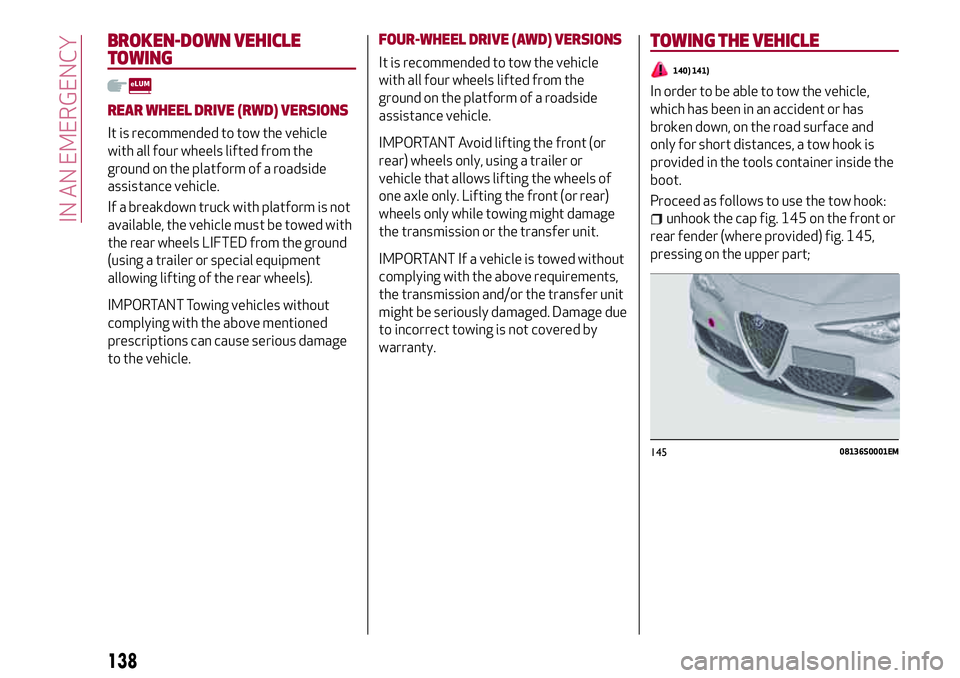
unhook the cap fig. 145 on the front or
rear fender (where provided) fig. 145,
pressing on the upper part;
14508136S0001EM
138
IN AN EMERGENCY