2015 VOLKSWAGEN POLO Pressure
[x] Cancel search: PressurePage 13 of 100
Downloaded from www.Manualslib.com manuals search engine 12/29/2015Bedienungsanleitung < Service & Zubehör < Volkswagen Deutschland
10/32
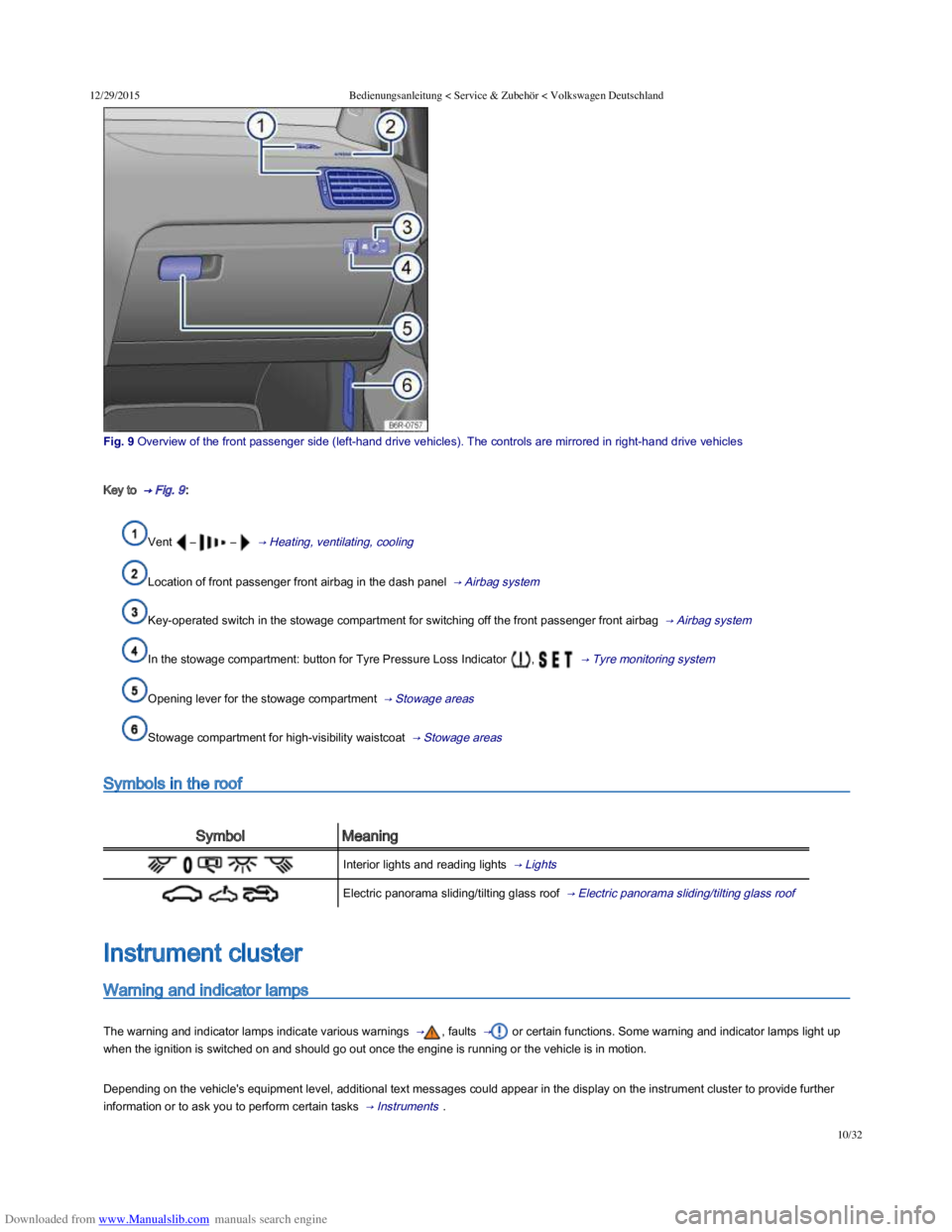
Fig. 9 Overview of the front passenger side (lefthand drive vehicles). The controls are mirrored in righthand drive vehicles
Key to → Fig. 9 :
Vent – – → Heating, ventilating, cooling
Location of front passenger front airbag in the dash panel → Airbag system
Key-operated switch in the stowage compartment for switching off the front passenger front airbag → Airbag system
In the stowage compartment: button for Tyre Pressure Loss Indicator , → Tyre monitoring system
Opening lever for the stowage compartment → Stowage areas
Stowage compartment for high-visibility waistcoat → Stowage areas
Symbols in the roof
SymbolMeaning
Interior lights and reading lights → Lights
Electric panorama sliding/tilting glass roof → Electric panorama sliding/tilting glass roof
Warning and indicator lamps
The warning and indicator lamps indicate various warnings → , faults → or certain functions. Some warning and indicator lamps light up
when the ignition is switched on and should go out once the engine is running or the vehicle is in motion.
Depending on the vehicle's equipment level, additional text messages could appear in the display on the instrument cluster to provide further
information or to ask you to perform certain tasks → Instruments .
Instrument cluster
Page 14 of 100
Downloaded from www.Manualslib.com manuals search engine 12/29/2015Bedienungsanleitung < Service & Zubehör < Volkswagen Deutschland
11/32
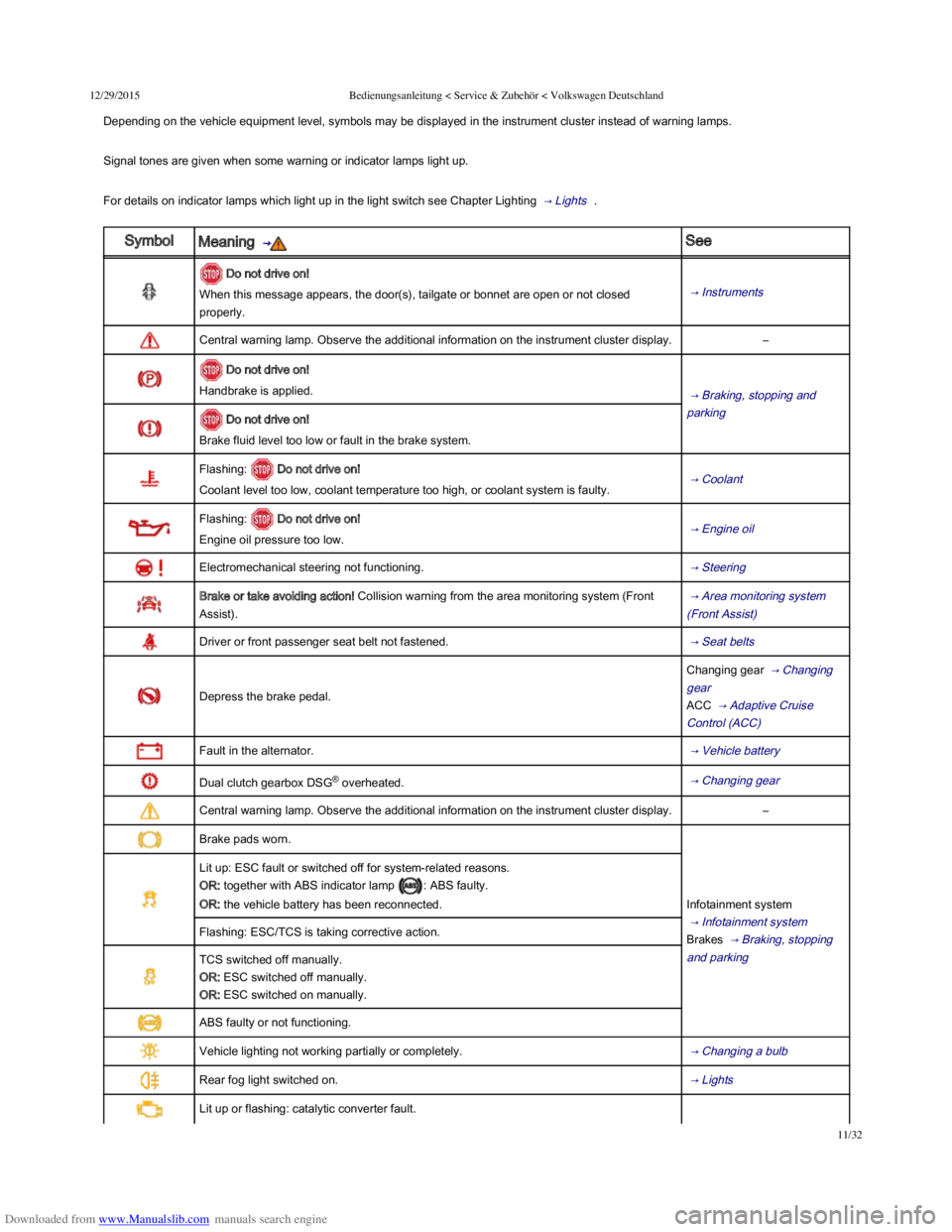
Depending on the vehicle equipment level, symbols may be displayed in the instrument cluster instead of warning lamps.
Signal tones are given when some warning or indicator lamps light up.
For details on indicator lamps which light up in the light switch see Chapter Lighting → Lights .
SymbolMeaning → See
Do not drive on!
When this message appears, the door(s), tailgate or bonnet are open or not closed
properly.
→ Instruments
Central warning lamp. Observe the additional information on the instrument cluster display.–
Do not drive on!
Handbrake is applied. → Braking, stopping and
parking Do not drive on!
Brake fluid level too low or fault in the brake system.
Flashing: Do not drive on!
Coolant level too low, coolant temperature too high, or coolant system is faulty. → Coolant
Flashing: Do not drive on!
Engine oil pressure too low. → Engine oil
Electromechanical steering not functioning. → Steering
Brake or take avoiding action! Collision warning from the area monitoring system (Front
Assist).
→ Area monitoring system
(Front Assist)
Driver or front passenger seat belt not fastened. → Seat belts
Depress the brake pedal.
Changing gear → Changing
gear
ACC → Adaptive Cruise
Control (ACC)
Fault in the alternator. → Vehicle battery
Dual clutch gearbox DSG® overheated. → Changing gear
Central warning lamp. Observe the additional information on the instrument cluster display.–
Brake pads worn.
Infotainment system
→ Infotainment system
Brakes → Braking, stopping
and parking
Lit up: ESC fault or switched off for system-related reasons.
OR: together with ABS indicator lamp : ABS faulty.
OR: the vehicle battery has been reconnected.
Flashing: ESC/TCS is taking corrective action.
TCS switched off manually.
OR: ESC switched off manually.
OR: ESC switched on manually.
ABS faulty or not functioning.
Vehicle lighting not working partially or completely. → Changing a bulb
Rear fog light switched on. → Lights
Lit up or flashing: catalytic converter fault.
Starting the engine → Starting
Page 15 of 100
Downloaded from www.Manualslib.com manuals search engine 12/29/2015Bedienungsanleitung < Service & Zubehör < Volkswagen Deutschland
12/32
Starting the engine → Starting
and stopping the engine
Engine management, exhaust
gas purification → Engine
management system and
exhaust purification system
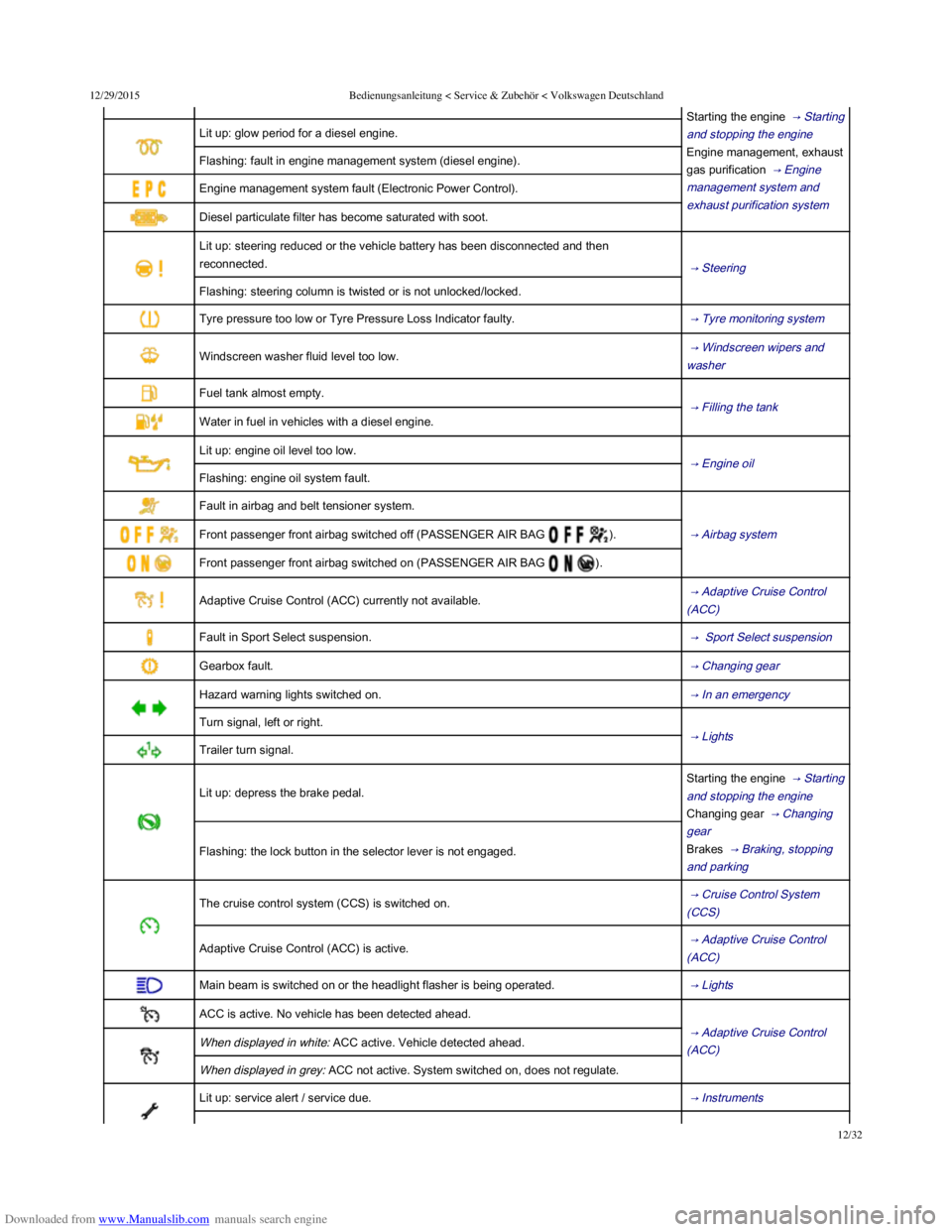
Lit up: glow period for a diesel engine.
Flashing: fault in engine management system (diesel engine).
Engine management system fault (Electronic Power Control).
Diesel particulate filter has become saturated with soot.
Lit up: steering reduced or the vehicle battery has been disconnected and then
reconnected. → Steering
Flashing: steering column is twisted or is not unlocked/locked.
Tyre pressure too low or Tyre Pressure Loss Indicator faulty. → Tyre monitoring system
Windscreen washer fluid level too low. → Windscreen wipers and
washer
Fuel tank almost empty.
→ Filling the tank
Water in fuel in vehicles with a diesel engine.
Lit up: engine oil level too low.
→ Engine oil
Flashing: engine oil system fault.
Fault in airbag and belt tensioner system.
→ Airbag system Front passenger front airbag switched off (PASSENGER AIR BAG ).
Front passenger front airbag switched on (PASSENGER AIR BAG ).
Adaptive Cruise Control (ACC) currently not available. → Adaptive Cruise Control
(ACC)
Fault in Sport Select suspension. → Sport Select suspension
Gearbox fault. → Changing gear
Hazard warning lights switched on. → In an emergency
Turn signal, left or right.
→ Lights
Trailer turn signal.
Lit up: depress the brake pedal.
Starting the engine → Starting
and stopping the engine
Changing gear → Changing
gear
Brakes → Braking, stopping
and parking
Flashing: the lock button in the selector lever is not engaged.
The cruise control system (CCS) is switched on. → Cruise Control System
(CCS)
Adaptive Cruise Control (ACC) is active. → Adaptive Cruise Control
(ACC)
Main beam is switched on or the headlight flasher is being operated. → Lights
ACC is active. No vehicle has been detected ahead.
→ Adaptive Cruise Control
(ACC) When displayed in white: ACC active. Vehicle detected ahead.
When displayed in grey: ACC not active. System switched on, does not regulate.
Lit up: service alert / service due. → Instruments
→ Changing gear
Page 31 of 100
Downloaded from www.Manualslib.com manuals search engine 12/29/2015Bedienungsanleitung < Service & Zubehör < Volkswagen Deutschland
28/32
After starting the engine with a discharged vehicle battery, or after the battery has been changed, system settings (time, date, personal
convenience settings and programming) may have been changed or deleted. Check and correct the settings as necessary once the vehicle
battery has been sufficiently charged.
Vehicle settings menu
First read and observe the introductory information and safety warnings →Introduction
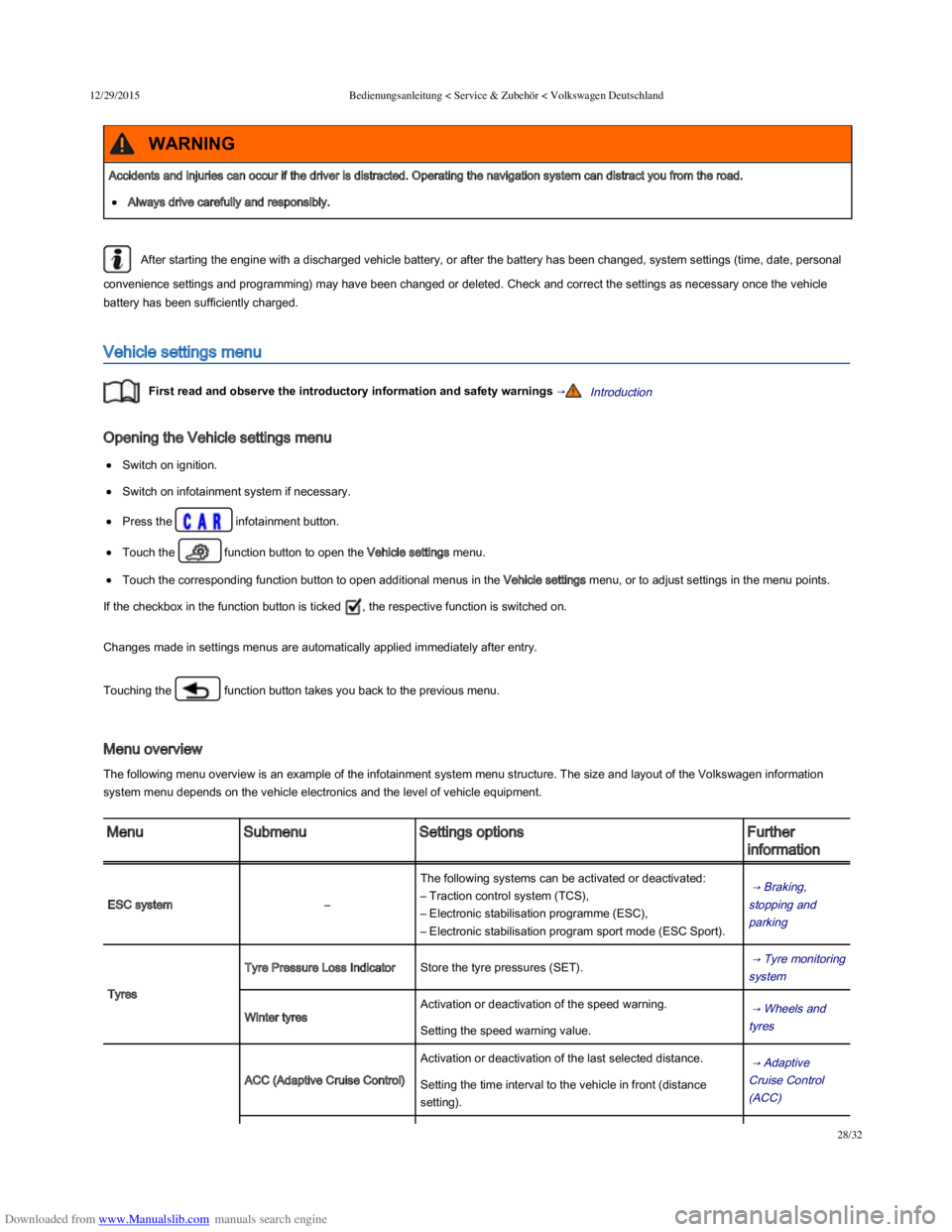
Opening the Vehicle settings menu
Switch on ignition.
Switch on infotainment system if necessary.
Press the infotainment button.
Touch the function button to open the Vehicle settings menu.
Touch the corresponding function button to open additional menus in the Vehicle settings menu, or to adjust settings in the menu points.
If the checkbox in the function button is ticked , the respective function is switched on.
Changes made in settings menus are automatically applied immediately after entry.
Touching the function button takes you back to the previous menu.
Menu overview
The following menu overview is an example of the infotainment system menu structure. The size and layout of the Volkswagen information
system menu depends on the vehicle electronics and the level of vehicle equipment.
MenuSubmenuSettings optionsFurther
information
ESC system–
The following systems can be activated or deactivated:
– Traction control system (TCS),
– Electronic stabilisation programme (ESC),
– Electronic stabilisation program sport mode (ESC Sport).
→ Braking,
stopping and
parking
Tyres
Tyre Pressure Loss IndicatorStore the tyre pressures (SET). → Tyre monitoring
system
Winter tyres
Activation or deactivation of the speed warning. → Wheels and
tyres Setting the speed warning value.
ACC (Adaptive Cruise Control)
Activation or deactivation of the last selected distance. → Adaptive
Cruise Control
(ACC)
Setting the time interval to the vehicle in front (distance
setting).
Accidents and injuries can occur if the driver is distracted. Operating the navigation system can distract you from the road.
Always drive carefully and responsibly.
WARNING
Page 33 of 100
Downloaded from www.Manualslib.com manuals search engine 12/29/2015Bedienungsanleitung < Service & Zubehör < Volkswagen Deutschland
30/32
Time and date–– Time format (12h, 24h),
– Set summer time automatically,
– Time zone,
– Date,
– Date format.
–
Units–
The following functions can be set:
– Distance,
– Speed,
– Temperature,
– Volumes,
– Consumption,
– Pressure.
–
Service–
The following data are displayed:
– Vehicle identification number,
– Date of next inspection,
– Date of next oil change service.
→ Instruments
Factory settings–
The following settings can be reset:
– All settings,
– Driver assistance,
– Parking/manoeuvring,
– Lights,
– Mirror and wipers,
– Opening/closing,
– Multifunction display.
–
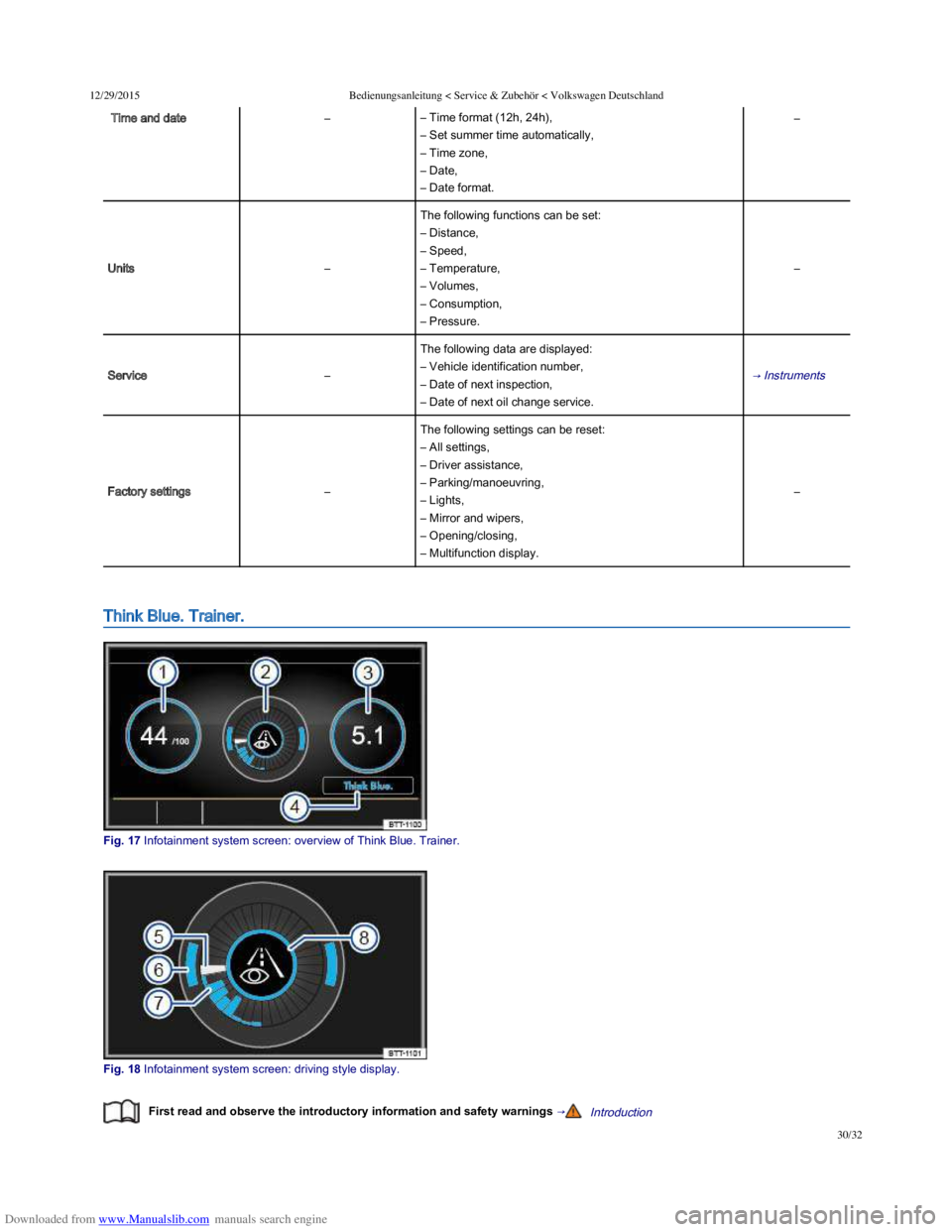
Think Blue. Trainer.
Fig. 17 Infotainment system screen: overview of Think Blue. Trainer.
Fig. 18 Infotainment system screen: driving style display.
First read and observe the introductory information and safety warnings →Introduction
Page 36 of 100
Downloaded from www.Manualslib.com manuals search engine 12/29/2015Bedienungsanleitung < Service & Zubehör < Volkswagen Deutschland
1/136
Check that all lights and turn signals are working properly.
Check the tyre pressure Wheels and tyres Wheels and tyres Tyres see Wheels and tyres_3 and fuel level Filling the tank Filling the tank
.
Make sure that you have a good, clear view through all of the windows.
Air intake to the engine must not be obstructed, and the engine must not be covered with any kind of insulating materials .
Secure any objects and luggage in the stowage compartments, the luggage compartment or on the roof Transporting items Transporting
items .
Introduction
This chapter contains information on the following subjects:
→ Preparing for a journey and driving safely
→ Driving abroad
→ Driving through water on roads
An engine and transmission guard may prove useful, depending on the conditions in which the vehicle is to be driven. An engine and
transmission guard can reduce the risk of damage to the vehicle's underbody and engine oil sump, for example when driving over kerbs,
driveways or unsurfaced roads. If you wish to have one fitted, Volkswagen recommends contacting your Volkswagen dealership.
Additional information and warnings:
Sitting correctly and safely → Sitting correctly and safely
Transporting → Transporting items
Starting the engine, changing gear and parking the vehicle → Starting the engine, changing gear and parking
Driving with respect for the environment → Driving with respect for the environment
Consumer information → Consumer information
Preparing for a journey and driving safely
First read and observe the introductory information and safety warnings →Introduction
Checklist
Observe the following information both before and during every journey to ensure your own safety, and the safety of all passengers and other
road users → :
Before the journey
Before setting off
Driving tips
Driving under the influence of alcohol, drugs, medication or narcotics can cause serious accidents and fatal injuries.
Alcohol, drugs, medication and narcotics can severely impair perception, reaction times and driving safety. This could cause you to lose
control of the vehicle.
WARNING
Page 79 of 100
Downloaded from www.Manualslib.com manuals search engine 12/29/2015Bedienungsanleitung < Service & Zubehör < Volkswagen Deutschland
44/136
The seat heating should be switched off as soon as it is no longer needed. Fuel is otherwise wasted.
Introduction
This chapter contains information on the following subjects:
→ Warning lamp
→ Frontal collisions and the laws of physics
→ What happens to vehicle occupants who have not fastened their seat belts
→ Seat belt protection
→ Using seat belts
→ Fastening and unfastening seat belts
→ Seat belt routing
→ Belt height adjuster
→ Automatic belt retractor, belt tensioner, belt tension limiter
→ Service and disposal of belt tensioners
Check the condition of all seat belts regularly. If the belt webbing, belt connections, belt retractor or seat belt buckle become damaged, the seat
belt in question should be replaced immediately by a qualified workshop → . The qualified workshop must use correct spare parts that are
compatible with the vehicle, equipment level and model year. Volkswagen recommends using a Volkswagen dealership for this purpose.
Additional information and warnings:
Adjusting the seat position → Adjusting the seat position
Airbag system → Airbag system
Child seats → Child seats
Stowage → Stowage areas
Cleaning and caring for the interior → Cleaning and caring for the interior
Accessories, modifications, repairs and renewal of parts → Accessories, modifications, repairs and renewal of parts
Wet upholstery can cause a fault in the seat heating and increase the risk of burns.
Make sure that the seat cushion is dry before using the seat heating.
Do not sit on the seat when wearing damp or wet clothing.
Do not set any damp or wet objects or items of clothing on the seat.
Do not spill any liquids on the seat.
WARNING
To avoid damaging the heating elements, do not kneel on the seat or apply sharp pressure at a single point on the seat cushion and
backrest.
Liquids, sharp objects and insulating materials such as a protective cover or child seat on the seat could damage the seat heating.
If the system starts to emit a smell, switch the seat heating off immediately and have it checked by a qualified workshop.
NOTICE
Seat belts
Page 87 of 100
Downloaded from www.Manualslib.com manuals search engine 12/29/2015Bedienungsanleitung < Service & Zubehör < Volkswagen Deutschland
52/136
risk of severe or fatal injuries. Correct seat belt routing also holds the vehicle occupants in position so that an inflating airbag can offer the
maximum level of protection. Therefore you must always fasten your seat belt and ensure that the seat belt routing is correct.
Assuming an incorrect sitting position can cause severe or fatal injuries → Adjusting the seat position .
Correct seat belt routing
The shoulder part of the seat belt must always lie on the centre of the shoulder, never across the neck, over or under the arm or behind the
back.
The lap part of the seat belt must always lie across the pelvis, never across the stomach.
The seat belt must always lie flat and snugly on the body. Tighten the belt if necessary.
For pregnant women the seat belt must be positioned evenly over the chest and as low as possible over the pelvis. It must lie flat so that no
pressure is exerted on the lower body – this applies in every stage of pregnancy → Fig. 57 .
Correct seat belt routing according to height
The following equipment can be used to adjust the seat belt routing:
Belt height adjuster for the front seats → Belt height adjuster .
Height-adjustable front seats → Adjusting the seat position .
If a person's physical build prevents them from routing the seat belt properly, contact a qualified workshop to find out about any special
modifications so that the seat belts and airbags can provide the optimum level of protection. Volkswagen recommends using a Volkswagen
dealership for this purpose.
Belt height adjuster
Incorrect seat belt routing can cause severe injuries in the event of an accident or a sudden braking or driving manoeuvre.
The seat belts only offer best protection when the backrests are in an upright position and the seat belts have been fastened properly.
The seat belt itself or a loose seat belt can cause serious injuries if the seat belt shifts from harder body parts in the direction of softer body
parts (e.g. stomach).
The shoulder part of the seat belt must lie on the centre of the shoulder and never under the arm or across the neck.
The seat belt must lie flat and snugly on the chest.
The lap part of the seat belt must lie across the pelvis and never across the stomach. The seat belt must lie flat and snugly on the pelvis.
Tighten the belt if necessary.
For pregnant women, the lap part of the seat belt must be as low as possible over the pelvis and lie flat around the bulge of the belly.
Do not twist the belt webbing while the seat belt is being worn.
Never hold the seat belt away from the body by hand.
The belt webbing should not lie over hard or fragile objects, such as glasses, pens or keys.
Never use seat belt clips, retaining rings or similar items to alter the seat belt routing.
WARNING