2015 SKODA FABIA lock
[x] Cancel search: lockPage 81 of 220
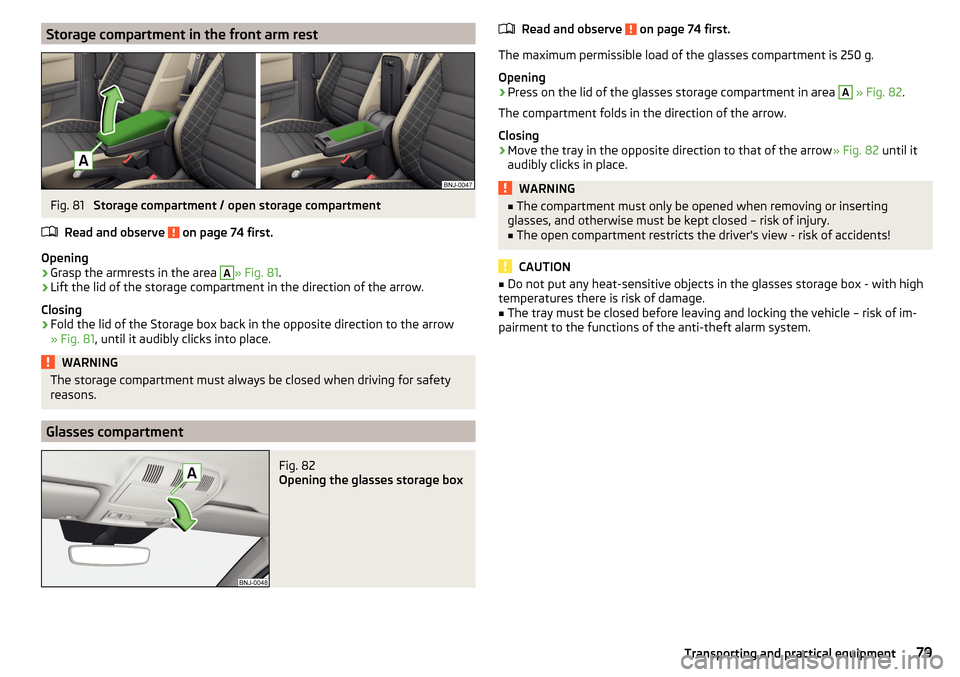
Storage compartment in the front arm restFig. 81
Storage compartment / open storage compartment
Read and observe
on page 74 first.
Opening
›
Grasp the armrests in the area
A
» Fig. 81 .
›
Lift the lid of the storage compartment in the direction of the arrow.
Closing
›
Fold the lid of the Storage box back in the opposite direction to the arrow
» Fig. 81 , until it audibly clicks into place.
WARNINGThe storage compartment must always be closed when driving for safety
reasons.
Glasses compartment
Fig. 82
Opening the glasses storage box
Read and observe on page 74 first.
The maximum permissible load of the glasses compartment is 250 g.
Opening
›
Press on the lid of the glasses storage compartment in area
A
» Fig. 82 .
The compartment folds in the direction of the arrow.
Closing
›
Move the tray in the opposite direction to that of the arrow » Fig. 82 until it
audibly clicks in place.
WARNING■ The compartment must only be opened when removing or inserting
glasses, and otherwise must be kept closed – risk of injury.■
The open compartment restricts the driver's view - risk of accidents!
CAUTION
■ Do not put any heat-sensitive objects in the glasses storage box - with high
temperatures there is risk of damage.■
The tray must be closed before leaving and locking the vehicle – risk of im-
pairment to the functions of the anti-theft alarm system.
79Transporting and practical equipment
Page 85 of 220

Fig. 91
Remove holder/remove Adapter
Read and observe
on page 82 first.
Fitting
›
Attach the opened adapter to the guide rods of the head restraint » Fig. 90.
›
Clip in the adapter in the direction of arrow
1
» .
›
Clip in the holder in the direction of arrow
2
into the adapter.
Removing
›
Pull on the locking strap
A
in the direction of arrow
3
» Fig. 91 .
›
Remove the holder from the bracket in the direction of arrow
4
.
›
Press the adapter and remove in the direction of the arrow
5
from the guide
rods of the headrest.
WARNINGCarefully clip in the adapter - it is a risk of injuring your finger.
Handle holder
Fig. 92
Tilt and rotate holder
Fig. 93
Adjust holder size
Read and observe on page 82 first.
Tilt and rotate holder
The holder may be tilted 30° in the direction of arrow
1
and rotated through
360° in the direction of arrow
2
» Fig. 92 .
Adjust holder size
›
Pull out the securing tab
A
in the direction of arrow
3
and move part
B
in
direction of arrow
4
to the desired position » Fig. 93.
Luggage compartment and transport of cargo
Introduction
This chapter contains information on the following subjects:
Fastening elements
84
Fixing nets
85
Multifunction pocket
85
Hooks
85
Storage compartments in the luggage compartment
86
Luggage compartment cover
86
Other positions of the luggage compartment cover
87
Roll-up cover
87
Storage compartments under the floor
88
Cargo element
88
Flexible storage compartment
88
Class N1 vehicles
89
83Transporting and practical equipment
Page 88 of 220

The maximum permissible load of the hook is 7.5 kg.
CAUTION
■Place the item of luggage suspended from a hook, if possible, in the storage
compartment B » Fig. 99 on page 86 , otherwise there is a risk of damaging
the storage compartment cover.■
If an item of luggage weighing more than 2.5 kg is suspended on the hook,
then we recommend removing the storage compartment cover
B
» Fig. 99 on
page 86 , otherwise there is a risk of damaging the storage compartment
cover.
Storage compartments in the luggage compartment
Fig. 99
Storage compartments
Read and observe and on page 84 first.
Storage compartments » Fig. 99
Fixed
With removable cover
Remove the cover
›
Remove the cover of the storage compartment
B
in the direction of the ar-
row » Fig. 99 .
The removable storage compartment
A
» Fig. 99 is suitable for stowing small
objects weighing up to 1.5 kg in total.
The storage compartment
B
is designed for storing small objects of up to 2.5
kg. in weight in total.
CAUTION
When handling the cover of the storage compartment B, ensure that this or
the luggage compartment trim is not damaged.ABLuggage compartment coverFig. 100
Remove the luggage compartment cover
Read and observe
and on page 84 first.
If the support straps
A
» Fig. 100 are attached to the boot lid, then opening
the lid will raise the boot lid cover (hereafter only referred to as "cover").
If you want to transport bulky goods, the cover can be removed and stowed in two positions » Fig. 101 on page 87 .
The maximum permissible load of the cover is 1 kg.
Removing
›
On both sides of the boot lid, unhook the straps
A
in direction of arrow
1
» Fig. 100 .
›
Hold the raised cover.
›
Press both sides onto the underside of the cover near the studs
C
.
›
Remove the cover in the direction of the arrow
2
.
Fitting
›
Position the mounts on the cover
B
onto the side trim panel via pins
C
» Fig. 100 .
›
Press both sides onto the upper side of the cover near the studs
C
.
The fixture
B
must lock into place on the studs
C
on both sides of the lug-
gage compartment.
›
On both sides of the boot lid, unhook the straps
A
.
WARNINGNo objects should be placed on the cover. This could endanger the vehicle
occupants during sudden braking or vehicle impact. 86Operation
Page 91 of 220

The storage compartment is designed for storing small objects with a maxi-
mum total weight of 8 kg.
Fitting›
Place both ends of the storage compartment into the openings on the right
side panel of the boot.
›
Push the storage compartment down to lock it.
Removing
›
Grasp the storage compartment on the two upper corners.
›
Remove the storage compartment by pulling upwards and then towards you.
Class N1 vehicles
Read and observe
and on page 84 first.
In class N1 vehicles that are not fitted with a protective grille, a lashing set that
complies with the EN 12195 standard (1-4) must be used for fastening the load.
Proper functioning of the electrical installation is essential for safe vehicle op-
eration. It is important to ensure that the electrical installation is not damaged
during the adjustment process or when the storage area is being loaded and
unloaded.
Variable loading floor in the luggage compartment
Introduction
This chapter contains information on the following subjects:
Setting in the upper position
89
Setting in the lower position
90
Removing/inserting
90
Folding / Securing
91
The maximum permissible load of the variable loading floor is 75 kg. For the
transport of heavy loads, adjust the variable loading floor to the lower position
or remove it from the vehicle.
Setting in the upper positionFig. 106
Set the variable loading floor to the upper position
The variable loading floor in the lower position can be set to the upper position
as follows.
›
Grasp the variable loading floor at handle
A
» Fig. 106 .
›
Lift the variable loading floor in the direction of arrow
1
and move partially
backwards in the direction of arrow
2
.
›
Lift the variable loading floor in the front area and place on edge
C
.
›
Insert the variable loading floor into slots
B
up to the stop in the direction of
arrow
3
.
›
Place the variable loading floor in the direction of arrow
4
.
Note
When in the upper position, there is space for storing items underneath the
variable loading floor.89Transporting and practical equipment
Page 93 of 220

Folding / SecuringFig. 109
Fold up variable loading floor / secure variable loading floor
For easier handling, e. g. with the spare tyre, the variable load floor can be fol-
ded up and fastened by means of a hook on the frame of the boot lid.
The variable loading floor can be folded up in both positions (both upper and
lower) and fastened.
›
Grasp the variable loading floor at handle
A
» Fig. 109 .
›
Place the variable loading floor in the direction of the arrow.
›
Hook the
B
hook to the frame of the boot lid.
WARNINGThe folded-up variable cargo floor limits the driver's view to the rear.
CAUTION
Before closing the tailgate, the variable loading floor is to be unhooked from
the frame and set in the upper or lower position - there is a risk of damage to
the hook.
Bicycle carrier in the luggage compartment
Introduction
This chapter contains information on the following subjects:
Install/remove crossmember
91
Fitting/removing the bike rack
92
Place bicycle into the carrier
93
Ensure the stability of the bicycles with a belt
93Up to two bicycles can be transported in a carrier in the luggage compartment.
Maximum size of the transported bikes: 19 "frame with 26" wheels.
Before transporting, the following steps must be taken.›
Remove the roll-up cover » page 87.
›
Push the head rests into the seat backrests until they click into position
» page 70 .
›
Fold the rear seat forward » page 72.
›
Fold the rear seat backrests forward » page 72.
WARNINGWhen transporting bicycles, ensuring the safety of the passengers is para-
mount.
CAUTION
■ Take care handling the bicycle - there is a risk of damaging the vehicle.■The bike rack cannot be installed if the variable cargo floor is stowed in the
luggage compartment.
Install/remove crossmember
Fig. 110
Install crossmember: Loosen the screws and unlock brackets /
place crossmember on the lashing eyelets
91Transporting and practical equipment
Page 94 of 220

Fig. 111
Install crossmember: Tighten the
screws
Read and observe and on page 91 first.
Installing/replacing
›
Unscrew screws
A
» Fig. 110 in direction of arrow
1
completely and partially
pull out.
The brackets
B
are unlocked.
›
Set the crossbar so that the screws
A
are pointing forward.
›
Place the crossmember with the fixed part
C
onto the left lashing eyelet in
the direction of arrow
2
.
›
Pull out part
D
of the cross member and place onto the right lashing eyelet
in arrow direction
3
.
›
Push in the brackets
B
» Fig. 111 in the direction of arrow
4
until they audi-
bly click into place.
›
Turn the screws
A
in the direction of arrow
5
up to the stop .
›
Check how well the crossmember is fastened by pulling on it.
Removal is carried out in the reverse order.
Fitting/removing the bike rackFig. 112
Fitting the bike rack
Read and observe
and on page 91 first.
Installing/replacing
›
Loosen screw
A
on the bicycle rack (hereinafter only referred to as "carrier")
in direction of arrow
1
» Fig. 112 .
›
Place the carrier of the crossmember in the direction of arrow
2
.
›
Hold part
B
of the carrier firmly and press on part
C
of the support in the
direction of arrow
3
.
›
Remove screw
A
in the direction of arrow
4
.
›
Screw out screw
D
in the direction of arrow
5
and remove.
›
Place part
E
in the direction of arrow
6
, depending on bike size, in one of
the possible positions » .
›
Insert screw
D
and tighten in the direction of arrow
7
.
Removal is carried out in the reverse order.
CAUTION
The bike stowed in the rack must not touch either the boot lid or other vehicle
parts - there is a risk of damage to the vehicle occurring.92Operation
Page 101 of 220
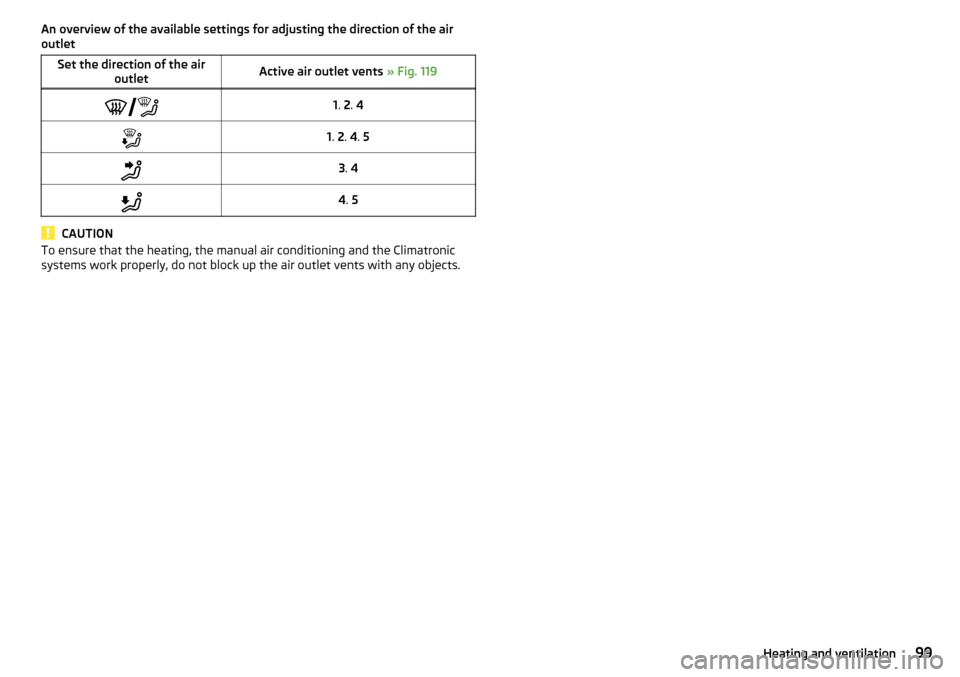
An overview of the available settings for adjusting the direction of the air
outletSet the direction of the air outletActive air outlet vents » Fig. 1191. 2 . 41. 2 . 4 . 53 . 44 . 5
CAUTION
To ensure that the heating, the manual air conditioning and the Climatronic
systems work properly, do not block up the air outlet vents with any objects.99Heating and ventilation
Page 102 of 220

Driving
Starting-off and driving
Starting and stopping the engine using the key
Introduction
This chapter contains information on the following subjects:
Electronic immobilizer
100
Steering lock locking / unlocking
100
Turn ignition on / off and start the engine
101
Stopping the engine
101
With the key in the ignition, the ignition can be switched on and off and the
engine can be started / stopped.
WARNING■ While driving with the engine stopped, the ignition must always be
switched on » page 101, Turn ignition on / off and start the engine .
■ With the ignition off, the steering may lock » page 100 - danger of an
accident!■
Do not withdraw the ignition key from the ignition lock until the vehicle
has come to a stop » page 108, Parking . Otherwise, the steering may lock -
danger of an accident!
■
Never leave the key in the vehicle when you exit the vehicle. Unauthor-
ized persons such as children could lock the car, turn on the ignition or start
the engine -risk of injury, accidents and damage!
■
Never leave the vehicle unattended with the engine running - risk of acci-
dent, damage or theft!
■
Never switch off the engine before the vehicle has come to a halt – risk of
accident.
WARNING■ Never (e.g. in garages) run the engine in a closed place - risk of poisoning
and death!■
Do not leave any items (e.g. cleaning cloths or tools) in the engine com-
partment. There is a fire hazard and the risk of engine damage.
■
Never cover the engine with additional insulation material (e.g. with a
blanket) – risk of fire.
CAUTION■ Only start the engine when the engine and the vehicle are stationary - risk of
starter and engine damage!■
Do not push-start the engine – there is a risk of damaging the engine and
the catalytic converter. The battery from another vehicle can be used as a
jump-start aid » page 174.
Note
Do not warm up the engine while the vehicle is stationary. If possible, start
your journey as soon as the engine has started. The engine reaches its operat-
ing temperature faster this way.
Electronic immobilizer
Read and observe
and on page 100 first.
The electronic immobiliser (hereinafter referred to as "immobiliser") makes apossible attempted theft or unauthorized use of your vehicle more difficult.
An electronic chip is integrated in the head of the key. The immobiliser is deac-
tivated with the aid of this chip when the key is inserted in the ignition lock.
As soon as the ignition key is removed from the ignition lock the immobiliser is
automatically activated.
Operational problems
If a component in the immobiliser key fails, it is not possible to start the en-
gine. A corresponding message appears in the display of the instrument clus-
ter to explain the immobiliser is active.
To start, use the other vehicle key or seek help from a specialist garage.
Steering lock locking / unlocking
Read and observe
and on page 100 first.
The steering lock (steering lock) deters any attempted theft of your vehicle.
Locking
›
Withdraw the ignition key.
›
Turn the steering wheel to the left or right until the steering lock clicks into
place.
Unlocking
›
Insert the key into the ignition lock.
100Driving