Page 258 of 348
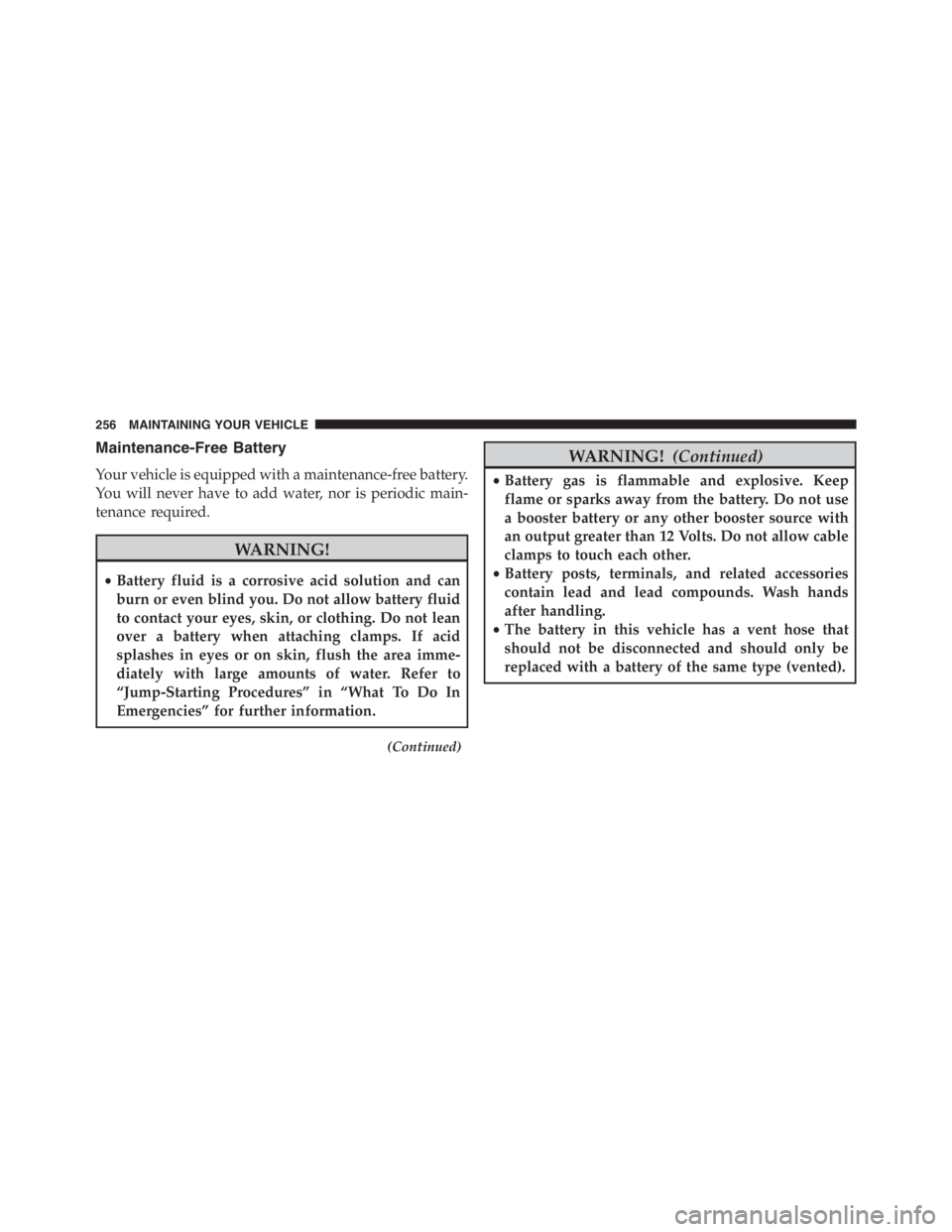
Maintenance-Free Battery
Your vehicle is equipped with a maintenance-free battery.
You will never have to add water, nor is periodic main-
tenance required.
WARNING!
•Battery fluid is a corrosive acid solution and can
burn or even blind you. Do not allow battery fluid
to contact your eyes, skin, or clothing. Do not lean
over a battery when attaching clamps. If acid
splashes in eyes or on skin, flush the area imme-
diately with large amounts of water. Refer to
“Jump-Starting Procedures” in “What To Do In
Emergencies” for further information.
(Continued)
WARNING!(Continued)
•Battery gas is flammable and explosive. Keep
flame or sparks away from the battery. Do not use
a booster battery or any other booster source with
an output greater than 12 Volts. Do not allow cable
clamps to touch each other.
•Battery posts, terminals, and related accessories
contain lead and lead compounds. Wash hands
after handling.
•The battery in this vehicle has a vent hose that
should not be disconnected and should only be
replaced with a battery of the same type (vented).
256 MAINTAINING YOUR VEHICLE
Page 259 of 348
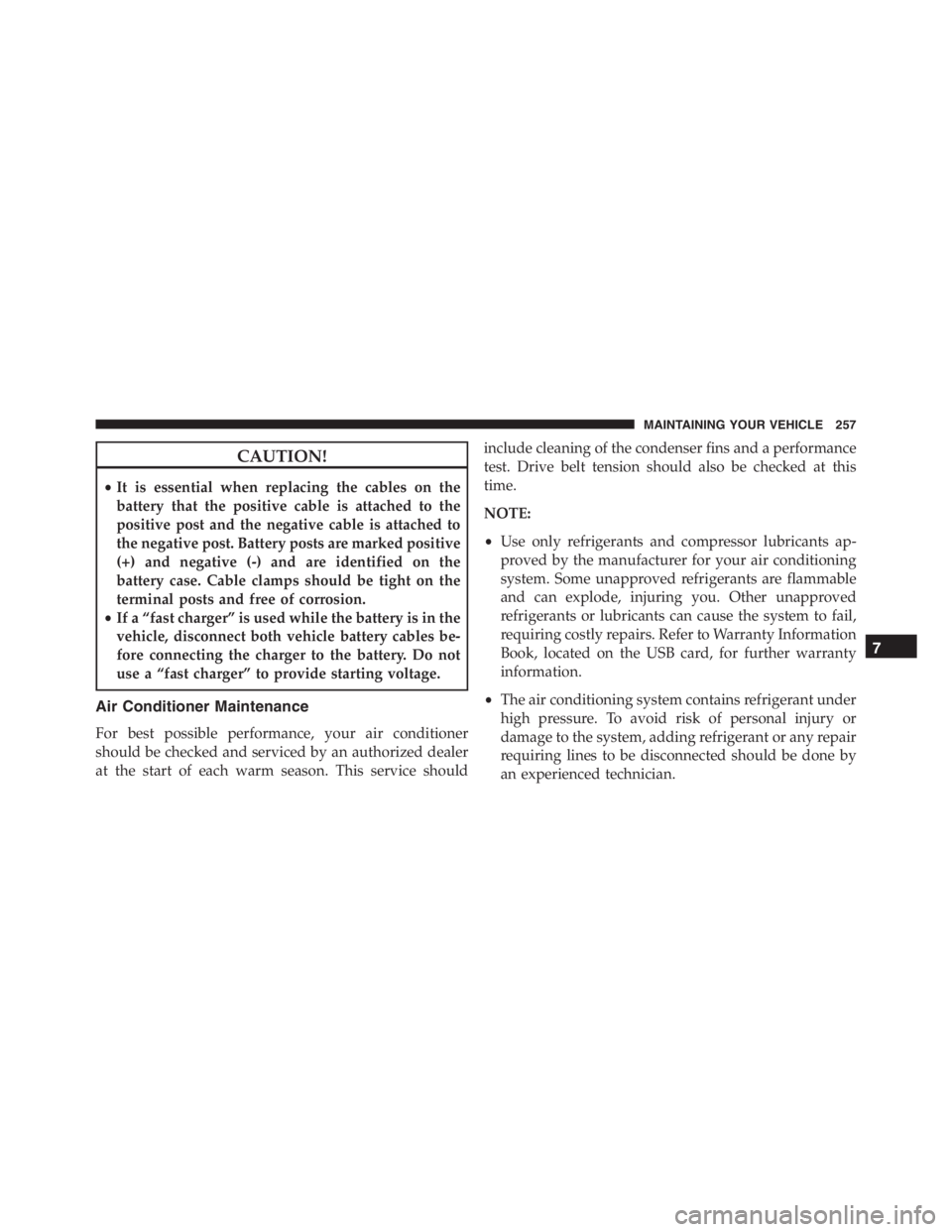
CAUTION!
•It is essential when replacing the cables on the
battery that the positive cable is attached to the
positive post and the negative cable is attached to
the negative post. Battery posts are marked positive
(+) and negative (-) and are identified on the
battery case. Cable clamps should be tight on the
terminal posts and free of corrosion.
•If a “fast charger” is used while the battery is in the
vehicle, disconnect both vehicle battery cables be-
fore connecting the charger to the battery. Do not
use a “fast charger” to provide starting voltage.
Air Conditioner Maintenance
For best possible performance, your air conditioner
should be checked and serviced by an authorized dealer
at the start of each warm season. This service shouldinclude cleaning of the condenser fins and a performance
test. Drive belt tension should also be checked at this
time.
NOTE:
•Use only refrigerants and compressor lubricants ap-
proved by the manufacturer for your air conditioning
system. Some unapproved refrigerants are flammable
and can explode, injuring you. Other unapproved
refrigerants or lubricants can cause the system to fail,
requiring costly repairs. Refer to Warranty Information
Book, located on the USB card, for further warranty
information.
•The air conditioning system contains refrigerant under
high pressure. To avoid risk of personal injury or
damage to the system, adding refrigerant or any repair
requiring lines to be disconnected should be done by
an experienced technician.
7
MAINTAINING YOUR VEHICLE 257
Page 290 of 348
Engine Compartment Fuses
The engine compartment fuse box is located on the left
side of the engine compartment, next to the battery. To
access the fuses, remove screws and then remove the
cover.
The ID number of the electrical component correspond-
ing to each fuse can be found on the back of the cover.
Engine Compartment Fuse Box
1 — Forward Screw
2 — Fuse Box Cover
3 — Rearward Screw 288 MAINTAINING YOUR VEHICLE
Page 294 of 348
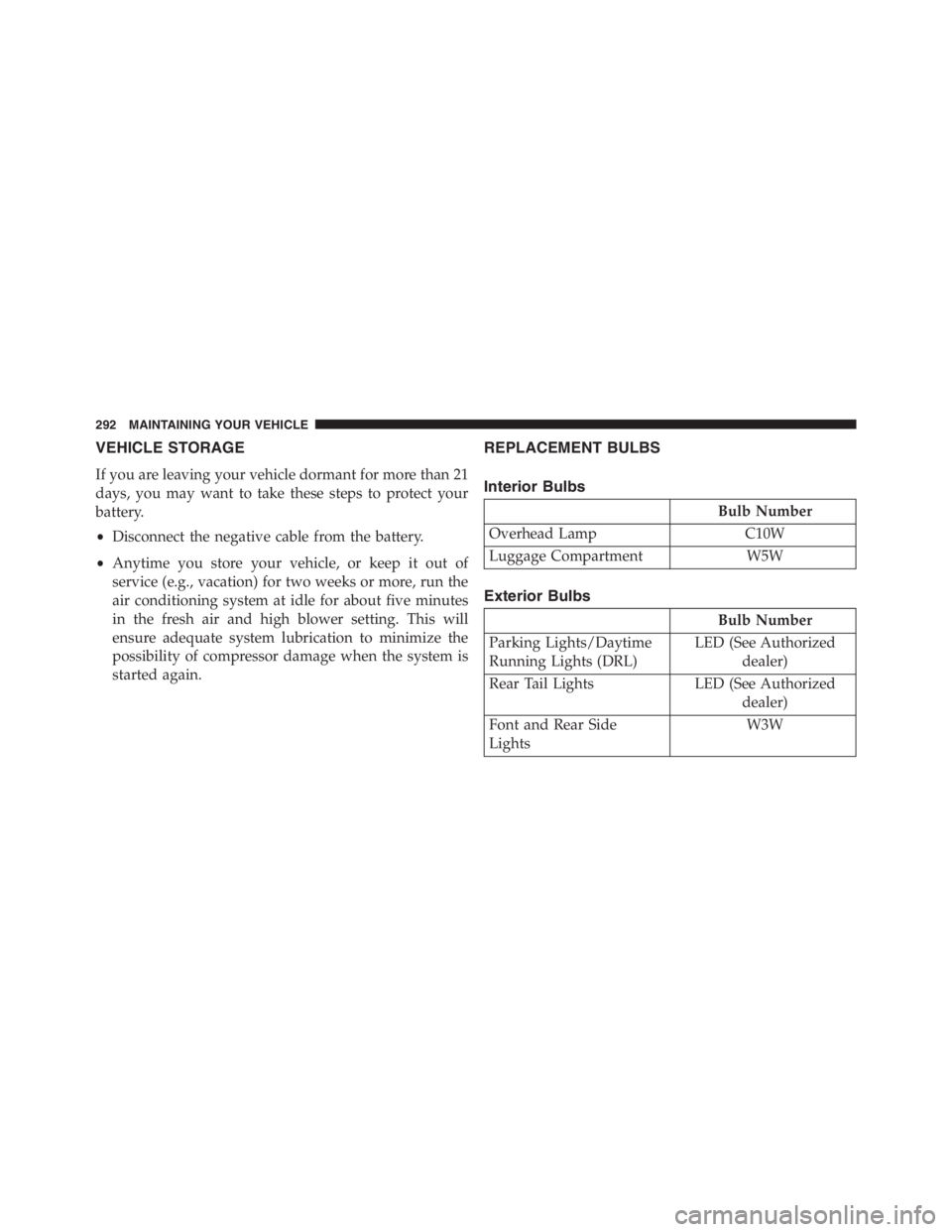
VEHICLE STORAGE
If you are leaving your vehicle dormant for more than 21
days, you may want to take these steps to protect your
battery.
•Disconnect the negative cable from the battery.
•Anytime you store your vehicle, or keep it out of
service (e.g., vacation) for two weeks or more, run the
air conditioning system at idle for about five minutes
in the fresh air and high blower setting. This will
ensure adequate system lubrication to minimize the
possibility of compressor damage when the system is
started again.
REPLACEMENT BULBS
Interior Bulbs
Bulb Number
Overhead Lamp C10W
Luggage Compartment W5W
Exterior Bulbs
Bulb Number
Parking Lights/Daytime
Running Lights (DRL)LED (See Authorized
dealer)
Rear Tail Lights LED (See Authorized
dealer)
Font and Rear Side
LightsW3W
292 MAINTAINING YOUR VEHICLE
Page 315 of 348

•Short, repeated trips (less than 4-5 miles or 7-8 km) at
sub-zero temperatures
•Allowing the engine to idle for extended periods of
time
•Driving for long distances at low speeds
•Allowing the vehicle to sit for long periods of inactiv-
ity
Under any of the above circumstances, the following
checks need to be performed more frequently than indi-
cated in the Maintenance Schedule:
•Check front and rear disc brake pad condition and
wear
•Check cleanliness of tailgate locks.
•Check cleanliness and lubrication of chassis and steer-
ing linkage•Visually inspect condition of: engine, gearbox, trans-
mission, pipes and hoses (exhaust - fuel system -
brakes) and rubber elements (gaiters - sleeves - bushes
- etc.)
•Check battery charge and battery fluid level (electro-
lyte)
•Visually inspect condition of the auxiliary drive belts
•Check and, if necessary, change engine oil and replace
oil filter
•Check and, if necessary, replace air cleaner
Using the car on track should be regarded as an excep-
tion. The car has been designed and produced for road
use.
8
MAINTENANCE SCHEDULES 313
Page 317 of 348
Required Maintenance Intervals
Refer to the maintenance schedules on the following
page for the required maintenance intervals.
At Every Oil Change Interval As Indicated By Oil
Change Indicator System:
Change oil and filter.
Inspect battery and clean and tighten terminals as
required.
Inspect brake pads, shoes, rotors, drums, and hoses.
Inspect engine cooling system protection and hoses.
Check and adjust hand brake.
Inspect exhaust system.
Inspect engine air cleaner if using in dusty or off-road
conditions.
8
MAINTENANCE SCHEDULES 315
Page 318 of 348
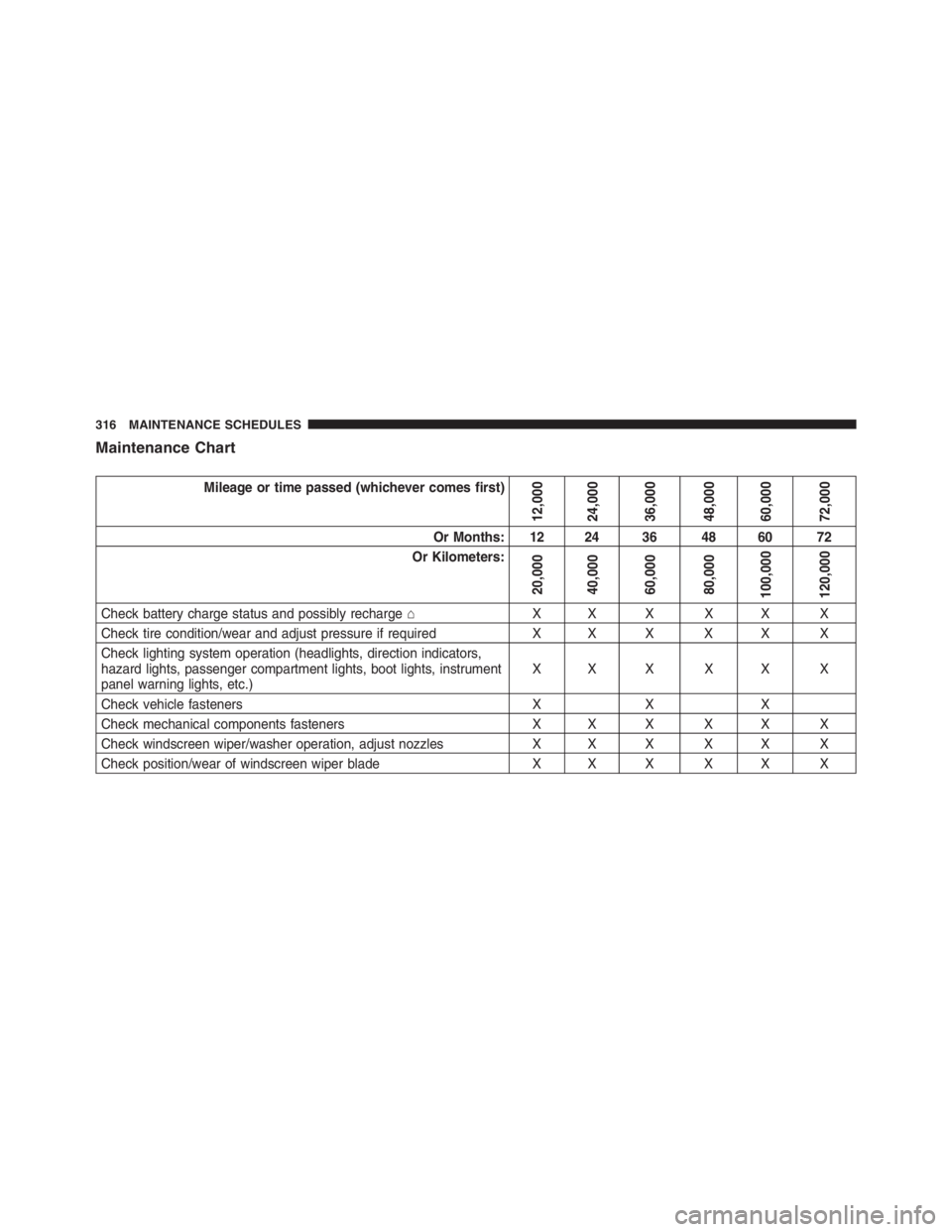
Maintenance Chart
Mileage or time passed (whichever comes first)
12,000
24,000
36,000
48,000
60,000
72,000
Or Months: 12 24 36 48 60 72
Or Kilometers:
20,000
40,000
60,000
80,000
100,000
120,000
Check battery charge status and possibly recharge⌂XX X X X X
Check tire condition/wear and adjust pressure if required X X X X X X
Check lighting system operation (headlights, direction indicators,
hazard lights, passenger compartment lights, boot lights, instrument
panel warning lights, etc.)XX X X X X
Check vehicle fasteners X X X
Check mechanical components fasteners X X X X X X
Check windscreen wiper/washer operation, adjust nozzles X X X X X X
Check position/wear of windscreen wiper blade X X X X X X
316 MAINTENANCE SCHEDULES
Page 319 of 348
Mileage or time passed (whichever comes first)
12,000
24,000
36,000
48,000
60,000
72,000
Or Months: 12 24 36 48 60 72
Or Kilometers:
20,000
40,000
60,000
80,000
100,000
120,000
Check cleanliness of hood and deck lid locks, as well as cleanli-
ness and lubrication of associated linkagesXX X X X X
Visually inspect condition of: exterior bodywork, carbon monocoque,
aerodynamic bottom, pipes and hoses (exhaust, fuel supply system,
brakes), rubber elements (boots, driveshaft boots, sleeves, bushes,
etc.)XX X X X X
Check condition and wear of front brake pads and discs, and op-
eration of pad wear indicatorXX X X X X
Check condition and wear of rear brake pads and discs, and opera-
tion of pad wear indicatorXX X X X X
Check and top off, if required, fluid levels (engine coolant, brake/
hydraulic clutch fluid, windscreen washer fluid, battery fluid, etc)XX X X X X
Visually inspect the condition of accessory drive belt(s) X
8
MAINTENANCE SCHEDULES 317