Page 236 of 348
WARNING!
Store the sealant canister in its special compartment,
away from sources of heat.
JUMP-STARTING
If your vehicle has a discharged battery it can be jump-
started using a set of jumper cables and a battery in
another vehicle or by using a portable battery booster
pack. Jump-starting can be dangerous if done improperly
so please follow the procedures in this section carefully.
NOTE:When using a portable battery booster pack
follow the manufacturer’s operating instructions and
precautions.
CAUTION!
Do not use a portable battery booster pack or any
other booster source with a system voltage greater
than 12 Volts or damage to the battery, starter motor,
alternator or electrical system may occur.
WARNING!
Do not attempt jump-starting if the battery is frozen.
It could rupture or explode and cause personal injury.
Preparations For Jump-Start
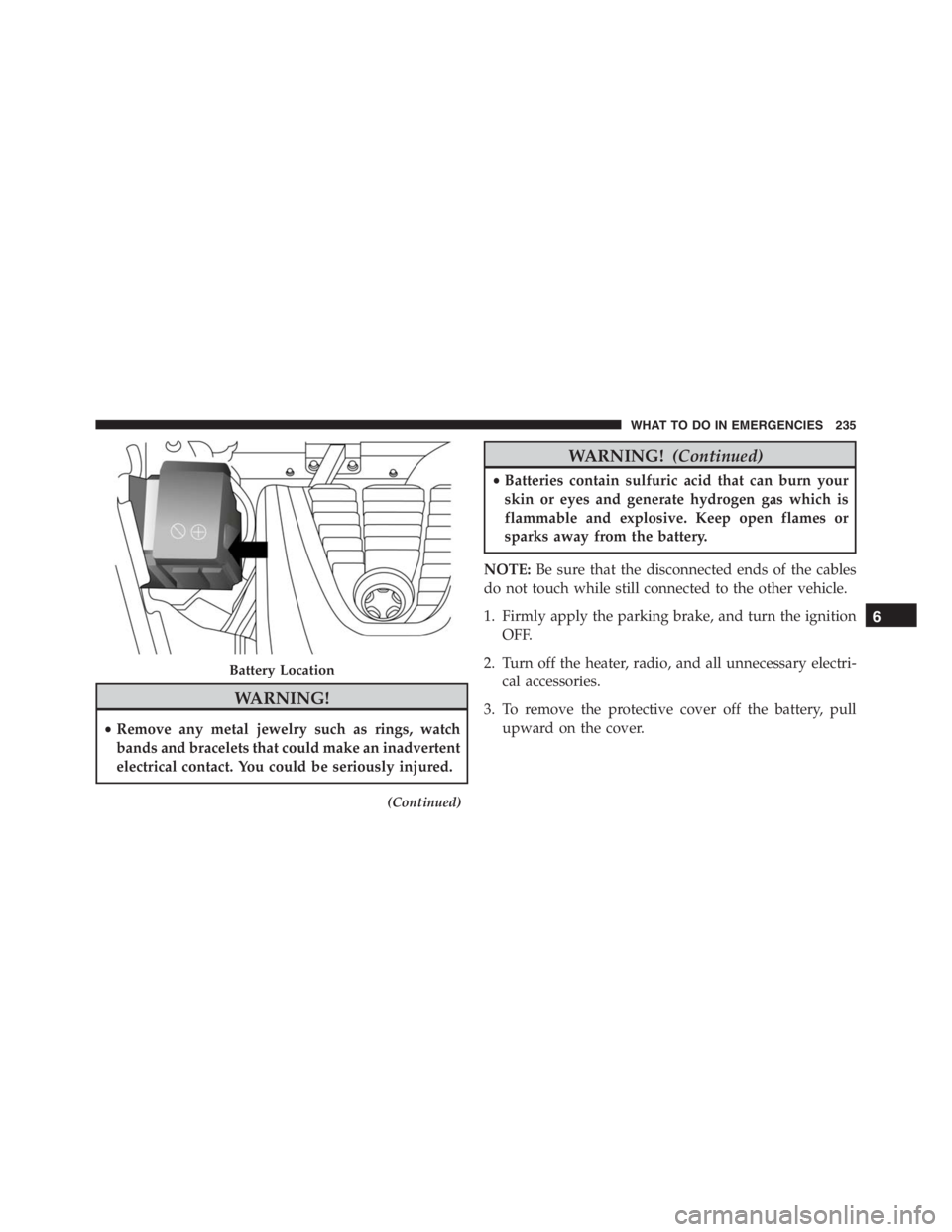
The battery in your vehicle is located on the left side of
the engine compartment. To access the battery remove
the protective cover.
234 WHAT TO DO IN EMERGENCIES
Page 237 of 348
WARNING!
•Remove any metal jewelry such as rings, watch
bands and bracelets that could make an inadvertent
electrical contact. You could be seriously injured.
(Continued)
WARNING!(Continued)
•Batteries contain sulfuric acid that can burn your
skin or eyes and generate hydrogen gas which is
flammable and explosive. Keep open flames or
sparks away from the battery.
NOTE:Be sure that the disconnected ends of the cables
do not touch while still connected to the other vehicle.
1. Firmly apply the parking brake, and turn the ignition
OFF.
2. Turn off the heater, radio, and all unnecessary electri-
cal accessories.
3. To remove the protective cover off the battery, pull
upward on the cover.
Battery Location
6
WHAT TO DO IN EMERGENCIES 235
Page 238 of 348
4. If using another vehicle to jump-start the battery, park
the vehicle within the jumper cables reach, set the
parking brake and make sure the ignition is OFF.
WARNING!
Do not allow vehicles to touch each other as this
could establish a ground connection and personal
injury could result.
Jump-Starting Procedure
WARNING!
Failure to follow this jump-starting procedure could
result in personal injury or property damage due to
battery explosion.
CAUTION!
Failure to follow these procedures could result in
damage to the charging system of the booster vehicle
or the discharged vehicle.
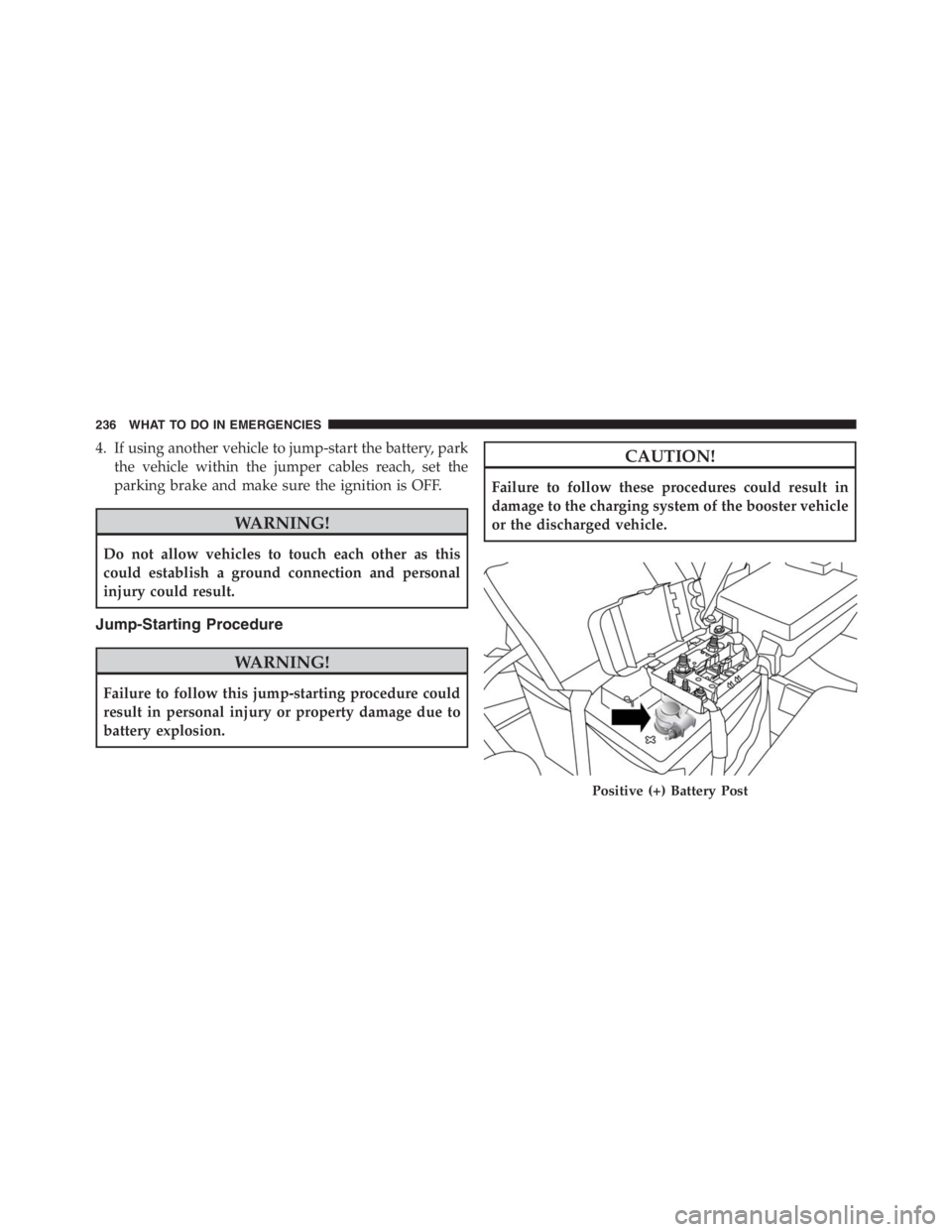
Positive (+) Battery Post
236 WHAT TO DO IN EMERGENCIES
Page 239 of 348
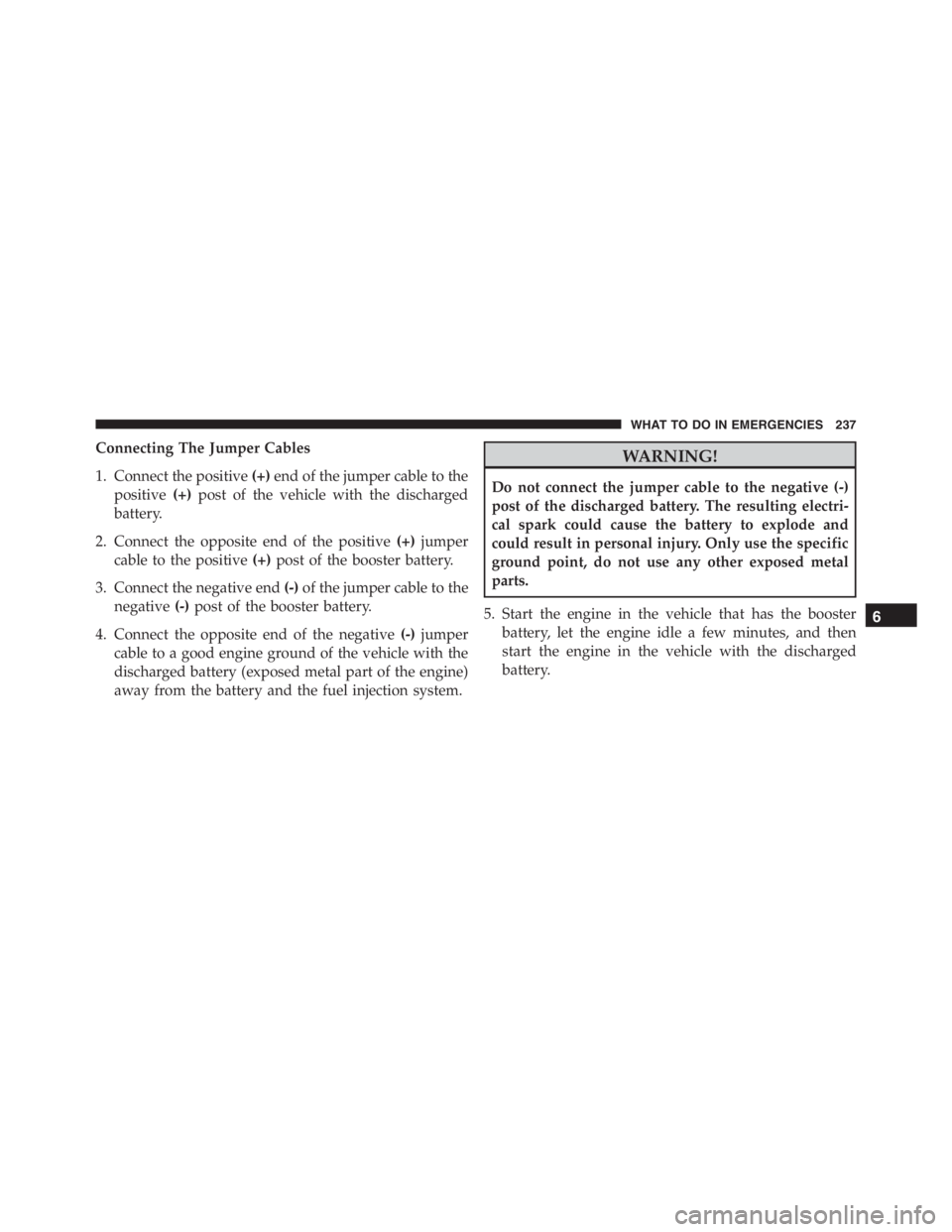
Connecting The Jumper Cables
1. Connect the positive(+)end of the jumper cable to the
positive(+)post of the vehicle with the discharged
battery.
2. Connect the opposite end of the positive(+)jumper
cable to the positive(+)post of the booster battery.
3. Connect the negative end(-)of the jumper cable to the
negative(-)post of the booster battery.
4. Connect the opposite end of the negative(-)jumper
cable to a good engine ground of the vehicle with the
discharged battery (exposed metal part of the engine)
away from the battery and the fuel injection system.WARNING!
Do not connect the jumper cable to the negative (-)
post of the discharged battery. The resulting electri-
cal spark could cause the battery to explode and
could result in personal injury. Only use the specific
ground point, do not use any other exposed metal
parts.
5. Start the engine in the vehicle that has the booster
battery, let the engine idle a few minutes, and then
start the engine in the vehicle with the discharged
battery.
6
WHAT TO DO IN EMERGENCIES 237
Page 240 of 348
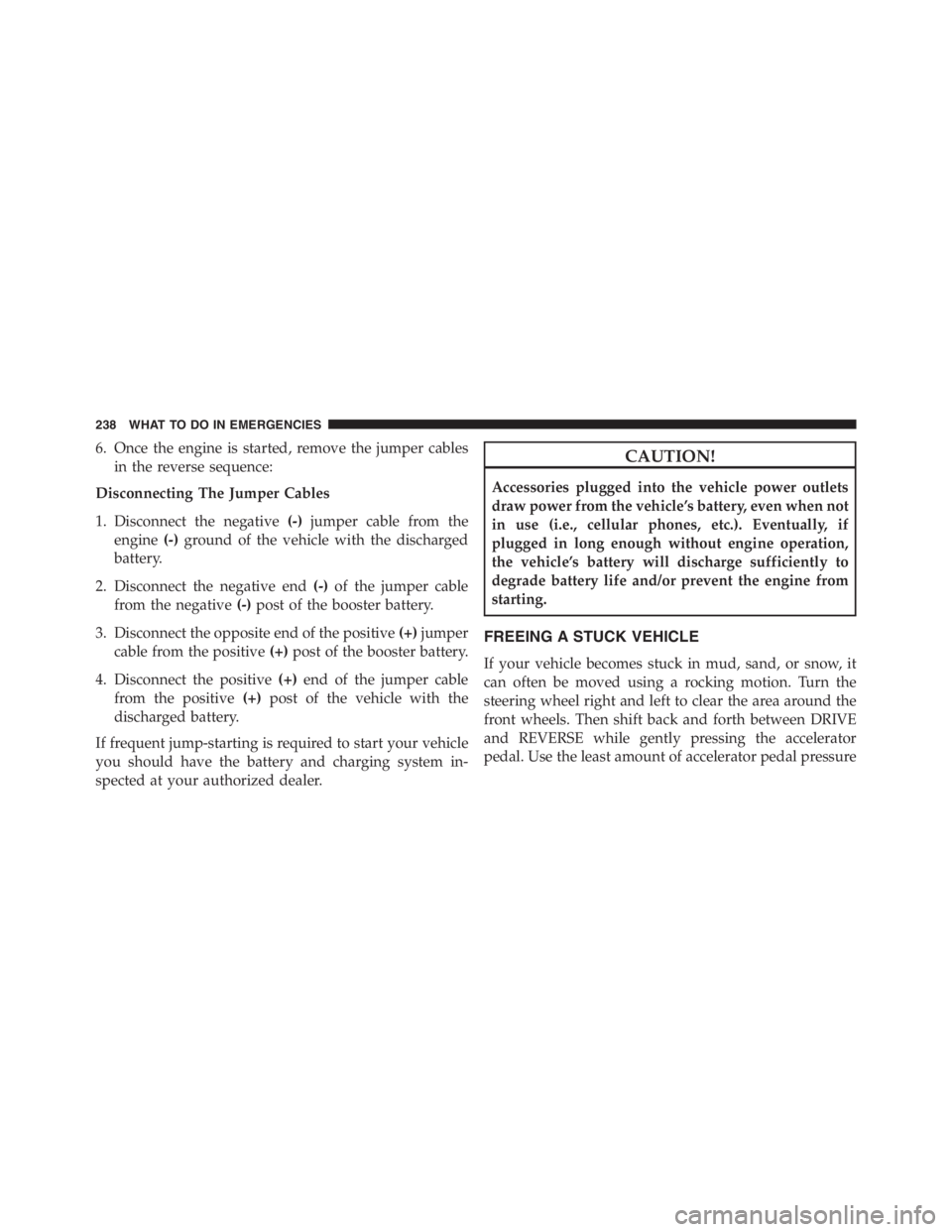
6. Once the engine is started, remove the jumper cables
in the reverse sequence:
Disconnecting The Jumper Cables
1. Disconnect the negative(-)jumper cable from the
engine(-)ground of the vehicle with the discharged
battery.
2. Disconnect the negative end(-)of the jumper cable
from the negative(-)post of the booster battery.
3. Disconnect the opposite end of the positive(+)jumper
cable from the positive(+)post of the booster battery.
4. Disconnect the positive(+)end of the jumper cable
from the positive(+)post of the vehicle with the
discharged battery.
If frequent jump-starting is required to start your vehicle
you should have the battery and charging system in-
spected at your authorized dealer.CAUTION!
Accessories plugged into the vehicle power outlets
draw power from the vehicle’s battery, even when not
in use (i.e., cellular phones, etc.). Eventually, if
plugged in long enough without engine operation,
the vehicle’s battery will discharge sufficiently to
degrade battery life and/or prevent the engine from
starting.
FREEING A STUCK VEHICLE
If your vehicle becomes stuck in mud, sand, or snow, it
can often be moved using a rocking motion. Turn the
steering wheel right and left to clear the area around the
front wheels. Then shift back and forth between DRIVE
and REVERSE while gently pressing the accelerator
pedal. Use the least amount of accelerator pedal pressure
238 WHAT TO DO IN EMERGENCIES
Page 242 of 348

WARNING!
Fast spinning tires can be dangerous. Forces gener-
ated by excessive wheel speeds may cause damage, or
even failure, of the axle and tires. A tire could
explode and injure someone. Do not spin your vehi-
cle’s wheels faster than 30 mph (48 km/h) or for
longer than 30 seconds continuously without stop-
ping when you are stuck and do not let anyone near
a spinning wheel, no matter what the speed.
ENHANCED ACCIDENT RESPONSE SYSTEM
In the event of an impact, if the communication network
remains intact, and the power remains intact, depending
on the nature of the event the ORC will determine
whether to have the Enhanced Accident Response Sys-
tem perform the following functions:
•Cut off fuel to the engine.•Flash hazard lights as long as the battery has power or
until the ignition key is turned off.
•Turn on the interior lights, which remain on as long as
the battery has power or until the ignition key is
removed.
•Unlock the doors automatically.
After the event occurs, when the system is active, in
addition to the message Fuel Cutoff See Handbook, a
specific soft telltale is displayed.
Carefully check the vehicle for fuel leaks in the engine
compartment and on the ground near the engine com-
partment and fuel tank before resetting the system and
starting the engine.
System Reset Procedure
Depending on the nature of the event the left and right
turn signal lights, located in the instrument panel cluster,
240 WHAT TO DO IN EMERGENCIES
Page 249 of 348
MAINTAINING YOUR VEHICLE
CONTENTS
�ENGINE COMPARTMENT — 1.750 TURBO . . .249
�ONBOARD DIAGNOSTIC SYSTEM — OBD II . .250
�REPLACEMENT PARTS..................250
�DEALER SERVICE......................251
�MAINTENANCE PROCEDURES...........251
▫Engine Oil..........................252
▫Engine Oil Filter......................254
▫Engine Air Cleaner Filter................254
▫Engine Cover........................255
▫Maintenance-Free Battery...............256▫Air Conditioner Maintenance.............257
▫Body Lubrication.....................258
▫Wiper Blades........................259
▫Windshield Washer Nozzles..............261
▫Adding Washer Solvent.................262
▫Exhaust System......................265
▫Cooling System......................268
▫Brake System........................274
▫Alfa Twin Clutch Transmission...........278
7
Page 251 of 348
ENGINE COMPARTMENT — 1.750 TURBO
1 — Fuse Box 3 — Engine Oil Dip Stick 5 — Coolant Reservoir
2 — Battery 4 — Engine Oil Fill
7
MAINTAINING YOUR VEHICLE 249