2015 NISSAN TITAN four wheel drive
[x] Cancel search: four wheel drivePage 390 of 457
If you have a flat tire, refer to “Flat tire” in
the “In case of emergency” section of this
manual for additional information.
TIRE PRESSURE
Tire Pressure Monitoring System
(TPMS)
This vehicle is equipped with the Tire
Pressure Monitoring System (TPMS) . It
monitors tire pressure of all four tires ex-
cept the spare. When the low tire pres-
sure warning light is lit and the CHECK
TIRE PRESSURE warning appears in the
vehicle information display, one or more of
your tires is significantly under-inflated. If
equipped, the system also displays pres-
sure of all tires (except the spare tire) on
the display screen by sending a signal
from a sensor that is installed in each
wheel.
The TPMS will activate only when the
vehicle is driven at speeds above 16 MPH
(25 km/h). Also, this system may not de-
tect a sudden drop in tire pressure (for
example a flat tire while driving) .For additional information, refer to
“Warning/Indicator Lights and Audible
Reminders” in the “Instruments and con-
trols” section, “Tire Pressure Monitoring
System (TPMS)” in the “Starting and driv-
ing” section, and “Flat tire” in the “In case
of emergency” section.Tire inflation pressure
Check the tire pressures (including the
spare) often and always prior to long dis-
tance trips. The recommended tire pres-
sure specifications are shown on the
F.M.V.S.S./C.M.V.S.S. certification label
or the Tire and Loading Information label
under the “Cold Tire Pressure” heading.
The Tire and Loading Information label is
affixed to the driver side center pillar. Tire
pressures should be checked regularly
because:
● Most tires naturally lose air over time.
● Tires can lose air suddenly when
driven over potholes or other objects
or if the vehicle strikes a curb while
parking.
Rear combination light
LDI0410
WHEELS AND TIRES
8-34Maintenance and do-it-yourself
Page 397 of 457
If you install snow tires, they must be the same
size, brand, construction and tread pattern on all
four wheels.
For additional traction on icy roads, studded tires
may be used. However, some U.S. states and
Canadian provinces prohibit their use. Check
local, state and provincial laws before installing
studded tires. Skid and traction capabilities of
studded snow tires on wet or dry surfaces may be
poorer than that of non-studded snow tires.
TIRE CHAINS
CAUTION
Tire chains/cables should not be installed
on P275/60R20 size tires. Installation of
the tire chains/cables on P275/60R20 size
tires will cause damage to the vehicle. If
you plan to use tire chains/cables, you
should install P265/70R18 size tires on
your vehicle.
Use of tire chains may be prohibited according to
location. Check the local laws before installing
tire chains. When installing tire chains, make sure
they are the proper size for the tires on your
vehicle and are installed according to the chain
manufacturer’s suggestions. Use only SAE
class “S” chains. Class “S” chains are used on
vehicles with restricted tire to vehicle clearance.
Vehicles that can use Class “S” chains are de- signed to meet the minimum clearances between
the tire and the closest vehicle suspension or
body component required to accommodate the
use of a winter traction device (tire chains or
cables) . The minimum clearances are determined
using the factory equipped tire size. Other types
may damage your vehicle. Use chain tensioners
when recommended by the tire chain manufac-
turer to ensure a tight fit. Loose end links of the
tire chain must be secured or removed to prevent
the possibility of whipping action damage to the
fenders or underbody. If possible, avoid fully load-
ing your vehicle when using tire chains. In addi-
tion, drive at a reduced speed. Otherwise, your
vehicle may be damaged and/or vehicle handling
and performance may be adversely affected.
Tire chains must be installed only on the
rear wheels and not on the front wheels.
Do not use tire chains on dry roads. Driving with
chains in such conditions can cause damage to
the various mechanisms of the vehicle due to
some overstress.
Use only the 2WD range when driving on clear
paved roads.CHANGING WHEELS AND TIRES
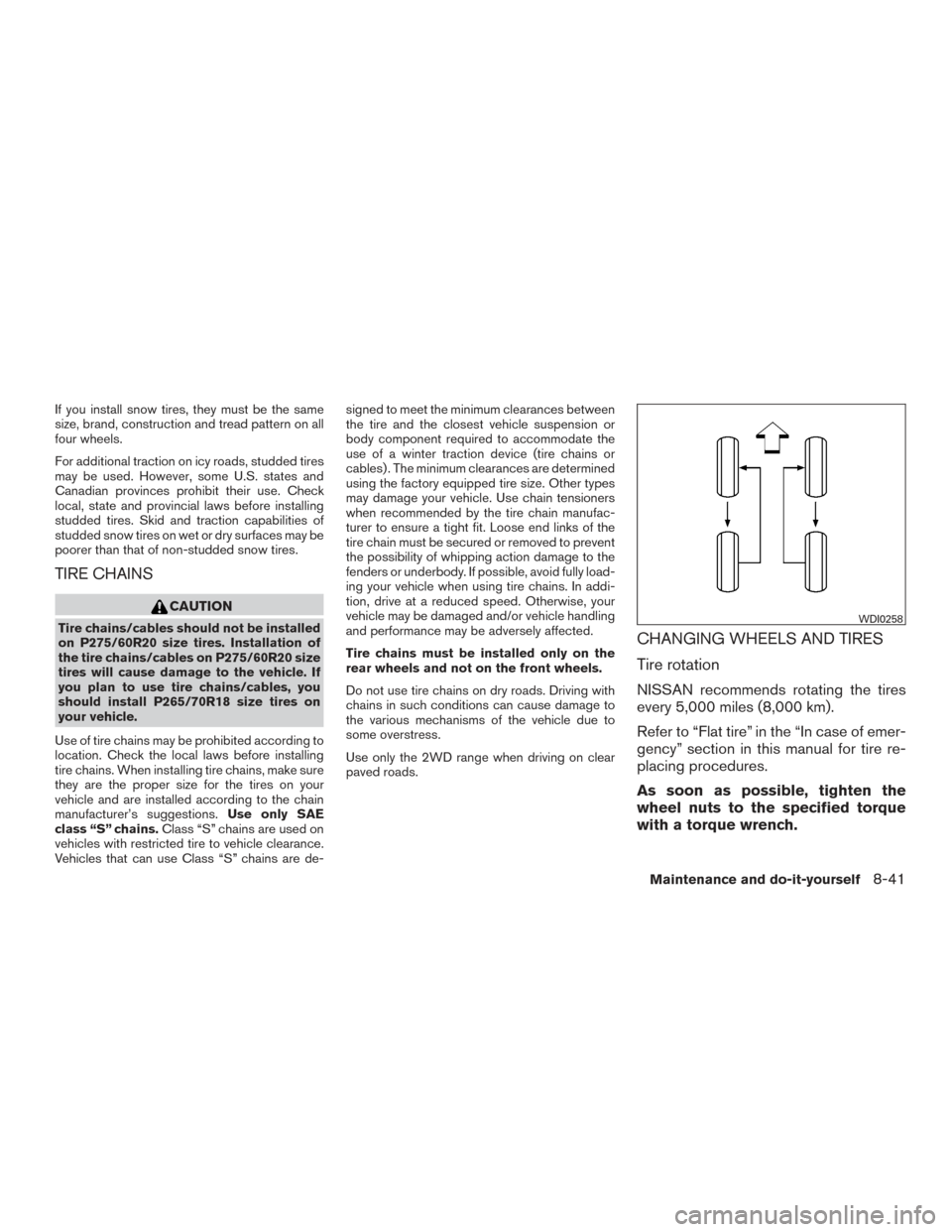
Tire rotation
NISSAN recommends rotating the tires
every 5,000 miles (8,000 km).
Refer to “Flat tire” in the “In case of emer-
gency” section in this manual for tire re-
placing procedures.
As soon as possible, tighten the
wheel nuts to the specified torque
with a torque wrench.
WDI0258
Maintenance and do-it-yourself8-41
Page 399 of 457
Replacing wheels and tires
When replacing a tire, use the same size, tread
design, speed rating and load carrying capacity
as originally equipped. Recommended types and
sizes are shown in “Wheels and tires” in the
“Technical and consumer information” section of
this manual.
WARNING
●The use of tires other than those recom-
mended or the mixed use of tires of
different brands, construction (bias,
bias-belted or radial) , or tread patterns
can adversely affect the ride, braking,
handling, VDC system, ground clear-
ance, body-to-tire clearance, tire chain
clearance, speedometer calibration,
headlight aim and bumper height.
Some of these effects may lead to acci-
dents and could result in serious per-
sonal injury.
● If your vehicle was originally equipped
with 4 tires that were the same size and
you are only replacing 2 of the 4 tires,
install the new tires on the rear axle.
Placing new tires on the front axle may
cause loss of vehicle control in some
driving conditions and cause an acci-
dent and personal injury. ●
If the wheels are changed for any rea-
son, always replace with wheels which
have the same off-set dimension.
Wheels of a different off-set could
cause premature tire wear, degrade ve-
hicle handling characteristics, affect the
VDC system and/or interference with
the brake discs. Such interference can
lead to decreased braking efficiency
and/or early brake pad wear. Refer to
“Wheels and tires” in the “Technical and
consumer information” section of this
manual for wheel off-set dimensions.
● When a spare tire is mounted or a wheel
is replaced, tire pressure will not be
indicated, the TPMS will not function
and the low tire pressure warning light
will flash for approximately 1 minute.
The light will remain on after 1 minute.
Contact your NISSAN dealer as soon as
possible for tire replacement and/or
system resetting.
● Replacing tires with those not originally
specified by NISSAN could affect the
proper operation of the TPMS. ●
Do not install a damaged or deformed
wheel or tire even if it has been re-
paired. Such wheels or tires could have
structural damage and could fail with-
out warning.
● The use of retread tires is not
recommended.
● For additional information regarding
tires, refer to “Important Tire Safety In-
formation” (US) or “Tire Safety Informa-
tion” (Canada) in the Warranty Informa-
tion Booklet.
Four-wheel drive models
CAUTION
Always use tires of the same type, size,
brand, construction (bias, bias-belted or
radial) , and tread pattern on all four
wheels. Failure to do so may result in a
circumference difference between tires on
the front and rear axles which will cause
excessive tire wear and may damage the
transmission, transfer case and differen-
tial gears.
Maintenance and do-it-yourself8-43
Page 441 of 457
FLAT TOWING
Towing your vehicle with all four wheels on the
ground is sometimes called flat towing. This
method is sometimes used when towing a vehicle
behind a recreational vehicle, such as a motor
home.
CAUTION
●Failure to follow these guidelines can
result in severe transmission damage.
● Whenever flat towing your vehicle, al-
ways tow forward, never backward.
● DO NOT tow any automatic transmis-
sion vehicle with all four wheels on the
ground (flat towing) . Doing so WILL
DAMAGE internal transmission parts
due to lack of transmission lubrication.
● For emergency towing procedures refer
to “Towing recommended by NISSAN”
in the “In case of emergency” section of
this manual.
Automatic Transmission
To tow a vehicle equipped with an automatic
transmission, an appropriate vehicle dolly MUST
be placed under the towed vehicle’s drive
wheels. Always follow the dolly manufacturer’s
recommendations when using their product.
WARNING
Do not use this vehicle for snowplowing.
Installing a snowplow may affect vehicle
handling. This may cause the driver to lose
control of the vehicle and could result in
serious vehicle damage or personal injury. DOT (Department of Transportation) Quality
Grades: All passenger car tires must conform to
federal safety requirements in addition to these
grades.
Quality grades can be found where applicable on
the tire sidewall between tread shoulder and
maximum section width. For example:
Treadwear 200 Traction AA Temperature A
Treadwear
The treadwear grade is a comparative rating
based on the wear rate of the tire when tested
under controlled conditions on a specified gov-
ernment test course. For example, a tire graded
150 would wear one and one-half (1 1/2) times
as well on the government course as a tire graded
100. The relative performance of tires depends
upon the actual conditions of their use, however,
and may depart significantly from the norm due to
variations in driving habits, service practices and
differences in road characteristics and climate.
Traction AA, A, B and C
The traction grades, from highest to lowest, are
AA, A, B, and C. Those grades represent the
tire’s ability to stop on wet pavement as mea-
sured under controlled conditions on specified
government test surfaces of asphalt and con-
crete. A tire marked C may have poor traction
performance.
SNOW PLOW
UNIFORM TIRE QUALITY GRADING
Technical and consumer information9-41
Page 449 of 457
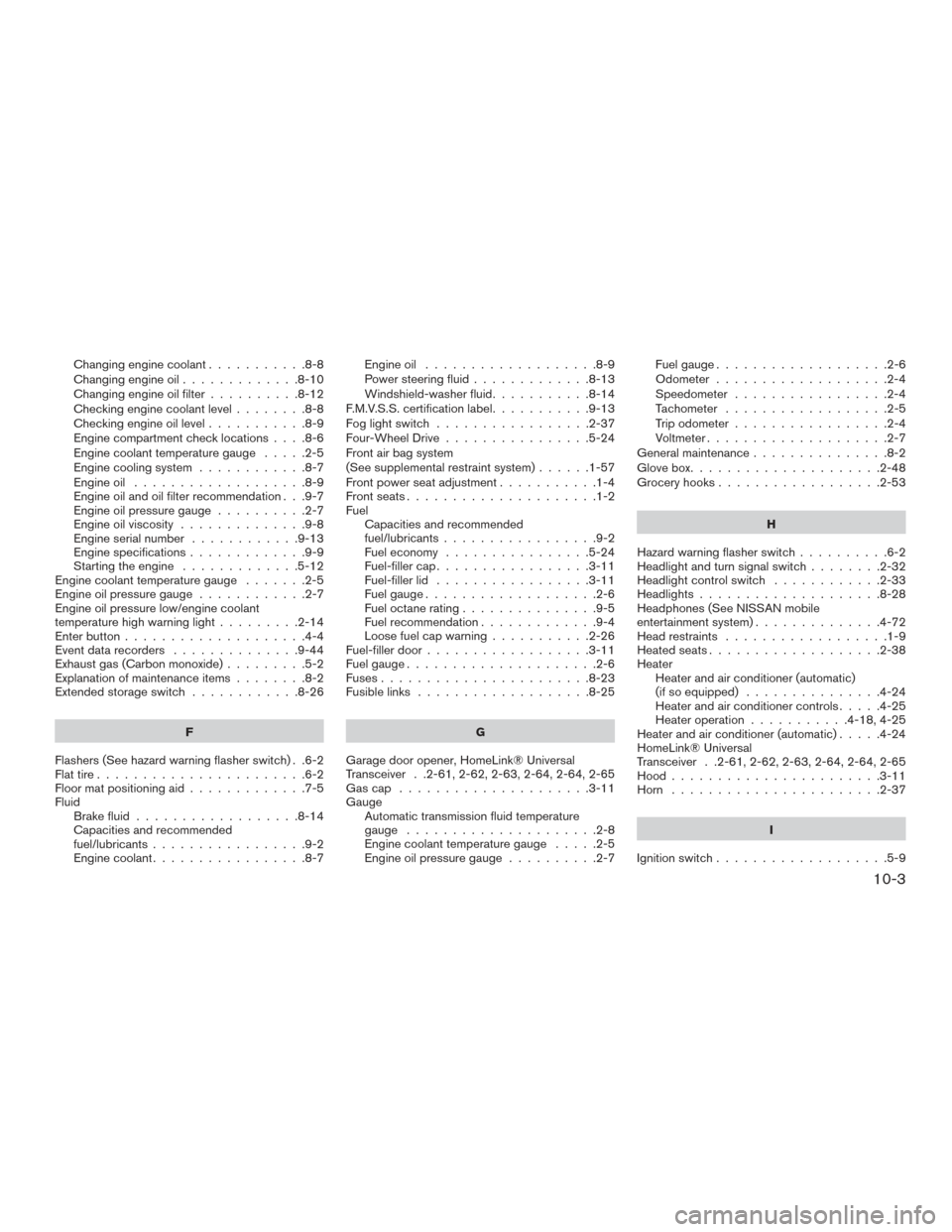
Changing engine coolant...........8-8
Changing engine oil .............8-10
Changing engine oil filter ..........8-12
Checking engine coolant level ........8-8
Checking engine oil level ...........8-9
Engine compartment check locations ....8-6
Engine coolant temperature gauge .....2-5
Engine cooling system ............8-7
Engine oil ...................8-9
Engine oil and oil filter recommendation . . .9-7
Engine oil pressure gauge ..........2-7
Engine oil viscosity ..............9-8
Engine serial number ............9-13
Engine specifications .............9-9
Starting the engine .............5-12
Engine coolant temperature gauge .......2-5
Engineoilpressuregauge............2-7
Engine oil pressure low/engine coolant
temperature high warning light .........2-14
Enterbutton....................4-4
Event data recorders ..............9-44
Exhaust gas (Carbon monoxide) .........5-2
Explanation of maintenance items ........8-2
Extendedstorageswitch ............8-26
F
Flashers (See hazard warning flasher switch) . .6-2
Flat tire .......................6-2
Floor mat positioning aid .............7-5
Fluid Brake fluid ..................8-14
Capacities and recommended
fuel/lubricants .................9-2
Engine coolant .................8-7 Engine oil
...................8-9
Power steering fluid .............8-13
Windshield-washer fluid ...........8-14
F.M.V.S.S. certification label ...........9-13
Foglightswitch .................2-37
Four-Wheel Drive ................5-24
Front air bag system
(See supplemental restraint system) ......1-57
Front power seat adjustment ...........1-4
Frontseats.....................1-2
Fuel Capacities and recommended
fuel/lubricants .................9-2
Fuel economy ................5-24
Fuel-filler cap .................3-11
Fuel-filler lid .................3-11
Fuel gauge ...................2-6
Fuel octane rating ...............9-5
Fuel recommendation .............9-4
Loose fuel cap warning ...........2-26
Fuel-filler door ..................3-11
Fuelgauge.....................2-6
Fuses.......................8-23
Fusiblelinks ...................8-25
G
Garage door opener, HomeLink® Universal
Transceiver . .2-61, 2-62, 2-63, 2-64, 2-64, 2-65
Gascap .....................3-11
Gauge Automatic transmission fluid temperature
gauge .....................2-8
Engine coolant temperature gauge .....2-5
Engine oil pressure gauge ..........2-7 Fuelgauge...................2-6
Odometer
...................2-4
Speedometer .................2-4
Tachometer ..................2-5
Trip odometer .................2-4
Voltmeter ....................2-7
General
maintenance ...............8-2
Glovebox.....................2-48
Groceryhooks..................2-53
H
Hazard warning flasher switch ..........6-2
Headlightandturnsignalswitch........2-32
Headlightcontrolswitch ............2-33
Headlights....................8-28
Headphones (See NISSAN mobile
entertainment system) ..............4-72
Head restraints ..................1-9
Heated seats ...................2-38
Heater Heater and air conditioner (automatic)
(if so equipped) ...............4-24
Heater and air conditioner controls .....4-25
Heater operation ...........4-18,4-25
Heater and air conditioner (automatic) .....4-24
HomeLink® Universal
Transceiver . .2-61, 2-62, 2-63, 2-64, 2-64, 2-65
Hood.......................3-11
Horn .......................2-37
I
Ignition switch ...................5-9
10-3
Page 453 of 457
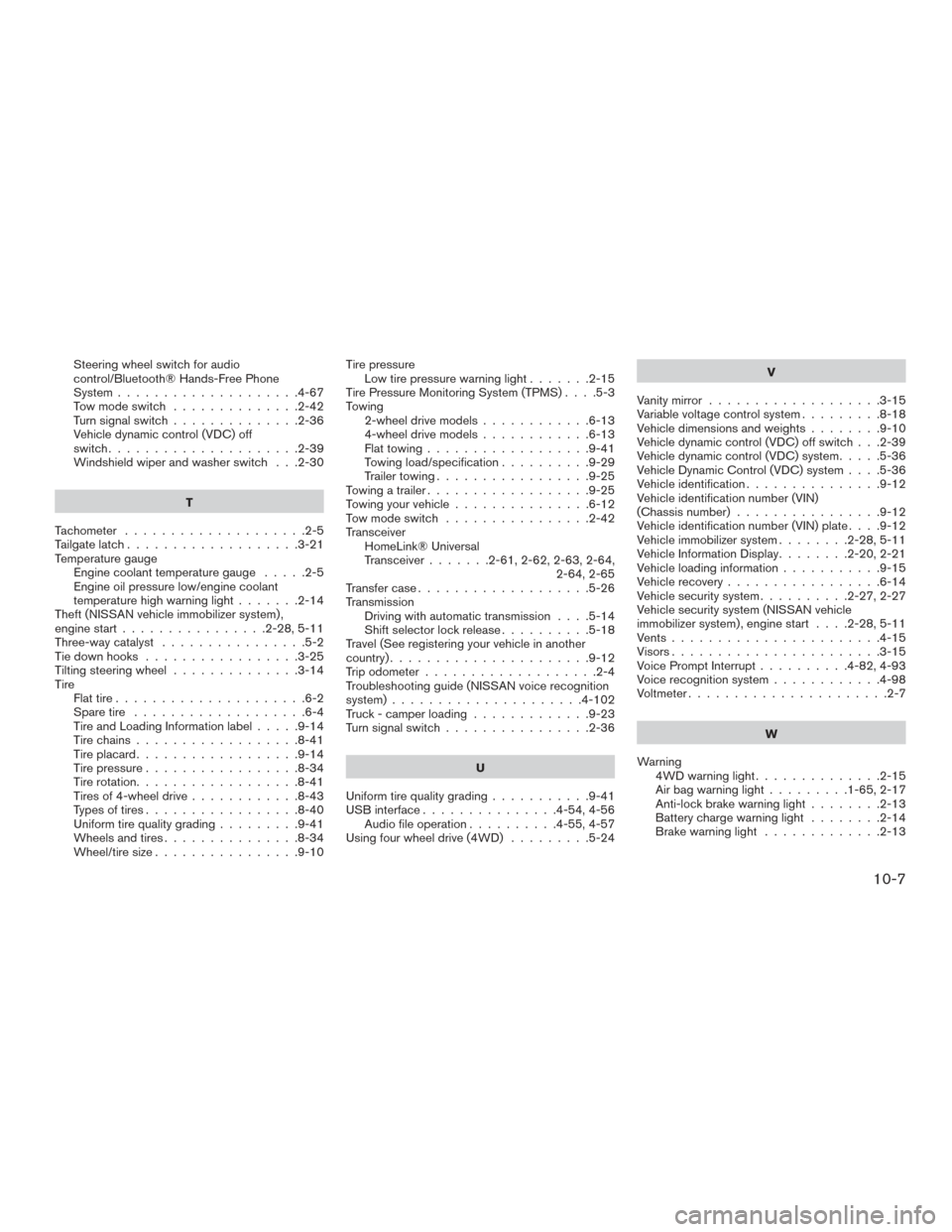
Steering wheel switch for audio
control/Bluetooth® Hands-Free Phone
System....................4-67
Tow mode switch ..............2-42
Turnsignalswitch..............2-36
Vehicle dynamic control (VDC) off
switch.....................2-39
Windshield wiper and washer switch . . .2-30
T
Tachometer ....................2-5
Tailgate latch ...................3-21
Temperature gauge Engine coolant temperature gauge .....2-5
Engine oil pressure low/engine coolant
temperature high warning light .......2-14
Theft (NISSAN vehicle immobilizer system) ,
engine start ................2-28,5-11
Three-way catalyst ................5-2
Tie down hooks .................3-25
Tilting steering wheel ..............3-14
Tire Flat tire .....................6-2
Spare tire ...................6-4
TireandLoadingInformationlabel.....9-14
Tire chains ..................8-41
Tireplacard..................9-14
Tirepressure.................8-34
Tire rotation..................8-41
Tires of 4-wheel drive ............8-43
Types of tires .................8-40
Uniform tire quality grading .........9-41
Wheels and tires ...............8-34
Wheel/tire size ................9-10 Tire pressure
Low tire pressure warning light .......2-15
Tire Pressure Monitoring System (TPMS) ....5-3
Towing 2-wheel drive models ............6-13
4-wheel drive models ............6-13
Flattowing..................9-41
Towing load/specification ..........9-29
Trailer towing .................9-25
Towing a trailer ..................9-25
Towingyourvehicle...............6-12
Tow mode switch ................2-42
Transceiver HomeLink® Universal
Transceiver .......2-61,2-62,2-63,2-64,
2-64, 2-65
Transfer case ...................5-26
Transmission Driving with automatic transmission ....5-14
Shift selector lock release ..........5-18
Travel (See registering your vehicle in another
country) ......................9-12
Trip odometer ...................2-4
Troubleshooting guide (NISSAN voice recognition
system) .....................4-102
Truck - camper loading .............9-23
Turn signal switch ................2-36
U
Uniform tire quality grading ...........9-41
USB interface ...............4-54,4-56
Audio file operation ..........4-55,4-57
Using four wheel drive (4WD) .........5-24 V
Vanity mirror ...................3-15
Variable voltage control system .........8-18
Vehicle dimensions and weights ........9-10
Vehicle dynamic control (VDC) off switch . . .2-39
Vehicle dynamic control (VDC) system .....5-36
Vehicle Dynamic Control (VDC) system .
. . .5-36
Vehicle identification ...............9-12
Vehicle identification number (VIN)
(Chassis number) ................9-12
Vehicle identification number (VIN) plate ....9-12
Vehicle immobilizer system ........2-28,5-11
Vehicle Information Display ........2-20,2-21
Vehicle loading information ...........9-15
Vehicle recovery .................6-14
Vehicle security system ..........2-27,2-27
Vehicle security system (NISSAN vehicle
immobilizer system) , engine start ....2-28,5-11
Vents.......................4-15
Visors.......................3-15
Voice Prompt Interrupt ..........4-82,4-93
Voice recognition system ............4-98
Voltmeter......................2-7
W
Warning 4WD warning light ..............2-15
Airbagwarninglight.........1-65,2-17
Anti-lock brake warning light ........2-13
Battery charge warning light ........2-14
Brake warning light .............2-13
10-7