2015 NISSAN TITAN fuel pressure
[x] Cancel search: fuel pressurePage 23 of 457
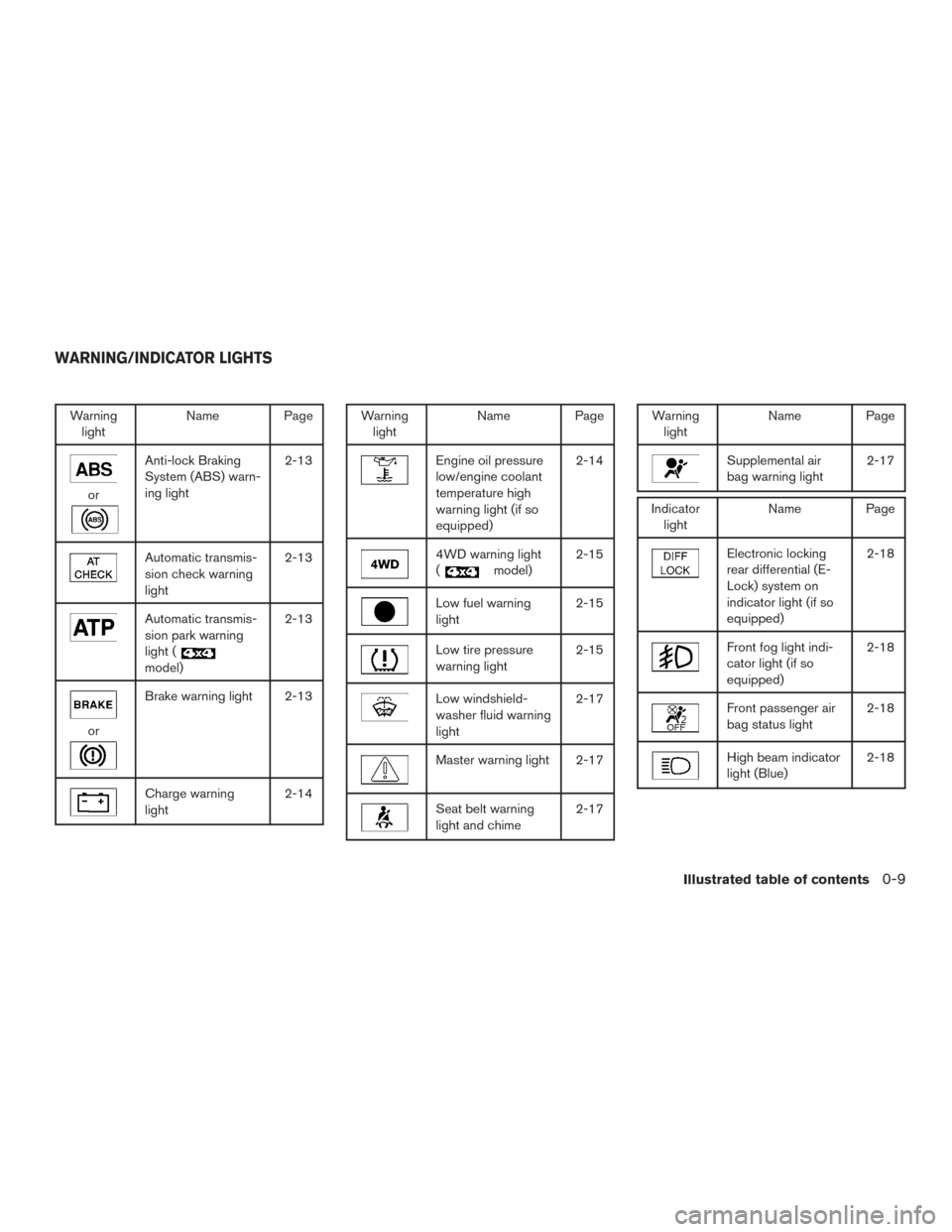
Warninglight Name Page
or
Anti-lock Braking
System (ABS) warn-
ing light 2-13
Automatic transmis-
sion check warning
light2-13
Automatic transmis-
sion park warning
light (
model)2-13
or
Brake warning light 2-13
Charge warning
light
2-14
Warning
light Name Page
Engine oil pressure
low/engine coolant
temperature high
warning light (if so
equipped) 2-14
4WD warning light
(
model)
2-15
Low fuel warning
light 2-15
Low tire pressure
warning light2-15
Low windshield-
washer fluid warning
light2-17
Master warning light 2-17
Seat belt warning
light and chime
2-17
Warning
light Name Page
Supplemental air
bag warning light 2-17
Indicator
light Name Page
Electronic locking
rear differential (E-
Lock) system on
indicator light (if so
equipped) 2-18
Front fog light indi-
cator light (if so
equipped)
2-18
Front passenger air
bag status light
2-18
High beam indicator
light (Blue)2-18
WARNING/INDICATOR LIGHTS
Illustrated table of contents0-9
Page 94 of 457
2 Instruments and controls
Instrument panel...................................2-2
Meters and gauges ................................2-3
Speedometer and odometer .....................2-4
Tachometer ....................................2-5
Engine coolant temperature gauge ...............2-5
Fuel gauge ....................................2-6
Engine oil pressure gauge (if so equipped) ........2-7
Voltmeter (if so equipped) .......................2-7
Automatic transmission fluid temperature
gauge (if so equipped) ..........................2-8
Compass display (if so equipped) ...................2-8
Compass display ...............................2-9
Warning/indicator lights and audible reminders ......2-12
Checking bulbs ............................... 2-12
Warning lights ................................ 2-13
Indicator lights ................................ 2-18
Audible reminders ............................. 2-20
Vehicle Information Display (if so equipped) .........2-20
How to use the Vehicle Information Display .......2-21
Security systems (if so equipped) ..................2-27
Vehicle security system (if so equipped) ..........2-27
NISSAN vehicle immobilizer system
(if so equipped) ............................... 2-28Windshield wiper and washer switch
...............2-30
Switch operation .............................. 2-30
Rear window and outside mirror (if so equipped)
defroster switch .................................. 2-31
Headlight and turn signal switch ....................2-32
Headlight control switch ........................ 2-33
Daytime running light system (Canada only) ......2-35
Instrument brightness control ...................2-36
Turn signal switch ............................. 2-36
Fog light switch (if so equipped) ................2-37
Horn ............................................ 2-37
Cargo lamp switch (if so equipped) .................2-38
Heated seats (if so equipped) ......................2-38
Vehicle Dynamic Control (VDC) off switch ...........2-39
Electronic locking rear differential (E-Lock) system
switch (if so equipped) ............................ 2-39
Power inverter switch (if so equipped) ..............2-40
Rear sonar system off switch (if so equipped) ........2-41
T
ow mode switch ................................. 2-42
Power outlets .................................... 2-42
12v Outlets ................................... 2-42
120v outlet (if so equipped) ....................2-44
Storage ......................................... 2-46
Page 97 of 457
16. Power outlet (P. 2-42)
17. Heated seat switch (if so equipped)(P. 2-38)
18. Vehicle Dynamic Control (VDC) off
switch (P. 2-39)
19. Tow mode switch (P. 2-42)
20. Electronic locking rear differential (E-
Lock) system switch (if so equipped)
(P.2-39)
21. Shift lever (console) (if so equipped)
(P. 5-14)
22. Hazard warning flasher switch (P. 6-2)
23. Power outlet (P. 2-42)
24. 4WD shift switch (if so equipped)
(P. 5-29)
25. Ignition switch (P. 5-9)
26. Tilt steering wheel control (P. 3-14)
27. Cargo lamp switch (if so equipped)
(P. 2-38)/Rear sonar system off switch
(if so equipped) (P. 2-41)/Pedal posi-
tion adjustment switch (if so equipped)
(P. 3-14)/Rear power window switch
(if so equipped) (P. 2-57)
*: Refer to the separate Navigation System Own-
er’s Manual (if so equipped) .
See the page number indicated in paren-
theses for operating details.
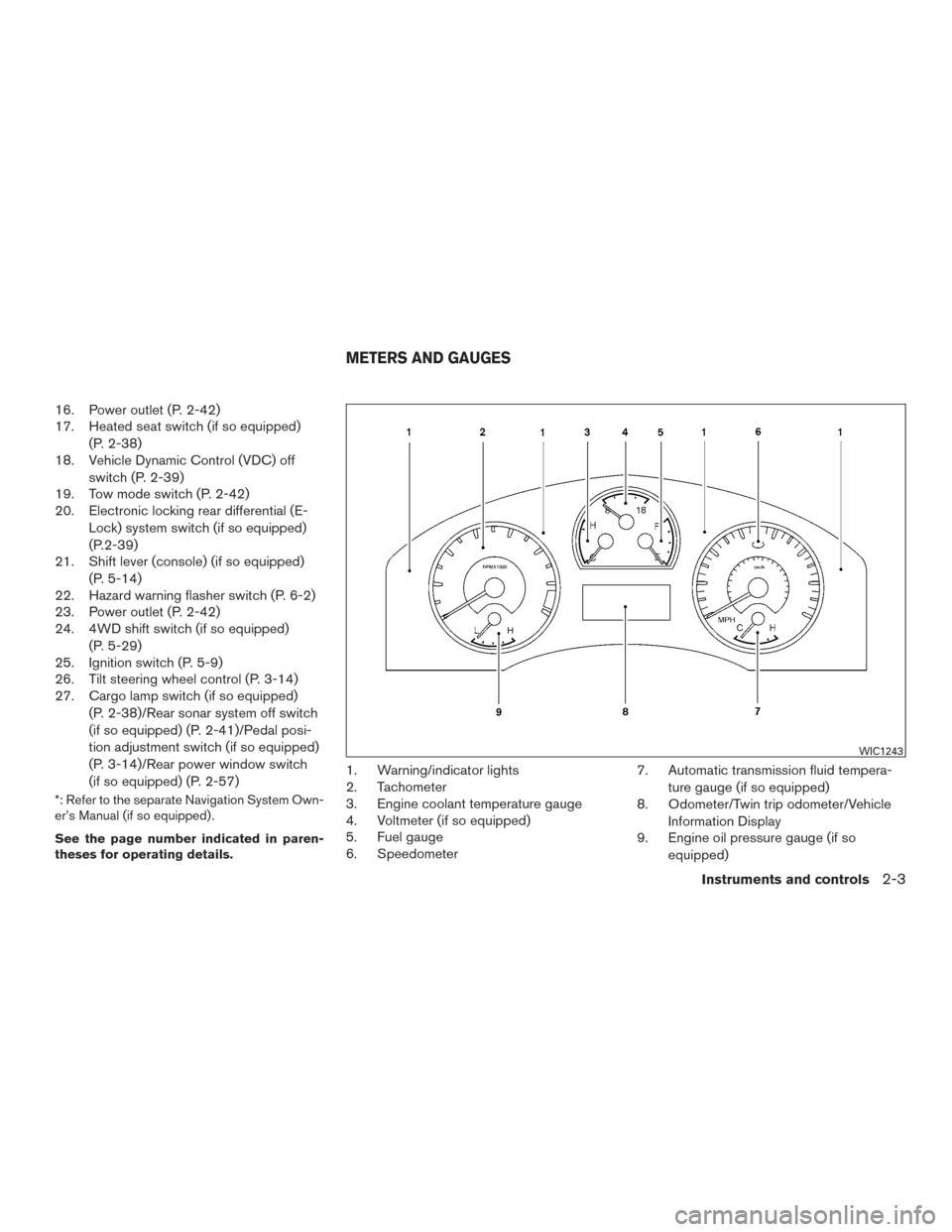
1. Warning/indicator lights
2. Tachometer
3. Engine coolant temperature gauge
4. Voltmeter (if so equipped)
5. Fuel gauge
6. Speedometer 7. Automatic transmission fluid tempera-
ture gauge (if so equipped)
8. Odometer/Twin trip odometer/Vehicle
Information Display
9. Engine oil pressure gauge (if so
equipped)
WIC1243
METERS AND GAUGES
Instruments and controls2-3
Page 106 of 457
orAnti-lock Braking System (ABS)
warning lightLow tire pressure warning lightHigh beam indicator light (Blue)
Automatic transmission check warning lightLow windshield-washer fluid warning lightMalfunction Indicator Light (MIL)
Automatic transmission park warning light
(model)Master warning lightSecurity indicator light (if so equipped)
orBrake warning lightSeat belt warning light and chimeSlip indicator light
Charge warning lightSupplemental air bag warning lightTurn signal/hazard indicator lights
Engine oil pressure low/engine coolant tem-
perature high warning light (if so equipped)Electronic locking rear differential (E-Lock)
system on indicator light (if so equipped)Vehicle Dynamic Control (VDC) off indicator
light
4WD warning light (model)Front fog light indicator light (if so equipped)
Low fuel warning lightFront passenger air bag status light
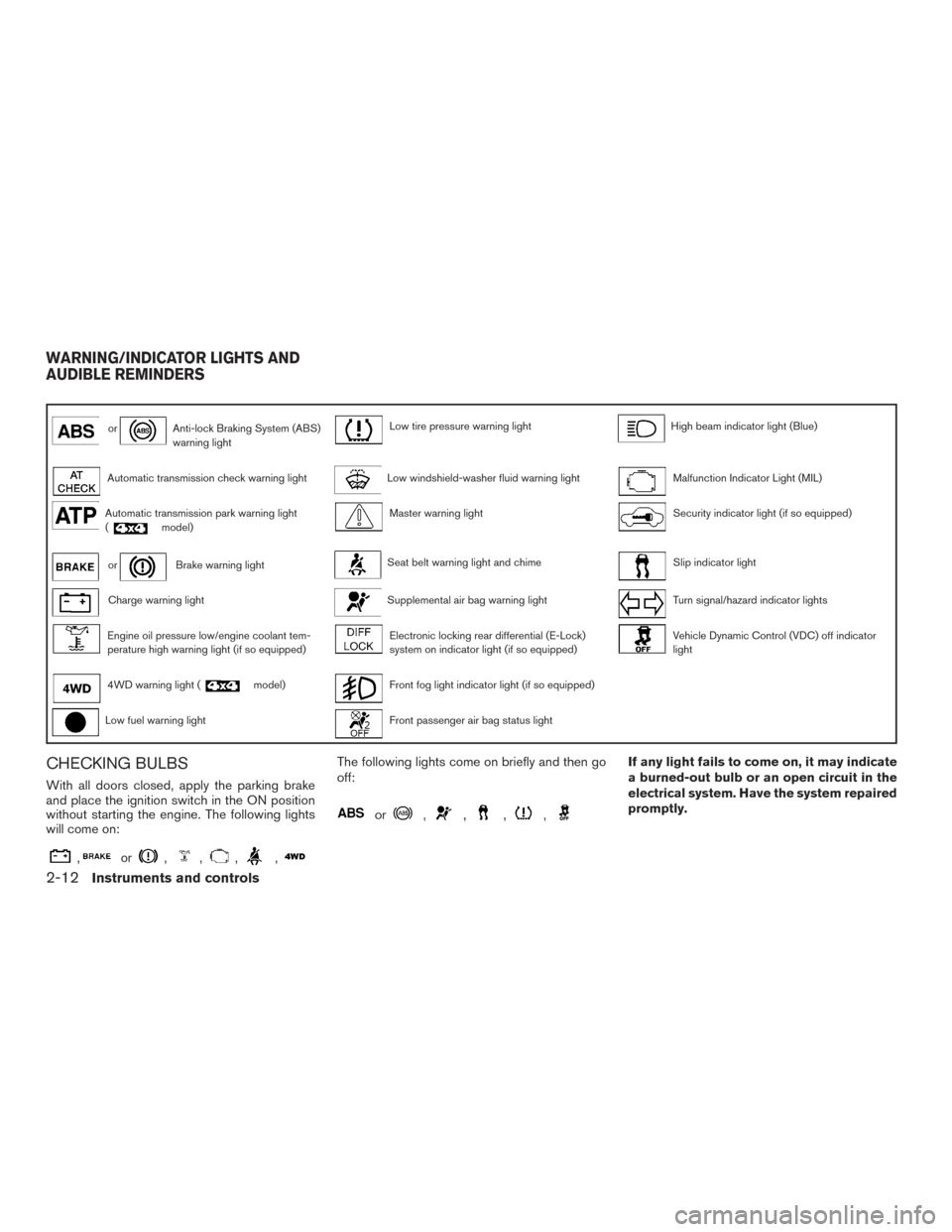
CHECKING BULBS
With all doors closed, apply the parking brake
and place the ignition switch in the ON position
without starting the engine. The following lights
will come on:
,or,,,,
The following lights come on briefly and then go
off:
or,,,,
If any light fails to come on, it may indicate
a burned-out bulb or an open circuit in the
electrical system. Have the system repaired
promptly.
WARNING/INDICATOR LIGHTS AND
AUDIBLE REMINDERS
2-12Instruments and controls
Page 109 of 457
CAUTION
●Running the engine with the engine oil
pressure warning light on could cause
serious damage to the engine almost
immediately. Such damage is not cov-
ered by warranty. Turn off the engine as
soon as it is safe to do so.
● If the gauge indicates engine coolant
temperature over the normal range,
stop the vehicle as soon as safely pos-
sible. If the engine is overheated, con-
tinued operation of the vehicle may se-
riously damage the engine. For
additional information, refer to “If your
vehicle overheats” in the “In case of
emergency” section for immediate ac-
tion required.
4WD warning light (
model)
The 4WD warning light comes on when the key
switch is turned to ON. It turns off soon after the
engine is started.
If the engine or vehicle is not functioning properly,
the warning light will either remain illuminated or
blink. For additional information, refer to “4WD
warning light” in the “Starting and driving” section
of this manual.
CAUTION
● If the warning light comes on or blinks
during operation, have your vehicle
checked by a NISSAN dealer as soon as
possible.
● Do not drive on dry hard surface roads
in the 4H or 4LO position. If the 4WD
warning light turns on when you are
driving on dry hard surface roads:
– in the 4H position, shift the 4WD shift switch to 2WD.
– in the 4LO position, stop the vehicle, move the shift lever to the N position
with the brake pedal depressed, and
shift the 4WD shift switch to 2WD.
● If the warning light is still on after the
above operation, have your vehicle
checked by a NISSAN dealer as soon as
possible.
Low fuel warning light
This light comes on when the fuel level in the fuel
tank is getting low. Refuel as soon as it is conve-
nient, preferably before the fuel gauge reaches E
(Empty) . There will be a small reserve of fuel
in the tank when the fuel gauge needle
reaches E (Empty) .
Low tire pressure warning light
Your vehicle is equipped with a TPMS that moni-
tors the tire pressure of all tires except the spare.
The low tire pressure warning light warns of low
tire pressure or indicates that the TPMS is not
functioning properly.
After the ignition switch is placed in the ON
position, this light illuminates for about 1 second
and turns off.
Low tire pressure warning:
If the vehicle is being driven with low tire
pressure, the warning light will illuminate.
A CHECK TIRE PRESSURE warning also
appears in the vehicle information dis-
play.If you select the tire pressure informa-
tion in the display (if so equipped) , the LOW
PRESSURE warning message will be dis-
played. The tire pressure for each tire will
also be displayed.
When the low tire pressure warning light
illuminates, you should stop and adjust the
tire pressure of all four tires to the recom-
mended COLD tire pressure shown on the
Tire and Loading Information label located
in the driver’s door opening. The low tire
pressure warning light does not automati-
cally turn off when the tire pressure is ad-
Instruments and controls2-15
Page 111 of 457
CAUTION
●The TPMS is not a substitute for the
regular tire pressure check. Be sure to
check the tire pressure regularly.
● If the vehicle is being driven at speeds
of less than 16 MPH (25 km/h), the
TPMS may not operate correctly.
● Be sure to install the specified size of
tires to the 4 wheels correctly.
Low windshield-washer fluid
warning light
This light comes on when the windshield-washer
fluid is at a low level. Add windshield-washer fluid
as necessary. For additional information, refer to
“Windshield-washer fluid” in the “Maintenance
and do-it-yourself” section of this manual.
Master warning light
This light comes on when various vehicle infor-
mation display warnings appear.
● No key warning
● Low fuel warning
● Low windshield-washer fluid warning
● Parking brake release warning ●
Door open warning
● Loose fuel cap warning
● Check tire pressure warning
Seat belt warning light and
chime
The light and chime remind you to fasten your
seat belts. The light illuminates whenever the
ignition switch is placed in the ON or START
position and remains illuminated until the driver’s
seat belt is fastened. At the same time, the chime
sounds for about 6 seconds unless the driver’s
seat belt is securely fastened.
The seat belt warning light may also illuminate if
the front passenger’s seat belt is not fastened
when the front passenger’s seat is occupied . For
7 seconds after the ignition switch is placed in
the ON position, the system does not activate the
warning light for the front passenger.
For additional information, refer to “Seat belts” in
the “Safety—Seats, seat belts and supplemental
restraint system” section of this manual for pre-
cautions on seat belt usage.
Supplemental air bag warninglight
When the ignition switch is placed in the ON or
START position, the supplemental air bag warn-
ing light illuminates for about 7 seconds and then
turns off. This means the system is operational.
If any of the following conditions occur, the front
air bag, side air bag, curtain air bag, and preten-
sioner systems need servicing and your vehicle
must be taken to a NISSAN dealer:
● The supplemental air bag warning light re-
mains on after approximately 7 seconds.
● The supplemental air bag warning light
flashes intermittently.
● The supplemental air bag warning light does
not come on at all.
Unless checked and repaired, the supplemental
restraint system (air bag system) and/or the seat
belts with pretensioner system may not function
properly. For additional information, refer to
“Supplemental restraint system (SRS)” in the
“Safety—Seats, seat belts and supplemental re-
straint system” section of this manual.
Instruments and controls2-17
Page 119 of 457
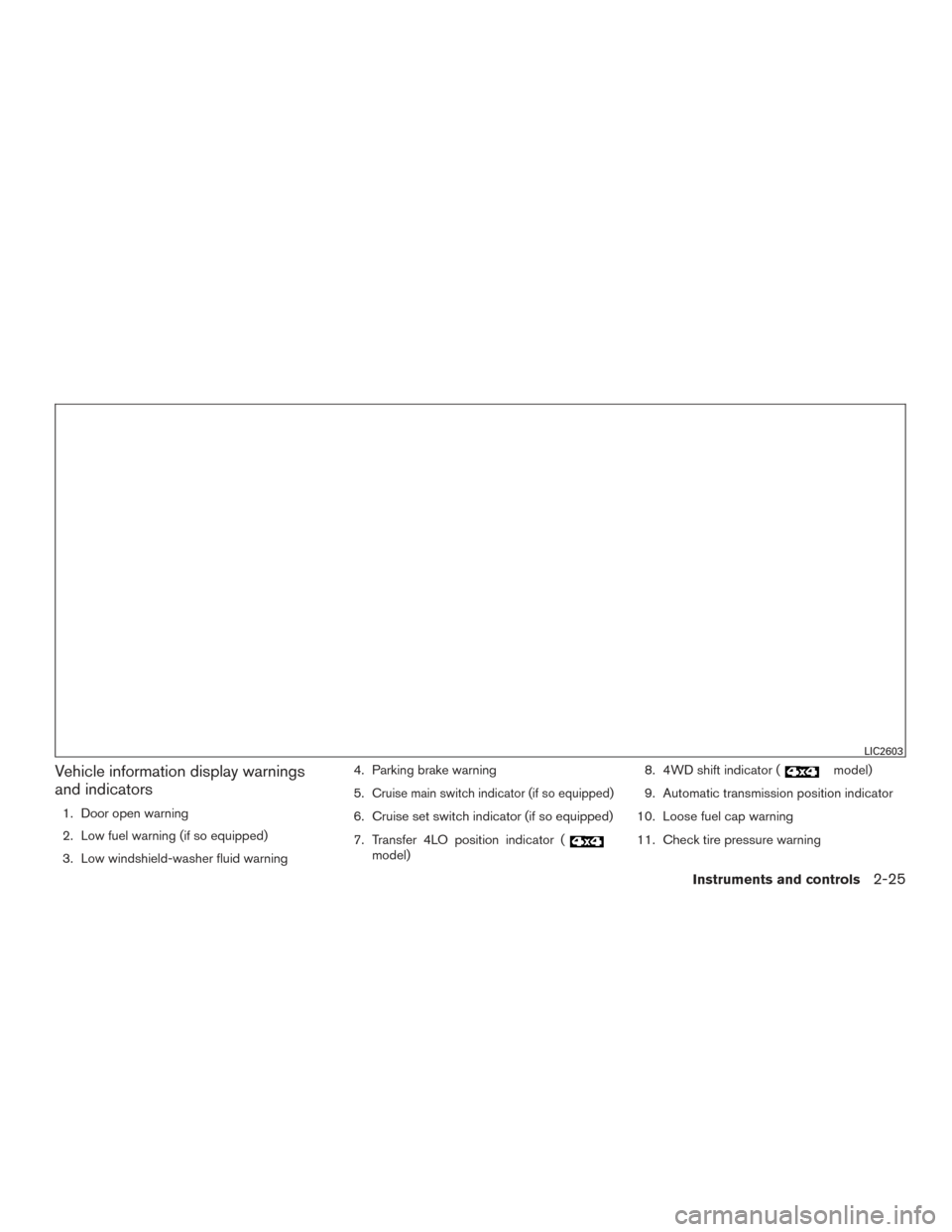
Vehicle information display warnings
and indicators
1. Door open warning
2. Low fuel warning (if so equipped)
3. Low windshield-washer fluid warning4. Parking brake warning
5.
Cruise main switch indicator (if so equipped)
6. Cruise set switch indicator (if so equipped)
7. Transfer 4LO position indicator (
model)
8. 4WD shift indicator (
model)
9. Automatic transmission position indicator
10. Loose fuel cap warning
11. Check tire pressure warning
LIC2603
Instruments and controls2-25
Page 292 of 457
5 Starting and driving
Precautions when starting and driving................5-2
Exhaust gas (carbon monoxide) ..................5-2
Three-way catalyst ..............................5-2
Tire Pressure Monitoring System (TPMS) ..........5-3
On-pavement and off-road driving
precautions ....................................5-5
Avoiding collision and rollover . . ..................5-6
Off-road recovery ...............................5-6
Rapid air pressure loss ..........................5-6
Drinking alcohol/drugs and driving ................5-7
Driving safety precautions .......................5-7
Ignition switch .....................................5-9
Automatic transmission ......................... 5-10
Ignition switch positions ........................ 5-10
NISSAN Vehicle Immobilizer System
(if so equipped) ............................... 5-11
Before starting the engine ......................... 5-11
Starting the engine ............................... 5-12
Driving the vehicle ................................ 5-13
Engine protection mode ........................ 5-13
Automatic transmission ......................... 5-14
Parking brake .................................... 5-20
Cruise control (if so equipped) .....................5-20Precautions on cruise control
...................5-20
Cruise control operations .......................5-21
Break-in schedule ................................ 5-22
Fuel efficient driving tips ........................... 5-23
Increasing fuel economy ........................... 5-24
Using 4–wheel drive (4WD)
(if so equipped) .................................. 5-24
Transfer case shifting procedures . . .............5-26
Electronic locking rear differential (E-Lock) system
(if so equipped) .................................. 5-31
Parking/parking on hills ............................ 5-32
Power steering ................................... 5-33
Brake system .................................... 5-33
Brake precautions ............................. 5-33
Anti-lock Braking System (ABS) .................5-34
Brake assist .................................. 5-35
Active brake limited slip (ABLS) system .............5-35
Vehicle Dynamic Control (VDC) system .............5-36
Brake force distribution ........................ 5-37
Rear sonar system (if so equipped) .................5-38
Cold weather driving .............................. 5-39
Freeing a frozen door lock ......................5-39
Antifreeze ..................................... 5-39