2015 MITSUBISHI OUTLANDER SPORT heating
[x] Cancel search: heatingPage 308 of 384
8
For emergenciesIf the vehicle breaks
down ...............................................................8-2
Jump-starting the engine
........................................
..........................8-2
Engine overheating .........
.................................................................8-4
Jack and tools ..................
.................................................................8-5
How to change a tire
..............................................
..........................8-5
Towing ................................................
...........................................8-12
Operation under adverse driv
ing conditions ..................................8-13
Fuel Pump Shut-off Sy
stem ...........................................................8-15
BK0206700US.bo
ok 1 ページ 2014年3月25日 火曜日 午後4時42分
Page 311 of 384
Engine overheating 8-4 For emergencies
8
If you drive your vehicle with a low battery charge after the engine has been started by using jumper cables, the engine may misfire. This can cause the anti-lock braking systemwarning light to blink on and off. This is only due to the low battery voltage. It is not a problem with the brake system. If this hap-pens, fully charge the battery and ensure thecharging system is operating properly.
N00836500352
When the engine is overheating, the informa-tion screen in the multi-information display will be interrupted and the engine coolant temperature warning display will appear. Also “ ” blink. If this happens: 1. Stop the vehicle in a safe place. Turn on the hazard warning flashers. 2. With the engine still running, carefullyraise the engine hood to vent the engine compartment.
3. Check that the cooling fan is running. If the fan is not turning, stop the engine immediately and contact an authorized Mitsubishi Motors dealer or a repair facil-ity of your choice for assistance. 4. If you see steam or spray coming from under the hood, turn off the engine. 5. If you do not see steam or spray comingfrom under the hood, leave the engine on until the bar graph for the engine coolant temperature warning display on the multi-information display goes down. When it is in the middle of the normal zone, you can start driving again. If the bar graphstays in the red zone, turn off the engine.
6. When you do not see any more steam or spray, open the hood. Look for obvious leaks, such as a split radiator hose. Be careful as components will be hot. Anyleak source must be repaired. 7. If there is no obvious leak source, check the coolant level in the engine coolantreserve tank. If there is none, or if it is too low, slowly add coolant. 8. If the engine coolant reserve tank needscoolant, you will probably also need toadd coolant to the radiator. Do not loosen or remove the radiator cap until the engine has cooled down. 9. Start the engine, and slowly add coolant, up to the bottom of the filler neck. Useplain water if you have to (and replace it with the right coolant as soon as possible).
As your vehicle has anti-lock brakes Engine overheating
WA R N I N G To avoid personal injury, keep hands, hair, jewelry and clothes away from the coolingfan. The cooling fan can start at any time.WA R N I N G Before raising the engine hood, check to see if there is steam or spray coming from under the hood. Steam or spray coming from an overheated engine could seriously scald you.Do not open the hood until there is no steam or spray.
WA R N I N G Removing the radiator cap could scald you with escaping hot water or steam.When checking the radiator level, cover the cap with a cloth before trying to remove it. Turn it slowly counterclock-wise, without pressing down, to the first notch. The pressure in the system will then be let out. When the pressure is COM-PLETELY LET OUT, press down and keep turning the cap counterclockwise until it comes off.
BK0206700US.bo
ok 4 ページ 2014年3月25日 火曜日 午後4時42分
Page 320 of 384
Operation under adverse driving conditions
For emergencies 8-13
8
Set the gearshift lever to the “N” (Neutral) position. Secure the steering wheel in a straight-aheadposition with a rope or tie-down strap.
Release the parking brake. Place the gearshift lever in the “N” (Neutral) position (manual transaxle) or the selector lever in the “N” (NEUTRAL) position(CVT).
N00837200675
If your vehicle becomes stuck in snow, sand,or mud, it can often be moved by a rocking motion. Rock your vehicle back and forth to free it.Do not rev the engine or spin the wheels. Constant efforts to free a stuck vehicle can cause overheating and transaxle failure. Letthe engine idle for a few minutes to cool the transaxle before trying again. If your vehicle is still stuck after several rock-ing attempts, call for help.
Towing the vehicle by a tow truck
CAUTION This vehicle must not be towed by a tow truck using sling lift type equipment (TypeA) as illustrated. Using a sling lift will dam- age the bumper and front end. Do not tow all-wheel dr
ive vehicles with the
front or rear wheels on the ground (Type B or Type C) as illustrated. This could result inthe driving system damage or vehicle may jump at the carriage. If you tow all-wheel drive vehicles, use onlyType D or E equipment. All-wheel-drive vehicles cannot be towed with only the front or rear tires on the groundeven if it is in “2WD” drive mode. Do not tow continuously variable transmis- sion (CVT) vehicles with the driving wheels on the ground (Type B) as illustrated. If the vehicle is towed like this, the continuouslyvariable transmission (CVT) fluid may not reach all parts of the transmission, thus dam- aging it.If you tow CVT vehicles, use Type C, D or E equipment. If the manual transaxle is malfunctioning or damaged, transport the vehicle with the driv-ing wheels on a carriage (Type C, D or E) as illustrated.
[For front-wheel drive vehicle equipped with the active stability control (ASC)] If the vehicle is towed with the ignition switch in the “ON” position or the operation mode in ON and only the front wheels oronly the rear wheels raised off the ground (Type B or C), the ASC may operate, result- ing in an accident. When towing the vehiclewith the rear wheels raised, turn the ignition switch to “OFF” or “ACC” position or put the operation mode in OFF or ACC. Whentowing the vehicle with the front wheels raised, keep the ignition switch or the opera- tion mode as follows.[Except for vehicles equipped with the F. A . S . T. - k e y ] The ignition switch is in “OFF” or “ACC”position. [Vehicles equipped with the F.A.S.T.-key] The operation mode is in OFF or ACC.
Towing with rear wheels off the ground (Type B)
CAUTION
Towing a front-wheel drive vehi-cle with front wheels off the ground (Type C) Operation under adverse driving conditions If your vehicle becomes stuck in sand, mud or snow
BK0206700US.bo
ok 13 ページ 2014年3月25日 火曜日 午後4時42分
Page 326 of 384
Engine hood
Vehicle care and maintenance 9-3
9
To reduce the possibility of catalytic con- verter damage: Use UNLEADED GASOLINE ONLY of the type of recommended in “Fuel selec- tion”. Do not drive with an extremely low fuel level. Running out of gas could damage the catalytic converter. Do not try to start the engine by pushing or towing the vehicle. If the battery is weak or run down, use jumper cables to properly start the engine.
Do not idle the engine with any spark plug wires disconnected or removed, such as when performing diagnostic tests. Do not idle the engine for a long time if it is idling roughly or otherwise obviously malfunctioning. To prevent the catalytic converter from being damaged from unburned gas, do not race the engine when stopping the engine. Stop driving the vehicle if you think the performance is noticeably low, or theengine has a malfunction such as with the ignition, etc. If you
are not able to stop
driving immediately, slow down and drivefor only a short time. Have your vehicle checked at an authorized Mitsubishi Motors dealer or a repair facility of yourchoice as soon as possible. In unusual situations involving major engine problems, a burning odor mayindicate severe and abnormal catalytic converter overheating. If this occurs, stop in a safe place, shut the engine off and letthe vehicle cool. Once the engine is cool, immediately take your vehicle to a dealer or a repair facility of your choice for ser-vice.
N00937500477
Use the engine hood release lever (locatedunder the instrument panel near the driver’sdoor) to unlock the engine hood. Pull the lever toward you to release the engine hood latch.
CAUTION Damage to the catalytic converter can result if your vehicle is not kept in proper operating condition. If the engine malfunctions or mis- fires, or if your vehicle performance suffers, have it serviced promptly. Running yourvehicle when it is overheated may result in damage to the converter and vehicle.WA R N I N G Do not park or run your vehicle in areas where combustible materials such as dry grass or leaves can come in contact with a hot exhaust, since a fire could occur. Do not put undercoat paint on the cata- lytic converter.
Engine hood To open
WA R N I N G Never use the release lever to unlatch the engine hood while the vehicle is in motion. Do not drive your vehicle unless the engine hood is locked.
BK0206700US.bo
ok 3 ページ 2014年3月25日 火曜日 午後4時42分
Page 347 of 384
For cold and snowy weather 9-24 Vehicle care and maintenance
9
Also, put a light coat of the same grease on the safety catch wherever moving parts touch.
N00942600102
The ventilation slots in front of the wind-shield should be brushed clear after a heavysnowfall so that the operation of the heating and ventilation systems will not be impaired. To prevent freezing of the weatherstripping on the doors, engine hood, etc., they should be treated with silicone grease. It is a good idea to carry a shovel or a short- handled spade in the vehicle during the win- ter so that you can clear away snow if you getstranded. A small hand-brush for sweeping snow off the vehicle and a plastic scraper for
the windshield, side and rear window are also useful.
N00942700305
The fusible links will melt
to prevent a fire if
a large current attempts to flow through cer- tain electrical systems. In case of a melted fusible link, see yourauthorized Mitsubishi Motors dealer or arepair facility of your choice for inspection and replacement. For the fusible links, please refer to “Fuseload capacities” on page 9-25.
N00942800856
To prevent damage to the electrical systemfrom short-circuiting or overloading, eachindividual circuit is equipped with a fuse. The
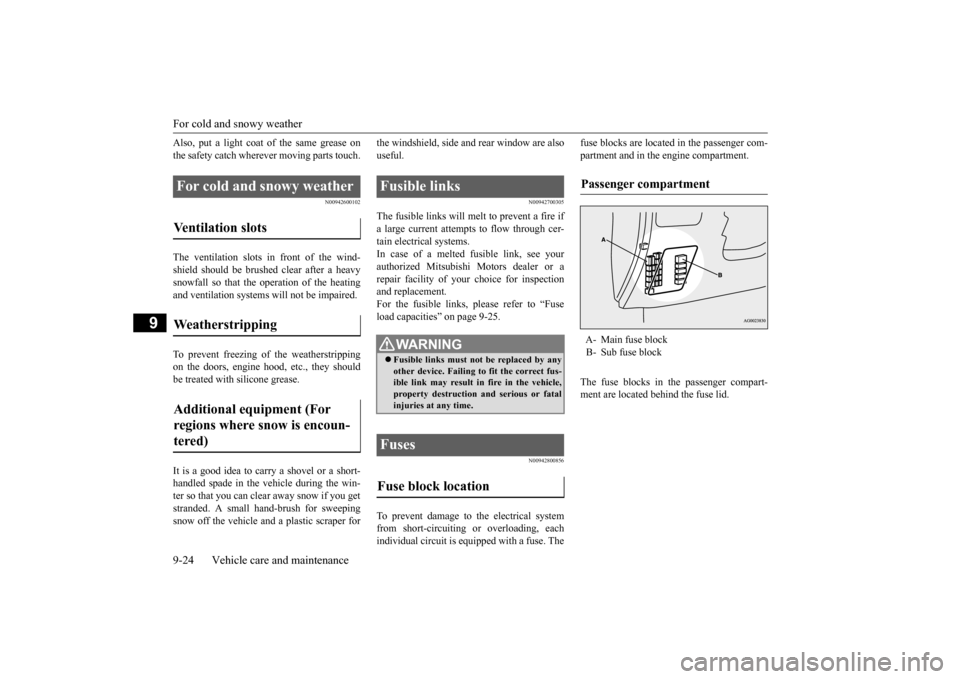
fuse blocks are located in the passenger com- partment and in the engine compartment. The fuse blocks in the passenger compart- ment are located behind the fuse lid.
For cold and snowy weather Ventilation slots Weatherstripping Additional equipment (For regions where snow is encoun- tered)
Fusible links
WA R N I N G Fusible links must not be replaced by any other device. Failing to fit the correct fus- ible link may result in fire in the vehicle, property destruction and serious or fatalinjuries at any time.
Fuses Fuse block location
Passenger compartment A- Main fuse block B- Sub fuse block
BK0206700US.bo
ok 24 ページ 2014年3月25日 火曜日 午後4時42分
Page 379 of 384
Alphabetical index 12-2
12
Continuously variable transmission (CVT)
....
5-49 Fluid
.....................
...............
9-10
, 11-5
Selector lever operation
...................
5-49
Selector lever positions
...................
5-52
Sports mode
..................
.................
5-53
Coolant (engine)
..........................
9-7
, 11-5
Cruise control
....................
.................
5-71
Cup holder
....................
...................
5-167
D
Daytime running lights
Bulb capacity
................
.................
9-29
Replacement
.................
.................
9-35
Defogger (rear window)
....................
5-134
Defrosting or defogging (windshield, door windows)
.................
7-8
, 7-13
, 7-19
, 7-24
Digital clock
Time setting
..................
.................
7-55
Dimensions
...................
.....................
11-3
Dimmer (high/low beam change)
.......
5-125
Disc brake pads
.................
.................
9-23
Dome light
Bulb capacity
................
.................
9-30
Doors
Lock
......................
........................
5-28
Power door locks
............................
5-30
Driving during cold weather
..................
6-5
Driving precaution
...............................
6-2
Driving, alcohol and drugs
....................
6-2
E
Electric rear window defogger switch
..5-134
Electronic immobilizer (Anti-theft starting system)
.....................
................
5-4
, 5-23
Electronically controlled 4WD system
..5-56
Emission-control system maintenance
...
9-21
Engine
Compartment
..................
.................
9-5
Coolant
...................
................
9-7
, 11-5
Hood
.......................
........................
9-3
Oil and oil filter
.......................
9-5
, 11-5
Overheating
....................
.................
8-4
Serial number
.................
................
11-2
Specification
...................
................
11-4
Engine coolant temperature display
.......
5-90
Engine hood
....................
....................
9-3
Engine switch
.....................
................
5-16
Exhaust system
...................
................
9-23
F
Floor console box
..............................
5-166
Floor mat
.........................
....................
6-3
Fluid
Automatic transaxle fluid
.................
11-5
Brake fluid
.....................
................
11-5
Continuously variable transmission (CVT) fluid
....................
...............
9-10
, 11-5
Engine coolant
........................
9-7
, 11-5
Power steering fluid
........................
11-5
Washer fluid
.........................
9-11
, 11-5
Fluid capacities and lubricants
.............
11-5
Free-hand advanced security transmitter (F.A.S.T.-key)
.................
.................
5-11
Front fog lights
Bulb capacity
................
.................
9-29
Indicators
..................
...................
5-118
Replacement
.................
.................
9-34
Switch
......................
...................
5-128
Front seat adjustment
............................
4-3
Front side-marker lights
Bulb capacity
................
.................
9-29
Replacement
.................
.................
9-33
Front turn signal light
Bulb capacity
................
.................
9-29
Replacement
.................
.................
9-33
Fuel
Filling the fuel tank
...........................
3-3
Fuel economy
...................
................
6-2
Fuel hoses
.....................
.................
9-22
Fuel selection
...................
................
3-2
Tank capacity
................
.................
11-5
Fuses
.........................
........................
9-24
Fusible links
..................
.....................
9-24
BK0206700US.bo
ok 2 ページ 2014年3月25日 火曜日 午後4時42分
Page 381 of 384
Alphabetical index 12-4
12
Operation under adverse driving conditions
...
8-13 Outside rearview mirrors
.....................
5-43
Overheating
......................
...................
8-4
P
Parking
.........................
.......................
6-6
Parking brake break-in
....................
9-21
Parking brake lever stroke
...............
9-21
Parking brake
....................
.................
5-40
Parking lights (type 1)
Bulb capacity
................
.................
9-29
Replacement
.................
.................
9-33
Parking lights (type 2)
Bulb capacity
................
.................
9-29
Replacement
.................
.................
9-35
Polishing
.......................
.....................
9-41
Power brakes
.....................
.................
5-62
Power outlet
..................
...................
5-160
Power steering
Fluid
........................
.....................
11-5
Power windows
.................
.................
5-36
Puncture (Tire changing)
.......................
8-5
R
Radio
General information about your radio 7-59
Reading lights
Bulb capacity
..................
................
9-30
Rear axle oil
..............................
9-11
, 11-5
Rear combination lights
Bulb capacity
..................
................
9-29
Replacement
...................
................
9-35
Rear side-marker lights
Bulb capacity
..................
................
9-29
Replacement
...................
................
9-35
Rear turn signal light
Bulb capacity
..................
................
9-29
Replacement
...................
................
9-35
Rear-view camera
...............
................
5-79
Rearview mirror
Inside rearview mirror
.....................
5-41
Outside rearview mirrors
.................
5-43
Replacement of light bulbs
...................
9-29
Replacing tires and wheels
...................
9-18
Reporting Safety Defects
.....................
10-2
S
Safe driving techniques
.........................
6-4
Seat belt
......................
.......................
4-11
Adjustable seat belt shoulder anchor
.4-16
Child restraint systems
.....................
4-18
Front passenger seat belt warning light
.....
4-16 Maintenance and inspection
.............
4-26
Seat belt extender
............................
4-17
Seat belt force limitter
.....................
4-18
Seat belt pre-tensioners
...................
4-17
Seat belt use during pregnancy
.........
4-17
Seats
..........................
..........................
4-2
Arm rest
.......................
...................
4-7
Front seats
....................
...................
4-3
Head restraints
.................
................
4-7
Heated seat
...................
...................
4-6
Seats and restraint systems
................
4-2
Service brake
.....................
.................
5-62
Service precautions
...............
................
9-2
Side turn signal light
Bulb capacity
................
.................
9-29
Snow tires
.....................
.....................
9-20
Spark plugs
...................
.....................
9-22
Starting the engine
..............................
5-45
Steering
Power steering fluid
........................
11-5
Steering wheel height and reach adjustment 5-41
Stop lights
Bulb capacity
................
.................
9-29
Replacement
.................
.................
9-35
Storage spaces
...................
...............
5-165
Sun visors
.....................
...................
5-159
Sunshade
......................
.....................
5-39
Supplemental Restraint System
............
4-26
How the Supplemental Restraint System works
.....................
.....................
4-29
BK0206700US.bo
ok 4 ページ 2014年3月25日 火曜日 午後4時42分