2015 MITSUBISHI OUTLANDER display
[x] Cancel search: displayPage 369 of 446
Engine overheating 8-4 For emergencies
8
If you drive your vehicl
e with a low battery
charge after the engine has been started byusing jumper cables, th
e engine may misfire.
This can cause the anti-lock braking system warning light to blink on
and off. This is only
due to the low battery voltage. It is not a problem with the brake system. If this hap- pens, fully charge the battery and ensure the charging system is operating properly.
N00836501375
When the engine is overheating, the warningwill be displayed in th
e instrument cluster as
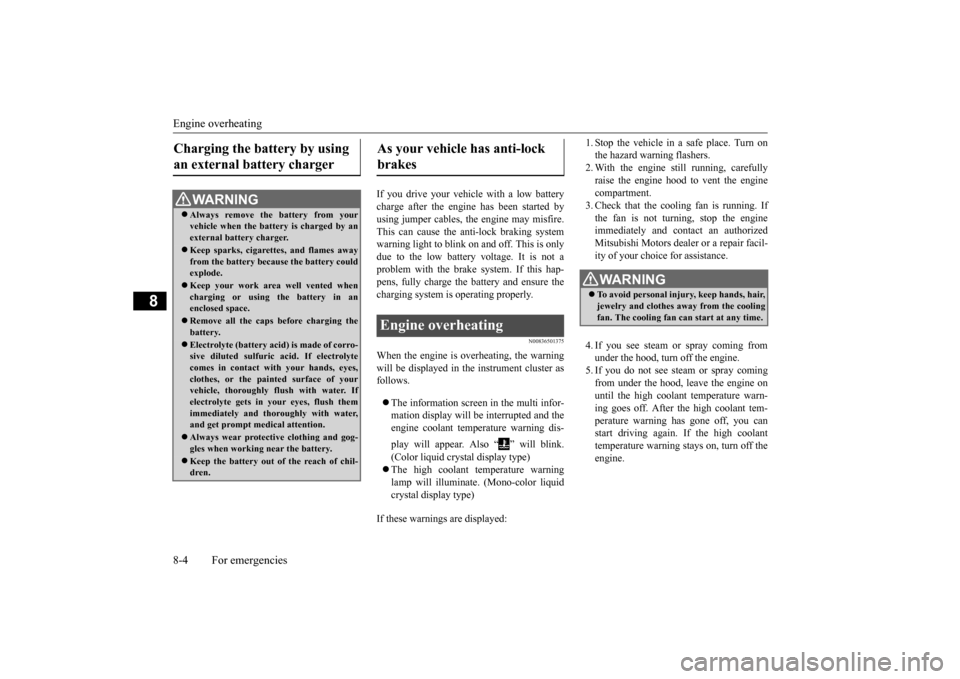
follows. The information screen in the multi infor- mation display will be interrupted and the engine coolant temp
erature warning dis-
play will appear. Also “ ” will blink. (Color liquid crystal display type) The high coolant temperature warning lamp will illuminate.
(Mono-color liquid
crystal display type)
If these warnings are displayed:
1. Stop the vehicle in a safe place. Turn on the hazard warning flashers.2. With the engine st
ill running, carefully
raise the engine hood to vent the engine compartment.3. Check that the cooling fan is running. If the fan is not turn
ing, stop the engine
immediately and cont
act an authorized
Mitsubishi Motors dealer or a repair facil- ity of your choice for assistance. 4. If you see steam or spray coming from under the hood, turn off the engine.5. If you do not see steam or spray coming from under the hood, leave the engine on until the high coolant
temperature warn-
ing goes off. After the high coolant tem- perature warning has gone off, you can start driving again. If the high coolanttemperature warning stays on, turn off the engine.
Charging the battery by using an external battery charger
WA R N I N G Always remove the
battery from your
vehicle when the battery is charged by an external battery charger. Keep sparks, cigarette
s, and flames away
from the battery because the battery couldexplode. Keep your work area well vented when charging or using
the battery in an
enclosed space. Remove all the caps before charging the battery. Electrolyte (battery acid) is made of corro- sive diluted sulfuric acid. If electrolyte comes in contact with your hands, eyes,clothes, or the pain
ted surface of your
vehicle, thoroughly
flush with water. If
electrolyte gets in your eyes, flush themimmediately and thor
oughly with water,
and get prompt medical attention. Always wear protective clothing and gog- gles when working near the battery. Keep the battery out of the reach of chil- dren.
As your vehicle has anti-lock brakes Engine overheating
WA R N I N G To avoid personal injury, keep hands, hair, jewelry and clothes aw
ay from the cooling
fan. The cooling fan ca
n start at any time.
BK0211800US.book 4 ページ 2014年3月12日 水曜日 午後2時42分
Page 370 of 446
Jack and tools
For emergencies 8-5
8
6. When you do not see any more steam or spray, open the hood. Look for obviousleaks, such as a split radiator hose. Be careful as components will be hot. Any leak source must be repaired.7. If there is no obvious leak source, check the coolant level in the engine coolant reserve tank. If there is
none, or if it is too
low, slowly add coolant. 8. If the engine coolant reserve tank needs coolant, you will probably also need toadd coolant to the radiator. Do not loosen or remove the radiator cap until the engine has cooled down.
9. Start the engine, a
nd slowly add coolant,
up to the bottom of the filler neck. Use plain water if you have to (and replace itwith the right coolant as soon as possible).
10. Replace the radiator cap and tighten it
fully. Check the engine coolant tempera-ture display on the mu
lti information dis-
play (Color liquid crystal display type) or the high coolant temperature warninglight (Mono-color liqui
d crystal display
type). You can start driving again when the high coolant temperature warningdoes not come on.
11. Have the system inspected by your autho-
rized Mitsubishi Motors
dealer or a repair
facility of your choice.
N00836601389
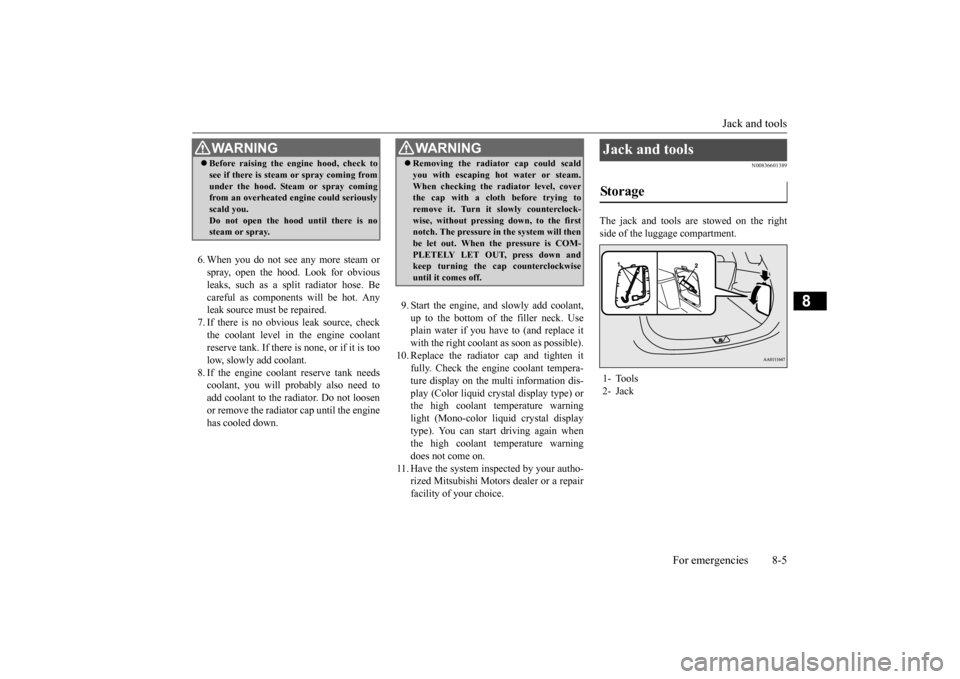
The jack and tools are stowed on the right side of the luggage compartment.
WA R N I N G Before raising the en
gine hood, check to
see if there is steam or spray coming fromunder the hood. Steam or spray comingfrom an overheated en
gine could seriously
scald you. Do not open the hood until there is nosteam or spray.
WA R N I N G Removing the radiat
or cap could scald
you with escaping hot water or steam.When checking the radiator level, coverthe cap with a cloth before trying to remove it. Turn it slowly counterclock- wise, without pressing down, to the firstnotch. The pressure in the system will then be let out. When the pressure is COM- PLETELY LET OUT, press down andkeep turning the cap counterclockwise until it comes off.
Jack and tools Storage 1- Tools 2- Jack
BK0211800US.book 5 ページ 2014年3月12日 水曜日 午後2時42分
Page 385 of 446
Engine hood 9-4 Vehicle care and maintenance
9
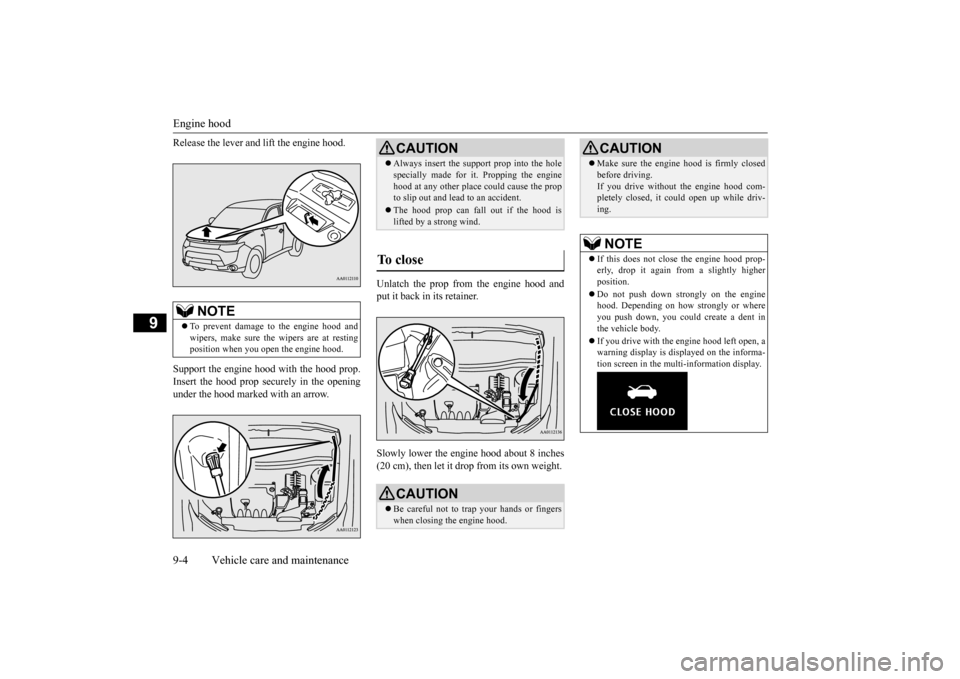
Release the lever and
lift the engine hood.
Support the engine hood with the hood prop. Insert the hood prop securely in the opening under the hood marked with an arrow.
Unlatch the prop from the engine hood and put it back in its retainer. Slowly lower the engine hood about 8 inches (20 cm), then let it drop from its own weight.
NOTE
To prevent damage to the engine hood and wipers, make sure the
wipers are at resting
position when you open the engine hood.
CAUTION Always insert the support prop into the hole specially made for it. Propping the enginehood at any other place
could cause the prop
to slip out and lead
to an accident.
The hood prop can fall out if the hood is lifted by a strong wind.
To close
CAUTION Be careful not to trap your hands or fingers when closing the engine hood.
Make sure the engine hood is firmly closed before driving.If you drive without the engine hood com-pletely closed, it c
ould open up while driv-
ing.NOTE
If this does not clos
e the engine hood prop-
erly, drop it again from a slightly higher position. Do not push down strongly on the engine hood. Depending on how strongly or whereyou push down, you could create a dent in the vehicle body. If you drive with the e
ngine hood left open, a
warning display is displayed on the informa- tion screen in the multi-information display.CAUTION
BK0211800US.book 4 ページ 2014年3月12日 水曜日 午後2時42分
Page 388 of 446
Engine oil and oil filter
Vehicle care and maintenance 9-7
9
Mitsubishi Motors re
commends using only
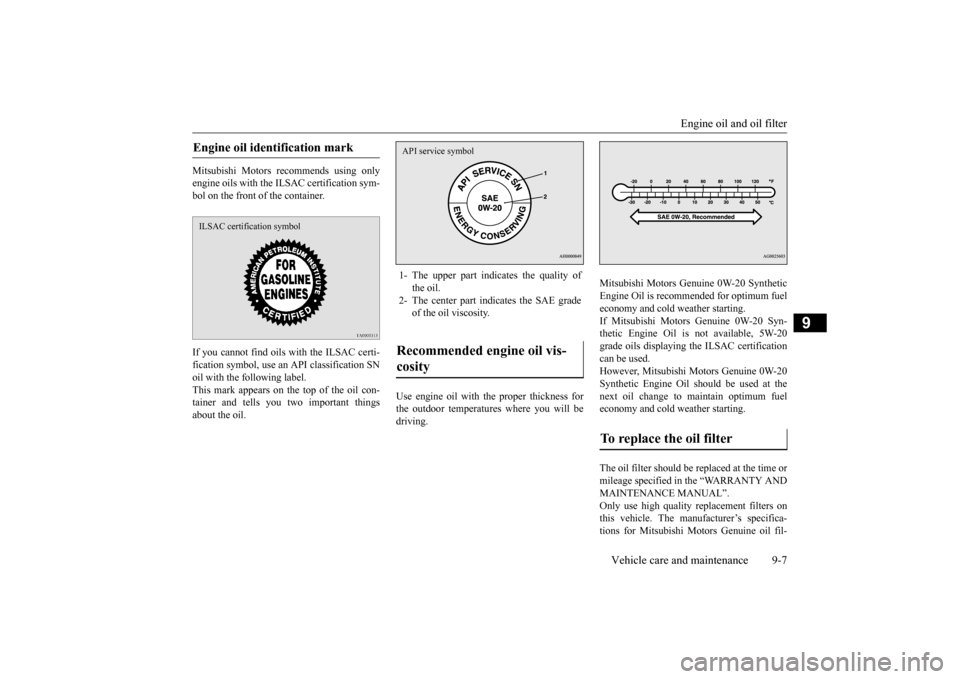
engine oils with the ILSAC certification sym- bol on the front of the container. If you cannot find oils
with the ILSAC certi-
fication symbol, use an
API classification SN
oil with the following label. This mark appears on the top of the oil con-tainer and tells you two important things about the oil.
Use engine oil with the proper thickness for the outdoor temperatures where you will bedriving.
Mitsubishi Motors Genui
ne 0W-20 Synthetic
Engine Oil is recommended for optimum fueleconomy and cold weather starting. If Mitsubishi Motors Genuine 0W-20 Syn- thetic Engine Oil is not available, 5W-20grade oils displaying the ILSAC certification can be used. However, Mitsubishi
Motors Genuine 0W-20
Synthetic Engine Oil s
hould be used at the
next oil change to maintain optimum fuel economy and cold weather starting. The oil filter should be replaced at the time or mileage specified in the “WARRANTY ANDMAINTENANCE MANUAL”. Only use high quality replacement filters on this vehicle. The manufacturer’s specifica-tions for Mitsubishi Mo
tors Genuine oil fil-
Engine oil identification mark ILSAC certification symbol
1- The upper part indi
cates the quality of
the oil.
2- The center part i
ndicates the SAE grade
of the oil viscosity.
Recommended engine oil vis- cosity API service symbol
To replace the oil filter
BK0211800US.book 7 ページ 2014年3月12日 水曜日 午後2時42分
Page 391 of 446
Automatic transaxle fl
uid (if so equipped)
9-10 Vehicle care and maintenance
9
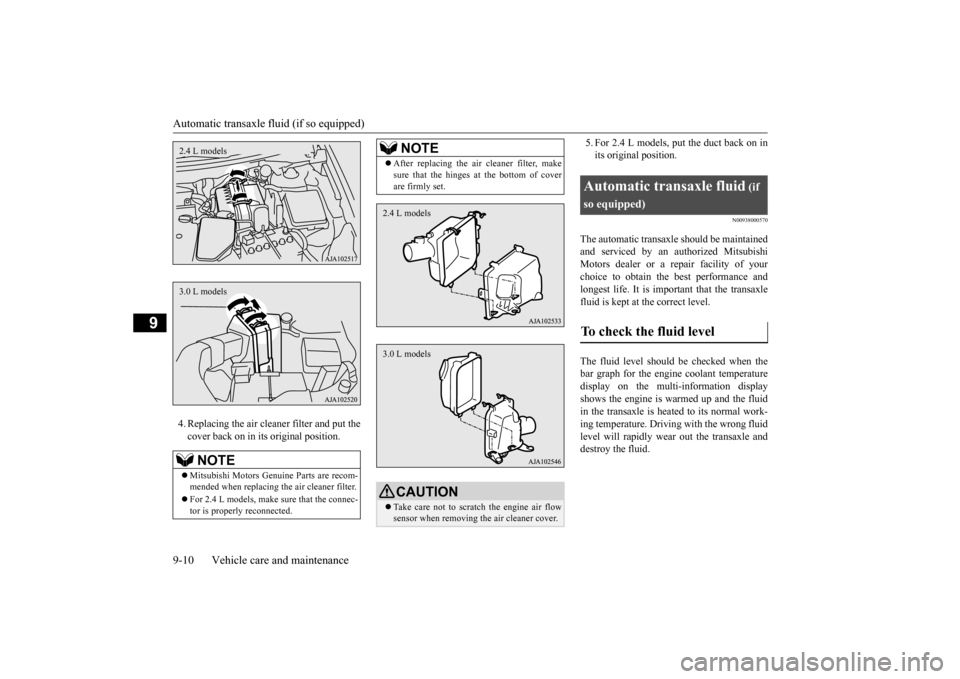
4. Replacing the air clea
ner filter and put the
cover back on in its original position.
5. For 2.4 L models, put the duct back on in its original position.
N00938000570
The automatic transaxle should be maintainedand serviced by an au
thorized Mitsubishi
Motors dealer or a repair facility of your choice to obtain the best performance and longest life. It is impor
tant that the transaxle
fluid is kept at the correct level. The fluid level should be checked when the bar graph for the engine coolant temperaturedisplay on the multi-information display shows the engine is wa
rmed up and the fluid
in the transaxle is heated to its normal work-ing temperature. Driving with the wrong fluid level will rapidly wear
out the transaxle and
destroy the fluid.
NOTE
Mitsubishi Motors Genui
ne Parts are recom-
mended when replacing th
e air cleaner filter.
For 2.4 L models, make sure that the connec- tor is properl
y reconnected.
2.4 L models3.0 L models
After replacing the air cleaner filter, make sure that the hinges at the bottom of coverare firmly set.CAUTION Take care not to scratc
h the engine air flow
sensor when removing
the air cleaner cover.
NOTE
2.4 L models3.0 L models
Automatic transaxle fluid
(if
so equipped)To check the fluid level
BK0211800US.book 10 ページ 2014年3月12日 水曜日 午後2時42分
Page 438 of 446
Tires and wheels
Specifications 11-7
11
N01147901744
PCD: Pitch Circle
Diameter (ins
tallation holes)
N01148002097
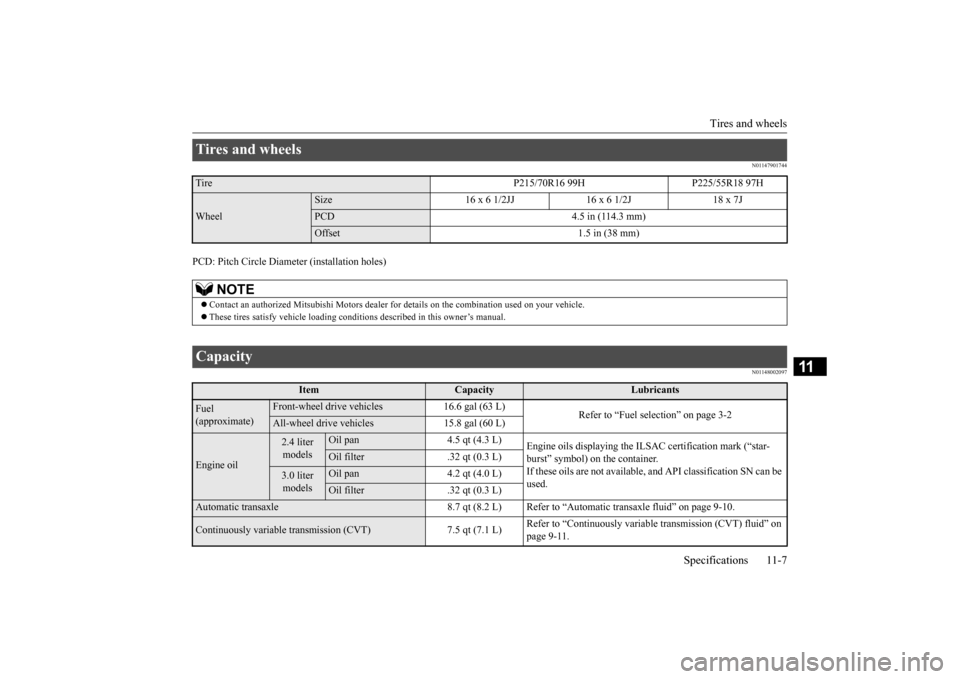
Tires and wheels Tire P215/70R16 99H P225/55R18 97HWheel
Size 16 x 6 1/2JJ 16 x 6 1/2J 18 x 7JPCD 4.5 in (114.3 mm)Offset 1.5 in (38 mm)
NOTE
Contact an authorized Mitsubishi
Motors dealer for de
tails on the combinati
on used on your vehicle.
These tires satisfy vehicle loading condi
tions described in
this owner’s manual.
Capacity
Item
Capacity
Lubricants
Fuel (approximate)
Front-wheel drive ve
hicles 16.6 gal (63 L)
Refer to “Fuel selection” on page 3-2
All-wheel drive vehicles 15.8 gal (60 L)
Engine oil
2.4 liter models
Oil pan 4.5 qt (4.3 L)
Engine oils displayi
ng the ILSAC certification mark (“star-
burst” symbol) on the container. If these oils are not available,
and API classification SN can be
used.
Oil filter .32 qt (0.3 L)
3.0 liter models
Oil pan 4.2 qt (4.0 L)Oil filter .32 qt (0.3 L)
Automatic transaxle 8.7 qt (8.2 L) Refer to
“Automatic transaxle fluid” on page 9-10.
Continuously variable transm
ission (CVT) 7.5 qt (7.1 L)
Refer to “Continuously variable
transmission (CVT) fluid” on
page 9-11.
BK0211800US.book 7 ページ 2014年3月12日 水曜日 午後2時42分
Page 442 of 446
Alphabetical index
12-3
12
Replacement
..................................
9-33
Front turn signal light
Bulb capacity
.................................
9-30
Replacement
..................................
9-35
Fuel
Filling the fuel tank
...........................
3-3
Fuel economy
...................................
6-2
Fuel hoses
......................................
9-22
Fuel selection
...................................
3-2
Tank capacity
.................................
11-7
Fuel Pump Shut-off System
.................
8-16
Fuses
.................................................
9-25
Fusible links
.......................................
9-25
G
General maintenance
...........................
9-23
General vehicle data
............................
11-4
Genuine parts
.......................................
3-6
Glove compartment
...........................
5-214
Glove compartment light
Bulb capacity
.................................
9-32
H
Hazard warning
flasher switch
...........
5-177
Hazard warning lights
.......................
5-166
Head restraints
....................................
4-10
Headlight leveling switch
..................
5-176
Headlights
Bulb capacity
.................................
9-30
Dimmer
........................................
5-174
Headlight flasher
...........................
5-174
Replacement
..........................
9-32
, 9-33
Switch
..........................................
5-171
High beam indicator
..........................
5-166
High-mounted stop light
Bulb capacity
.................................
9-30
Hill start assist
...................................
5-85
Hood lock release me
chanism and safety
catch
...............................................
9-24
Horn switch
......................................
5-184
I
If the vehicle breaks down
.....................
8-2
Ignition switch
...................................
5-55
Important facts to know in
case of an accident
10-4 Indicators
....................
5-148
, 5-165
, 5-166
Information screen display
.................
5-149
Inside rearview mirror
.........................
5-53
Inspection and maintena
nce following rough
road operation
..................................
5-82
Instrument cluster
..............................
5-120
Interior lights
....................................
5-211
J
Jack
.....................................................
8-5
Storage
............................................
8-5
Jump-starting the engine
........................
8-2
K
Keyless entry system
....................
5-7
, 5-28
Keys
....................................................
5-3
L
Labeling
.............................................
11-2
Lane Departure Warning System (LDW)
.....
5-111 License plate light
Bulb capacity
.................................
9-30
Replacement
...................................
9-38
Liftgate
..............................................
5-35
Link System
.....................................
5-184
Loading information
..............................
6-6
Lubricants
..........................................
11-7
Luggage floor box
.............................
5-215
Luggage hooks
.................................
5-221
M
MIVEC engine
..........................
5-24
, 5-59
Modification of your vehicle
..................
3-5
BK0211800US.book 3 ページ 2014年3月12日 水曜日 午後2時42分
Page 443 of 446

Alphabetical index 12-4
12
Multi information display - Type 1
.....
5-122
Multi information display - Type 2
.....
5-140
O
Octane rating
........................................
3-2
Oil
Engine oil
......................................
11-7
Rear axle oil
...................................
11-7
Transfer oil
....................................
11-7
Operation under adverse driving conditions
...
8-15 Outside rearview mirrors
.....................
5-54
Overheating
.........................................
8-4
P
Parking
................................................
6-6
Parking brake
.................................
5-52
Parking lights
Bulb capacity
.................................
9-30
Replacement
..................................
9-34
Polishing
............................................
9-42
Power brakes
......................................
5-84
Power liftgate
.....................................
5-36
Power outlet
.....................................
5-210
Power windows
..................................
5-47
Puncture (Tire changing)
.......................
8-6
R
Radiator cap
........................................
9-9
Radio
.................................................
7-15
General information
about your radio 7-48
Reading lights
Bulb capacity
..................................
9-32
Rear axle oil
..............................
9-12
, 11-7
Rear combination lights
Bulb capacity
..................................
9-30
Replacement
...................................
9-36
Rear side-marker lights
Bulb capacity
..................................
9-30
Rear turn signal light
Bulb capacity
..................................
9-30
Replacement
...................................
9-36
Rear-view camera
.............................
5-118
Rearview mirror
Inside rearview mirror
.....................
5-53
Outside rearview mirrors
.................
5-54
Replacement of light bulbs
...................
9-29
Replacing tires and wheels
...................
9-19
Reporting Safety Defects
.....................
10-2
Roof antenna
......................................
7-47
S
Safe driving techniques
.........................
6-4
S-AWC (Super-All Wheel Control)
......
5-77
Seat belt
.............................................
4-17
Adjustable seat belt shoulder anchor
.4-23
Child restraint systems
....................
4-25
Front passenger seat belt warning light
.....
4-22Maintenance and inspection
.............
4-32
Seat belt extender
...........................
4-24
Seat belt force limitter
.....................
4-25
Seat belt pr
e-tensioners
...................
4-24
Seat belt use
during pregnancy
.........
4-24
Seats
....................................................
4-2
Arm rest
..........................................
4-9
Front seats
.......................................
4-4
Head restraints
...............................
4-10
Heated seat
......................................
4-7
Making a cargo area
........................
4-12
Making a flat seat
...........................
4-16
Seat arrangement
..............................
4-3
Seats and restraint systems
................
4-4
Second row seats
..............................
4-8
Third row seats
...............................
4-10
Service brake
......................................
5-84
Service precautions
...............................
9-2
Side turn-signal light
Bulb capacity
.................................
9-30
Snow tires
..........................................
9-20
Spark plugs
........................................
9-22
Starting the engine
.....................
5-23
, 5-58
Steering
Steering wheel height and reach adjustment
BK0211800US.book 4 ページ 2014年3月12日 水曜日 午後2時42分