2015 MERCEDES-BENZ SPRINTER ESP
[x] Cancel search: ESPPage 30 of 334

safety-relevant systems, e.g. the brake sys-
tem. Only use genuine Mercedes-Benz parts
or parts of equal quality. Only use tires,
wheels and accessories that have been spe-
cifically approved for your vehicle.
We test genuine Sprinter parts, as well as
conversion parts and accessories that have
been specifically approved for the type of
vehicle, for:
R reliability
R safety
R suitability
Despite ongoing market research, Mercedes- Benz is unable to assess other parts. There-
fore, we accept no responsibility for the use of
such parts in Sprinter vehicles, even if they
have been officially approved or independ-
ently approved by a testing center.
In some countries, certain parts are only offi- cially approved for installation or modification
if they comply with legal requirements. All
genuine Sprinter parts satisfy these require-
ments. Make sure that all parts are suitable
for your vehicle.
Always specify the vehicle identification num- ber (VIN) and engine number when ordering
genuine Sprinter parts (Y page 316).Service and vehicle operation
Maintenance and literature
The Service and Warranty Information Book-
let contains detailed information on the types
of warranty that your Sprinter is covered by,
including:
R New Vehicle Limited Warranty
R Diesel Engine Limited Warranty
R Anti-Perforation Warranty
R Limited Warranty for Restraint Systems
(only vehicles that have been sold and reg- istered in the state of Kansas)
R Legally required Emission Performance
Warranty Replacement parts and accessories are sub-
ject to the Replacement Part and Accessory
Warranty of the dealer mentioned on the
inside cover. You can obtain these from any
authorized Sprinter dealer. Maintenance
The Maintenance Booklet and the Service and
Warranty Information Booklet describe all
necessary maintenance work that should be
carried out at regular intervals.
When you take the vehicle to an authorized
Sprinter dealer, always be sure to bring the
Maintenance/Service/Warranty Information
Booklet. Your customer service advisor
enters each maintenance service into the
Maintenance Booklet for you. Registering your vehicle
We may ask our authorized Sprinter Dealers
to carry out technical inspections on certain
vehicles to improve their quality or safety.
We can only inform you about vehicle checks if we have your registration data.
Your registration data is not stored if:
R you did not purchase your vehicle at an
authorized Sprinter Dealer.
R your vehicle has never been inspected at an
authorized Sprinter Dealer.
It is advisable to register your vehicle with an
authorized Sprinter Dealer. Please inform us
as soon as possible about any change of
address or vehicle ownership. Problems with your vehicle
If you should experience a problem with your
vehicle, particularly one that you believe may
affect its safe operation, we urge you to con-
tact an authorized Sprinter Dealer immedi-
ately to have the problem diagnosed and rec-
tified. 28
Introduction
Page 37 of 334

Indicator and warning lamps
Instrument cluster on vehicles without steering wheel buttons
Instrument cluster in vehicles with steering-wheel buttons
Function Page
0043 Speedometer with warn-
ing and indicator lamps
0072
ESP
®
warning lamp 218
ASR warning lamp 218
003F
Coolant level too low 223
00AC
Coolant temperature too
high 223
0075
Restraint systems malfunc-
tion 42
0065
Brake fluid level too low 219
EBD malfunctioning 218
Trailer brake force booster
malfunction
219
00B2
Engine oil level warning 222 Function Page
00B9
Check Engine indicator
lamp
224
0028
Preglow 139
Preglow system malfunc-
tion
225
0044 Indicator and warning
lamps
004A
Left-hand turn signal 94
0025
ABS malfunction 218
0077
Tire pressure loss or the tire
pressure monitor is mal-
functioning (USA only) 226
Tire pressure loss (Canada
only)
292Instrument cluster
35At a glance
Page 38 of 334
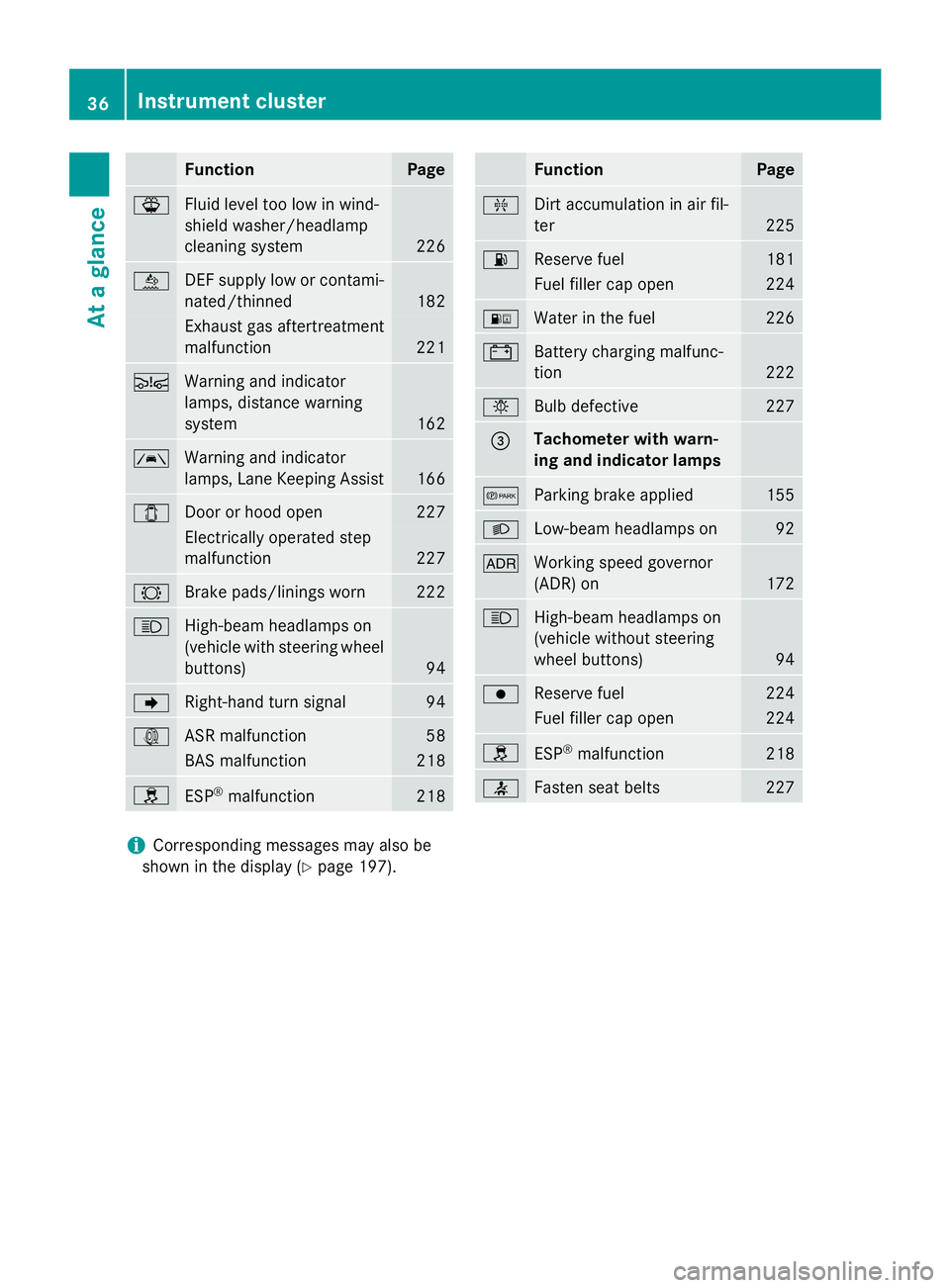
Function Page
00B1
Fluid level too low in wind-
shield washer/headlamp
cleaning system
226
00E2
DEF supply low or contami-
nated/thinned 182
Exhaust gas aftertreatment
malfunction 221
00C7
Warning and indicator
lamps, distance warning
system
162
00B0
Warning and indicator
lamps, Lane Keeping Assist
166
003E
Door or hood open 227
Electrically operated step
malfunction 227
0026
Brake pads/linings worn 222
0057
High-beam headlamps on
(vehicle with steering wheel
buttons) 94
004D
Right-hand turn signal 94
003D
ASR malfunction 58
BAS malfunction 218
0089
ESP
®
malfunction 218 Function Page
009F
Dirt accumulation in air fil-
ter
225
00B4
Reserve fuel 181
Fuel filler cap open 224
00B8
Water in the fuel 226
003D
Battery charging malfunc-
tion
222
0049
Bulb defective 227
0087 Tachometer with warn-
ing and indicator lamps 0066
Parking brake applied 155
0058
Low-beam headlamps on 92
004E
Working speed governor
(ADR) on
172
0057
High-beam headlamps on
(vehicle without steering
wheel buttons) 94
0077
Reserve fuel 224
Fuel filler cap open 224
0089
ESP
®
malfunction 218
0076
Fasten seat belts 227
i
Corresponding messages may also be
shown in the display (Y page 197).36
Instrument clusterAt a glance
Page 52 of 334

may cause short-term breathing difficulties in
people with asthma or other respiratory prob-
lems. To avoid this, you may wish to get out of
the vehicle or open the windows as soon as it is safe to do so.
Air bags and pyrotechnic Emergency Tension-
ing Devices (ETDs) contain perchlorate mate- rial, which may require special handling and
regard for the environment. National guide-
lines must be observed during disposal. In
California, see www.dtsc.ca.gov/
HazardousWaste/Perchlorate/
index.cfm.
Method of operation During the first stage of a collision, the
restraint system control unit evaluates impor-
tant physical data relating to vehicle deceler- ation or acceleration, such as:
R duration
R direction
R intensity
Based on the evaluation of this data, the
restraint system control unit triggers the
Emergency Tensioning Devices during a fron- tal or rear collision.
An Emergency Tensioning Device can only be
triggered, if:
R the ignition is switched on.
R the components of the restraint system are
operational; see "Restraint system warning
lamp" (Y page 42)
R the belt tongue is engaged in the buckle on
the respective front-passenger seat
Vehicles with two seats on the front-
passenger side: the Emergency Tensioning
Device on the inner front-passenger seat is
triggered independently of the lock status of
the seat belt. If the restraint system control unit detects a
more severe accident, further components of
the restraint system are activated independ-
ently of each other in certain frontal collision
situations:
R Front air bags
R Window curtain air bag on the side of
impact
The activation threshold of the Emergency
Tensioning Devices and the air bag are deter- mined by evaluating the rate of vehicle decel-
eration or acceleration which occurs at vari-
ous points in the vehicle. This process is pre-
emptive in nature. Deployment should take
place in good time at the start of the collision.
The rate of vehicle deceleration or accelera-
tion and the direction of the force are essen- tially determined by:
R the distribution of forces during the colli-
sion
R the collision angle
R the deformation characteristics of the vehi-
cle
R the characteristics of the object with which
the vehicle has collided
Factors which can only be seen and measured after a collision has occurred do not play a
decisive role in the deployment of an air bag.
Nor do they provide an indication of air bag
deployment.
The vehicle can be deformed considerably,
without an air bag being deployed. This is the
case if only parts which are relatively easily
deformed are affected and the rate of decel-
eration is not high. Conversely, air bags may
be deployed even though the vehicle suffers
only minor deformation. This is the case if, for
example, very rigid vehicle parts such as lon- gitudinal body members are hit, and sufficient
deceleration occurs as a result. 50
Occupant safetySafety
Page 53 of 334

If the restraint system control unit detects a
side impact or that the vehicle is rolling over, the relevant restraint system components areactivated independently of one another
depending on the apparent type of accident.
If the system determines a need for additional
protection for the vehicle occupants, the
Emergency Tensioning Devices are triggered.
R Thorax bag on the side of impact, inde-
pendently of the Emergency Tensioning
Device and the use of the seat belt
R Window curtain air bag on the side of
impact, independently of the use of the
seat belt and independently of whether the
front-passenger seat is occupied
i Not all air bags are deployed in an acci-
dent. The different air bag systems work
independently of each other.
How the air bag system works is deter-
mined by the severity of the accident detec- ted, especially the vehicle deceleration or
acceleration and the apparent type of acci-
dent:
R frontal collision
R side impact Children in the vehicle
Important safety notes
Accident statistics show that children
secured in the rear seats are safer than chil-
dren secured in the front-passenger seat. For this reason, we strongly advise that you install
a child restraint system on a rear seat. Chil-
dren are generally better protected there.
If a child younger than 12 years and under 5 ft
(1.50 m) in height is traveling in the vehicle:
R always secure the child in a child restraint
system suitable for this vehicle. The child
restraint system must be appropriate to the
age, weight and size of the child
R be sure to observe the instructions and
safety notes in this section in addition to the child restraint system manufacturer's
installation instructions G
WARNING
If you leave children unsupervised in the vehi- cle, they could set it in motion by, for example:
R release the parking brake.
R shift the automatic transmission out of the
parking position P.
R start the engine.
In addition, they may operate vehicle equip-
ment and become trapped. There is a risk of
an accident and injury.
When leaving the vehicle, always take the
SmartKey with you and lock the vehicle. Never
leave children unsupervised in the vehicle. G
WARNING
If persons, particularly children are subjected to prolonged exposure to extreme heat or
cold, there is a risk of injury, possibly even
fatal. Never leave children unattended in the
vehicle. G
WARNING
If the child restraint system is subjected to
direct sunlight, parts may get very hot. Chil-
dren may burn themselves on these parts,
particularly on the metal parts of the child
restraint system. There is a risk of injury.
If you leave the vehicle, taking the child with
you, always ensure that the child restraint
system is not exposed to direct sunlight. Pro- tect it with a blanket, for example. If the child
restraint system has been exposed to direct
sunlight, let it cool down before securing the
child in it. Never leave children unattended in the vehicle.
Always ensure that all vehicle occupants have
their seat belts fastened correctly and are sit- ting properly. Particular attention must be
paid to children.
Observe the safety notes on the seat belt
(Y page 44) and the notes on correct use of
seat belts (Y page 45). Children in the vehicle
51Safety Z
Page 55 of 334

sudden change in direction. The child
restraint system could be thrown about, strik- ing vehicle occupants. There is an increased
risk of injury, possibly even fatal.
Always install child restraint systems prop-
erly, even if they are not being used. Make
sure that you observe the child restraint sys-
tem manufacturer's installation instructions.
You will find further information on stowing
objects, luggage or loads under "Loading
guidelines" (Y page 240). G
WARNING
Child restraint systems or their securing sys-
tems which have been damaged or subjected to a load in an accident can no longer protect
as intended. The child cannot then be
restrained in the event of an accident, heavy
braking or sudden changes of direction. There is an increased risk of injury, possibly even
fatal.
Replace child restraint systems which have
been damaged or subjected to a load in an
accident as soon as possible. Have the secur-
ing systems on the child restraint system
checked at a qualified specialist workshop,
before you install a child restraint system
again.
The securing systems of child restraint sys-
tems are:
R the seat belt system
R the LATCH-type (ISOFIX) securing rings
R the Top Tether anchorages
i If it is absolutely necessary to carry a child
on the front-passenger seat, be sure to
observe the information on "Child restraint
systems on the front-passenger seat"
(Y page 55).
All child restraint systems must meet the fol- lowing standards:
R U.S. Federal Motor Vehicle Safety Stand-
ards 213 and 225
R Canadian Motor Vehicle Safety Standards
213 and 210.2 Confirmation that the child restraint system
corresponds to the standards can be found
on an instruction label on the child restraint
system. This confirmation can also be found
in the installation instructions that are inclu-
ded with the child restraint system.
Observe the warning labels in the vehicle inte-
rior and on the child restraint system. LATCH-type (ISOFIX) child seat secur-
ing system G
WARNING
LATCH-type (ISOFIX) child restraint systems
do not offer sufficient protective effect for
children whose weight is greater than 48 lbs
(22 kg) who are secured using the safety belt integrated in the child restraint system. In the
event of an accident, a child might not be
restrained correctly. This poses an increased
risk of injury or even fatal injury.
If the child weighs more than 48 lbs (22 kg),
only use LATCH-type (ISOFIX) child restraint
systems with which the child is also secured
with the vehicle seat belt. Also secure the
child restraint system with the Top Tether
belt, if available.
Always comply with the manufacturer's
installation and operating instructions for the child restraint system used.
Before every trip, make sure that the LATCH- type (ISOFIX) child restraint system is
engaged correctly in both LATCH-type (ISO-
FIX) securing rings
! When installing the child restraint system,
make sure that the seat belt for the middle seat does not get trapped. The seat belt
could otherwise be damaged. Children in the vehicle
53Safety Z
Page 56 of 334

0043
LATCH-type (ISOFIX) securing rings
X Install the LATCH-type (ISOFIX) child
restraint system on both LATCH-type (ISO-
FIX) securing rings 0043.
ISOFIX is a standardized securing system for
specially designed child restraint systems on
the rear seats. LATCH-type (ISOFIX) securing rings 0043for a LATCH-type (ISOFIX) child
restraint system are installed between the
seat cushion and the seat backrest:
R on the outer left and right seat on rear
bench seats with 3 seats
R on the outer left seat on rear bench seats
with 2 seats
Non-LATCH-type (ISOFIX) child seats may
also be used and can be installed using the
vehicle's seat belt system. Install the child
seat according to the manufacturer's instruc- tions. Top Tether
Introduction Top Tether provides an additional connection
between the child restraint system secured
with a LATCH-type (ISOFIX) child seat mount
and the vehicle. This helps reduce the risk of
injury even further. If the child restraint sys-
tem is equipped with a Top Tether belt, this
should always be used. Important safety notes G
WARNING
If the Top Tether belt has been incorrectly
secured, e.g. to an eyelet in the cargo com-
partment, the child restraint system is not
correctly kept in place. It therefore cannot
perform its intended protective function in the
event of an accident. There is an increased
risk of injury.
Only secure the Top Tether hook to the Top
Tether anchorage intended for this purpose.
Top Tether anchorages Example: rear bench seat with 3 seats
Top Tether anchorages 0044are on the bench
seat legs on the rear side of the respective
rear bench seat. X
Move head restraint 0043upwards.
X Install the LATCH-type (ISOFIX) child
restraint system with Top Tether. Always
comply with the child restraint system
manufacturer's installation instructions
when doing so. 54
Children in the vehicleSafety
Page 59 of 334

As a result, they could:
R activate vehicle equipment and become
trapped, for example
R activate or deactivate systems, thereby
endangering other road users
Unsecured animals could also be flung around the vehicle in the event of an accident or sud-
den steering or braking, thereby injuring vehi- cle occupants. There is a risk of an accident
and injury.
Never leave animals unattended in the vehi-
cle. Always secure animals properly during
the journey, e.g. use a suitable animal trans-
port box. Driving safety systems
Overview
In this section, you will find information about the following driving safety systems:
R ABS ( Anti-lock BrakingSystem)
R ASR (A cceleration SkidControl)
R BAS (B rakeAssist System)
R EBD ( Electronic Brake Force Distribution)
R ESP ®
(E lectronic StabilityProgram) Important safety notes
If you fail to adapt your driving style or if you
are inattentive, the driving safety systems can
neither reduce the risk of accident nor over-
ride the laws of physics. Driving safety sys-
tems are merely aids designed to assist driv- ing. You are responsible for the distance to
the vehicle in front, for vehicle speed, braking in good time and for staying in your lane.
Always adapt your driving style to the prevail-
ing road and weather conditions and maintain a sufficient, safe distance from other road
users. Drive carefully.
The driving safety systems described can only
attain their maximum effectiveness when
there is optimum contact between the tires and the road can. Pay particular attention to
the information regarding tires, recommen-
ded minimum tire tread depth etc. under
"Wheels and tires" (Y page 284).
In wintry driving conditions, always use winter
tires (M+S tires) and if necessary, snow
chains. This is the only way to get the full
benefit from the driving safety systems
described. ABS (Anti-lock Braking System)
Important safety notes Observe the important safety guidelines for
the driving safety system (Y
page 57). G
WARNING
If ABS is faulty, the wheels could lock when
braking. The steerability and braking charac-
teristics may be severely impaired. Addition-
ally, further driving safety systems are deac-
tivated. There is an increased danger of skid- ding and accidents.
Drive on carefully. Have ABS checked imme-
diately at a qualified specialist workshop.
If ABS is malfunctioning, other systems will
also fail, including driving safety systems.
Observe the information relating to the 0025
warning lamp (Y page 218).
ABS regulates brake pressure in such a way
that the wheels do not lock when you brake.
This allows you to continue steering the vehi-
cle when braking.
ABS works from a speed of about 5 mph
(8 km/h), regardless of road-surface condi-
tions. ABS works on slippery surfaces, even
when you only brake gently.
The yellow 0025warning lamp in the instru-
ment cluster lights up when the ignition is
switched on. The lamp goes out when the
engine starts running. Driving safety systems
57Safety Z