Page 633 of 878

Maintenance and care
4
6334-1. Maintenance and care
Cleaning and protecting
the vehicle exterior............. 634
Cleaning and protecting
the vehicle interior .............. 637
4-2. Maintenance
Maintenance
requirements ........................ 640
General maintenance .......... 643
Emission inspection and
maintenance (I/M)
programs................................ 647 4-3. Do-it-yourself
maintenance
Do-it-yourself service
precautions ........................... 648
Hood ........................................... 651
Positioning a floor jack ......... 652
Engine compartment ........... 654
12-volt battery ........................ 664
Tires............................................. 670
Tire inflation pressure............ 679
Wheels ...................................... 683
Air conditioning filter ........... 685
Electronic key battery.......... 687
Checking and replacing
fuses ........................................ 689
Headlight aim ......................... 705
Light bulbs ................................ 708
Page 636 of 878
6364-1. Maintenance and care
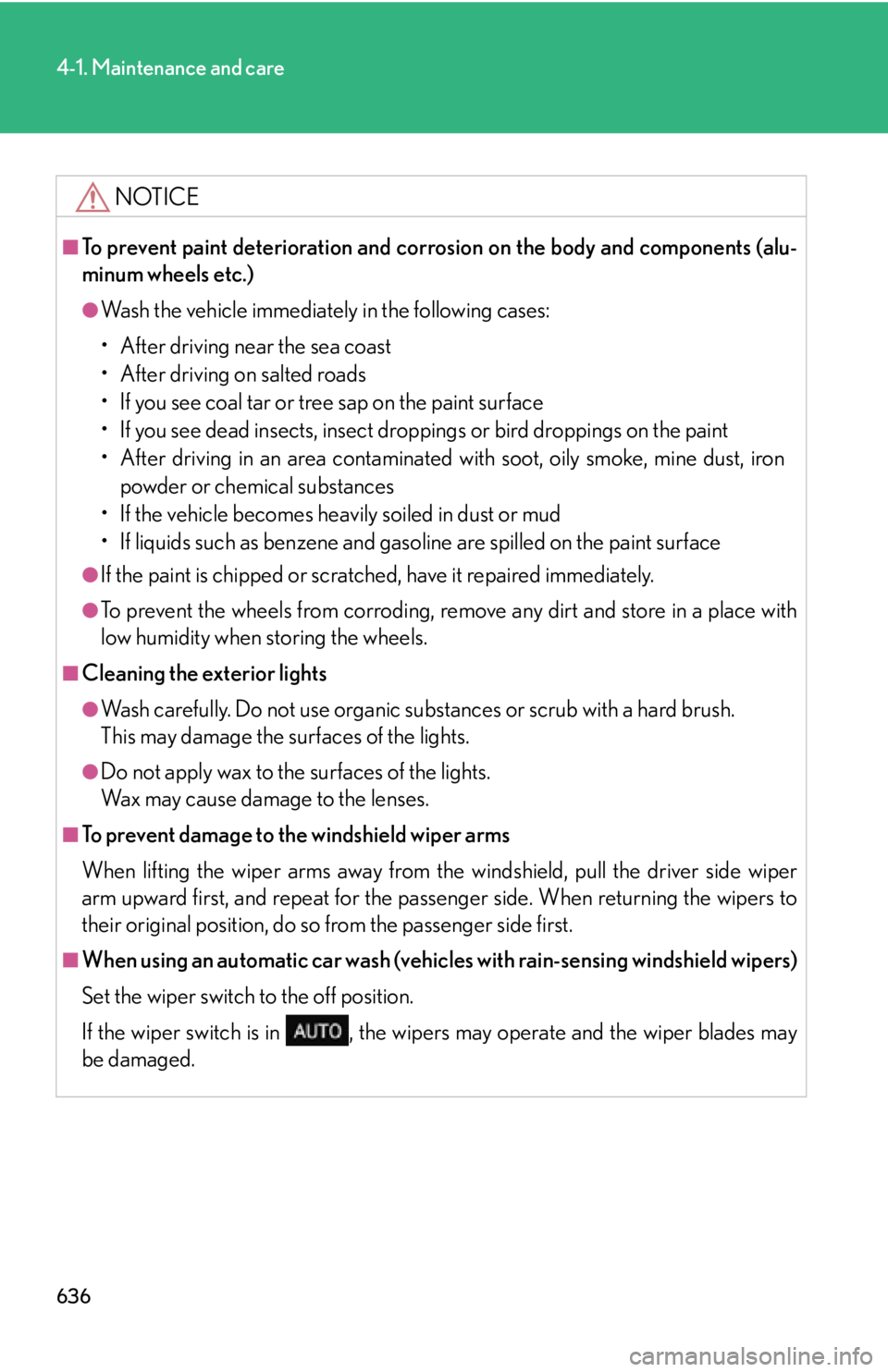
NOTICE■
To prevent paint deterioration and corros ion on the body and components (alu-
minum wheels etc.) ●
Wash the vehicle immediately in the following cases:
• After driving near the sea coast
• After driving on salted roads
• If you see coal tar or tree sap on the paint surface
• If you see dead in sects, insect droppings or bird droppings on the paint
• After driving in an area contaminated with soot, oily smoke, mine dust, iron
powder or chemical substances
• If the vehicle becomes heavily soiled in dust or mud
• If liquids such as benzene and gasoline are spilled on the paint surface●
If the paint is chipped or scratched, have it repaired immediately.●
To prevent the wheels from corroding, remove any dirt and store in a place with
low humidity when storing the wheels.■
Cleaning the exterior lights ●
Wash carefully. Do not use organic substances or scrub with a hard brush.
This may damage the surfaces of the lights.●
Do not apply wax to the surfaces of the lights.
Wax may cause damage to the lenses.■
To prevent damage to the windshield wiper arms
When lifting the wiper arms away from th e windshield, pull the driver side wiper
arm upward first, and repeat for the passenger side. When returning the wipers to
their original position, do so from the passenger side first.■
When using an automatic car wash (vehicle s with rain-sensing windshield wipers)
Set the wiper switch to the off position.
If the wiper switch is in , the wipers may operate and the wiper blades may
be damaged.
Page 639 of 878

6394-1. Maintenance and care
4
Maintenance and care NOTICE■
Cleaning detergents ●
Do not use the following types of detergent, as they may discolor the vehicle inte-
rior or cause streaks or damage to painted surfaces:
• Non-seat portions: Organic substances such as benzene or gasoline, alkaline
or acidic solutions, dye, or bleach
• Seats: Acidic solutions, such as thinner, benzene, or alcohol●
Do not use polish wax or polish cleaner. The instrument panel's or other interior
part’s painted surface may be damaged.■
Preventing damage to leather surfaces
Observe the following precautions to avoid damage to and deterioration of leather
surfaces: ●
Remove any dust or dirt from leather surfaces immediately.●
Do not expose the vehicle to direct sunlight for extended pe riods of time. Park
the vehicle in the shade, especially during summer.●
Do not place items made of vinyl, plastic, or that contain wax on the upholstery, as
they may stick to the leather surface if th e vehicle interior heats up significantly.■
Water on the floor
Do not wash the vehicle floor with water.
Vehicle systems such as the audio syst em may be damaged if water comes into
contact with electrical components under the floor of vehicle. Water may also
cause the body to rust.■
Cleaning the inside of the rear window ●
Do not use glass cleaner to clean the re ar window, as this may cause damage to
the rear window defogger heater wires or antenna. Use a cloth dampened with
lukewarm water to gently wipe the window clean. Wipe the window in strokes
running parallel to the heater wires or antenna.
●
Be careful not to scratch or damage the heater wires or antenna.
Page 645 of 878
6454-2. Maintenance
4
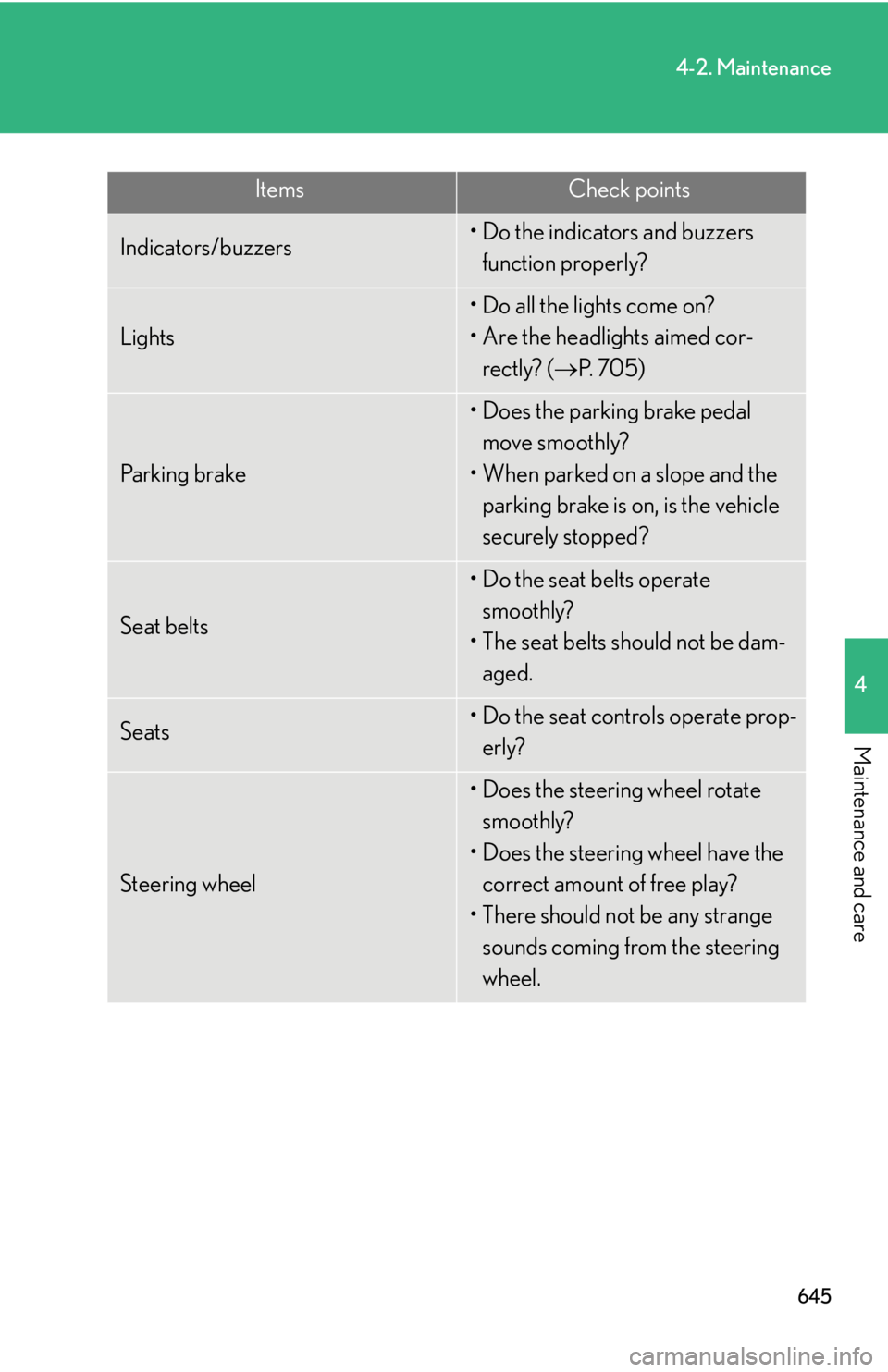
Maintenance and care Items Check points
Indicators/buzzers • Do the indicators and buzzers
function properly?
Lights • Do all the lights come on?
• Are the headlights aimed cor-
rectly? ( P. 7 0 5 )
Pa r k i n g b r a ke • Does the parking brake pedal
move smoothly?
• When parked on a slope and the
parking brake is on, is the vehicle
securely stopped?
Seat belts • Do the seat belts operate
smoothly?
• The seat belts should not be dam-
aged.
Seats • Do the seat controls operate prop-
erly?
Steering wheel • Does the steering wheel rotate
smoothly?
• Does the steering wheel have the
correct amount of free play?
• There should not be any strange
sounds coming from the steering
wheel.
Page 649 of 878
6494-3. Do-it-yourself maintenance
4
Maintenance and care Items Pa r t s a n d t o o l s
Engine oil level ( P. 6 5 6 ) • “Toyota Genuine Motor Oil” or
equivalent
•Rag or paper towel
• Funnel (used only for adding
engine oil)
Fuses ( P. 6 8 9 ) • Fuse with same amperage rating as
original
Tire inflation pressure ( P. 6 7 9 ) • Tire pressure gauge
• Compressed air source
Headlight aim ( P. 7 0 5 ) • Phillips-head screwdriver
Radiator and condenser ( P. 6 6 1 )
Wa s h e r f l u i d ( P. 663) • Water or washer fluid containing
antifreeze (for winter use)
• Funnel (used only for adding water
or washer fluid)
Page 651 of 878
6514-3. Do-it-yourself maintenance
4
Maintenance and care Hood
CAUTION■
Pre-driving check
Check that the hood is fully closed and locked.
If the hood is not locked properly, it may open while the vehicle is in motion and
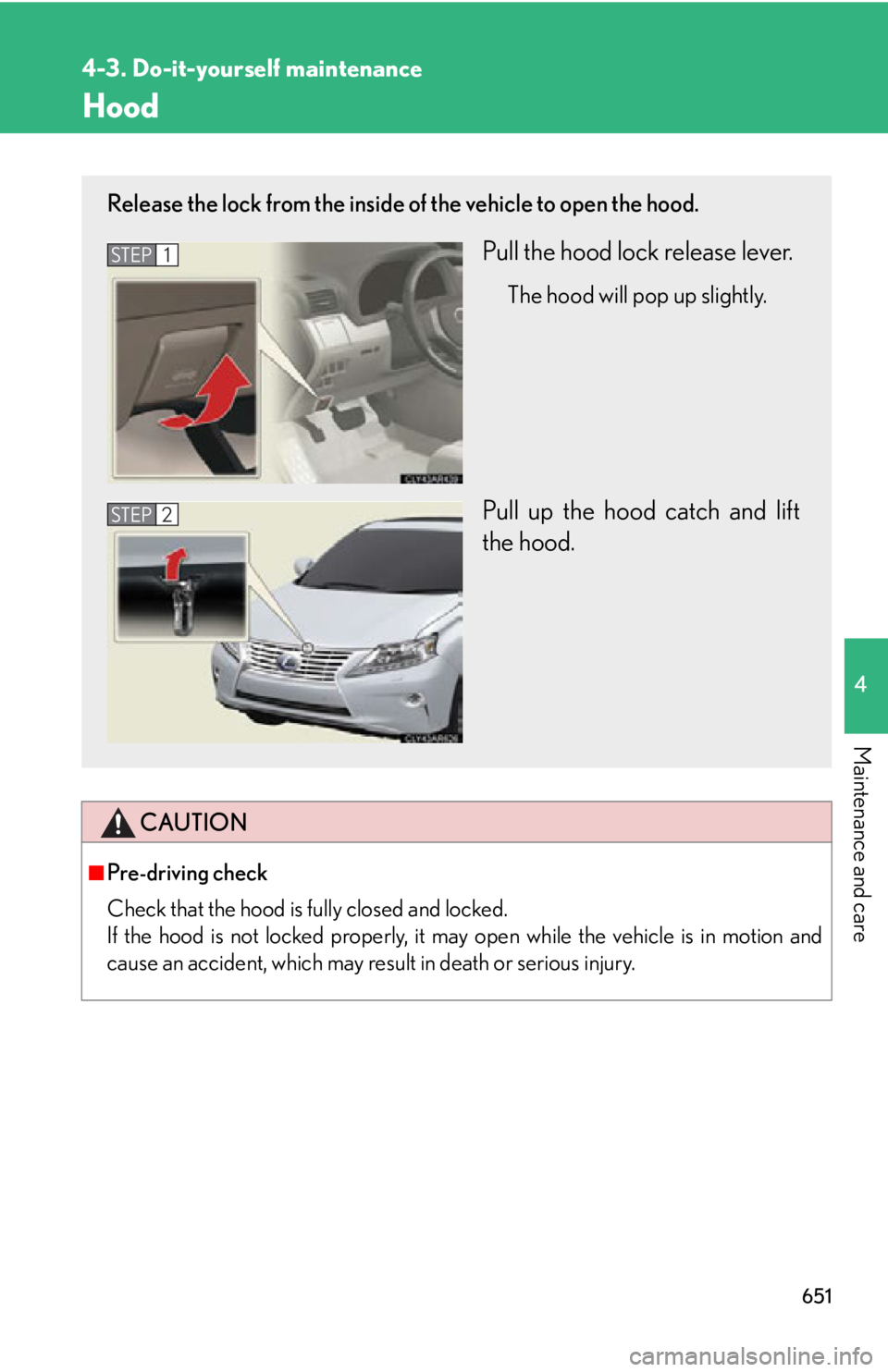
cause an accident, which may result in death or serious injury.Release the lock from the inside of the vehicle to open the hood.
Pull the hood lock release lever. The hood will pop up slightly.
Pull up the hood catch and lift
the hood.STEP 1
STEP 2
Page 663 of 878

6634-3. Do-it-yourself maintenance
4
Maintenance and care
Washer fluid
If any washer does not work or the
warning message appears on the
multi-information display, the
washer tank may be empty. Add
washer fluid.NOTICE■
If the fluid level is low or high
It is normal for the brake fluid level to go down slightly as the brake pads wear out or
when the fluid level in the accumulator is high.
If the reservoir needs frequent re filling, may be a serious problem.
CAUTION■
When adding washer fluid
Do not add washer fluid when the hybrid system is hot or operating as washer fluid
contains alcohol and may catch fire if spilled on the hybrid system etc.
NOTICE■
Do not use any fluid other than washer fluid
Do not use soapy water or engine antifreeze instead of washer fluid.
Doing so may cause streaking on the vehicle’s painted surfaces.
■
Diluting washer fluid
Dilute washer fluid with water as necessary.
Refer to the freezing temperatures listed on the label of the washer fluid bottle.
Page 668 of 878
6684-3. Do-it-yourself maintenance
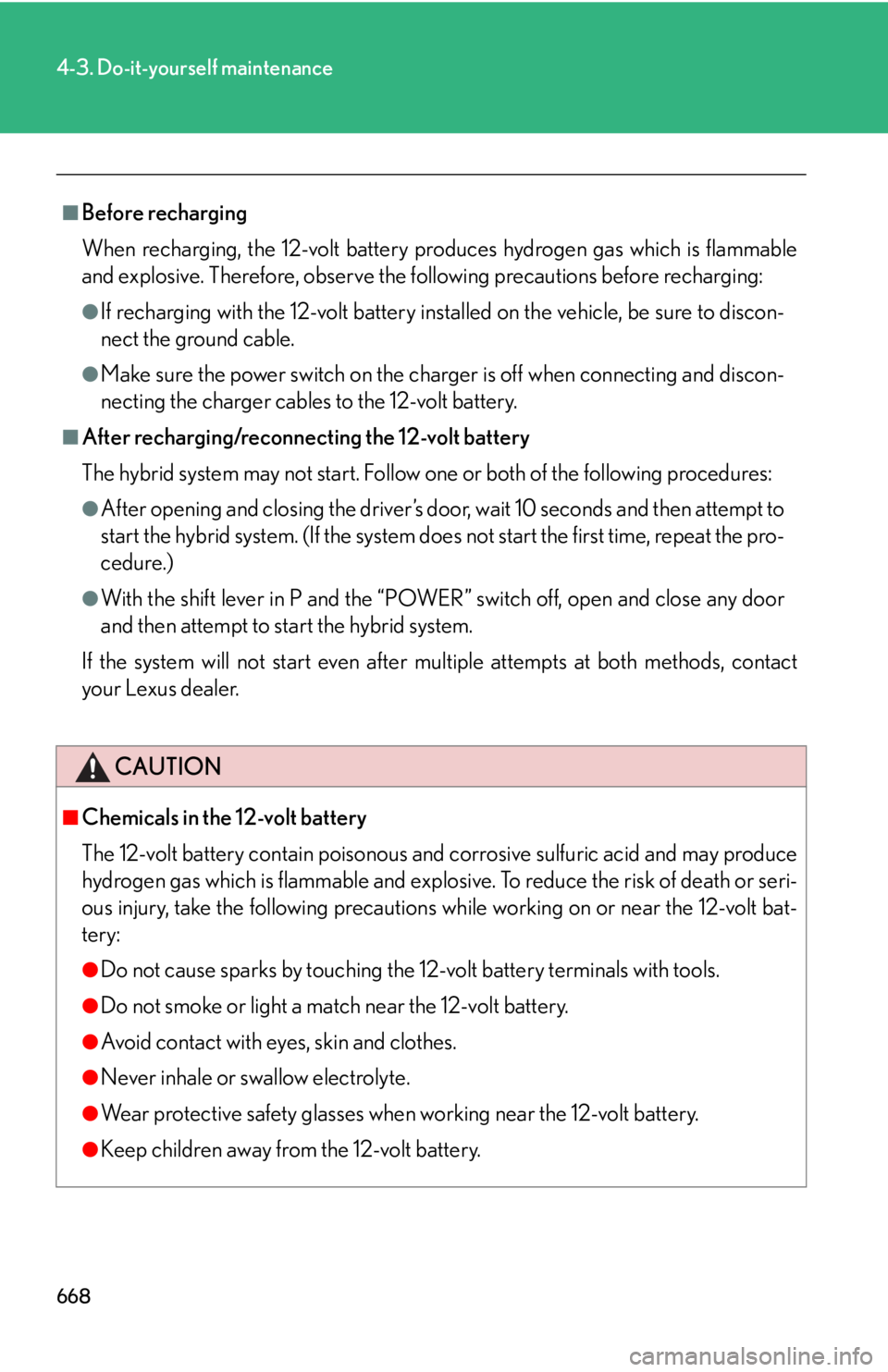
■
Before recharging
When recharging, the 12-volt battery produces hydrogen gas which is flammable
and explosive. Therefore, observe the following precautions before recharging: ●
If recharging with the 12-volt battery installed on the vehicle, be sure to discon-
nect the ground cable.●
Make sure the power switch on the charger is off when connecting and discon-
necting the charger cables to the 12-volt battery.■
After recharging/reconnecting the 12-volt battery
The hybrid system may not start. Follow one or both of the following procedures: ●
After opening and closing the driver’s do or, wait 10 seconds and then attempt to
start the hybrid system. (If the system does not start the first time, repeat the pro-
cedure.)●
With the shift lever in P and the “POWER” switch off, open and close any door
and then attempt to start the hybrid system.
If the system will not start even after mult iple attempts at both methods, contact
your Lexus dealer.
CAUTION■
Chemicals in the 12-volt battery
The 12-volt battery contain poisonous and corrosive sulfuric acid and may produce
hydrogen gas which is flammable and explosiv e. To reduce the risk of death or seri-
ous injury, take the following precautions while working on or near the 12-volt bat-
tery: ●
Do not cause sparks by touching the 12-volt battery terminals with tools.●
Do not smoke or light a match near the 12-volt battery.
●
Avoid contact with eyes, skin and clothes.
●
Never inhale or swallow electrolyte.
●
Wear protective safety glasses when working near the 12-volt battery.
●
Keep children away from the 12-volt battery.