Page 278 of 886

2782-4. Using other driving systems
Pre-Collision System When the radar sensor detects the possib ility of a frontal collision, the pre-
collision system such as the brakes and seat belts are automatically
engaged to lessen impact as well as vehicle damage.
■ Pre-collision seat belts (front seat belts only) If the pre-collision sensor detects that a collision is unavoidable, the pre-
collision system will retract the seat belt before the collision occurs.
The same will happen if the driver makes an emergency braking or loses
control of the vehicle. ( P. 8 5 )
However, the system will not operate in the event of skidding when the
VSC system is disabled.
■ Pre-collision brake assist When there is a high possibility of a frontal collision, the system applies
greater braking force in relation to how strongly the brake pedal is
depressed. The system may not warn the driver using a warning light,
warning display and buzzer when the system detects and judges braking
operations.
■ Pre-collision braking When there is a high possibility of a frontal collision, the system warns the
driver using a warning light, warnin g display and buzzer. If the system
determines that a collision is unavoidable, the brakes are automatically
applied to reduce the collision speed. Pre-collision braking can be dis-
abled using the pre-collision braking off switch.
: If equipped
Page 280 of 886

2802-4. Using other driving systems
■
The pre-collision system is operational when ●
Pre-collision seat belts (type A):
• Vehicle speed is greater than about 4 mph (5 km/h).
• The speed at which your vehicle is approaching the obstacle or the vehicle
running ahead of you is greater than about 19 mph (30 km/h).
• The front occupants are wearing a seat belt.●
Pre-collision seat belts (type B):
• Vehicle speed is greater than about 19 mph (30 km/h).
• The system detects sudd en braking or skidding.
• The front occupants are wearing a seat belt.●
Pre-collision brake assist:
• Vehicle speed is greater than about 19 mph (30 km/h).
• The speed at which your vehicle is approaching the obstacle or the vehicle
running ahead of you is greater than about 19 mph (30 km/h).
• The brake pedal is depressed.●
Pre-collision braking:
• The pre-collision braking off switch is not pressed.
• Vehicle speed is greater than about 10 mph (15 km/h).
• The speed at which your vehicle is approaching the obstacle or the vehicle
running ahead of you is greater than about 10 mph (15 km/h).
Page 281 of 886

2812-4. Using other driving systems
2
When driving ■
Conditions that may trigger the system even if there is no possibility of collision ●
When there is an object by the roadside at the entrance to a curve●
When passing an oncoming vehicle on a curve●
When driving over a narrow iron bridge●
When there is a metal object on the road surface●
When driving on an uneven road surface●
When passing an oncoming vehicle on a left-turn●
When your vehicle rapidly closes on the vehicle in front●
When a grade separation/interchange, sign, billboard, or other structure
appears to be directly in the vehicle's line of travel●
When climbing a steep hill causes an over head billboard or ot her metallic struc-
ture to appear directly in the vehicle's line of travel●
When an extreme change in vehicle height occurs●
When the axis of the radar is out of adjustment●
When passing through certain toll gates●
When driving on a bridge●
When passing through a tunnel
When the system is activated in the situations described above, there is also a possi-
bility that the seat belts will retract quickly and the brakes will be applied with a force
greater than normal. When the seat belt is locked in the retracted position, stop the
vehicle in a safe place, release the seat belt and refasten it.
Page 292 of 886
2922-5. Driving information
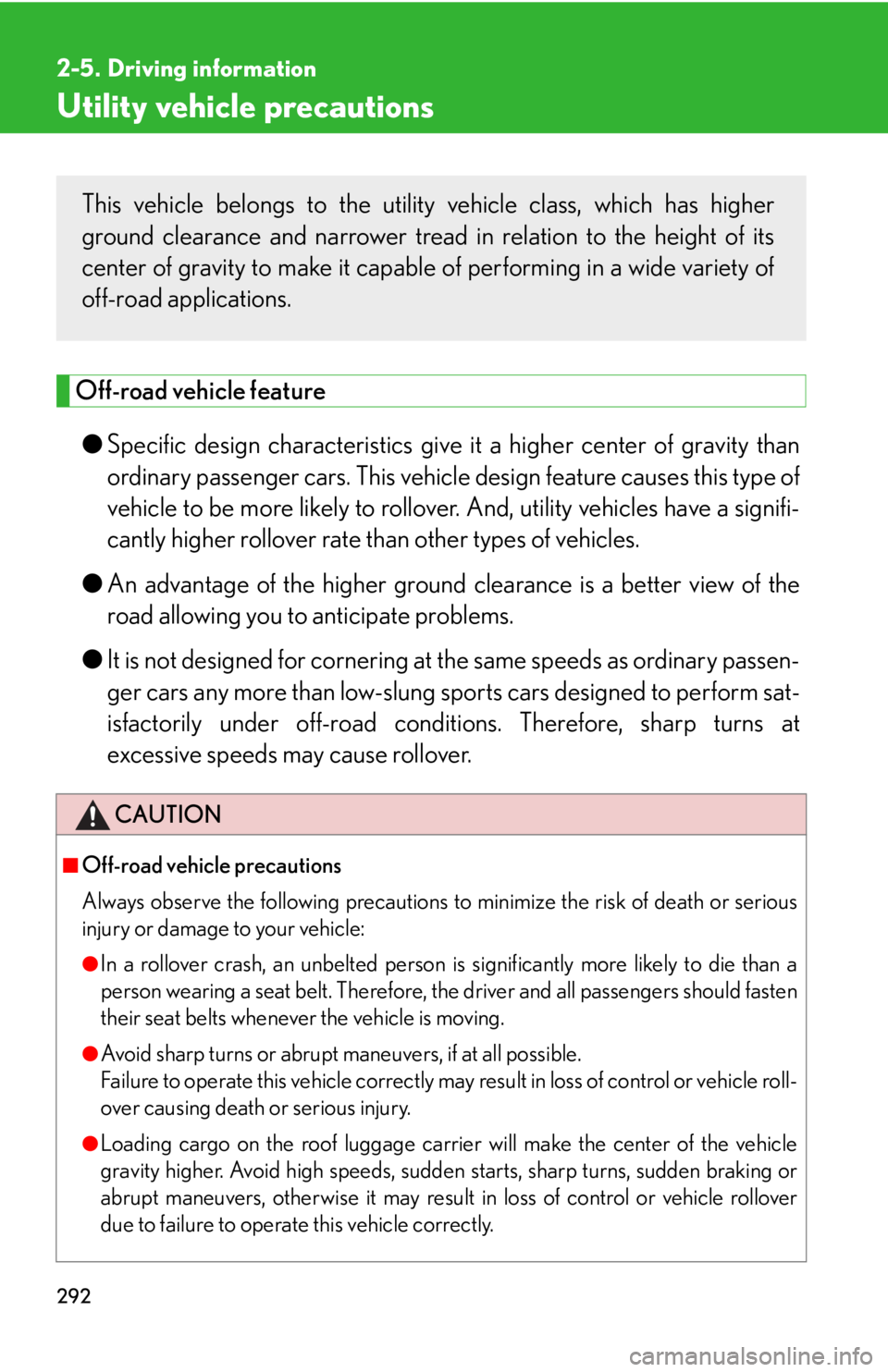
Utility vehicle precautions
Off-road vehicle feature
● Specific design characteristics give it a higher center of gravity than
ordinary passenger cars. This vehicle design feature causes this type of
vehicle to be more likely to rollov er. And, utility vehicles have a signifi-
cantly higher rollover rate than other types of vehicles.
● An advantage of the higher ground clearance is a better view of the
road allowing you to anticipate problems.
● It is not designed for cornering at the same speeds as ordinary passen-
ger cars any more than low-slung sports cars designed to perform sat-
isfactorily under off-road condit ions. Therefore, sharp turns at
excessive speeds may cause rollover.
CAUTION■
Off-road vehicle precautions
Always observe the following precautions to minimize the risk of death or serious
injury or damage to your vehicle: ●
In a rollover crash, an unbelted person is significantly more likely to die than a
person wearing a seat belt. Therefore, the driver and all passengers should fasten
their seat belts whenever the vehicle is moving.
●
Avoid sharp turns or abrupt maneuvers, if at all possible.
Failure to operate this vehicle correctly may result in loss of control or vehicle roll-
over causing death or serious injury.
●
Loading cargo on the roof luggage carrier will make the center of the vehicle
gravity higher. Avoid high speeds, sudden starts, sharp turns, sudden braking or
abrupt maneuvers, otherwise it may result in loss of control or vehicle rollover
due to failure to operate this vehicle correctly.This vehicle belongs to the utilit y vehicle class, which has higher
ground clearance and narrower tread in relation to the height of its
center of gravity to make it capable of performing in a wide variety of
off-road applications.
Page 299 of 886

2992-5. Driving information
2
When driving CAUTION●
Never allow anyone to ride in the luggage compartment. It is not designed for
passengers. They should ride in their seat s with their seat belt s properly fastened.
Otherwise, they are much more likely to suffer death or serious bodily injury, in
the event of sudden braking, sudden swerving or an accident.■
Capacity and distribution ●
Do not exceed the maximum axle weight ra ting or the total vehicle weight rating. ●
Even if the total load of occupant's weight and the cargo load is less than the total
load capacity, do not apply the load unevenly. Improper loading may cause dete-
rioration of steering or braking control which may cause death or serious injury.■
Roof luggage carrier precautions (if equipped)
To use the roof rails as a roof luggage carrier, you must fit the roof rails with two or
more genuine Lexus cross rails or their equivalent.
When you load cargo on the roof luggage carrier, observe the following:
●
Before driving, make sure the cargo is securely fastened on the roof luggage car-
rier.●
Loading cargo on the roof luggage carrier will make the center of gravity of the
vehicle higher. Avoid high speeds, sudden starts, sharp turns, sudden braking or
abrupt maneuvers, otherwise the result may be a loss of control or vehicle roll-
over due to failure to operate this vehicl e correctly and result in death or serious
injury.
●
If driving for long distances, on rough ro ads, or at high spee ds, stop the vehicle
now and then during the trip to make sure the cargo remains in its place.
●
Do not exceed 165 lb. (75 kg) cargo weight on the roof luggage carrier.
●
To reduce wind noise when there is no luggage loaded on the roof luggage car-
rier, move the front cross rail to the front-most position and the rear cross rail to
the rearmost position. ●
Place the cargo so that its weight is distrib-
uted evenly between the front and rear
axles. ●
If loading long or wide cargo, never exceed
the vehicle’s overall length or width.
( P. 8 0 6 )Cross rails
Roof rails
Page 654 of 886

6544-1. Maintenance and care
■
Caring for leather areas
Lexus recommends cleaning the interior of the vehicle at least twice a year to main-
tain the quality of the vehicle’s interior.■
Shampooing the carpets
There are several commercial foaming-type cleaners available. Use a sponge or
brush to apply the foam. Rub in overlappin g circles. Do not apply water. Excellent
results are obtained by keeping the carpet as dry as possible.■
Seat belts
Clean with mild soap and lukewarm water using a cloth or sponge. Also check the
belts periodically for excessive wear, fraying or cuts.
CAUTION■
Water in the vehicle ●
Do not splash or spill liquid in the vehicle.
Doing so may cause electrical components etc. to malfunction or catch fire.●
Do not get any of the SRS components or wiring in the vehicle interior wet.
( P. 121)
An electrical malfunction may cause the airbags to deploy or not function prop-
erly, resulting in death or severe injury.■
Cleaning the interior (especially instrument panel)
Do not use polish wax or polish cleaner. The instrument panel may reflect off the
windshield, obstructing the driver's view and leading to an accident, resulting in
death or serious injury.
Page 661 of 886
6614-2. Maintenance
4
Maintenance and care Items Check points
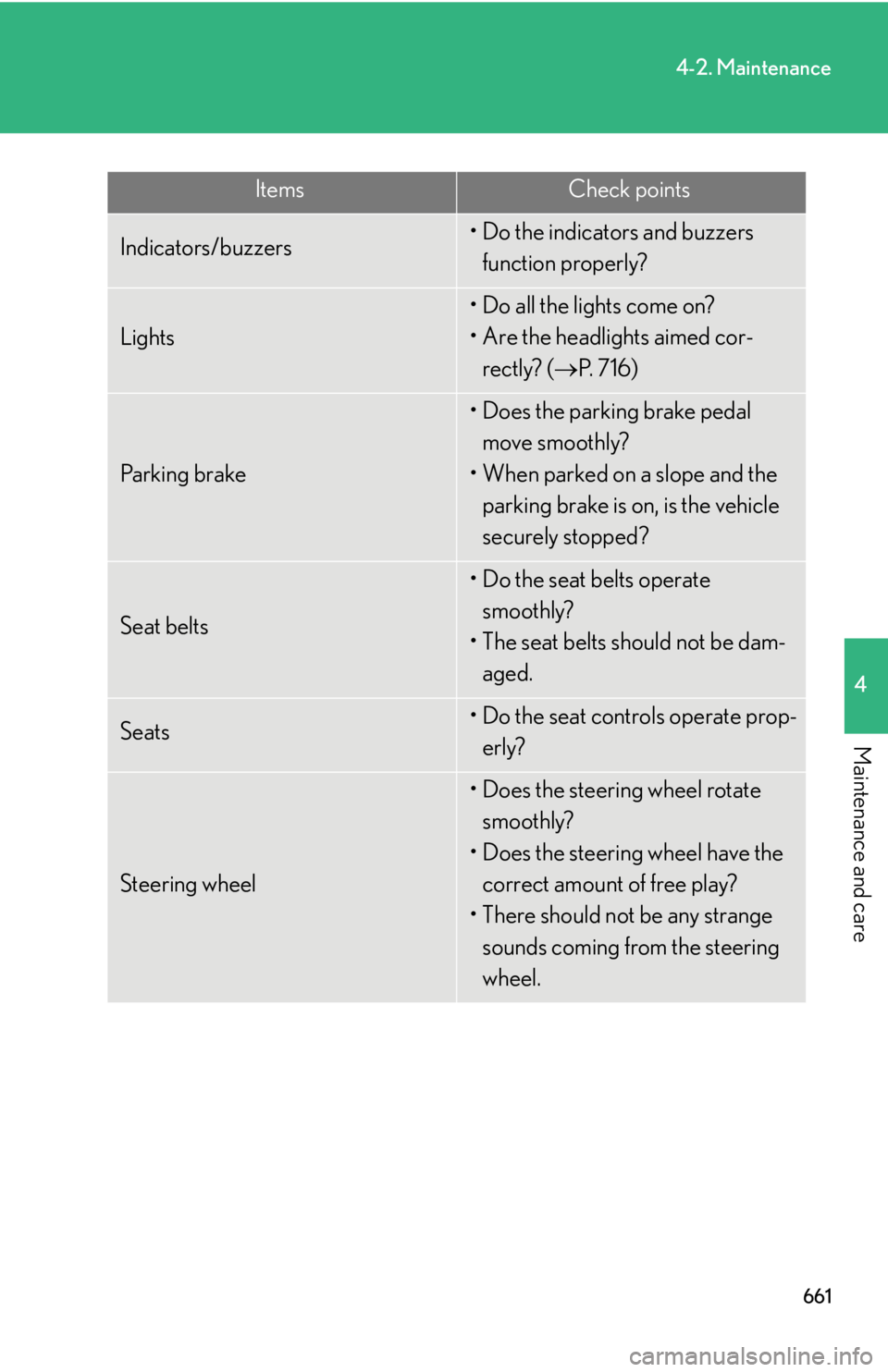
Indicators/buzzers • Do the indicators and buzzers
function properly?
Lights • Do all the lights come on?
• Are the headlights aimed cor-
rectly? ( P. 7 1 6 )
Pa r k i n g b r a ke • Does the parking brake pedal
move smoothly?
• When parked on a slope and the
parking brake is on, is the vehicle
securely stopped?
Seat belts • Do the seat belts operate
smoothly?
• The seat belts should not be dam-
aged.
Seats • Do the seat controls operate prop-
erly?
Steering wheel • Does the steering wheel rotate
smoothly?
• Does the steering wheel have the
correct amount of free play?
• There should not be any strange
sounds coming from the steering
wheel.
Page 666 of 886

6664-3. Do-it-yourself maintenance
CAUTIONThe engine compartment contains many mechanisms and fluids that may move sud-
denly, become hot, or become electrically energized. To avoid death or serious injury,
observe the following precautions: ■
When working on the engine compartment ●
Keep hands, clothing and tools away from the moving fans and engine drive belt.●
Be careful not to touch the engine, radiator , exhaust manifold, etc. right after driv-
ing as they may be hot. Oil and other fluids may also be hot.●
Do not leave anything that may burn easi ly, such as paper and rags, in the engine
compartment.●
Do not smoke, cause sparks or expose an open flame to fuel or the battery. Fuel
and battery fumes are flammable.●
Be extremely cautious when working on the battery. It contains poisonous and
corrosive sulfuric acid.■
When working near the electric cooling fans or radiator grille
Be sure the “ENGINE START STOP” switch is off.
With the “ENGINE START STOP” switch in IGNITION ON mode, the electric
cooling fans may automatically start to run if the air conditioning is on and/or the
coolant temperature is high. ( P. 6 7 8 )■
Safety glasses
Wear safety glasses to prevent flying or falling material, fluid spray, etc. from getting
in your eyes.
NOTICE■
If you remove the air cleaner filter
Driving with the air cleaner filter removed may cause excessive engine wear due to
dirt in the air.