2015 LEXUS LS600H inflation pressure
[x] Cancel search: inflation pressurePage 500 of 620

4987-2. Steps to take in an emergency
LS600hL_U(OM50E41U)
■SRS warning light
This warning light system monitors the airbag sensor assembly, front impact sensors,
side impact sensors (front door), side impact sensors (front), side impact sensors
(rear door) side impact sensors (rear), driver ’s seat position sensor, driver’s seat belt
buckle switch, front passenger occupant classification system (ECU and sensors),
“AIR BAG ON” indicator light, “AIR BAG OFF” indicator light, front passenger’s seat
belt buckle switch, seat belt pretensioner s and force limiters, airbags, interconnect-
ing wiring and power sources. ( P. 44)
■Front passenger detection sensor, seat belt reminder and warning buzzer
●If luggage is placed on the front passenger seat, the front passenger detection sen-
sor may cause the warning light to flash an d the warning buzzer to sound even if a
passenger is not sitting in the seat.
●If a cushion is placed on the seat, the sensor may not detect a passenger, and the
warning light may not operate properly.
■Electric power steering system warning light
When the 12-volt battery charge becomes insufficient or the voltage temporarily
drops, the electric power steering system warning light may come on.
■If the malfunction indicator lamp comes on while driving
First check the following:
●Is the fuel tank empty?
If it is, fill the fuel tank immediately.
●Is the fuel tank cap loose?
If it is, tighten it securely.
The light will go off after several driving trips.
If the light does not go off even after several trips, contact your Lexus dealer as soon
as possible.
■When the tire pressure warning light comes on
Check the tire inflation pressure and adjust it to the appropriate level. Pushing the
tire pressure warning reset switch will not turn off the tire pressure warning light.
Page 501 of 620

4997-2. Steps to take in an emergency
7
When trouble arises
LS600hL_U(OM50E41U)
■The tire pressure warning light may come on due to natural causes
The tire pressure warning light may come on due to natural causes such as natural
air leaks and tire inflation pressure changes caused by temperature. In this case,
adjusting the tire inflation pressure will turn off the warning light (after a few minutes).
■When a tire is replaced with a spare tire (vehicles with a spare tire)
The spare tire is also equipped with a tire pressure warning valve and transmitter. The
tire pressure warning light will turn on if the tire inflation pressure of the spare tire is
low. If a tire goes flat, the tire pressure warning light will not turn off even though the
flat tire has been replaced with the spare tire.
■Conditions that the tire pressure warning system may not function properly
P. 4 5 9
■If the tire pressure warning light freque ntly comes on after blinking for 1 minute
If the tire pressure warning light frequently comes on after blinking for 1 minute when
the power switch is turned to ON mode, have it checked by your Lexus dealer.
■Warning buzzer
In some cases, the buzzer may not be hear d due to ambient noise or sounds from the
audio system.
■Customization
The vehicle speed linked seat belt reminder buzzer can be disabled.
(Customizable features P. 5 7 2 )
Page 502 of 620
5007-2. Steps to take in an emergency
LS600hL_U(OM50E41U)
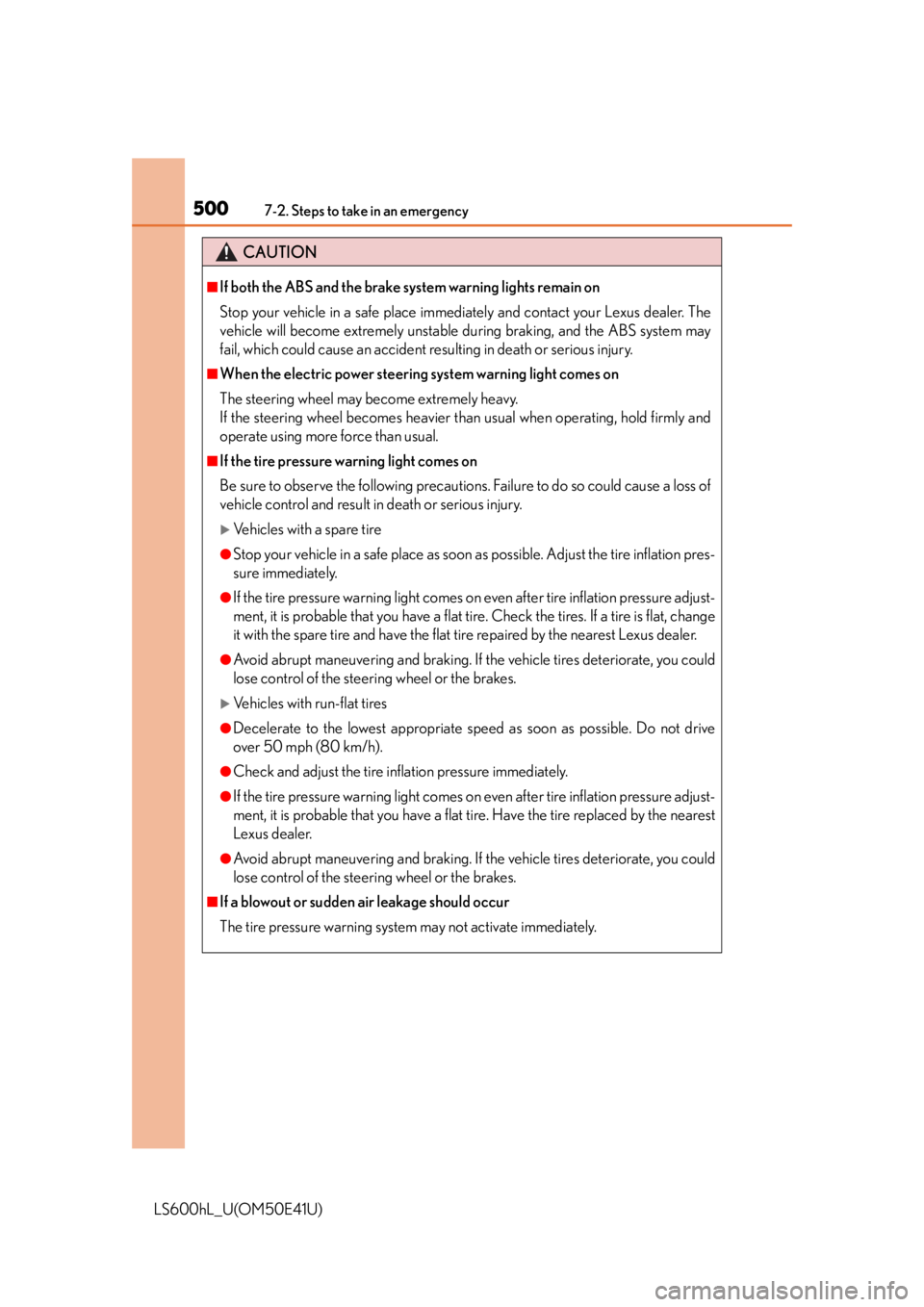
CAUTION
■If both the ABS and the brake system warning lights remain on
Stop your vehicle in a safe place immediately and contact your Lexus dealer. The
vehicle will become extremely unstable during braking, and the ABS system may
fail, which could cause an accident resulting in death or serious injury.
■When the electric power steering system warning light comes on
The steering wheel may become extremely heavy.
If the steering wheel becomes heavier than usual when operating, hold firmly and
operate using more force than usual.
■If the tire pressure warning light comes on
Be sure to observe the following precautions. Failure to do so could cause a loss of
vehicle control and result in death or serious injury.
Vehicles with a spare tire
●Stop your vehicle in a safe place as soon as possible. Adjust the tire inflation pres-
sure immediately.
●If the tire pressure warning light comes on even after tire inflation pressure adjust-
ment, it is probable that you have a flat tire. Check the tires. If a tire is flat, change
it with the spare tire and have the flat tire repaired by the nearest Lexus dealer.
●Avoid abrupt maneuvering and braking. If the vehicle tires deteriorate, you could
lose control of the steering wheel or the brakes.
Vehicles with run-flat tires
●Decelerate to the lowest appropriate speed as soon as possible. Do not drive
over 50 mph (80 km/h).
●Check and adjust the tire inflation pressure immediately.
●If the tire pressure warning light comes on even after tire inflation pressure adjust-
ment, it is probable that you have a flat tire. Have the tire replaced by the nearest
Lexus dealer.
●Avoid abrupt maneuvering and braking. If the vehicle tires deteriorate, you could
lose control of the steering wheel or the brakes.
■If a blowout or sudden air leakage should occur
The tire pressure warning system may not activate immediately.
Page 503 of 620

5017-2. Steps to take in an emergency
7
When trouble arises
LS600hL_U(OM50E41U)
CAUTION
■Maintenance of the tires
Each tire, including the spare (if provided), should be checked monthly when cold
and inflated to the inflation pressure re commended by the vehicle manufacturer on
the vehicle placard or tire inflation pressu re label (tire and load information label).
(If your vehicle has tires of a different size than the size indicated on the vehicle
placard or tire inflation pressure label [t ire and load information label], you should
determine the proper tire inflation pressure for those tires.)
As an added safety feature, your vehicle has been equipped with a tire pressure
monitoring system (TPMS-tire pressure wa rning system) that illuminates a low tire
pressure telltale (tire pressure warning light ) when one or more of your tires is sig-
nificantly under-inflated. Accordingly, when the low tire pressure telltale (tire pres-
sure warning light) illuminates, you should stop and check your tires as soon as
possible, and inflate them to the proper pressure. Driving on a significantly under-
inflated tire causes the tire to overheat and can lead to tire failure. Under-inflation
also reduces fuel efficiency and tire trea d life, and may affect the vehicle's handling
and stopping ability.
Please note that the TPMS (tire pressure warning system) is not a substitute for
proper tire maintenance, and it is the driv er's responsibility to maintain correct tire
pressure, even if under-inflation has not re ached the level to trigger illumination of
the TPMS low tire pressure telltale (tire pressure warning light).
Your vehicle has also been equipped with a TPMS (tire pressure warning system)
malfunction indicator to indicate when th e system is not operating properly. The
TPMS (tire pressure warning system) malfunction indicator is combined with the
low tire pressure telltale (tire pressure warning light). When the system detects a
malfunction, the telltale will flash for approximately one minute and then remain
continuously illuminated. This sequence will continue upon subsequent vehicle
start-ups as long as the malfunction exists . When the malfunction indicator is illumi-
nated, the system may not be able to detect or signal low tire pressure as intended.
Page 548 of 620
5468-1. Specifications
LS600hL_U(OM50E41U)
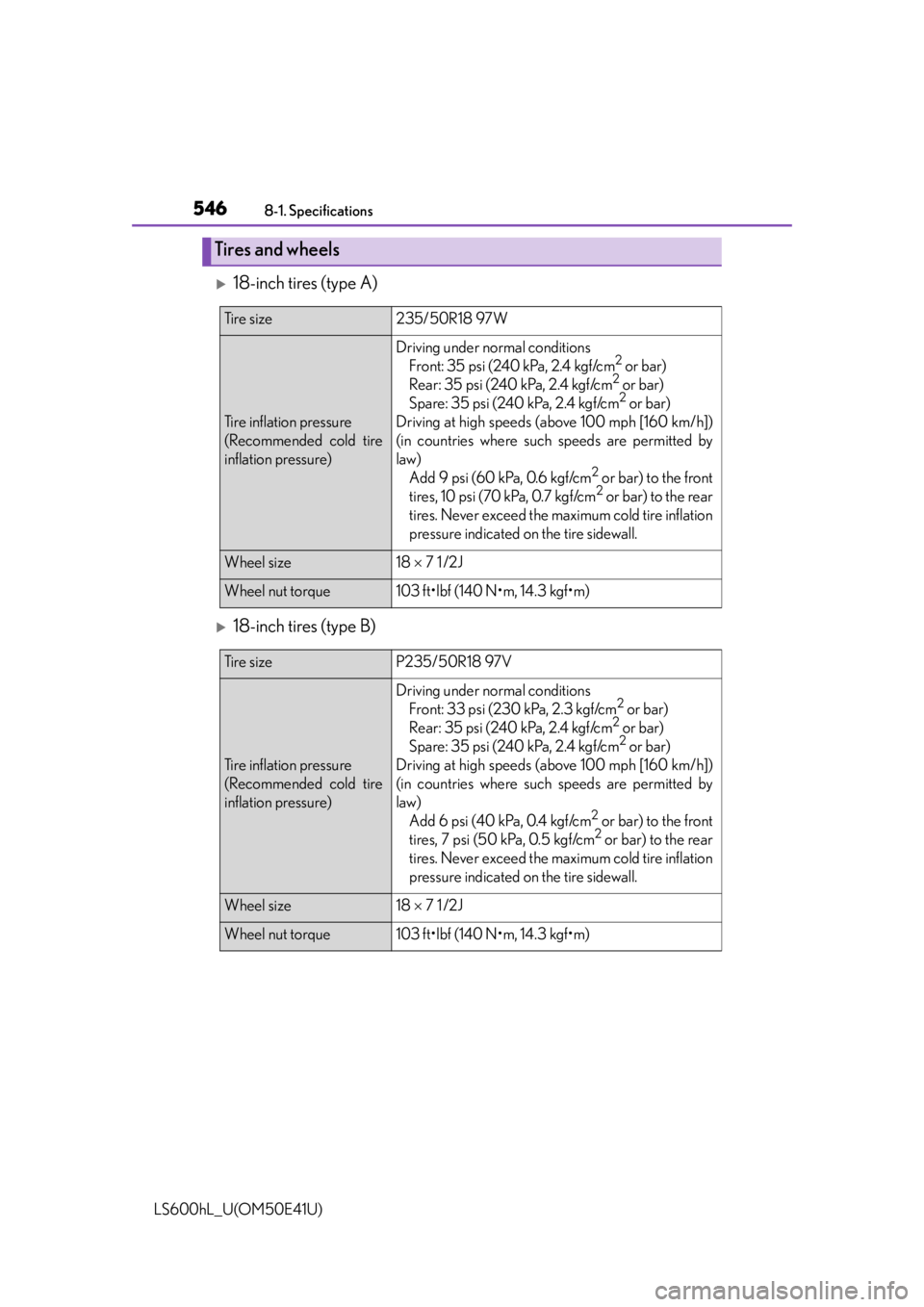
18-inch tires (type A)
18-inch tires (type B)
Tires and wheels
Ti r e s i z e235/50R18 97W
Tire inflation pressure
(Recommended cold tire
inflation pressure)
Driving under normal conditionsFront: 35 psi (240 kPa, 2.4 kgf/cm2 or bar)
Rear: 35 psi (240 kPa, 2.4 kgf/cm2 or bar)
Spare: 35 psi (240 kPa, 2.4 kgf/cm2 or bar)
Driving at high speeds (above 100 mph [160 km/h])
(in countries where such speeds are permitted by
law) Add 9 psi (60 kPa, 0.6 kgf/cm
2 or bar) to the front
tires, 10 psi (70 kPa, 0.7 kgf/cm2 or bar) to the rear
tires. Never exceed the maximum cold tire inflation
pressure indicated on the tire sidewall.
Wheel size18 7 1 /2J
Wheel nut torque103 ft•lbf (140 N•m, 14.3 kgf•m)
Ti r e s i z eP235/50R18 97V
Tire inflation pressure
(Recommended cold tire
inflation pressure)
Driving under normal conditions
Front: 33 psi (230 kPa, 2.3 kgf/cm2 or bar)
Rear: 35 psi (240 kPa, 2.4 kgf/cm2 or bar)
Spare: 35 psi (240 kPa, 2.4 kgf/cm2 or bar)
Driving at high speeds (above 100 mph [160 km/h])
(in countries where such speeds are permitted by
law) Add 6 psi (40 kPa, 0.4 kgf/cm
2 or bar) to the front
tires, 7 psi (50 kPa, 0.5 kgf/cm2 or bar) to the rear
tires. Never exceed the maximum cold tire inflation
pressure indicated on the tire sidewall.
Wheel size18 7 1 /2J
Wheel nut torque103 ft•lbf (140 N•m, 14.3 kgf•m)
Page 549 of 620
5478-1. Specifications
8
Vehicle specifications
LS600hL_U(OM50E41U)
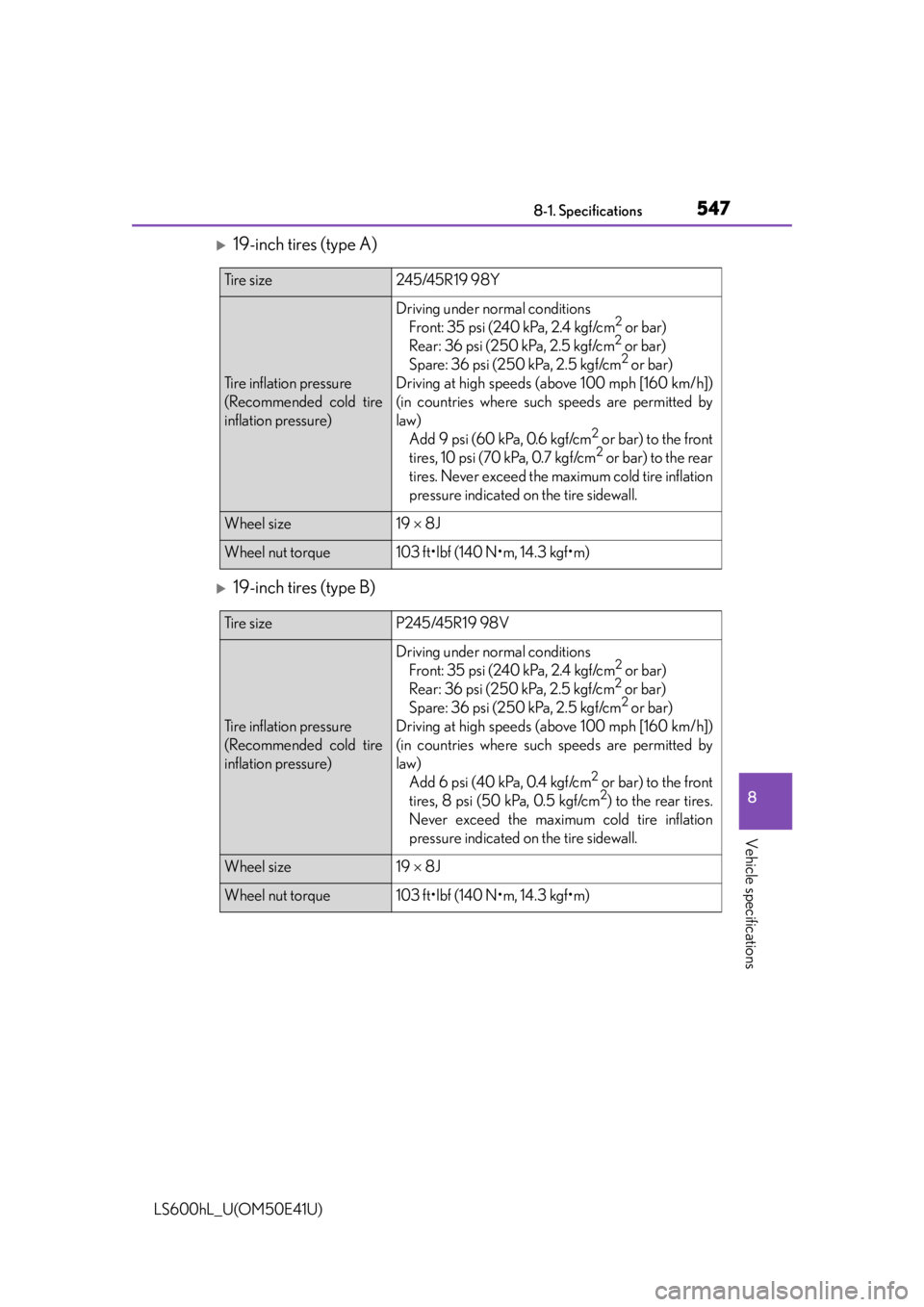
19-inch tires (type A)
19-inch tires (type B)
Ti r e s i z e245/45R19 98Y
Tire inflation pressure
(Recommended cold tire
inflation pressure)
Driving under normal conditionsFront: 35 psi (240 kPa, 2.4 kgf/cm2 or bar)
Rear: 36 psi (250 kPa, 2.5 kgf/cm2 or bar)
Spare: 36 psi (250 kPa, 2.5 kgf/cm2 or bar)
Driving at high speeds (above 100 mph [160 km/h])
(in countries where such speeds are permitted by
law) Add 9 psi (60 kPa, 0.6 kgf/cm
2 or bar) to the front
tires, 10 psi (70 kPa, 0.7 kgf/cm2 or bar) to the rear
tires. Never exceed the maximum cold tire inflation
pressure indicated on the tire sidewall.
Wheel size19 8J
Wheel nut torque103 ft•lbf (140 N•m, 14.3 kgf•m)
Ti r e s i z eP245/45R19 98V
Tire inflation pressure
(Recommended cold tire
inflation pressure)
Driving under normal conditions
Front: 35 psi (240 kPa, 2.4 kgf/cm2 or bar)
Rear: 36 psi (250 kPa, 2.5 kgf/cm2 or bar)
Spare: 36 psi (250 kPa, 2.5 kgf/cm2 or bar)
Driving at high speeds (above 100 mph [160 km/h])
(in countries where such speeds are permitted by
law) Add 6 psi (40 kPa, 0.4 kgf/cm
2 or bar) to the front
tires, 8 psi (50 kPa, 0.5 kgf/cm2) to the rear tires.
Never exceed the maximum cold tire inflation
pressure indicated on the tire sidewall.
Wheel size19 8J
Wheel nut torque103 ft•lbf (140 N•m, 14.3 kgf•m)
Page 550 of 620
5488-1. Specifications
LS600hL_U(OM50E41U)
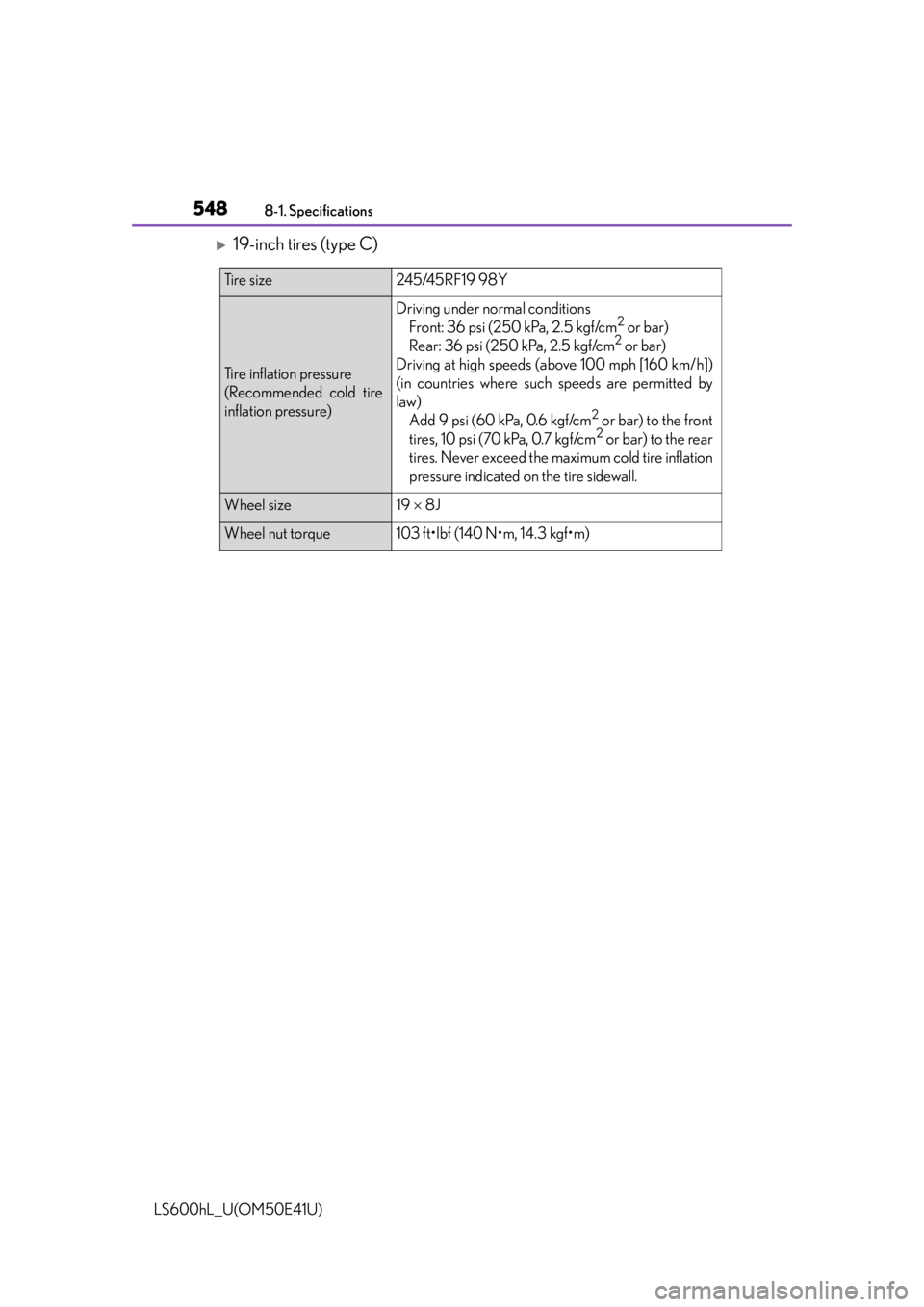
19-inch tires (type C)
Ti r e s i z e245/45RF19 98Y
Tire inflation pressure
(Recommended cold tire
inflation pressure)
Driving under normal conditionsFront: 36 psi (250 kPa, 2.5 kgf/cm2 or bar)
Rear: 36 psi (250 kPa, 2.5 kgf/cm2 or bar)
Driving at high speeds (above 100 mph [160 km/h])
(in countries where such speeds are permitted by
law)
Add 9 psi (60 kPa, 0.6 kgf/cm
2 or bar) to the front
tires, 10 psi (70 kPa, 0.7 kgf/cm2 or bar) to the rear
tires. Never exceed the maximum cold tire inflation
pressure indicated on the tire sidewall.
Wheel size19 8J
Wheel nut torque103 ft•lbf (140 N•m, 14.3 kgf•m)
Page 555 of 620
5538-1. Specifications
8
Vehicle specifications
LS600hL_U(OM50E41U)
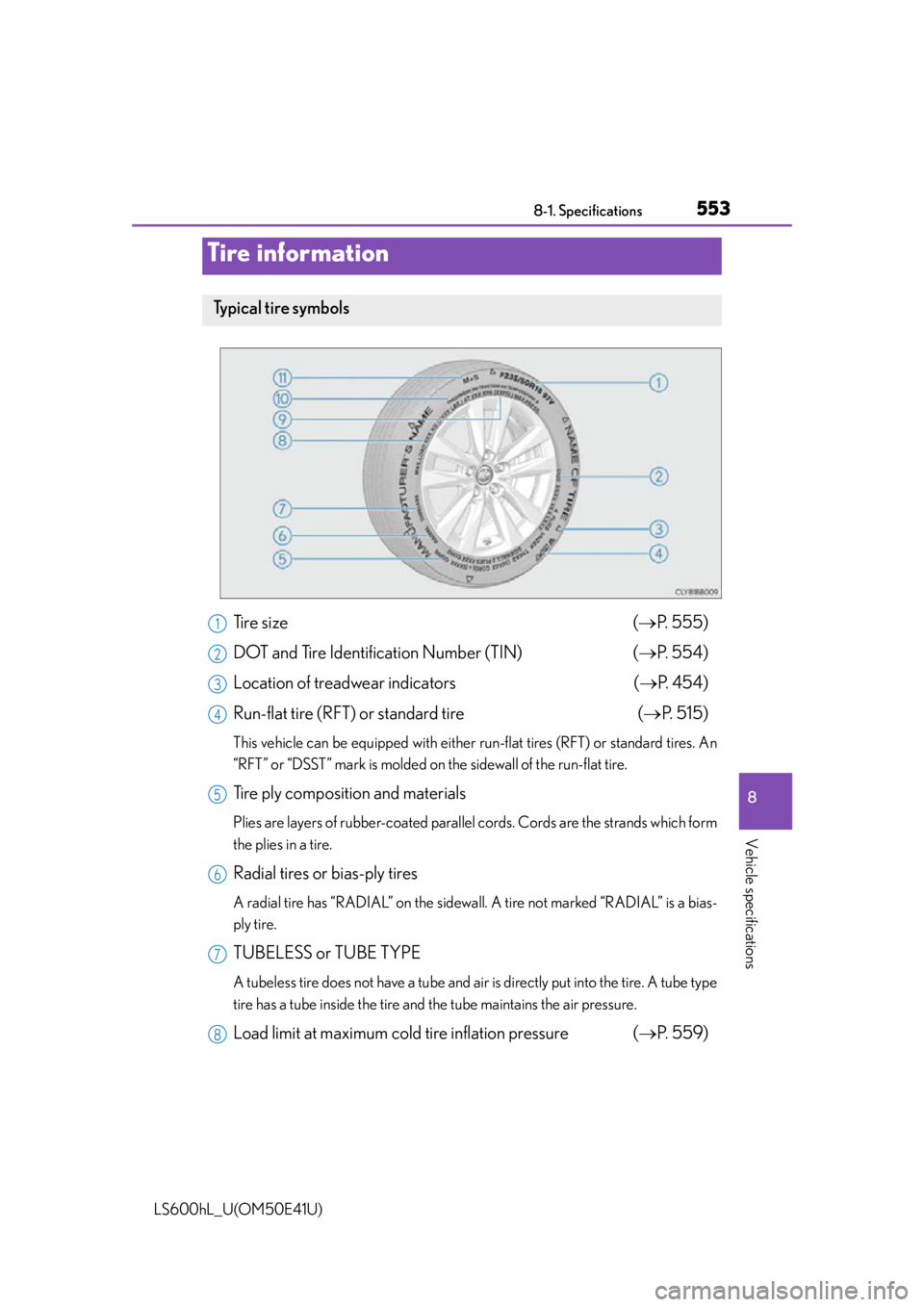
Ti r e s i z e ( P. 555)
DOT and Tire Identification Number (TIN) ( P. 5 5 4 )
Location of treadwear indicators ( P. 4 5 4 )
Run-flat tire (RFT) or standard tire ( P. 515)
This vehicle can be equipped with either run-flat tires (RFT) or standard tires. An
“RFT” or “DSST” mark is molded on the sidewall of the run-flat tire.
Tire ply composition and materials
Plies are layers of rubber-coated parallel cords. Cords are the strands which form
the plies in a tire.
Radial tires or bias-ply tires
A radial tire has “RADIAL” on the sidewall. A tire not marked “RADIAL” is a bias-
ply tire.
TUBELESS or TUBE TYPE
A tubeless tire does not have a tube and air is directly put into the tire. A tube type
tire has a tube inside the tire and the tube maintains the air pressure.
Load limit at maximum cold tire inflation pressure ( P. 559)
Tire information
Typical tire symbols
1
2
3
4
5
6
7
8