Page 390 of 678

EVIC/DID will display a “SERVICE TPM SYSTEM”
message for five seconds and then display dashes (- -)
in place of the pressure value.
5. Once you repair or replace the original road tire and
reinstall it on the vehicle in place of the compact spare
or non-matching full size, the TPMS will update
automatically. In addition, the “TPMS Telltale Light”
will turn off and the graphic in the EVIC/DID will
display a new pressure value instead of dashes (- -), as
long as no tire pressure is below the low-pressure
warning limit in any of the four active road tires. The
vehicle may need to be driven for up to 20 minutes
above 15.5 mph (25 km/h) in order for the TPMS to
receive this information.
General Information
This device complies with Part 15 of the FCC rules and
RSS 210 of Industry Canada. Operation is subject to the
following conditions:
•This device may not cause harmful interference.
•This device must accept any interference received,
including interference that may cause undesired op-
eration.
The TPM sensors are regulated under one of the follow-
ing licenses:
United StatesKR55WY9012
Canada7812D-5WY9012
FUEL REQUIREMENTS
1.4L Turbo Engine
This engine is designed to meet all emis-
sion regulations and provide satisfactory
388 STARTING AND OPERATING
Page 391 of 678

fuel economy and performance when using high-quality
unleaded#regular#gasoline having an octane rating of 87.
For optimum performance and fuel economy the use of
91 octane or higher is recommended.
2.4L Engine
All available gasoline engines are designed
to meet all emissions regulations and pro-
vide excellent fuel economy and perfor-
mance when using high quality unleaded
“regular” gasoline having an octane rating
of 87. The use of premium gasoline is not recommended,
as it will not provide any benefit over regular gasoline in
these engines.
Light spark knock at low engine speeds is not harmful to
your engine. However, continued heavy spark knock at
high speeds can cause damage and immediate service is
required. Poor quality gasoline can cause problems such
as hard starting, stalling, and hesitations. If you experi-
ence these symptoms, try another brand of gasoline
before considering service for the vehicle. Over 40 auto
manufacturers worldwide have issued and endorsed
consistent gasoline specifications (the Worldwide Fuel
Charter, WWFC) which define fuel properties necessary
to deliver enhanced emissions, performance, and dura-
bility for your vehicle. The manufacturer recommends
the use of gasoline that meet the WWFC specifications if
they are available.
Reformulated Gasoline
Many areas of the country require the use of cleaner
burning gasoline referred to as “Reformulated Gasoline.”
Reformulated gasoline contain oxygenates and are spe-
cifically blended to reduce vehicle emissions and im-
prove air quality.
7
STARTING AND OPERATING 389
Page 392 of 678

The use of reformulated gasoline is recommended. Prop-
erly blended reformulated gasoline will provide im-
proved performance and durability of engine and fuel
system components.
Gasoline/Oxygenate Blends
Some fuel suppliers blend unleaded gasoline with oxy-
genates such as ethanol.
CAUTION!
DO NOT use gasoline containing Methanol or gaso-
line containing more than 10% Ethanol. Use of these
blends may result in starting and drivability prob-
lems, damage critical fuel system components, cause
emissions to exceed the applicable standard, and/or
cause the “Malfunction Indicator Light” to illumi-
nate. Please observe pump labels as they should
clearly communicate if a fuel contains greater than
10% ethanol.
Problems that result from using gasoline containing
Methanol or gasoline containing more than 10% ethanol
are not the responsibility of the manufacturer and may
void or not be covered under New Vehicle Limited
Warranty.
E-85 Usage In Non-Flex Fuel Vehicles
Non-Flex Fuel Vehicles (FFV) are compatible with gaso-
line containing up to 10% ethanol (E10). Gasoline with
higher ethanol content may void the New Vehicle Lim-
ited Warranty.
If a Non-FFV vehicle is inadvertently fueled with E-85
fuel, the engine will have some or all of these symptoms:
•Operate in a lean mode.
•OBD II “Malfunction Indicator Light” on.
•Poor engine performance.
390 STARTING AND OPERATING
Page 394 of 678

Fuel System Cautions
CAUTION!
Follow these guidelines to maintain your vehicle’s
performance:
•The use of leaded gasoline is prohibited by Federal
law. Using leaded gasoline can impair engine per-
formance and damage the emissions control sys-
tem.
•An out-of-tune engine or certain fuel or ignition
malfunctions can cause the catalytic converter to
overheat. If you notice a pungent burning odor or
some light smoke, your engine may be out of tune
or malfunctioning and may require immediate ser-
vice. Contact your authorized dealer for service
assistance.
(Continued)
CAUTION!(Continued)
•The use of fuel additives, which are now being
sold as octane enhancers, is not recommended.
Most of these products contain high concentrations
of methanol. Fuel system damage or vehicle perfor-
mance problems resulting from the use of such
fuels or additives is not the responsibility of the
manufacturer and may void or not be covered
under the New Vehicle Limited Warranty.
NOTE:Intentional tampering with the emissions control
system can result in civil penalties being assessed against
you.
392 STARTING AND OPERATING
Page 407 of 678

Before climbing a steep hill,shift the transmission to a
lower gear and shift the 4WD System to 4WD LOW. Use
first gear and 4WD LOW for very steep hills.
If you stall or begin to lose headwaywhile climbing a
steep hill, allow your vehicle to come to a stop and
immediately apply the brakes. Restart the engine and
shift to REVERSE. Back slowly down the hill allowing the
compression braking of the engine to help regulate your
speed. If the brakes are required to control vehicle speed,
apply them lightly and avoid locking or skidding the
tires.
WARNING!
If the engine stalls or you lose headway or cannot
make it to the top of a steep hill or grade, never
attempt to turn around. To do so may result in
tipping and rolling the vehicle. Always back straight
(Continued)
WARNING!(Continued)
down a hill in REVERSE gear carefully. Never back
down a hill in NEUTRAL using only the brake.
NOTE:Remember, never drive diagonally across a hill -
drive straight up or down.
If the wheels start to slip as you approach the crest of a
hill, ease off the accelerator and maintain headway by
turning the front wheels slowly left and right. This may
provide a fresh “bite” into the surface and will usually
provide traction to complete the climb.
Traction Downhill
Shift the transmission into a low gear and the 4WD
System to 4WD LOW range or Select Hill Descent
Control if equipped (refer to#Electronic Brake Control
System#in this section for further information). Let the
vehicle go slowly down the hill with all four wheels
7
STARTING AND OPERATING 405
Page 409 of 678
WARNING!(Continued)
not have full braking power when you need it to
prevent a collision. If you have been operating your
vehicle in dirty conditions, get your brakes checked
and cleaned as necessary.
•If you experience unusual vibration after driving in
mud, slush or similar conditions, check the wheels for
impacted material. Impacted material can cause a
wheel imbalance and freeing the wheels of it will
correct the situation.
POWER STEERING
The electric power steering system will give you good
vehicle response and increased ease of maneuverability
in tight spaces. The system will vary its assist to provide
light efforts while parking and good feel while driving. If
the electric steering system experiences a fault that
reduces assist or prevents the vehicle from providing
assist, you will still have the ability to steer the vehicle
manually.
WARNING!
Continued operation with reduced assist could pose
a safety risk to yourself and others. Service should be
obtained as soon as possible.
7
STARTING AND OPERATING 407
Page 410 of 678

If the “SERVICE POWER STEERING#OR
#POWER STEERING ASSIST OFF - SERVICE
SYSTEM” message and a steering wheel icon
are displayed on the EVIC/DID screen, it indicates that
the vehicle needs to be taken to the dealer for service. It
is likely the vehicle has lost power steering assistance.
Refer to “Electronic Vehicle Information (EVIC) or
#Driver Information Display (DID)” in “Getting To Know
Your Instrument Panel” for further information.
If the “POWER STEERING SYSTEM HOT - PERFOR-
MANCE MAY BE LIMITED” message and an icon are
displayed on the EVIC/DID screen, it indicates that
extreme steering maneuvers may have occurred, which
caused an over temperature condition in the power
steering system. You will lose power steering assistance
momentarily until the over temperature condition no
longer exists. Once driving conditions are safe, then pull
over and let vehicle idle for a few moments until the light
turns off. Refer to “Electronic Vehicle Information
(EVIC)/Driver Information Display (DID)” in “Getting
To Know Your Instrument Panel” for further information.
NOTE:
•Even if the power steering assistance is no longer
operational, it is still possible to steer the vehicle.
Under these conditions there will be a substantial
increase in steering effort, especially at low speeds and
during parking maneuvers.
•If the condition persists, see your authorized dealer for
service.
TRAILER TOWING
In this section you will find safety tips and information
on limits to the type of towing you can reasonably do
with your vehicle. Before towing a trailer, carefully
review this information to tow your load as efficiently
and safely as possible.
408 STARTING AND OPERATING
Page 414 of 678
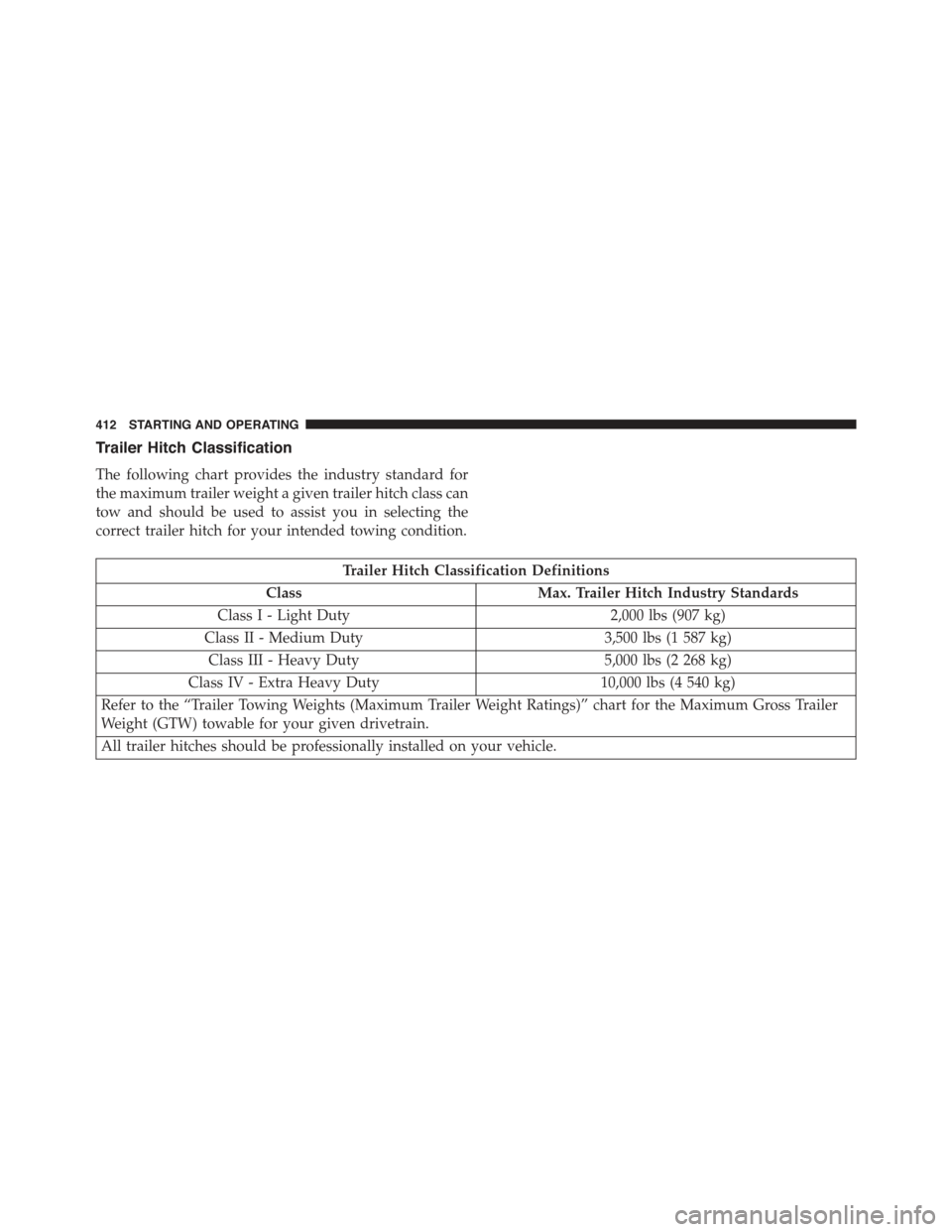
Trailer Hitch Classification
The following chart provides the industry standard for
the maximum trailer weight a given trailer hitch class can
tow and should be used to assist you in selecting the
correct trailer hitch for your intended towing condition.
Trailer Hitch Classification Definitions
ClassMax. Trailer Hitch Industry Standards
Class I - Light Duty2,000 lbs (907 kg)
Class II - Medium Duty3,500 lbs (1 587 kg)
Class III - Heavy Duty5,000 lbs (2 268 kg)
Class IV - Extra Heavy Duty10,000 lbs (4 540 kg)
Refer to the “Trailer Towing Weights (Maximum Trailer Weight Ratings)” chart for the Maximum Gross Trailer
Weight (GTW) towable for your given drivetrain.
All trailer hitches should be professionally installed on your vehicle.
412 STARTING AND OPERATING