Page 283 of 678

Enhanced Accident Response System
In the event of an impact, if the communication network
remains intact, and the power remains intact, depending
on the nature of the event, the ORC will determine
whether to have the Enhanced Accident Response Sys-
tem perform the following functions:
•Cut off fuel to the engine.
•Flash hazard lights as long as the battery has power or
until the ignition is placed in the “OFF” position. The
customer can deactivate the hazard lights flasher
pressing the Hazard flasher button also before the
rearm procedure.
•Turn on the interior lights, which remain on as long as
the battery has power or for 15 minutes from the
intervention of the Enhanced Accident Response Sys-
tem.
•Unlock the doors automatically.
•Turn off the Fuel Pump Heater.
•Turn Off the HVAC Blower Motor.
•Close the HVAC Circulation Door.
System Reset Procedure
Depending on the nature of the event the left and right
turn signal lights, located in the instrument panel, may
both be blinking and will continue to blink until the
ignition switch is turned to the OFF position. After an
accident, turn the ignition switch to STOP/OFF position,
check that there aren’t any losses of fuel/liquids. In order
to move your vehicle to the side of the road, you must
follow the system reset procedure.
6
SAFETY 281
Page 284 of 678

Customer Action Customer Will See
1. Turn ignition OFF.
(Turn Signal Switch Must
be placed in Neutral
State).
2. Turn ignition ON. Left Turn Light is OFF.
Right Turn Light
BLINKS.
3. Turn Right Turn Signal
Switch ON.
Right Turn Light is ON
SOLID. Left Turn Light
BLINKS.
4. Turn Left Turn Signal
Switch ON.
Left Turn Light is ON
SOLID. Right Turn Light
BLINKS.
5. Turn Right Turn Signal
Switch ON.
Right Turn Light is ON
SOLID. Left Turn Light
BLINKS.
Customer Action Customer Will See
6. Turn Left Turn Signal
Switch ON.
Left Turn Light is ON
SOLID. Right Turn Light
is ON SOLID.
7. Turn Left Turn Signal
Switch OFF. (Turn Signal
Switch Must be placed in
Neutral State).
Left Turn Light is OFF.
Right Turn Light is OFF.
8. Turn ignition OFF.
9. Turn Hazard Flashers
OFF (Manually).
System is now reset and
the engine may be
started.
If a reset procedure step is not completed within 60
seconds, then the turn signal lights will turn off and the
reset procedure must be performed again in order to be
successful.
282 SAFETY
Page 285 of 678

Air Bag Warning Light
The air bags must be ready to inflate for your protection
in a collision. The Occupant Restraint Control-
ler (ORC) monitors the internal circuits and
interconnecting wiring associated with air bag
system electrical components.
The ORC monitors the readiness of the electronic parts of
the air bag system whenever the ignition switch is in the
START or ON/RUN position. If the ignition switch is in
the OFF position the air bag system is not on and the air
bags will not inflate.
The ORC contains a backup power supply system that
may deploy the air bags even if the battery loses power or
it becomes disconnected prior to deployment.
The ORC turns on the Air Bag Warning Light in the
instrument panel for approximately four to eight seconds
for a self-check when the ignition switch is first turned to
the ON/RUN position. After the self-check, the Air Bag
Warning Light will turn off. If the ORC detects a mal-
function in any part of the system, it turns on the Air Bag
Warning Light, either momentarily or continuously. A
single chime will sound to alert you if the light comes on
again after initial startup.
The ORC also includes diagnostics that will illuminate
the instrument panel Air Bag Warning Light if a malfunc-
tion is detected that could affect the air bag system. The
diagnostics also record the nature of the malfunction.
While the air bag system is designed to be maintenance
free, if any of the following occurs, have an authorized
dealer service the air bag system immediately.
•The Air Bag Warning Light does not come on during
the four to eight seconds when the ignition switch is
first turned to the ON/RUN position.
•The Air Bag Warning Light remains on after the four to
eight-second interval.
6
SAFETY 283
Page 286 of 678

•The Air Bag Warning Light comes on intermittently or
remains on while driving.
NOTE:If the speedometer, tachometer, or any engine
related gauges are not working, the Occupant Restraint
Controller (ORC) may also be disabled. In this condition
the air bags may not be ready to inflate for your protec-
tion. Have an authorized dealer service the air bag
system immediately.
WARNING!
Ignoring the Air Bag Warning Light in your instru-
ment panel could mean you won’t have the air bags to
protect you in a collision. If the light does not come on
as a bulb check when the ignition is first placed in the
on position, and stays on after you start the vehicle, or
if it comes on as you drive, have an authorized dealer
service the air bag system immediately.
Redundant Air Bag Warning Light
If a fault with the Air Bag Warning Light is
detected, which could affect the Supplemental
Restraint System (“SRS”), the Redundant Air
Bag Warning Light will illuminate on the in-
strument panel.
The Redundant Air Bag Warning Light will stay on until
the fault is cleared. In addition, a single chime will sound
to alert you that the Redundant Air Bag Warning Light
has come on and a fault has been detected. If the
Redundant Air Bag Warning Light comes on intermit-
tently or remains on while driving have an authorized
dealer service the vehicle immediately.
For additional information regarding the Redundant Air
Bag Warning Light refer to the “Getting To Know Your
Instrument Panel” section of this manual.
284 SAFETY
Page 313 of 678

Safety Checks You Should Make Inside The
Vehicle
Seat Belts
Inspect the seat belt system periodically, checking for
cuts, frays, and loose parts. Damaged parts must be
replaced immediately. Do not disassemble or modify the
system.
Front seat belt assemblies must be replaced after a
collision. Rear seat belt assemblies must be replaced after
a collision if they have been damaged (i.e., bent retractor,
torn webbing, etc.). If there is any question regarding seat
belt or retractor condition, replace the seat belt.
Air Bag Warning Light
The light should come on and remain on for
four to eight seconds as a bulb check when the
ignition switch is first turned ON. If the light is
not lit during starting, see your authorized dealer. If the
light stays on, flickers, or comes on while driving, have
the system checked by an authorized dealer.
Defroster
Check operation by selecting the defrost mode and place
the blower control on high speed. You should be able to
feel the air directed against the windshield. See your
authorized dealer for service if your defroster is inoper-
able.
Floor Mat Safety Information
Always use floor mats designed to fit the footwell of your
vehicle. Use only floor mats that leave the pedal area
unobstructed and that are firmly secured so that they
cannot slip out of position and interfere with the pedals
or impair safe operation of your vehicle in other ways.
6
SAFETY 311
Page 315 of 678
Periodic Safety Checks You Should Make Outside
The Vehicle
Tires
Examine tires for excessive tread wear and uneven wear
patterns. Check for stones, nails, glass, or other objects
lodged in the tread or sidewall. Inspect the tread for cuts
and cracks. Inspect sidewalls for cuts, cracks, and bulges.
Check the wheel nuts for tightness. Check the tires
(including spare) for proper cold inflation pressure.
Lights
Have someone observe the operation of brake lights and
exterior lights while you work the controls. Check turn
signal and high beam indicator lights on the instrument
panel.
Door Latches
Check for proper closing, latching, and locking.
Fluid Leaks
Check area under vehicle after overnight parking for fuel,
engine coolant, oil, or other fluid leaks. Also, if gasoline
fumes are detected, or if fuel or brake fluid leaks are
suspected, the cause should be located and corrected
immediately.6
SAFETY 313
Page 327 of 678
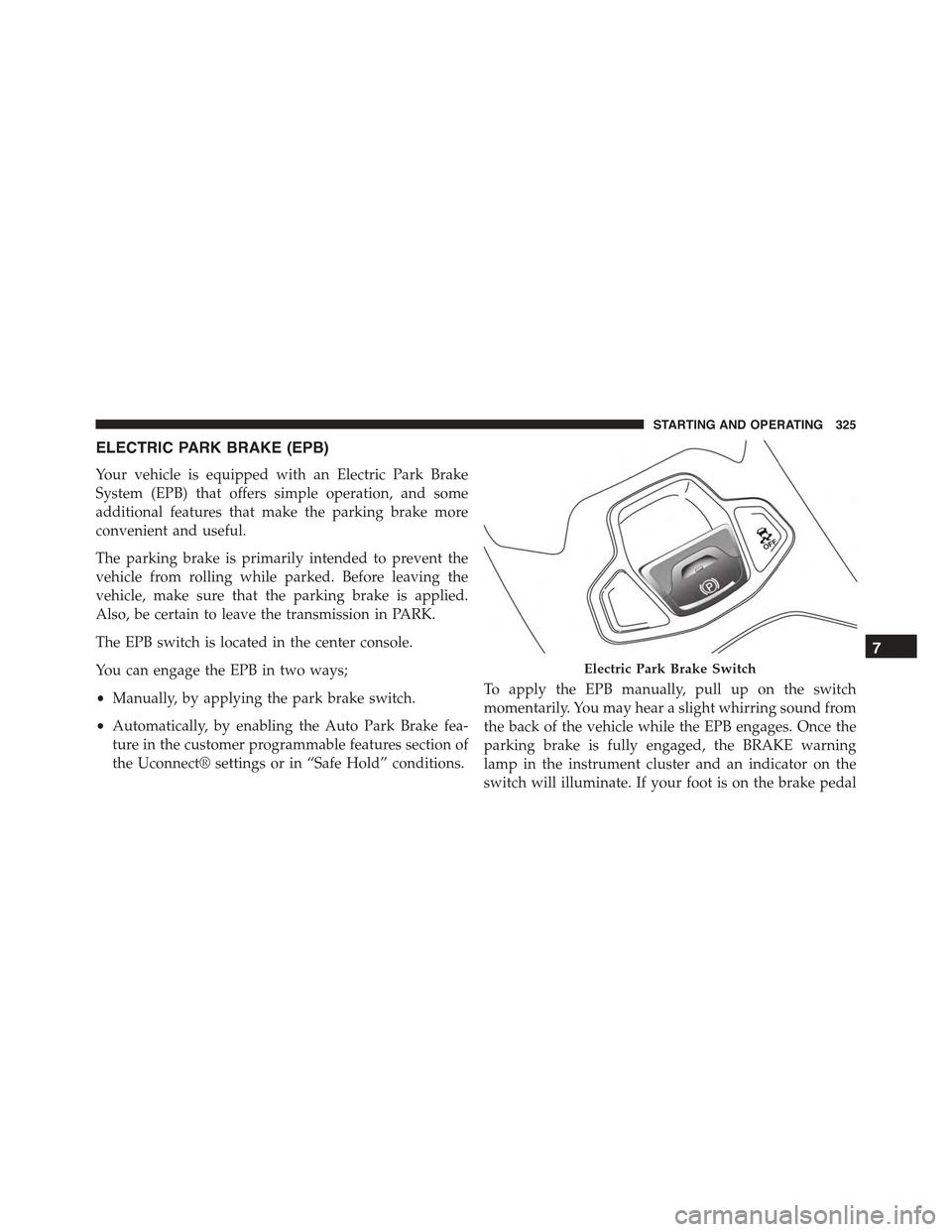
ELECTRIC PARK BRAKE (EPB)
Your vehicle is equipped with an Electric Park Brake
System (EPB) that offers simple operation, and some
additional features that make the parking brake more
convenient and useful.
The parking brake is primarily intended to prevent the
vehicle from rolling while parked. Before leaving the
vehicle, make sure that the parking brake is applied.
Also, be certain to leave the transmission in PARK.
The EPB switch is located in the center console.
You can engage the EPB in two ways;
•Manually, by applying the park brake switch.
•Automatically, by enabling the Auto Park Brake fea-
ture in the customer programmable features section of
the Uconnect® settings or in “Safe Hold” conditions.
To apply the EPB manually, pull up on the switch
momentarily. You may hear a slight whirring sound from
the back of the vehicle while the EPB engages. Once the
parking brake is fully engaged, the BRAKE warning
lamp in the instrument cluster and an indicator on the
switch will illuminate. If your foot is on the brake pedal
Electric Park Brake Switch
7
STARTING AND OPERATING 325
Page 328 of 678

while you apply the EPB, you may notice a small amount
of brake pedal movement. The EPB can be applied even
when the ignition switch is in the STOP/OFF position
but the BRAKE warning lamp will not illuminate, how-
ever, it can only be released when the ignition switch is in
the MAR/RUN position.
NOTE:The EPB fault lamp will illuminate if the EPB
switch is held for longer than 20 seconds in either the
released or applied position. The light will extinguish
upon releasing the switch.
If the Auto Park Brake feature is enabled, the EPB will
automatically engage whenever the transmission is
placed into PARK, or with a manual transmission, when
the ignition switch is in the STOP/OFF position. If your
foot is on the brake pedal, you may notice a small amount
of brake pedal movement while the EPB is engaging.
The electric park brake will be automatically released if
the driver ’s seat belt is buckled and driver’s intention to
start (in forward or reverse direction) is recognized by the
system
To release the EPB manually, the ignition switch must be
in the MAR/RUN position. Put your foot on the brake
pedal, then push the EPB switch down momentarily. You
may hear a slight whirring sound from the back of the car
while the parking brake disengages. You may also notice
a small amount of movement in the brake pedal. Once
the EPB is fully disengaged, The BRAKE warning lamp
in the instrument cluster and the LED indicator on the
switch will extinguish.
326 STARTING AND OPERATING
