2015 FORD SUPER DUTY maintenance
[x] Cancel search: maintenancePage 254 of 470
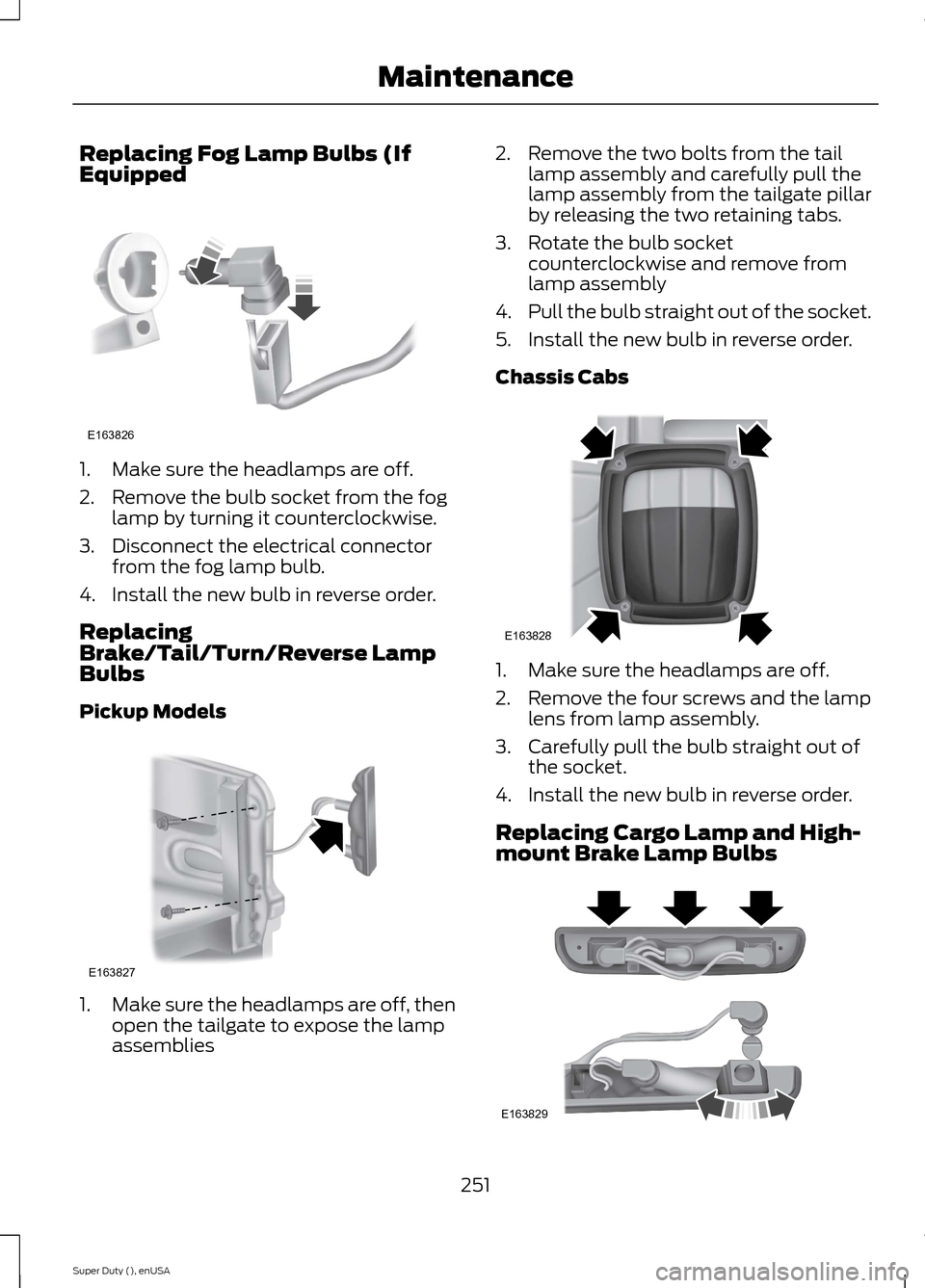
Replacing Fog Lamp Bulbs (IfEquipped
1.Make sure the headlamps are off.
2.Remove the bulb socket from the foglamp by turning it counterclockwise.
3.Disconnect the electrical connectorfrom the fog lamp bulb.
4.Install the new bulb in reverse order.
ReplacingBrake/Tail/Turn/Reverse LampBulbs
Pickup Models
1.Make sure the headlamps are off, thenopen the tailgate to expose the lampassemblies
2.Remove the two bolts from the taillamp assembly and carefully pull thelamp assembly from the tailgate pillarby releasing the two retaining tabs.
3.Rotate the bulb socketcounterclockwise and remove fromlamp assembly
4.Pull the bulb straight out of the socket.
5.Install the new bulb in reverse order.
Chassis Cabs
1.Make sure the headlamps are off.
2.Remove the four screws and the lamplens from lamp assembly.
3.Carefully pull the bulb straight out ofthe socket.
4.Install the new bulb in reverse order.
Replacing Cargo Lamp and High-mount Brake Lamp Bulbs
251Super Duty (), enUSAMaintenanceE163826 E163827 E163828 E163829
Page 255 of 470
1.Make sure the headlamps are off.
2.Remove the screws and lampassembly from the vehicle as wiringpermits.
3.Remove the bulb socket by rotating itcounterclockwise.
4.Pull the bulb straight out of the socket.
5.Install the new bulb in reverse order.
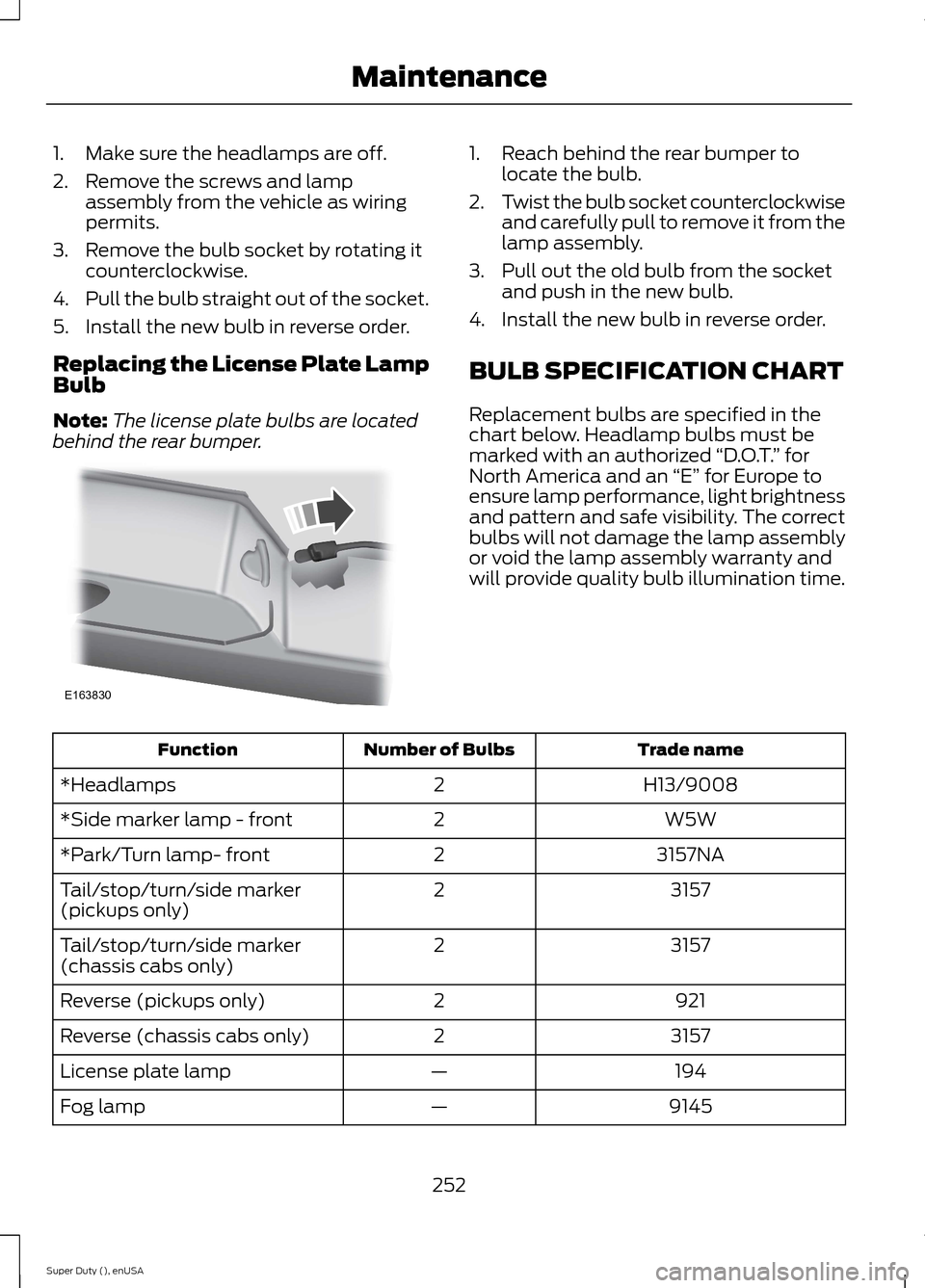
Replacing the License Plate LampBulb
Note:The license plate bulbs are locatedbehind the rear bumper.
1.Reach behind the rear bumper tolocate the bulb.
2.Twist the bulb socket counterclockwiseand carefully pull to remove it from thelamp assembly.
3.Pull out the old bulb from the socketand push in the new bulb.
4.Install the new bulb in reverse order.
BULB SPECIFICATION CHART
Replacement bulbs are specified in thechart below. Headlamp bulbs must bemarked with an authorized “D.O.T.” forNorth America and an “E” for Europe toensure lamp performance, light brightnessand pattern and safe visibility. The correctbulbs will not damage the lamp assemblyor void the lamp assembly warranty andwill provide quality bulb illumination time.
Trade nameNumber of BulbsFunction
H13/90082*Headlamps
W5W2*Side marker lamp - front
3157NA2*Park/Turn lamp- front
31572Tail/stop/turn/side marker(pickups only)
31572Tail/stop/turn/side marker(chassis cabs only)
9212Reverse (pickups only)
31572Reverse (chassis cabs only)
194—License plate lamp
9145—Fog lamp
252Super Duty (), enUSAMaintenanceE163830
Page 256 of 470
Trade nameNumber of BulbsFunction
9121High-mount brake lamp
9122Cargo lamp
12V6W2Map lamp
5783Dome/reading lamps
28252Interior visor lamp
28252Mirror turn signal
2825Mirror clearance lamp
1945Front clearance lamps and
front identification lamps1
LED24Rear fender clearance1
19323Rear identification1
9061Underhood Lamp
LED (if equipped)2
To replace all instrument panel lights - see your authorized dealer
1Dual rear wheels, if equipped
2 See your authorized dealer to replace the lamp assembly
253Super Duty (), enUSAMaintenance
Page 257 of 470
CHANGING THE ENGINE AIR
FILTER
WARNINGS
To reduce the risk of vehicle damageand personal burn injuries, do notstart your engine with the air cleanerremoved and do not remove it while theengine is running.
To reduce the risk of vehicle damageand personal burn injuries, do notstart your engine with the air cleanerremoved and do not remove it while theengine is running.
Note:Failure to use the correct air filterelement may result in severe enginedamage. The customer warranty may bevoid for any damage to the engine if thecorrect air filter element is not used.
When changing the air filter element, useonly the air filter element listed. SeeCapacities and Specifications (page301).
Change the air filter element at the properinterval. See Scheduled Maintenance(page 440).
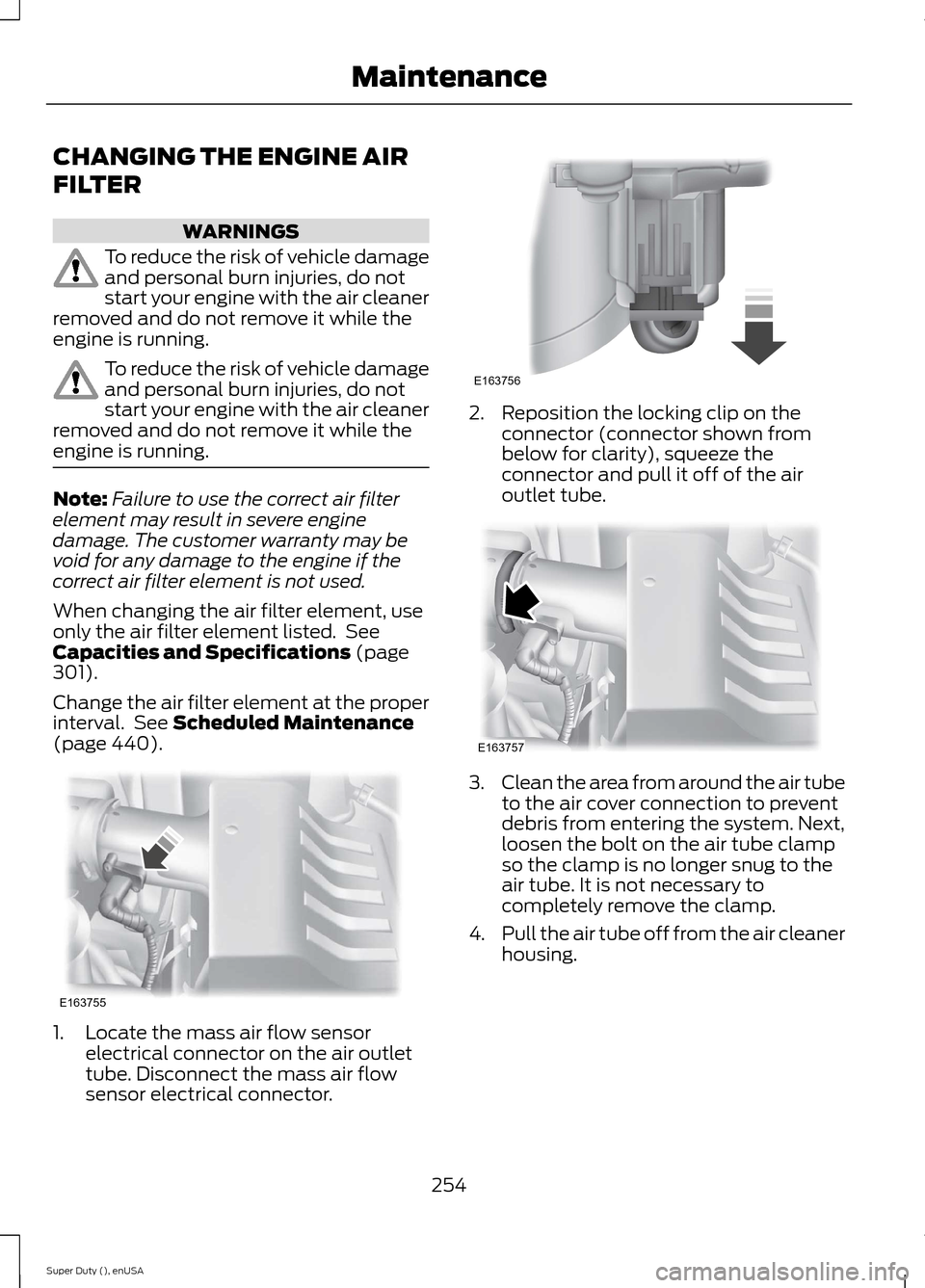
1.Locate the mass air flow sensorelectrical connector on the air outlettube. Disconnect the mass air flowsensor electrical connector.
2.Reposition the locking clip on theconnector (connector shown frombelow for clarity), squeeze theconnector and pull it off of the airoutlet tube.
3.Clean the area from around the air tubeto the air cover connection to preventdebris from entering the system. Next,loosen the bolt on the air tube clampso the clamp is no longer snug to theair tube. It is not necessary tocompletely remove the clamp.
4.Pull the air tube off from the air cleanerhousing.
254Super Duty (), enUSAMaintenanceE163755 E163756 E163757
Page 258 of 470
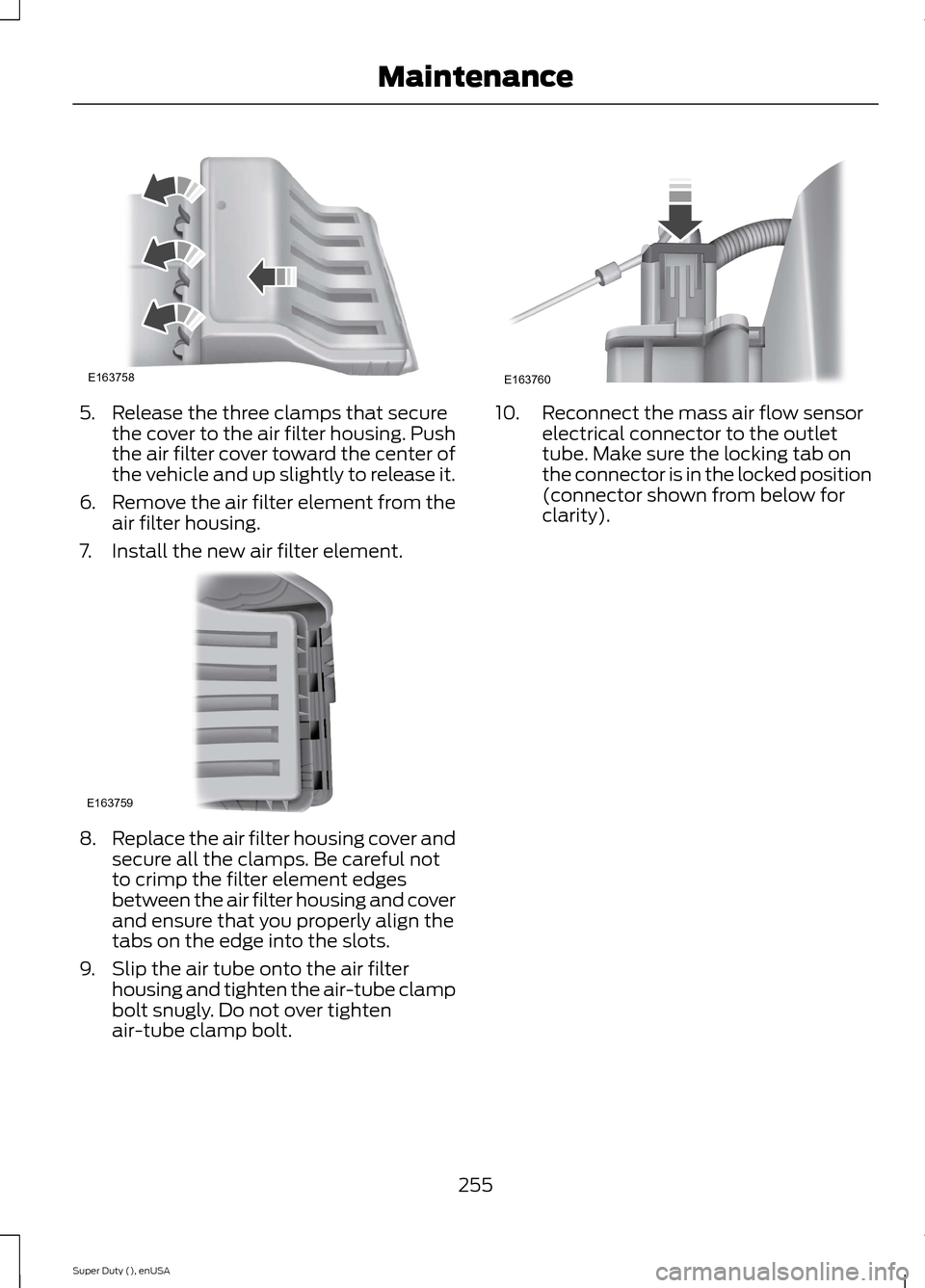
5.Release the three clamps that securethe cover to the air filter housing. Pushthe air filter cover toward the center ofthe vehicle and up slightly to release it.
6.Remove the air filter element from theair filter housing.
7.Install the new air filter element.
8.Replace the air filter housing cover andsecure all the clamps. Be careful notto crimp the filter element edgesbetween the air filter housing and coverand ensure that you properly align thetabs on the edge into the slots.
9.Slip the air tube onto the air filterhousing and tighten the air-tube clampbolt snugly. Do not over tightenair-tube clamp bolt.
10.Reconnect the mass air flow sensorelectrical connector to the outlettube. Make sure the locking tab onthe connector is in the locked position(connector shown from below forclarity).
255Super Duty (), enUSAMaintenanceE163758 E163759 E163760
Page 263 of 470
•alcohol solutions
•solvents or cleaners intendedspecifically for rubber, vinyl andplastics.
WITH THE KING RANCH EDITION
Your vehicle is equipped with seatingcovered in premium, top-grain leatherwhich is extremely durable, but stillrequires special care and maintenance inorder to preserve longevity and comfort.
Regular cleaning and conditioning willmaintain the appearance of the leather.
Cleaning
For dirt, use a vacuum cleaner then use aclean, damp cloth or soft brush.
For routine cleaning, wipe the surface witha soft, damp cloth. For more thoroughcleaning, wipe the surface with a mild soapand water solution.
•Clean spills as quickly as possible.
•Test any cleaner or stain remover onan inconspicuous part of the leather ascleaners may darken the leather.
•Do not spill coffee, ketchup, mustard,orange juice or oil-based products onthe leather as they may permanentlystain the leather.
•Do not use household cleaningproducts, alcohol solutions, solventsor cleaners intended for rubber, vinylor plastics.
Scratches
Natural Markings - Because the leather inthe seat comes from genuine steer hides,there will be evidence of naturallyoccurring markings, such as small scars.These markings give character to theseating covers and considered to be proofof a genuine leather product.
In order to lessen the appearance ofcertain scratches and other wear marks,apply conditioner on the affected areafollowing the same instructions as in theConditioning section.
Conditioning
Bottles of King Ranch Leather Conditionerare available at the King Ranch SaddleShop. Visit the website atwww.krsaddleshop.com, or telephone (inthe United States) 1–800–282–KING(5464). If you are unable to obtain KingRanch Leather Conditioner, use anotherpremium leather conditioner.
•Clean the surfaces using the stepsoutlined in the Cleaning section.
•Make sure the leather is dry then applya nickel-sized amount of conditionerto a clean, dry cloth.
•Rub the conditioner into the leatheruntil it disappears. Allow theconditioner to dry, then repeat theprocess for the entire interior. If a filmappears, wipe it off with a dry, cleancloth.
REPAIRING MINOR PAINT
DAMAGE
Your authorized dealer has touch-up paintto match your vehicle’s color. Take yourcolor code (printed on a sticker in thedriver’s door jamb) to your authorizeddealer to ensure you get the correct color.
•Remove particles such as birddroppings, tree sap, insect deposits, tarspots, road salt and industrial falloutbefore repairing paint chips.
•Always read the instructions beforeusing the products.
260Super Duty (), enUSAVehicle Care
Page 264 of 470
CLEANING THE ALLOY
WHEELS (IF EQUIPPED)
Note:Do not apply a cleaning chemical towarm or hot wheel rims and covers.
Note:Some automatic car washes maycause damage to the finish on your wheelrims and covers.
Note:Industrial-strength or heavy-dutycleaners in combination with brush agitationto remove brake dust and dirt, could wearaway the clear coat finish over a period time.
Note:Do not use hydrofluoric acid-basedor high caustic-based wheel cleaners, steelwool, fuels or strong household detergents.
Note:If you intend parking your vehicle foran extended period after cleaning thewheels with a wheel cleaner, drive yourvehicle for a few minutes before doing so.This will reduce the risk of increasedcorrosion of the brake discs.
Alloy wheels and wheel covers are coatedwith a clear coat paint finish. To maintaintheir condition we recommend that you:
•Clean the wheels weekly usingMotorcraft Wheel and Tire Cleaner.Apply using manufacturer'sinstructions.
•Use a sponge to remove heavydeposits of dirt and brake dustaccumulation.
•Rinse thoroughly with a strong streamof water when you have completed thecleaning process.
•To remove tar and grease, useMotorcraft Bug and Tar Remover.
VEHICLE STORAGE
If you plan on storing your vehicle for anextended period of time (30 days or more),read the following maintenancerecommendations to make sure yourvehicle stays in good operating condition.
All motor vehicles and their componentswere engineered and tested for reliable,regular driving. Long term storage undervarious conditions may lead to componentdegradation or failure unless specificprecautions are taken to preserve thecomponents.
General
•Store all vehicles in a dry, ventilatedplace.
•Protect from sunlight, if possible.
•If vehicles are stored outside, theyrequire regular maintenance to protectagainst rust and damage.
Body
•Wash your vehicle thoroughly toremove dirt, grease, oil, tar or mud fromexterior surfaces, rear-wheel housingand underside of front fenders.
•Periodically wash your vehicle storedin exposed locations.
•Touch-up exposed or primed metal toprevent rust.
•Cover chrome and stainless steel partswith a thick coat of auto wax to preventdiscoloration. Re-wax as necessarywhen your vehicle is washed.
•Lubricate all hood, door and trunk lidhinges, and latches with a light gradeoil.
•Cover interior trim to prevent fading.
•Keep all rubber parts free from oil andsolvents.
261Super Duty (), enUSAVehicle Care
Page 279 of 470
WARNING
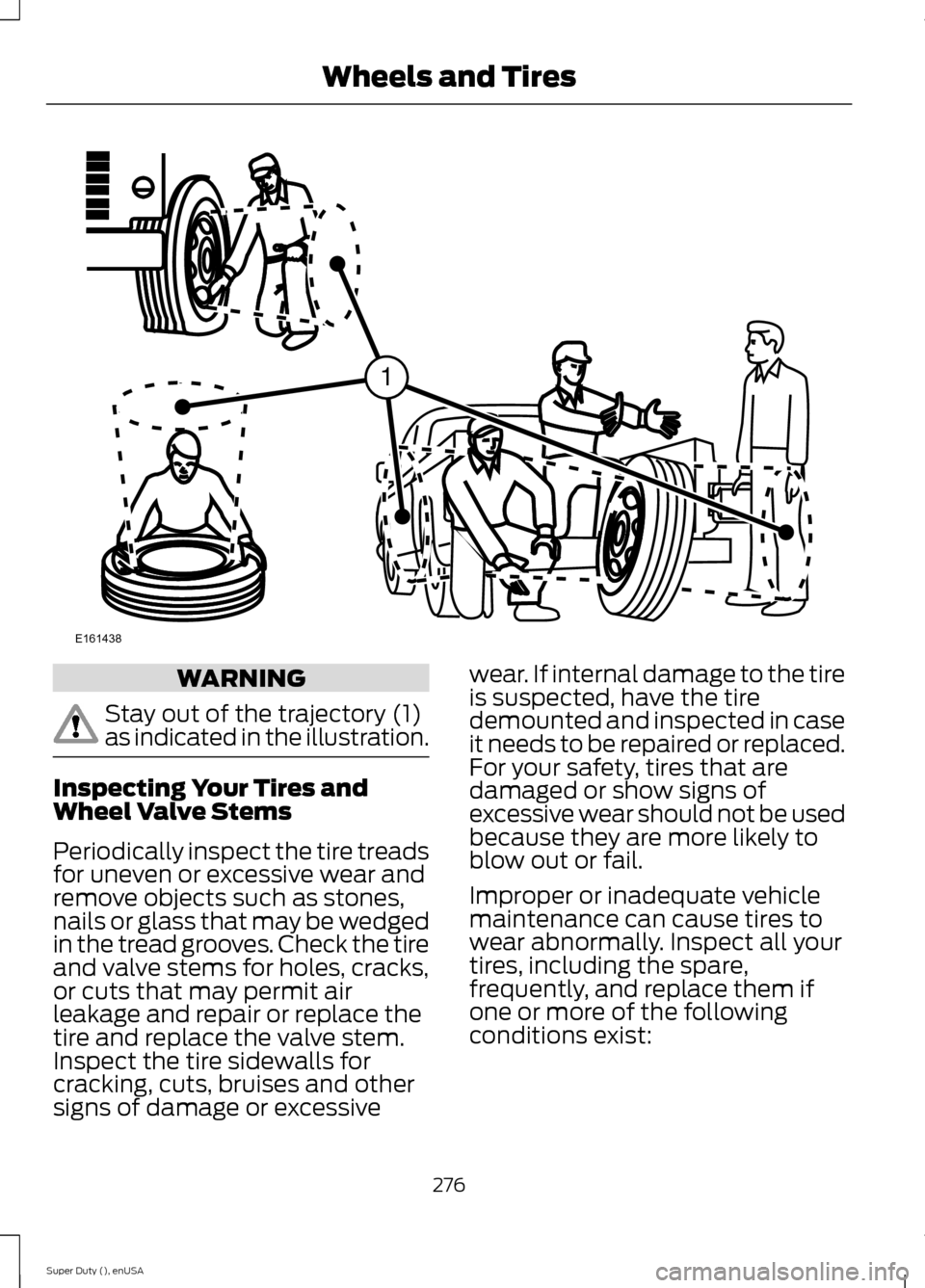
Stay out of the trajectory (1)as indicated in the illustration.
Inspecting Your Tires andWheel Valve Stems
Periodically inspect the tire treadsfor uneven or excessive wear andremove objects such as stones,nails or glass that may be wedgedin the tread grooves. Check the tireand valve stems for holes, cracks,or cuts that may permit airleakage and repair or replace thetire and replace the valve stem.Inspect the tire sidewalls for
cracking, cuts, bruises and othersigns of damage or excessive
wear. If internal damage to the tireis suspected, have the tiredemounted and inspected in caseit needs to be repaired or replaced.For your safety, tires that aredamaged or show signs ofexcessive wear should not be usedbecause they are more likely toblow out or fail.
Improper or inadequate vehiclemaintenance can cause tires towear abnormally. Inspect all yourtires, including the spare,frequently, and replace them ifone or more of the followingconditions exist:
276Super Duty (), enUSAWheels and TiresE1614381