2015 AUDI TT ROADSTER inflation pressure
[x] Cancel search: inflation pressurePage 183 of 244
-Never mount used tires on yo ur vehicle if
yo u are not sure of their "previous histo
ry." Old used tires may have been dam
aged even though the damage cannot be
seen that can lead to sudden tire failure
and loss of vehicle control.
- If you notice unusual vibration or if the
vehicle pulls to one side when d riving, al
ways stop as soon as it is safe to do so
and check the wheels and tires for dam
age .
(D Note
-Please note that summer and winter
tires are designed for the cond itions that
are typ ic al in those seasons. Aud i recom
mends using w inter t ires du ring the win-
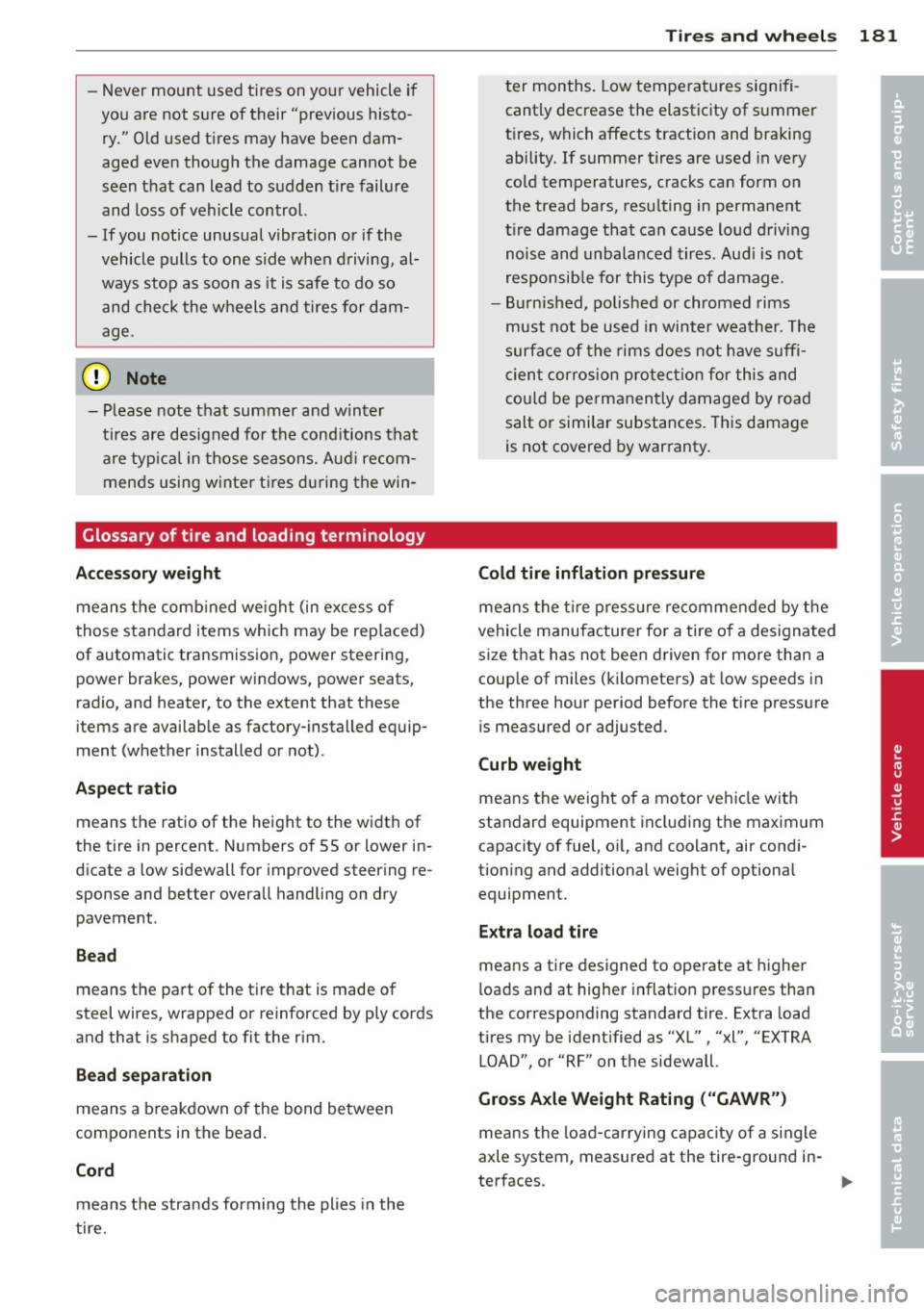
Glossary of tire and loading terminology
Accessory weight
means the comb ined weight (in excess of
those standard items which may be replaced)
of automatic tra nsmission, power steering,
power brakes, power windows, power seats,
radio, and heater, to the extent that these
items are availab le as factory-installed equip
ment (whether installed or not) .
Aspect ratio
means the ratio of the height to the width of
the tire in percent . Numbers of 55 or lower in
d icate a low sidewall for improved steering re
sponse and better overall handling on dry
pavement .
Bead
means the pa rt of the ti re that is made of
steel wires, wrapped or reinforced by ply cords
and that is shaped to fit the rim.
Bead s eparation
means a b reakdown of the bond between
components in the bead.
Cord
means the strands forming the plies in the
tire.
Tire s an d wheel s 181
ter months . Low temperatu res signifi
cantly decrease the elastic ity of summer
t ires, which affects traction and braking
ability. If summer tires are used in very
co ld temperatures, cracks can form on
the tread bars, res ulting in permanent
ti re damage that can cause loud drivi ng
noise and unbalanced tires. Aud i is not
responsib le for this type of damage.
- Burn ished, polished or chromed rims
must not be used in winter weather. Th e
surfa ce of the rims does not have suffi
c ien t cor rosion pro te cti on for this and
c o ul d be pe rmanen tly damaged by road
salt or similar substances. This damage
is not covered by warranty.
Cold tir e inflation pressure
me ans the t ire press ure re commended by the
vehicle manufacturer fo r a tire o f a des igna ted
size that has not bee n driven for more than a
coup le of miles (k ilomete rs) at low speeds in
the three hour pe riod before the tire press ure
is measured or adjusted.
Curb weight
means the weight o f a motor vehicle with
standard equipment including the maximum
capacity of fuel, o il, and coolant, air cond i
tion ing and additional weight of optiona l
equipment.
E xtra load tire
means a tire designed to operate at higher
l oads and at higher inflation press ures than
the corresponding standard tire. Extra load
tires my be ident ified as "XL", "xl", "EXTRA
LOAD", or "RF" on the sidewall.
Gross Axle Weight Rating ("GAWR")
means the load-carrying capacity of a single
axle system, measured at the tire-ground in-
ter~ces.
~
•
•
Page 184 of 244
182 Tires and wheels
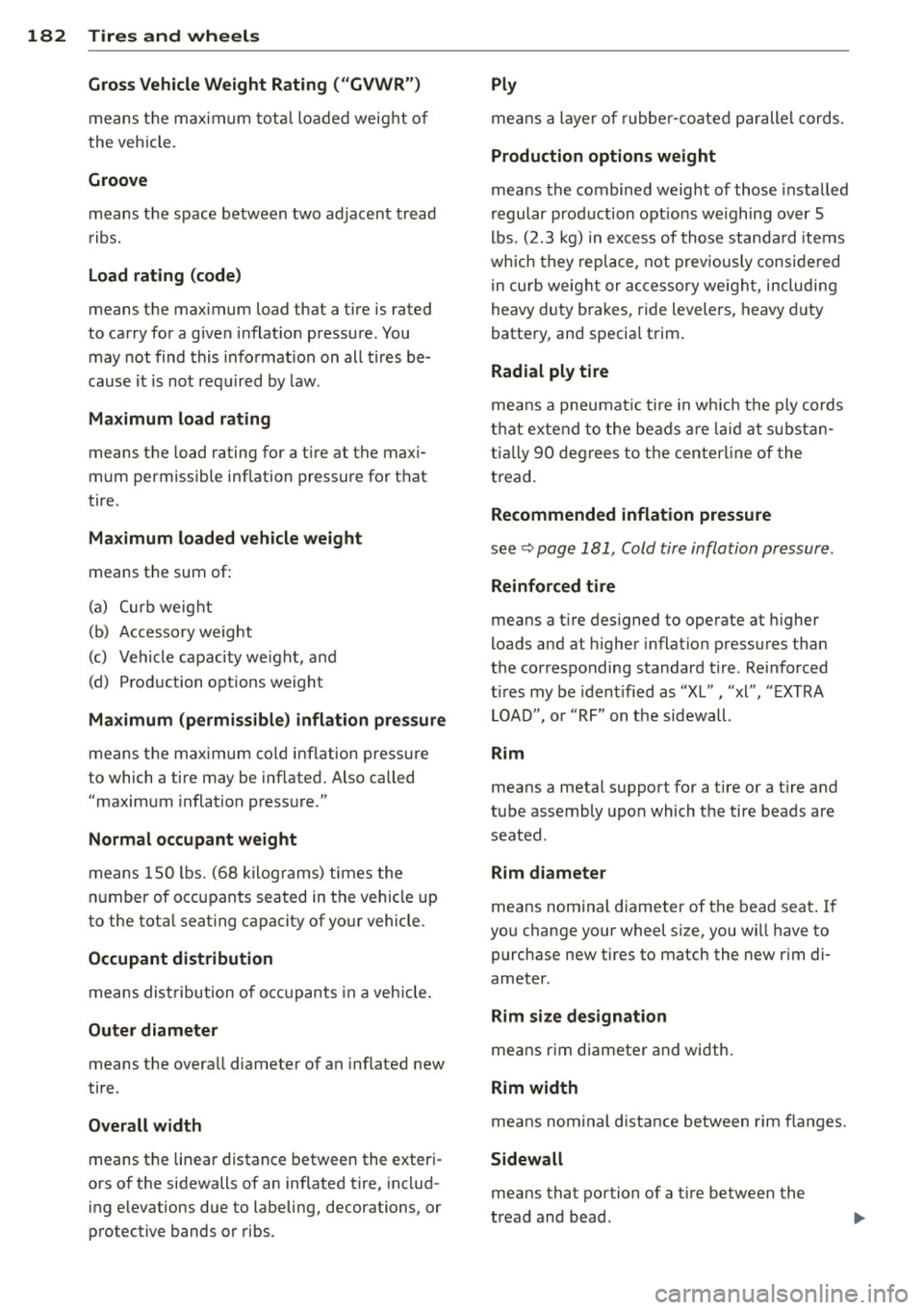
Gross Vehicle Weight Rating ("GVWR")
means the maximum total loaded weight o f
the vehicle.
Groove
means the space between two adjacent tread
ribs.
Load rating (code)
means the maximum load that a tire is rated
to carry for a given inflat ion pressure. You
may not find this informat ion on all tires be
cause it is not requ ired by law .
Maximum load rating
means the load rating for a t ire at the maxi
mum permissible inflation pressure for that
tire .
Maximum loaded vehicle weight
means the sum of:
(a) Curb weight
(b) Accessory weight
(c) Vehicle capacity we ight, and
(d) Production opt ions weight
Maximum (permissible) inflation pressure
means the maximum cold inflation pressure
to which a tire may be inflated . Also called
"maximum inflation press ure."
Normal occupant weight
means 150 lbs. (68 kilog rams) times the
number of occupants seated in the vehicle up
to the tota l seating capacity of your vehicle.
Occupant distribution
means distribution of occupants in a veh icle.
Outer diameter
means the overall diameter of an inflated new
tire.
Overall width
means the linear distance between the exteri
ors of the sidewalls of an inflated tire, includ
ing elevations due to labeling, decorations, or
protective bands or ribs .
Ply
means a layer of rubbe r-coated parallel cords.
Production options weight
means the combined weight of those installed
regular production opt ions we ighing over 5
lbs. (2.3 kg) in excess of those standa rd items
wh ich they replace, not previously considered
in curb weight or accessory weight, including
heavy duty brakes, ride levelers, heavy duty
battery, and specia l trim .
Radial ply tire
means a pneumat ic tire in which the ply cords
that extend to the beads are laid at substa n
tially 90 deg rees to the centerline of the
tread.
Recommended inflation pressure
see <=;> page 181, Cold tire inflation pressure .
Reinforced tire
means a tire designed to operate at higher
loads and at higher inflation pressures than
the corresponding standard tire. Re inforced
t ir es my be identified as "XL", "xl", "EXTRA
LOAD", or "RF" on the sidewall.
Rim
means a metal support for a tire or a t ire and
tube assembly upon which the tire beads are
seated .
Rim diameter
means nominal diameter of the bead seat. If
you change your wheel s ize, you will have to
purchase new tires to match the new r im di
ameter .
Rim size designation
means rim diameter and width.
Rim width
means nom inal distance between rim flanges.
Sidewall
means that portion of a t ire between the
tread and bead .
Page 186 of 244
184 Tires and wheels
Occupant loading for vehicle normal load (no luggage)
Designated seating capacity, number of occu- Vehicle normal load (no luggage), number of
pants occupants
2 2
Cold tire inflation pressure
Tire pressure affects the overall handling, performance and safety of a vehicle.
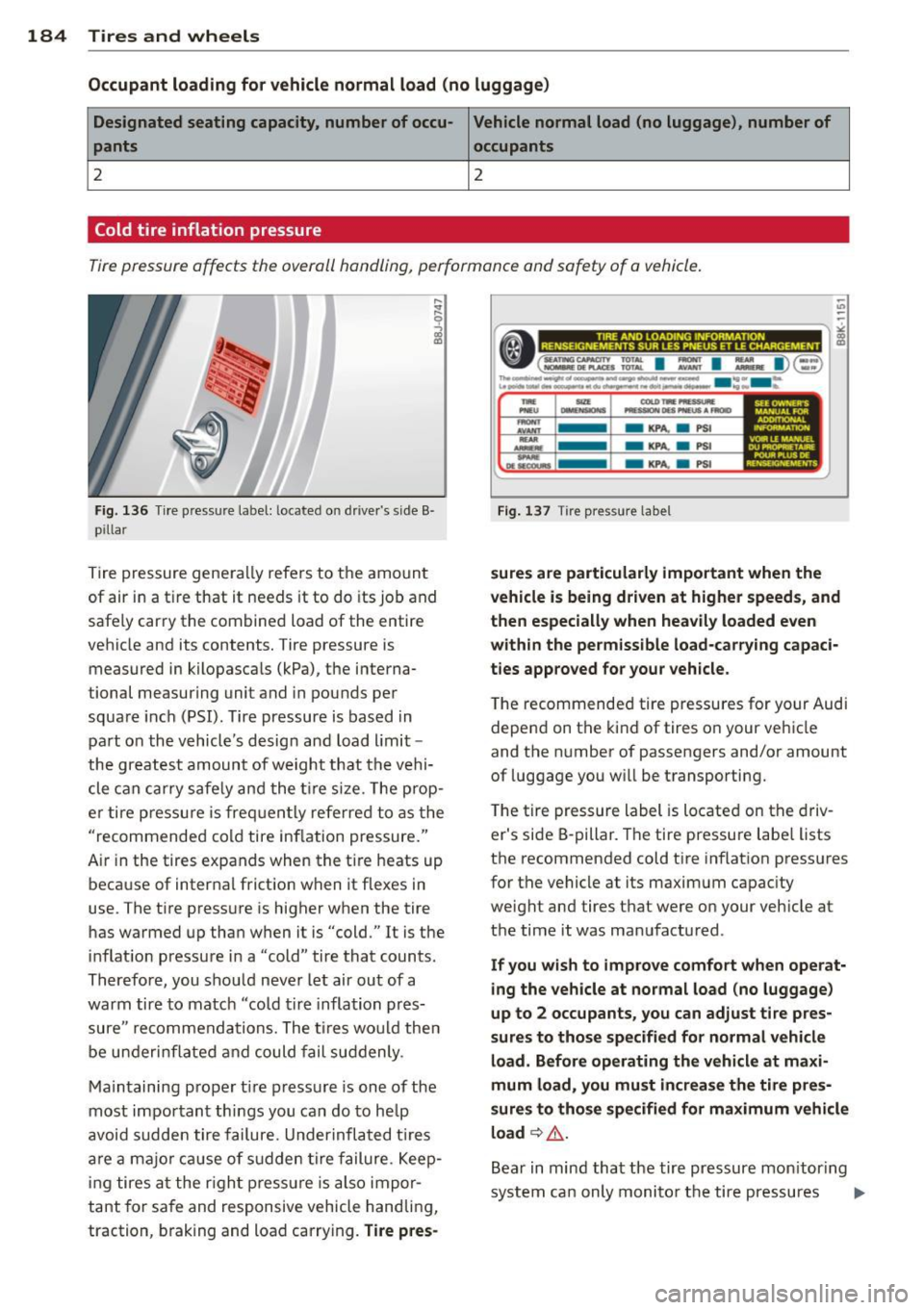
Fig. 136 Tire pressure label: located on driver's side B
pillar
Tire pressure genera lly refers to the amount
of air in a tire that it needs it to do its job and
safely carry the combined load of the entire
vehicle and its contents. Tire pressure is
measured in kilopascals (kPa), the interna
tional measuring unit and in pounds per
square inch (PSI). Tire pressure is based in
part on the vehicle's design and load limit -
the greatest amount of we ight that the vehi
cle can carry safe ly and the tire size. The prop
e r tire pressure is freq uent ly referred to as the
"recommended cold tire inflation pressure."
A ir in the tires expands when the tire heats up
because of interna l frict ion when it flexes in
use. The t ire pressure is higher when the tire
has warmed up than when it is "cold." It is the
inflation pressure in a "cold" tire that counts.
Therefore, you shou ld never let air out of a
warm tire to match "cold tire inflation pres
sure " recommendations. The tires would then
be underi nflated and could fail suddenly .
Maintaining proper tire pressure is one of the
most important things you can do to help
avoid sudden tire failure. Underinflated tires
are a major cause of sudden tire failure . K eep
ing tires at the rig ht pressure is also impor
tant for sa fe and responsive vehicle handling,
traction, braking and load carrying.
Tire pres-
-ID
-
-----------------~ ,.
•===~=~~=~~=-= :g
c
==. ~: I = I ::,,. I)@ TI- ........ ....,..,____, ..... _.,....,.._,...... .... _ ... "-.................. ~ ... --................ ..
1N SIZE COlD lWIE MlS5UM. ,..-u .,...,,..... PlillSSION OU flH£US A fllOD ,_,.
AVNff -KPA, a PSI
---KPA, a PSI
-.. _ -KPA, a PSI
Fig. 137 Tire pre ssure label
SEE OW9'Ell"'S MA.HUAlFOI' ADDITIOII IAL lo~FOAMATlON VOIIIU MAMJ(L OU PROf'Wl£TAJRE '°'-'AP\USDf R£NSEIOHEMUITS
sures are particularly important when the
vehicle is being driven at higher speeds, and
then especially when heavily loaded even
within the permissible load-carrying capaci
ties approved for your vehicle.
The recommended tire pressures for your Audi
depe nd on the kind of tires on your vehicle
and the number of passengers and/or amount
of luggage you will be transporting.
Th e tire pressure label is located on the driv
er's side B-pillar . The tire pressure labe l lists
the recommended cold tire inflation pressures
for the vehicle at its maximum capac ity
weight and tires that were on your veh icle at
the time it was manufactured .
If you wish to improve comfort when operat
ing the vehicle at normal load (no luggage)
up to 2 occupants, you can adjust tire pres
sures to those specified for normal vehicle
load. Before operating the vehicle at maxi
mum load, you must increase the tire pres
sures to those specified for maximum vehicle
load ~&. -
Bear in mind that the tire pressure monitoring
system can only monitor the tire pressures ..,.
Page 187 of 244
Tires an d wheel s 185
you have stored. The system does not
recognize the load condition of your vehicle.
The effectiveness of the ti re pressu re monitor
ing sys tem w ill be impaired if you store no r
mal load pressures but then operate the vehi
cle at its maximum load¢,&.
See the illustration¢
fig. 136 for the location
of the label on dr iver's side B-pillar (color of
the actual labe l and exact location on the ve
hicle wi ll vary slig htly) .
Note that the fo llowing tab le is accurate at
the t ime o f go ing to press and is subject to change. In the
event of discrepancies, the ti re
pressure label (on driver's side B-pi llar) always
takes precedence .
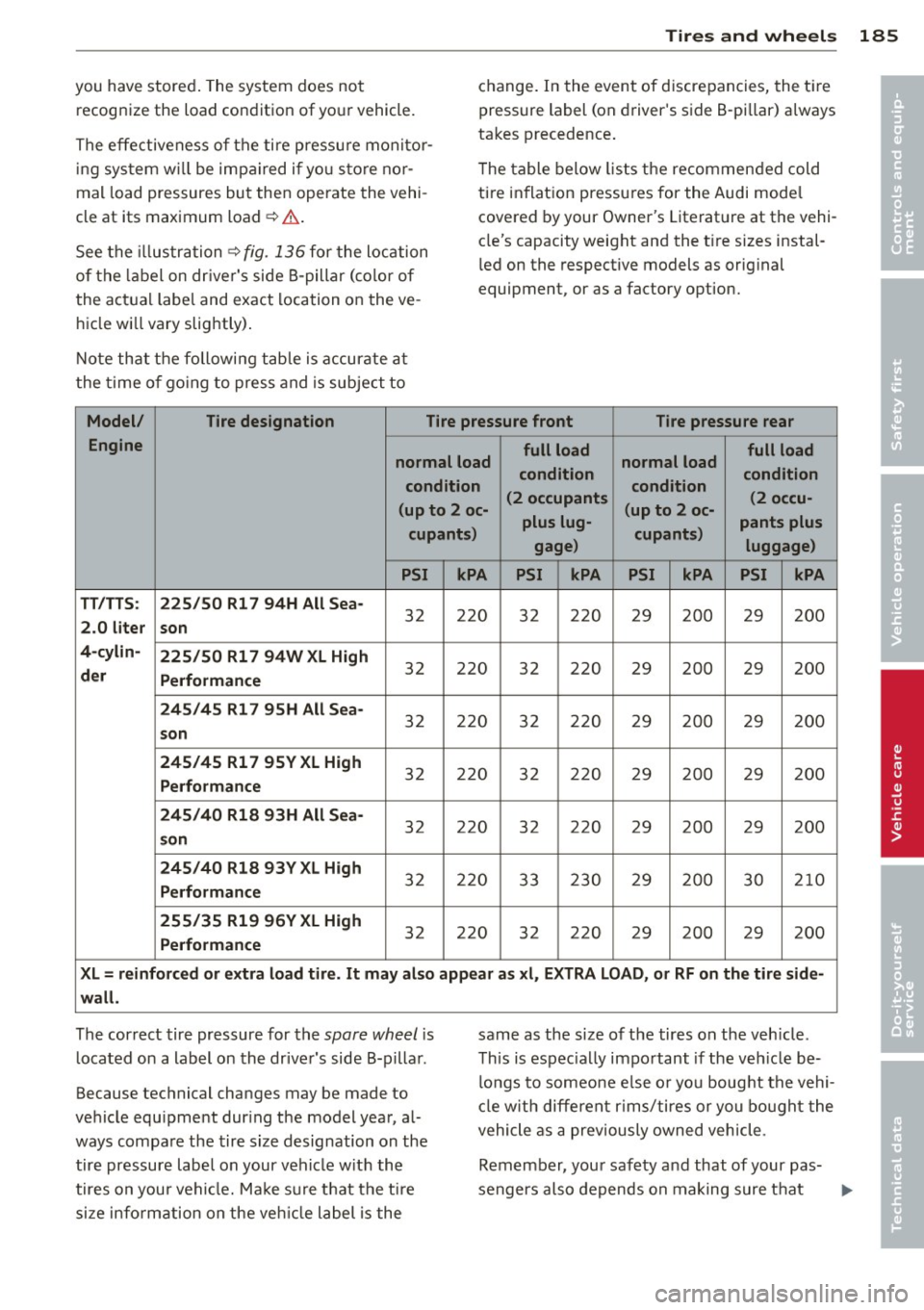
T he table below lists the recommended cold
ti re inflation pressures for the Audi mode l
covered by your Owner's Literature at the vehi
cle's capacity weight and the t ire sizes instal
led on the respective models as orig inal
equipment, or as a factory option.
Model/ Tire designation Tire pressure front Tire pre ssure rear
Engine full load full load
normal load condition normal load
condition
condition
(2 occupants condition
(2 occu-
( upto 2 oc-
plus lug- (
up to 2 oc-
pants plus
cupants) gage ) cupants)
luggage)
PSI kPA PSI kPA PSI kPA PSI kPA
TT /TI S: 225 /50 Rl 7 94H All Sea -
32 220 32 220 29 200 29 200 2.0 liter son
4-cyl in-
225/50 Rl 7 94W XL Hi gh
d er
Perf or man ce
32 220 32 220 29 200 29 200
24 5/ 45 Rl 7 95 H All S ea-
32 220 32 220 29 200 29 200 son
245 /45 R1 7 95YX L High
32 220 32 220 29 200 29 200 Performance
245 /40 R18 93H All S ea-
32 220 32 220 29 200 29 200 son
2 45 /40 R18 93Y XL High
32 220 33 230 29 200 30 210 Perf or mance
255 /35 R19 96 Y XL High
32 220 32 220 29 200 29 200
Perfo rmance
X L= r einf orced or extra lo ad tire. It ma y al so app ear a s xl, EX TR A LO AD, or RF on the tir e side-
wa ll.
The correct tire pressure for the spare wheel is
located on a label on the driver's side B-pillar.
Because technical changes may be made to
vehicle equ ipment during the model year, al
ways compare the tire size designation on the
tire pressure label on your vehicle w ith the
tires on your vehicle. Ma ke sure that the tire
size information on the veh icle label is the same
as the size of the tires on the veh icle.
Th is is espec ially important if the veh icle be
longs to someone else o r you boug ht the vehi
cle w ith diffe rent rims/tires or you bought the
vehicle as a prev iously owned vehicle.
Remember, your safety and that of your pas-
sengers also depends on making sure that
IJll,
•
•
Page 188 of 244
186 Tire s and wheel s
load limits a re not exceede d. Vehicle load in
cludes everybody and everything in and on t he
ve hicle . These load limits are technically refer
red to as the vehicle's Gross Vehicle We ight
Rating ("GVWR"). The Gross Axle Weight Rat
ing ("GAWR") is the maximum load that can
be applied at each of the veh icle 's two axles .
The Gross Vehicle Weight Rating and the
Gross Axle Weigh t Rat ing a re listed on the
safety compliance st ic k er labe l located on the
driver's side B-pill ar. T he tire pressure label on
your Audi lists the maximum combined weight of a ll of the occupants and luggage or
othe r cargo that the vehicle can carry. For the
locat ion of the tire pressure label¢
fig. 136.
A WARNING
Overloading a vehicle can cause loss of ve
hicle control, a crash or other acc ident, se
r ious personal in jury, and even death.
- Carry ing more weight than your vehicle
was desig ned to carry will prevent the
vehicle from hand ling p roperly and in
cr ease the risk of a loss of veh icle con
t ro l.
- T he brakes on a veh icle that has been
overloaded may not be ab le to stop t he
vehicle within a sa fe distance.
- Ti res on a vehicle that has been ove rload
ed can fail suddenly causi ng lo ss of con
tro l and a crash .
A WARNING
-Incorre ct tire pressures and/or underin
flation can lead to a serious o r fatal acci
dent.
- Incorrect tire pressures and/or underin
flation cause increase d tire wear and can
affect the handling of t he vehicle .
- Incorrect tire pressures and/o r underin
flation can also lead to sudden tire fa il
ure, incl uding a blowo ut and sudden de
flation, causing loss of vehicle control.
Checking tire pressure
The correct tire pressure for the tires original
ly installed on your vehicle is listed on the tire
pressure label located on driver's side 8-pil lar.
The recommended tire pressures are on the
t ir e p ressu re label a nd in the table
¢
page 184, Cold tire inflation pressure. This
means tha t the pressu re m ust be che cked and
adjus ted whe n the t ire has not been dr iven fo r
more than a couple of miles (kilometers) at
l ow speeds d uring the previous t hree ho urs.
Air in the tires expands when the tire heats up as a result of interna l frict ion as it flexes in
use. The tire pressure is higher when the tire
has warmed up than whe n it is "cold ."
It is the inflation pressure in a "co ld" t ire that
counts. Therefore, you should never let a ir o ut
of a warm tire to match "Cold t ire inflat ion
pressure" recommendat io ns ¢
page 184 . The
t ires wou ld then be unde rinflated and could
fail suddenly .
The tire pressure label on your Audi lists the recommended co ld tire inflation pressures fo r
the new, orig inal equ ipment tires that were
o n your veh icle at the time it was manufac
tu red. Fo r the lo cat ion of t he labe l
¢page 184, fig . 136.
Most t ires lose air naturally over t ime . They
can a lso lose some air if you d rive over a pot
hole or hit a curb while par king. It is usually
not poss ible to see whethe r the rad ial tires
u sed today are underinfla ted just by loo king
at them .
T he refore, be sure to check t ire p ressu res at
l east on ce a mo nth and a lways befo re going
o n a long trip. M ake s ure to ta ke the n umbe r
of peop le and the amount of luggage into ac
count when a djusting tire pressure for a trip -
even on e that yo u wo uld not conside r to be
" long." See ¢
page 188, Tires and vehicle
load limits
for more important information .
Always use an accurate tire press ure ga uge
when checking and ad justing inflat ion pres
s u res. Check all of the tires and be sure not to ..,.
Page 189 of 244
forget the spare tire. If the press ure in any tire
is too high when the tire is "cold," let air out
of the tire slowly with the edge of the t ire
gauge and keep checking the pressure until
you reach the pressure that is correct for the
load (passengers and luggage) and kind of
driving you plan to do .
If the pressure in any tire is too low, note the
d ifference between the pressure in the cold
tire and the pressure you need and add the a ir
that you need to reach the correct pressure for
the veh icle load (passengers and luggage) for
the tires on your veh icle as listed on the on
your ve hicle and in this manua l and the kind
of dr iving you p lan to do .
Never exce ed the ma ximum inflation pres
s ur e listed on t he tire s idewall for any re a
s on.
Remember that the vehicle manufacturer , not
the t ire manufacturer , determ ines the correct
tire pressure for the tires on your veh icle .
It is important to check the tire pressure when
the t ires a re cold .
- Read the req uired tire press ure from the tire
pressure label located on driver's s ide B-pil
l ar .
- Turn the valve stem cap counter-clockwise
to remove it from the tire valve .
- Place the air pressure ga uge on the valve.
- The tire pressures sho uld on ly be checked
and adjusted when the tires are cold . The
s light ly raised pressures of warm tires must
not be reduced.
- Adjust the tire pressure to the load you are
carrying.
- Re insta ll the va lve stem cap on the valve .
When should I check the tire pressure?
The correct tire pressure is espec ially impo r
tant at high speeds . The pressure sho uld
therefore be checked at least once a month
and a lways befo re starting a journey.
When should I adjust the tire pressures?
Adj ust the tire pressu re to the load you are
carry ing . After changi ng a wheel
or replacing
Tire s an d wheel s 187
whee ls yo u have to adjust the ti re p ressu res
o n all whee ls. In addition, yo u m ust then initi
a lize the new tire pressu res in the t ire pres
s u re monitoring system
Q page 198.
A WARNING
Incorrect tire pressures and/or underinfla
tion can lead sudden tire fa ilure, loss of
control, collision, serio us pe rsonal injury
or even death.
- When the warning symbol
It] appears in
the instrument cluster, stop and inspect
the t ires.
- Inco rrect tire pressure and/or underinfla
tion can cause increased tire wea r and
can affect the handling of the vehicle and
stopping ability.
- Inco rrect tire pressures and/or unde rin
flation can a lso lead to sudden t ire fail
ure, including a blowou t and su dden de
flation, caus ing loss of veh icle cont ro l.
- Th e drive r is responsib le for the co rrec t
tire pressures for all tires on the veh icle.
The applicable pressure values a re locat
ed on a sticke r on the driver's side B-pil
lar.
- On ly when all tires on the vehicle are fil
led to the correct pressure, the t ire pres
sure mon itor ing system can work cor
rectly.
- The use of incorrect tire pressu re va lues
can lead to acc idents or other damage.
Therefore it is essential that the driver
observe the spec ified t ire pressure val ues
for the tires and the correct pressures for
the function of the t i re p ress ure monito r
ing system.
- Always inf late t ires to the recommended
and correct t ire p ress ure before dr iv ing
off.
- Driving with unde rinflated tir es bend
mo re, lett ing t hem get too hot resulting
in tre ad separ ation, sudden tire failure
and loss of cont rol.
- Excessive speed and/overloading can
cause he at bu ild- up, sudden tire failure
an d loss of cont rol. •
•
Page 191 of 244
Determining correct load limit
Use the example below to cal
culate the total weight of the
passengers and luggage or oth
er things that you plan to trans
port so that you can make sure
that your vehicle will not be overloaded.
Steps for Determining
Correct Load Limit
1. Locate the statement "THE
COMBINED WEIGHT OF OC
CUPANTS AND CARGO
SHOULD NEVER EXCEED XXX KG OR XXX LBS"on your vehi
cle's placard (tire inflation pressure label)
¢ page 184,
fig . 136 .
2. Determine the combined
weight of the driver and pas sengers that will be riding in
your vehicle .
3 . Subtract the combined
weight of the driver and pas sengers from
"XXX" kilo
grams or
"XXX" pounds
shown on the sticker
¢ page 184 , fig. 136.
4. The resulting figure equals
the available amount of car
go and luggage load capaci
ty. For example, if the
"XXX"
amount equals 1400 lbs.
Tires and wheels
and there will be five 150 lbs. passengers in your vehi
cle, the amount of available
cargo and luggage load ca pacity is 650 lbs. (1400-7 50
(5
X 150) = 650 lbs.)
5 . Determine the combined
weight of luggage and cargo
being loaded on the vehicle .
That weight may not safely exceed the available cargo
and luggage load capacity
calculated in Step
4.
6. If your vehicle will be towing
a trailer, load from your trail
er will be transferred to your
vehicle. Consult this manual
to determine how this reduces the available cargo
and luggage load capacity of
your vehicle.
,...Check the tire sidewall
(¢ page 191 , fig. 140) to de
termine the designated load rating for a specific tire.
189
•
•
'
Page 195 of 244

V up to 149 mph (240 km/h)l)
Z over 149 mph (240 km/h)
1
)
W up to 168 mph (270 km/h)ll
Y up to 186 mph (298 km/h)
1 )
Your veh icle is norma lly factory equipped with
t ires, which posses s excellen t driving charac
ter istics and give your Audi opt imum driving
comfort . An electronic speed limiter
¢ page 30 w ill normally prevent your vehicle
from go ing faste r th an the tire speed rating
¢ &_ .
U.S. DOT T ire Identification Number (TIN )
and tire manufactur e date
This is the t ire's "serial numbe r" . It begins
with the le tters "DOT" and indicates that the
tire meets all federal standards . The next two
numbers or letters indicate the p lant where it
was manufactured, and the last four numbers represent the week and year of manufactu re.
Fo r example, the numbers 2213 mean that
t he t ire was produced in the 22nd week of
2013 . T he other numbers are marketing co
des that may or may not be used by the t ire
manufacturer . This information is used to con
tact consume rs if a tire defect requires a re
call.
Audi Original tire
Tires with the ident ificat ion "AO" or "RO" have
been spec ially matched with your Aud i. We
recommend using only these tires because
they meet the highest standards regard ing
safety and driving charac ter istics whe n used
correctly. Yo ur authorized Audi dealer will
g lad ly provide you with more informat ion.
Tire ply composition and materials used
The numbe r of p lies ind icates the numbe r of
l ayers of rubber -coa ted fabric in the t ire. In
general, the greater the number of p lies, the
mo re weight a tire can support . Tire manufac
turers also must indicate the materials in the
1) F o r tires wit h a m ax im um s pee d ca pabil ity over 149
mph (2 4 0 k m/h) , tire ma nufa cturers some times use
t h e le tters "Z R."
Tire s an d wheel s 193
tire, which include stee l, nylon, po lyester, and
others .
Maximum Load Rating
This number indicates the max imum load in
kil ograms and po unds that can be ca rr ied by
the tire.
Tire quality grading for treadwear ,
tract ion , and temperature resistance
T read wear, t raction and tempe ra tur e grades
¢page 194 .
Maximum Permissible Inflation Pressure
This number is the greatest amount of a ir
pressure that should ever be put in the tire
u nder norma l dr iv ing cond itions .
_&. WARNING
-Using incorrect o r unm atc hed tires and/
or wheels or improper tire and wheel
comb inat ions can lead to loss of control
,
collision and serio us personal inj ury .
- Always use t ires, rims and whee l bolts
that meet the specifications of original
factory- insta lled tires or other combina
tions that have been specifically ap proved by the vehicle manufacturer.
- Tires age even if they are not being used
and can fai l sudden ly, especially at hig h
speeds. Tires that are more than 6 years
old can only be used in an emergency
and then w ith special care and at lower
speeds .
- Never mount used tires on your veh icle if
you are not sure of the ir "previous histo
ry ." O ld used tires may have been dam
a ged even thoug h the damage cannot be
seen tha t can lead to sudden tire fai lure
and loss of vehicle control.
.
- All fo ur whee ls must be fitted wit h ra dial
tires of the same type, size (rolling cir
cumference) and the same tread pattern . ..,
•
•