2015 AUDI TT ROADSTER lock
[x] Cancel search: lockPage 175 of 244

If you have lost a consi derable amount of
coolant, then you should add co ld antifreeze
and cold water only when the engine is co ld .
Always use
new engine coolant when refi lling.
D o not fi ll coolant above the "MAX " mark . Ex
cess coolant will be forced out th rough the
p ress ure rel ief valve in the cap when the en
g ine becomes hot .
A WARNING ,_________
- The cooling system is under press ure and
can get very hot . Reduce the risk of
sca ld ing from hot coo lant by following
these steps.
- Tur n
off the eng ine and a llow itto cool
down.
- P rotect your face, hands and arms from
escap ing f lu id a nd steam by cover ing
the cap wi th a la rge, thick rag.
- Turn the cap slow ly and very ca refully
in a cou nte r-clockw ise d irect ion while
a pply ing ligh t, downw ard p ress ure on
the to p of the cap.
- T o avo id being burned, do no t sp ill an
tifreeze or coolan t on the exhaust sys
tem or hot engine parts . U nder certa in
conditions, the ethylene glyco l in en
gine coolant can catc h fire .
- Antifreeze is poisonous . Always store an
tifreeze in its original container and we ll
o ut o f the reach of children.
- If you drain the coolant , it must be
caught and safely stored in a proper con
tainer clearly marked "poison".
@ Note
- Do not add coolant if the expansion tank
i s empty . Ai r could enter the cooling sys
tem and damage the engine. If this is
the case, do not continue driving. Seek professional assistance.
- Coolant po llutes the env ironment and
could cause a n engine fire. Excess coo l
ant wi ll be f orced out through the pres
su re re lief valve in the cap when the en
gine becomes hot.
Checkin g and fillin g 173
- If, in an eme rgency, on ly wate r can be
added, the co rrect ratio between water
and antifreeze ¢
page 171 must be re
stored as soon as possible.
@) For the sake of the environment
Drained coolant sho uld not be reused. A l
ways d ispose of used coolant while observ
i ng a ll environmental regulations.
, Radiator fan
The radiator fan switches on automatically by
itself .
The electric radiator fan is controlled by ther
moswitches that switch on and
off depending
on coo lant and eng ine compartment tempera
tures.
An a uxiliary electric radiato r fan* sw itches on
and
off depending on coolant temperature
and othe r vehicle ope rat ion conditions .
After yo u switch the eng ine off, the aux iliary
f an can continu e running for up to 10 m inut es
- even with the ignition off. It can even switch
on again later by itself¢ & , if
- t he temperatu re of the engine coo lant rises
due to the hea t build -up from the engine in
the engine compa rtment, or
- the engine compa rtment heats up because
the vehicle is parked in intense sunlig ht.
A WARNING ~
- To reduce the risk of persona l in ju ry nev-
er touch the radiator fan .
- The a uxiliary electric fan is tempe rat ure
contro lled and can switch on suddenly
even when the engine is not running.
- The a uxiliary radiator fa n sw itches on a u
tomatically when the engine coo lant
reaches a certai n temperature and will
continue to ru n until the coo lant temper
ature drops. •
•
Page 176 of 244

17 4 Che cking and filling
Brake fluid
Checking brake fluid level
Fig . 133 Engine compa rtment: cove r on the brake fluid
reservo ir
Before you check anything in the engine com
partment,
a lw ays read and h eed all WA RN
ING S ¢&. in Working in the engine compart
ment on page 164.
,.. Read the brake fluid level from the brake
fluid reservoir¢
page 166, fig . 128. T he
brake flu id leve l must be between the "MIN"
and "MAX" markings.
The brake flu id rese rvo ir is located behind the
rear part ition of the eng ine compartment o n
the left side ¢
page 166.
The fluid level may drop slightly after some
time due to the automatic adjustment of the b rake pads . This is not cause for alarm.
If the brake fluid level falls
considerably be
low the "MIN" mark, the brake warning/indi
cator light (U.S. models: . , Canadian mod
e ls: . ) w ill come on
¢page 14. Do not con
tinue to operate the vehicle. The comp lete
brake system shou ld be thoroughly checked
by an authorized A udi dealer or other quali
fied facility and the cause corrected.
If the
brake fluid level is too low, the brake warn ing/
indicator light w ill illuminate. Contact an au
thor ized Audi dealer
imm ediatel y.
Changing brake fluid
Have the brake fluid changed by an experi
enced technician .
Brake fluid absorbs moisture from the air. If
the water content in the brake fluid is too high, corrosion in the brake system may result
after a period of time . The boiling point of the
brake flu id will also decrease conside rably and
decrease braking pe rformance.
Therefore, the brake fluid must be changed
eve ry two y ears. Always use new brake flu id
which conforms to Federal Motor Veh icle
Standard "F MVSS 116 DOT 4".
The brake fluid reservoir can be diff icult to
reach, therefore, we recommend that you
have the brake fluid changed by your author
ized
Audi dealer . Your dealer has the correct
tools, the right brake fl uid and the know -how
to do this for you.
A WARNING
- Brake fluid is poisonous . It must be stor
ed only in the closed original container
out of the reach of children!
- Brake failure can resu lt from o ld or inap
propriate brake flu id. Observe these pre
cautions:
- Use only brake f luid that meets SA E
specifica tion
J 1 7 03 and conforms to
Federa l Moto r Ve hicl e Standard 1 16.
Always check with yo ur authorized Aud i
dealer to make sure yo u are using the
correct brake fluid. The correct type of brake f lu id is also ind icated on the
brake flu id reservoir.
- The brake fluid must be new. Heavy use
of the brakes can cause a vapor lock if
the brake fluid is left in the system too
l ong. This can seriously affect the effi
c iency of the brakes as well as your
safety. This cou ld resu lt in an accident.
(D Note
Brake fluid will damage the paint of your
vehicle .
Page 189 of 244
forget the spare tire. If the press ure in any tire
is too high when the tire is "cold," let air out
of the tire slowly with the edge of the t ire
gauge and keep checking the pressure until
you reach the pressure that is correct for the
load (passengers and luggage) and kind of
driving you plan to do .
If the pressure in any tire is too low, note the
d ifference between the pressure in the cold
tire and the pressure you need and add the a ir
that you need to reach the correct pressure for
the veh icle load (passengers and luggage) for
the tires on your veh icle as listed on the on
your ve hicle and in this manua l and the kind
of dr iving you p lan to do .
Never exce ed the ma ximum inflation pres
s ur e listed on t he tire s idewall for any re a
s on.
Remember that the vehicle manufacturer , not
the t ire manufacturer , determ ines the correct
tire pressure for the tires on your veh icle .
It is important to check the tire pressure when
the t ires a re cold .
- Read the req uired tire press ure from the tire
pressure label located on driver's s ide B-pil
l ar .
- Turn the valve stem cap counter-clockwise
to remove it from the tire valve .
- Place the air pressure ga uge on the valve.
- The tire pressures sho uld on ly be checked
and adjusted when the tires are cold . The
s light ly raised pressures of warm tires must
not be reduced.
- Adjust the tire pressure to the load you are
carrying.
- Re insta ll the va lve stem cap on the valve .
When should I check the tire pressure?
The correct tire pressure is espec ially impo r
tant at high speeds . The pressure sho uld
therefore be checked at least once a month
and a lways befo re starting a journey.
When should I adjust the tire pressures?
Adj ust the tire pressu re to the load you are
carry ing . After changi ng a wheel
or replacing
Tire s an d wheel s 187
whee ls yo u have to adjust the ti re p ressu res
o n all whee ls. In addition, yo u m ust then initi
a lize the new tire pressu res in the t ire pres
s u re monitoring system
Q page 198.
A WARNING
Incorrect tire pressures and/or underinfla
tion can lead sudden tire fa ilure, loss of
control, collision, serio us pe rsonal injury
or even death.
- When the warning symbol
It] appears in
the instrument cluster, stop and inspect
the t ires.
- Inco rrect tire pressure and/or underinfla
tion can cause increased tire wea r and
can affect the handling of the vehicle and
stopping ability.
- Inco rrect tire pressures and/or unde rin
flation can a lso lead to sudden t ire fail
ure, including a blowou t and su dden de
flation, caus ing loss of veh icle cont ro l.
- Th e drive r is responsib le for the co rrec t
tire pressures for all tires on the veh icle.
The applicable pressure values a re locat
ed on a sticke r on the driver's side B-pil
lar.
- On ly when all tires on the vehicle are fil
led to the correct pressure, the t ire pres
sure mon itor ing system can work cor
rectly.
- The use of incorrect tire pressu re va lues
can lead to acc idents or other damage.
Therefore it is essential that the driver
observe the spec ified t ire pressure val ues
for the tires and the correct pressures for
the function of the t i re p ress ure monito r
ing system.
- Always inf late t ires to the recommended
and correct t ire p ress ure before dr iv ing
off.
- Driving with unde rinflated tir es bend
mo re, lett ing t hem get too hot resulting
in tre ad separ ation, sudden tire failure
and loss of cont rol.
- Excessive speed and/overloading can
cause he at bu ild- up, sudden tire failure
an d loss of cont rol. •
•
Page 196 of 244
194 Tire s and wheel s
Driving with different tires reduces vehi
cle handling and can lead to a loss of
co ntrol.
- If the spare tire is not the same as the
t ires that are mounted on the veh icle -
for example with winter tires - on ly use
the spare tire for a short period of time
and dr ive with extra ca re. Refit the nor
ma l road whee l as soon as safely possi
ble.
- Never drive faste r than the maximum
speed for which the tires o n your veh icle
are ra ted because ti res th at are driven
faster than their rated speed can fail
sudden ly .
- Over loading t ires c ause heat b uild- up,
sudden tire failure, including a blowout
and sudden deflation and loss of control.
- T emperature grades app ly to tires t hat
are properly inflated and not over o r un
derinflated.
- F or technical reasons it is not a lways
possible to use wheels from other
vehicles -in some cases not even w heels
from the same vehicle model.
- If you insta ll wheel trim discs on t he ve
hicle whee ls, make sure that the air f low
to the brakes is not blocked. Reduced air
flow to the brakes can them to overheat, increasing stopping distances and caus
ing a collision.
- Run flat t ires may on ly be used on
vehicles that were equ ipped w it h them
at the facto ry. The vehicle must have a
chassis des igned for run f lat t ires and a
fac to ry-installed t ire p ress ure moni to r
ing system that ind ic a tes a loss of tire
pressure. Incorrect use of run flat tires
can lead to vehicle damage or accidents .
Check with an a uth orized Audi dea ler or
t i re spec ialist to see i f your vehicle can be
equipped with run flat tires. If r un flat
t ires a re used, they must be installed on
all four wheels . M ixing tire types is not
permitted . (D Note
-For technical reasons, it is not generally
poss ible to use the w heel rims from oth
er ve hicles. T his can hold tr ue for wheels
of the same vehicle type.
- If the spare tire is diffe rent from the
tires that you have mounted on your ve
hicle (for example winter tires or wide
profi le tires), then use the spare tire for a
short period of time only and drive w ith
extra care. Replace the flat tire w it h the
ti re mat ching the othe rs on your vehicle
as soon as possi ble.
- N ever d rive without the valve stem cap.
T he v alves co ul d get damaged.
@ For the sake of the environment
Dis pose of o ld tires in accordance w ith the
l ocal requirements.
Uniform tire quality grading
- Tread wear
- Tra ction AA A B (
- Temperature ABC
Quality grades can be found where applicab le
o n the tire s ide wall between tread shoulder
and maximum section width
¢ page 191,
fig . 140 .
For example: Tread wear 200 , Traction AA,
Temperature A.
All passenger car ti res must conform to Feder
al Safety Req uirements in add ition to these
grades .
Tread wear
The tread wear g rade is a comparative rating
based on the wear rate of the tire when tested
u nder contro lled conditions o n a specified
government test course.
F o r example, a tire gra ded 150 wo uld wear
one and one ha lf (11/2) times as well on the
government course as a ti re graded 100.
Page 198 of 244
196 Tire s and wheel s
was manufactured . Please see q page 192,
Speed roting (letter code) for a listing of the
speed rat ing letter codes and the maximum
speed at wh ich the t ires can be driven .
The speed rating letter code( ¢ page
183) is
on the side wall of the tire ¢ page 191.
A WARNING
Winter tires have maximum speed limits
that may be lower t han your vehicle's max
imum speed . Always know the maximum
speed before driving off . Never drive faster
than the speed permitted for your specific
w inte r tires. This will cause damage to the
tires leading to an accident and serious
pe rsonal inj ury to you and your passen
gers .
A WARNING
= ~
Driv ing faster than the maximum speed
for which the winter tires on your vehicle
were designed can cause tire fai lure in
cluding a blowout and sudden deflat ion,
loss of control, crashes and serious per
sonal injuries. Have worn or damaged tires
rep laced immed iate ly .
- Winter tires have maximum speed rat ing
that may be lower tha n your veh icle's
maximum speed .
- Never drive faster than the speed for
w hich the winter or other tires installed
on your vehicle are rated.
A WARNING
Always adjust your d riving to the road and
t raffic conditions. Neve r let the good ac
celeration of the wi nte r t ir es and all-whee l
dr ive temp t you in to taking extr a ris ks . A l
ways remember :
- Whe n bra king, an al l-wheel d rive vehicle
hand les in the s ame way as a front drive
vehicle.
- Drive c aref ully and reduce your speed on
icy and slippery roads, even winter tires
cannot he lp under black ice conditions.
{® For the sa ke of the environment
Use summer tires when weather condi
tions permit. They are qu ieter, do not wear
as quickly and reduce fuel consumpt ion.
Snow chains
Snow cha ins may be f itted only to the front
whee ls, and o nly to certain tire sizes . Ask your
autho rized Aud i deale r on which tire sizes
snow c hains ca n be used.
If you are go ing to use snow chains, then you
must i nstall them on the front whee ls at
least.
The snow chains must have low-prof ile links
and must not be t hicker than 0.53 inch
(13.5 mm), includ ing the lock .
Remove whee l center covers and trim discs
before putt ing snow cha ins on your vehicle
¢ \!) . For safety reasons cover caps must then
be fitted over the wheel bolts . These are ava il
able from autho rized Aud i deale rs .
A WARNING
Using the wrong snow chai ns for your veh i
cle o r in stall ing them in correct ly can in
crease the risk o f loss of cont ro l leading to
se rious personal injury.
- Snow chains are available in di fferent
sizes. Always make sure to follow the i n
structions provided by the snow chain manufacturer .
- When driving wi th snow cha ins never
d rive faster than the speed permitted for
your specific snow chains.
- Always observe local regulations .
(D Note
-Remove snow chain s before dr iv ing o n
roads not covered with snow to avoid
damaging tires and wearing the snow
chains down unnecessa rily.
- Snow chains, which come in to direc t con
t act with the whee l rim, can scrat ch or
damage it . Therefore , make sure that the
1J1-
Page 211 of 244
.. Close your grip around the end of the
wrench handle for maximum torque and
turn the wheel bolts
c ounter-clockwis e
about one single turn in the direct ion of ar
row
r:> fig . 154.
Tightening
.. Fit the wheel bol t wrench over the wheel
bolt and push it down as far as it will go .
.. Close your grip around the
end of the
wrenc h handle for maximum torque and
turn each wheel bolt
cl ock wis e unt il it sits
t ight .
A WARNING
-Us ing fo rce without control to speed the
wheel change up can cause the veh icle to
slip off the jack and ca use se rious pe r
sonal in juries.
-Do not loosen the wheel bolts more than
one turn
before you ra ise the veh icle with
the jack. -Risk of inj ury!
(1) Tips
- N ever t ry and use the hexagona l socket
i n the handle of the screwdriver to loos
en or tighte n the wheel bolts .
- If a whee l bolt sits very t ight, you may
find i t easie r to loosen by carefully p ush
i ng down on the end of the whee l bolt
wrench with
one foot only . As you do,
ho ld on to the car to keep yourse lf stable
and ta ke care not to slip .
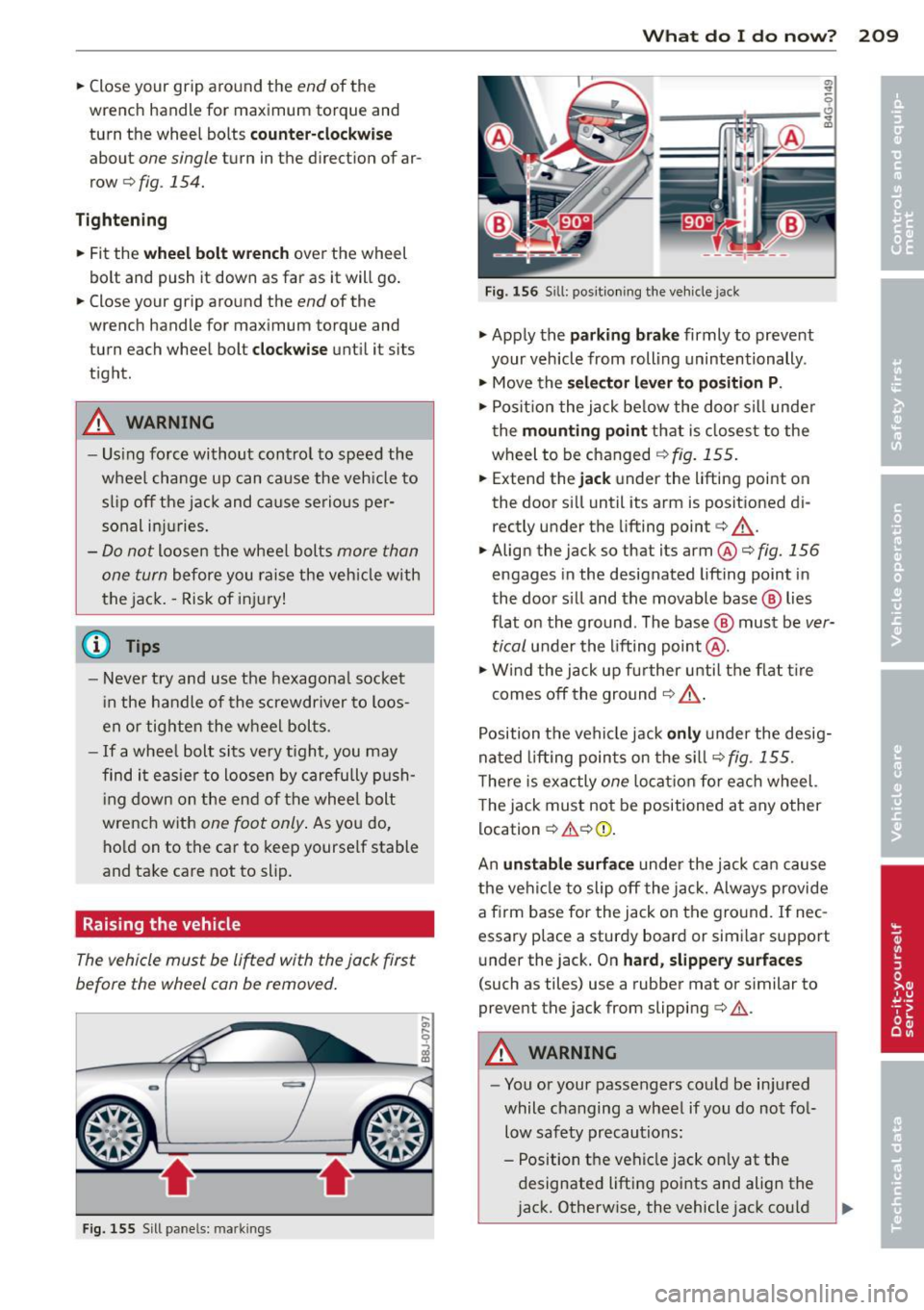
Raising the vehicle
The vehicle must be lifted with the jack first
before the wheel can be removed .
..
Fig. 155 Sill p ane ls: m arkin gs
What do I do now ? 209
Fig. 1 56 Sill : pos itio ning the ve hicle jac k
.. App ly the pa rkin g brake firmly to prevent
your veh icle from rolling unintentionally .
.. Move the
se lect or lever to p osition P .
.. Posit io n the jack be low the door sill unde r
t he
m ounting point tha t is closest to the
wheel to be changed
r=> fig. 155 .
.. Extend the jack under the lifting point on
the door s ill until its arm is positioned di
rectly under the lifting point
c> ,& .
.. Align the jack so that its arm@¢ fig. 156
engages in the designated lift ing point in
the door s ill and the movable base ® lies
flat on the ground . The base @ must be
ver
tical
under the lifting point @ .
.. Wi nd the jack up fu rther u ntil t he f lat t ire
comes off the ground
c> ,& .
Position t he vehicle jack only under the desig
na ted lifting points on the s ill
r:>fig . 155.
T he re is exactly one locat io n for eac h wheel.
T he jack must not be positioned at any other
location ¢
,&¢(D .
An unstable surfa ce unde r the jack ca n cause
the ve hicl e to slip off the jack. Always provide
a firm base for the jack on the gro und . If nec
essary place a sturdy board or s im ilar support
u nder the jack. On
hard , slippery surf aces
(such as tiles) use a rubber mat or similar to
prevent the jack from slipping ¢
.&.
A WARNING
-You or your passengers cou ld be in jured
while changing a wheel if you do not fo l
low safety precautions:
- Position the veh icle jack on ly at the
designated lifting poi nts and align the
j ack. Otherwise, the vehicle jack co uld
Page 212 of 244
210 What do I do now?
slip and cause an injury if it does not
have sufficient hold on the vehicle.
- A soft or unstable surface under the
jack may cause the vehicle to slip off
the jack. Always provide a firm base for
the jack on the ground . If necessary,
use a sturdy board under the jack.
- On hard, slippery surface (such as tiles)
use a rubber mat or similar to prevent
the jack from slipp ing .
- To help prevent injury to yourself and
your passengers:
- Do not raise the vehicle unti l yo u are
sure the jack is securely engaged.
- Passengers must not remain in the ve
hicle when it is jacked up.
- Make sure that passengers wait in a
safe p lace away from the vehicle and
well away from the roadway and traffic.
- Make sure jack position is correct, ad
just as necessa ry and then continue to
ra ise the jack .
(D Note
A floor jack or the pads on the hoist arms
must
not be posit ioned at the points
shown
-arrows- .
Taking the wheel off
Follow these instructions step-by-step for
changing the wheel.
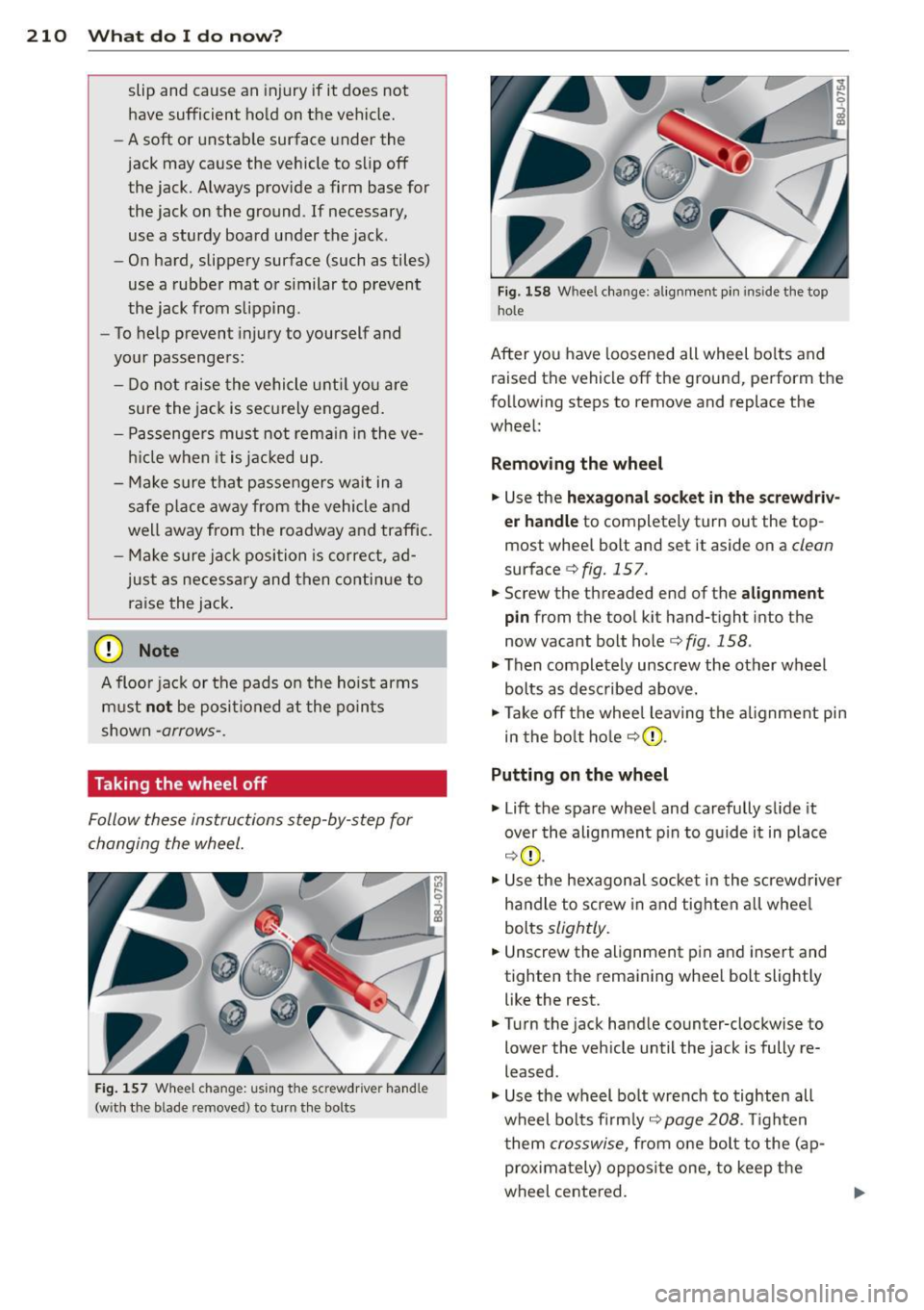
Fig. 157 Wheel ch an ge: us ing the sc rewdrive r hand le
(w ith the b lade removed) to turn the bolts
Fig. 158 Whee l change : alignmen t pin inside the top
hol e
After you have loosened all wheel bolts and
raised the vehicle off the ground, perform the
following steps to remove and replace the
wheel:
Removing the wheel
.,. Use the hexagonal socket in the screwdriv
er handle
to completely turn out the top
most whee l bolt and set it aside on a
clean
surface c;, fig. 15 7.
.,. Screw the threaded end of the
alignment
pin from the tool kit hand-tight into the
now vacant bolt hole <=>
fig. 158 .
.,. Then completely unscrew the other wheel
bolts as described above.
.,. Take off the whee l leaving the alignment pin
in the bolt hole
c;,(D .
Putting on the wheel
.,. Lift the spare wheel and carefully s lide it
over the alignment p in to guide it in place
c;,(D .
.,. Use the hexagonal socket in the screwdriver
handle to screw in and tighten all whee l
bolts
slightly .
.,. Unscrew the alignment p in and insert and
tighten the remaining wheel bolt slightly like the rest .
.,. Turn the jack handle counter-clockwise to
lower the vehicle until the jack is fully re
leased .
.,. Use the wheel bo lt wrench to tighten all
wheel bolts firmly ,=:,
page 208 . Tighten
t hem
crosswise, from one bolt to the ( ap
proximately) opposite one, to keep the
wheel centered.
Page 215 of 244

Fuse Location, Instrument Panel left
0
Fig. 161 Fuse carrier behind the instrument panel end
face, cover removed
Some of the eq u i prnent items listed a re op
tional or only available on certain model con
f igurations.
Note that the following table is accurate at
the time of going to press and is subject to
change. In the event of d iscrepancies, the la
bel on the in side of the cover always takes
precedence .
The power seats are protected by circuit
breakers ,
which automatically reset after a
few seconds after the overload has been rem
ed ied.
No. Equipment Amps
Engine relay, fuel tank cont ro l
1
unit, A irbag Off light, light
10 switch (sw itch illumi nation), di-
agnostic connector
2
ABS, ASR, ESC, brake light
5 switch
3 AFS headlight (left) 5
No.
4
5
6
7
8
9
10
11
12
13
14
15
16
17
18
19
20
21 22
23
Fuses and bulbs 213
Equipment Amps
Oil level sensor (extended main-
tenance interval)
(WIV), t ir e
press ure monitoring system,
sw itch for Electron ic Stabiliza-
5 tion Control (ESC), AFS head-
lights (control unit), A/C system
(pressure sensor), backup light
sw itch
Automatic headlight range con- trol, AFS headlight (right) /
5/10
manual headlight range con-
trol, halogen headlights
Control unit for CAN data trans-
fer (gateway), electrornechani-
5 cal steering, automatic trans-
miss ion shift gate
Acoustic Park Assist, automatic
d ip ping interior rear
view rnir-
ror, garage door opener, heata-
5 ble windshield washer nozzles,
washer pump, w ind deflector
relay (Roadster)
H aldex clutch/Ha ldex clutch
5/10 (TTS)
Control un it Audi magnetic ride
5
A irbag contro l unit 5
Mass airflow sensor, crankcase 5/10
heating
Door control unit (central lock -
10 ing driver/passenger)
Diagnostic connector
10
Rain sensor, automatic trans-
5 miss ion sh ift gate
Roof light (interior lighting)
5
A/C system (contro l unit) 10
Tire pressure monitoring sys -
5 tern (control un it)
Not used
Not used
Not used
Fuel injectors (gasoline eng ine)
10
Wind deflector (Roadster) 30
Horn 20