2015 AUDI TT ROADSTER child lock
[x] Cancel search: child lockPage 137 of 244
~ When using the vehicle safety belt to insta ll
a chi ld safety seat, you must first activate
the convertible locking retractor on the
safety belt to prevent the ch ild safety seat
from moving
c:::, page 137.
~ Push the child safety seat down with your
f ull weight to get the safety belt really t ight
so that the seat cannot move forward or
s ideways more than one in ch (2.5 cm)
¢page 137.
A toddler or child is usually too large for an in
fant restra int if it is more than one yea r old
and weighs more than
20 lbs. (9 k g) .
Toddlers and c hildren who are older than one
yea r up to about
4 years o ld and weigh more
than
20 lbs. (9 k g) up to 40 lbs. (1 8 kg) must
always be properly restra ined in a ch ild safety
seat certified fo r the ir s ize and we ight
¢ fig . 119.
& WARNING
Not using a child safety seat, using the
wrong chi ld safety seat or improper ly in
stalling a child restraint increases the risk
of serious personal injury and death in a
co llision or othe r emergency s ituation.
- Children on the front seat of any car,
even with Advanced A irbags, can be seri
o usly injured or even killed when an a ir
bag inflates. A child in a rearward-facing
child safety seat installed on the front
pas senge r seat w ill be seriously injured
and can be killed if the fron t air bag in
fla tes -even with an Advanced Airbag
System .
-
- The inflating airb ag w ill hit the child
sa fety seat or infant carrier w it h great
force and w ill smash the ch ild safety seat
and child against the backrest, door or
roof.
- Never install a rearward facing child
sa fety seat on the front passenge r seat
unless the
PASSENGER AIR BAG OFF
light comes on and stays on. If the PAS
SENGER AIR BAG OFF
light does not
come o n and stay on have the airbag sys-
Child Sa fet y 135
tern inspected immediately by you r Audi
dea le r.
- Always rea d and heed all WAR NIN GS
whenever us ing a child restrained in ave
hicle is being used
c:::, page 100, Safety
belts,
c:::, page 108, Airbag system and
c:::, page 129, Important things to know.
A WARNING
If exceptional circ umstances require the
use of a forward -facing child r est raint on
the front passenge r's seat, the child's safe
ty an d we ll-being re quire t hat the fol low
ing spec ial prec autions be t aken:
- Ma ke sure the forward-facing seat has
been designed and certified by its m anu
f a cturer fo r use on a fro nt sea t wi th a
passenger front and side airbag.
- Always follow the manuf acturer's in
struc tions p rov ided with the ch ild safety
seat o r infant ca rr ier.
- Always move the fron t passenger sea t in
to the rearmos t position of the passen
ger seat's fo re and aft adjustment range,
and as far away f rom the airbag as possi
ble before installing the ch ild restraint.
- Always make sure that nothing prevents
the front passenger's seat from being
moved to the rearmost position in its
fore and aft adjustment range.
-Always make sure the backrest is in an upright pos ition.
- Make sure that the
PASSENGER AIR BAG
OFF
li ght comes on and stays on all the
time wheneve r the ignit ion is switched
on.
- If the light does not stay on, perform the
checks
c:::, page 118 , Monitoring the Ad
vanced Airbag System .
-If the PASSENGER AIR BAG OFF light
does not come on and stay on have the
airbag system inspec ted immedia tely by
your Aud i dea le r. •
•
-
Page 138 of 244
136 Child Safet y
Booster seats and safety belts
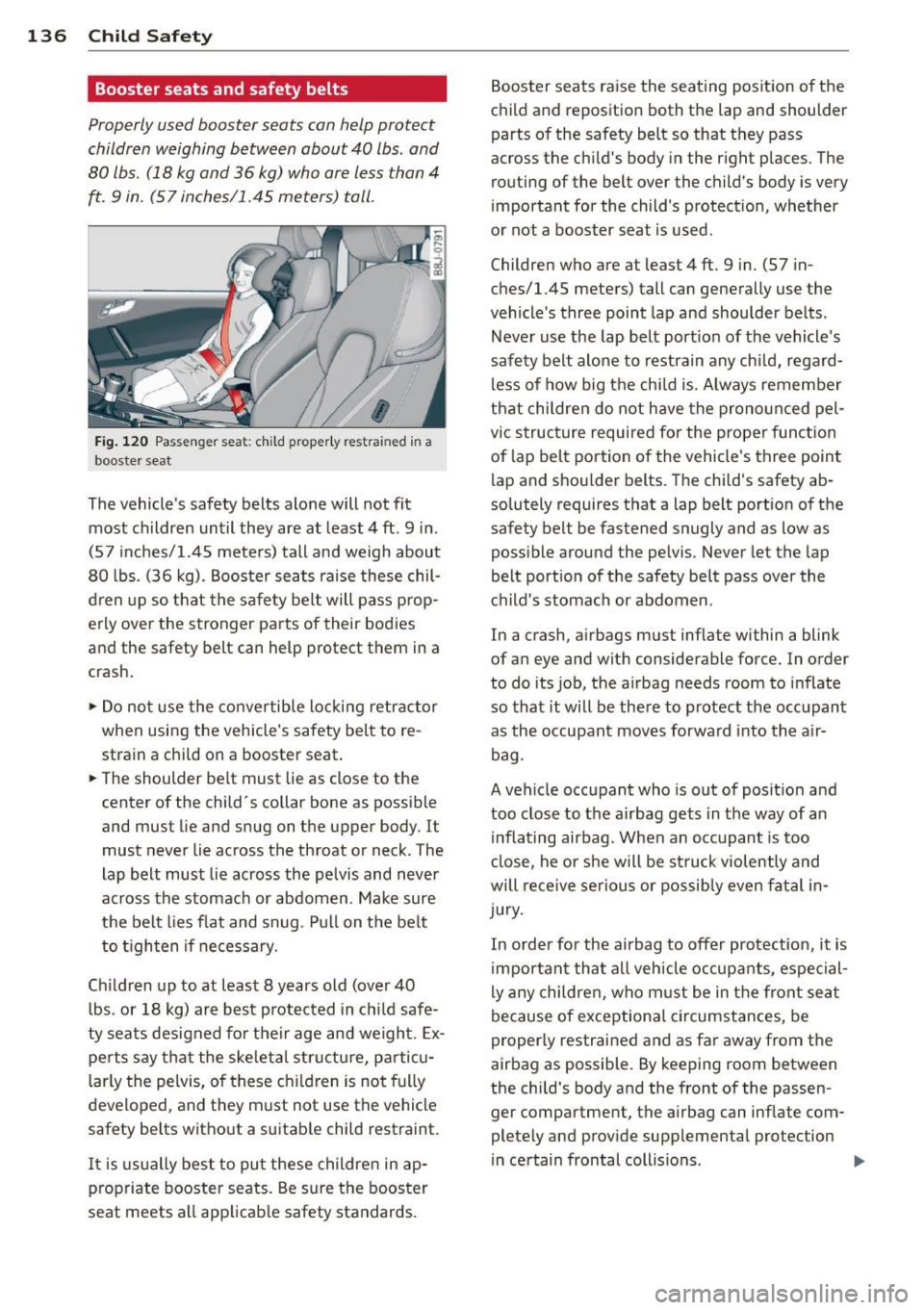
Properly used booster s eats can help protect
children weighing between about 40 lbs . and
80 lbs . (18 kg and 36 kg) who are less than 4
ft. 9 in. (57 inches/1 .45 meters) tall.
Fig . 120 Passenger seat: child proper ly rest ra in ed in a
booster seat
The vehicle's safety belts alone will not fit
most children until they are at least 4
ft. 9 in .
(57 inches/1.45 mete rs) tall and weigh about
80 lbs . (36 kg). Booster seats ra ise these chil
dren up so that the sa fety belt will pass p rop
erly over the stronger pa rts of their bodies
and the safety belt can help protect them in a
crash.
.. Do no t use the co nvertible locki ng retractor
when using the vehicle's safety belt to re strain a chi ld on a booster seat .
.. The shoulder be lt must lie as close to the
center of the child 's collar bone as possible
and must lie and snug on the upper body. It
must never lie across the throat or neck . The
lap belt must
lie across the pelvis and never
across the stomach or abdomen . Make sure
the belt lies f lat and snug . Pull on the be lt
to t ighten if necessary.
Ch ildren up to at least 8 years old (over 40
l bs. or 18 kg) are best protected in ch ild safe
ty seats designed fo r their age and weight . Ex
pe rts say that the ske leta l structure, pa rticu
larly the pelvis, of these ch ildren is not ful ly
developed , and they m ust not use the vehicle
safety belts without a suitab le child restraint.
It is us ually best to put these childre n in ap
propriate booster seats . Be sure the booster
seat meets all applicab le safety standards. Booster seats raise the seating position of the
c
h ild and reposition both the lap and shoulder
parts of the safety belt so that they pass
across the ch ild's body in the right p laces. The
ro uting of the belt over the child's body is very
important for the child's protect ion, whether
o r not a booster seat is used .
Children who are at least 4
ft. 9 in. (57 in
ches/1.45 meters) tall can generally use the
vehicle's three point lap and shoulder belts .
Never use the lap belt port io n of the vehicle's
safety belt alone to restrain any ch ild, regard
less of how big the chi ld is. A lways remember
that children do not have the prono unced pel
vi c structure required for the proper funct ion
of lap be lt portion of the vehicle's three point
lap and shou lde r belts . T he child 's safety ab
solutely requires that a lap belt port ion of the
safety belt be fastened snugly and as low as
possible around the pelvis. Never let the lap
belt portion of the safety be lt pass over the
c hi ld 's stomach or abdomen.
In a crash, a irbags must inflate within a blink
of a n eye and wi th considerable force. In order
to do its job, the airbag needs room to inflate
so that it will be the re to protect t he occupant
as the occupant moves forwa rd into the a ir
bag .
A vehicle occupant who is out of posit ion and
too close to the a irbag gets in t he way of an
inflating airbag . When an occupant is too
cl ose, he or she w ill be struck v iolently and
will receive serious or possibly even fatal in
Jury .
In order for the airbag to offer prote ction, it is
importan t that a ll vehicle occupa nts, espe cial
ly any childre n, who m ust be in t he front se at
because of exceptiona l circumstances , be
proper ly restrained and as fa r away from the
airbag as possible. By keeping room between
the chi ld's body and the front of the passen
ger compartment, the airbag can inf late com
pletely and prov ide supplemental protection
in certain frontal collisions .
..
Page 139 of 244
A WARNING ,~ ~
Not using a booster seat, us ing the boos
ter seat improperly, incorrectly install ing a
booster seat or using the vehicle safety
belt improperly increases the risk of seri
ous pe rsonal injury and death in a co llision
or other emergency s ituation. To help re
duce t he risk of serious persona l injury
and/or death:
- T he shoulder be lt mus t lie as close to t he
center o f the child's co llar bone as poss i
ble and must lie and snug on the upper
body . It must never lie across the throat
or neck. The lap belt must lie across the
pelvis and never across the stomach or
abdomen. Make sure the belt lies f lat
and snug . Pull on the belt to t ighten if
necessary .
- Failure to properly route safety belts over a ch ild's body will cause severe inju
ries in an acc ident or other emergency
situation
¢ page 100 .
-Children on the front seat of any car ,
even with Adva nced A irbags, can be seri
o usly injured or eve n killed when an a ir
bag inf lates.
- Never let a child stand or knee l on the
sea t.
- Never let a child ride in the ca rgo a rea of
yo ur vehicle .
- Always remember that a ch ild lean ing
forwar d, sit tin g s ideways o r out of posi
tio n in any way during an a ccident ca n be
stru ck by a deploying airbag. This will re
s u lt in serious personal injury or deat h.
- If you mus t inst all a b oos ter sea t on the
front passenger seat because of excep
tional circumstances the
PASSENGER
AIR BAG OFF
light must come on and
stay on, whenever the ignition is switch
ed on.
- If the
PASSENGER AIR BAG O FF light
does not come on and stay on, perform
the checks described
¢page 118, Moni
toring the Advanced Airbag System .
-If the PASSENGER AIR BAG OFF light
does not come on and stay on whenever
Child Sa fet y 137
the ignition is switched on the inflating
airbag w ill hit the child safety seat or in
fant carrier wit h great force and will
smash the child safety seat and child
aga inst the backrest, door o r roof . Have
the airbag system ins pected immed iately
by your Audi dea ler.
- Always read and heed all WAR NINGS
wheneve r us ing a child restrained in ave
hicle is being u sed
¢ page 100, Safety
bel ts,
¢ page 108, Airbag system and
¢ page 129, Important things to know .
Installing a child safety
seat
Securing a child safety seat using a
safety belt
Safety belts for the front passenger can be
Locked with the conver tible Locking retractor
to properly secure child safety seats .
The safety belts eme rgency locking retracto rs
for t he front passenger's seat safety belt h ave
a conver tible locking re trac to r f or c hild re
stra ints. The safety be lt must be locked so
that belt webb ing cannot unree l. The retrac
tor can be act ivated to lock the safety belt and
prevent the safety be lt webb ing from loosen
i ng up duri ng normal dr iv ing . A child safety
seat can only be properly insta lled when the
safe ty belt is locked so that the chi ld and child
safety seat w ill stay in place.
Always remember: Even tho ugh your vehicle is
equipped with an Advanced Airbag system, a
c hi ld should always ride in the seat prope rly
r est rained for its age and s ize .
A WARNING
Im properly installed chi ld safety seats in
cre ase the risk of serious personal injury
and deat h in a co llision.
- Always ma ke sure tha t the safe ty belt re
tr act or is lo cked w hen insta lling a chil d
safety sea t. An unlocke d safety bel t re
tracto r cannot hold the child safety seat
•
•
Page 141 of 244
and child against the backrest, door or
roof.
- Always be especially caref ul if you must
install a rearward facing child safety seat
on the front passenger seat in exception
al circumstances.
- Make sure that the
PASSENGER AIR BAG
OFF
light comes on and stays on all the
t ime whenever the ignition is switched
on.
- Never install a rearward facing child
safety seat on the front passenger seat unless the
PASSENGER AIR BAG OFF
light comes on and stays on . If the PAS
SENGER AIR BAG OFF
light does not
c ome on and stay on have the airbag sys
tem inspected immediately by your Audi
dealer .
Activating the convertible locking
retractor
Use the convertible locking retractor to se
cure a child restraint.
A lways heed the child sa fety seat manufactur
er's instructions when installing a chi ld re
straint in your vehicle . To activate the conver
tible locking ret ractor:
.,. Place the child restraint on a seat.
.,. Slow ly pull the be lt
all the way out.
.,. Route it around or through the chi ld re
stra int be lt path
c:> &_ .
.,. Push the child safety seat down with your
full weight to get the safety belt really t ight.
.,. Insert the belt tongue into the buckle for
that seating position .
.,. Gu ide the safety belt back into the retractor
until the belt lies flat and snug on the chi ld
safety seat.
.,. You should hear a "clicking" noise as the
belt winds back into the inertia reel. Test the
convertible locking retractor by pulling on
the belt . You should no longer be able to
pull the belt out of the retractor. The con
vertib le locking retractor is now act ivated.
Child Sa fet y 139
.,. Make sure that the red release button is fac
ing away from the child restraint so that it
can be unbuckled qui ck ly.
.,. Pull on the belt to make sure the safety belt
is properly tight and fastened so that the
seat cannot move forward or sideways more
than one inch (2 . S cm).
A WARNING
Using the wrong child res traint o r an im
properly installed chi ld restraint can cause
serious personal injury or death in a crash.
- Always ma ke sure that the safety belt re-
tractor is loc ked when insta lling a child
safety seat . An unlocked safety belt re
tractor cannot hold the child safety seat in place during norma l driving or in a
crash.
- Always buckle the child safety seat firmly
in place even if a chi ld is not sitting in it.
A loose child safety seat can fly around during a sudden stop or in a crash.
- Always make sure the seat backrest to
which the child restraint is installed is in
an upright pos ition. Otherw ise, the seat
back with the ch ild safety seat attached
to it could fly forward in the event of an accident or other emergency situation .
-Always read and heed all WARNINGS
whenever using a child restrained in ave hicle is being used
c:> page 129. Special
precautions apply when insta lling a child
safety seat on the front passenger seat
c:> page 109, Child restraints on the front
seat -some important things to know .
Deactivating the convertible locking
, retractor
-
The convertible locking retractor for child re
straints will be deactivated automatically when the belt is wound all the way back in to
the retractor.
.,. Press the red button on the safety belt buck
le . The belt tongue will pop out of the buck
le .
.,. Guide the safety belt all the way back into
its stowed position . •
•
Page 142 of 244
140 Child Saf ety
Always let the safety belt retract complete ly
into its stowed pos ition . The safety belt can
now be used as an ordinary safety belt with
out the convert ible lock ing retractor for chi ld
restra ints .
If the convertible locking retractor shou ld be
activated inadvertently , the safety belt must
be unfastened and guided completely back in
to its stowed pos ition to deactivate th is fea
ture .
If the convertible locking retractor is not
deactivated, the safety belt will gradually be
come tighter a nd u ncomfortab le to wear .
A WARNING
Improperly insta lled child safety seats in
crease the risk of ser ious personal inju ry
and death in a collision.
- Never unfaste n the sa fe ty belt to deac ti
va te the convert ible lo ck ing retractor fo r
child restraints while the veh icle is mov
ing. You would not be restrained and
cou ld be seriously injured in an accident.
- Always read and heed all WARNI NGS
whenever using a child restrained in ave
hicle is being used ¢page 129. Special
precautions apply when installing a ch ild
safety seat on the front passenger seat
¢ page 109, Child restraints on the front
seat -some important things to know .
Additional Information
Sources of information about child
restraints and their use
.
There are a number of sources of additional
information abou t ch ild restrai nt select ion, in
stallat io n and use:
NH TSA advises that the best child safety seat
is the one that fits your child and fits i n your
ve hicle, and that you w ill use correctly and
consistently .
Try before you buy!
U.S Nation al Highway Traffic Safet y Admin
i s trat ion
Te l.: 1-888-327 -4236 ( TTY : 1-800-424-9 153)
www .nhtsa .gov
National SAFE KIDS Campaign
T el.: (202) 662-0600
www.safek ids.o rg
Safet y BeltSafe U .S.A
T el.: (800) 745 -SAFE (English)
T el.: (800) 747-SANO (Spanis h)
www.ca rseat.org
Transport Can ada Information Centre
Tel.: 1 (800) 333 -037 1 or call
1 (613) 998-8616 if you are in the Ottawa
area
http://www .tc.gc.ca/eng/roadsafety/
menu. htm
Audi Cu stomer Relation s
Tel.: (800) 822-2834
Page 175 of 244

If you have lost a consi derable amount of
coolant, then you should add co ld antifreeze
and cold water only when the engine is co ld .
Always use
new engine coolant when refi lling.
D o not fi ll coolant above the "MAX " mark . Ex
cess coolant will be forced out th rough the
p ress ure rel ief valve in the cap when the en
g ine becomes hot .
A WARNING ,_________
- The cooling system is under press ure and
can get very hot . Reduce the risk of
sca ld ing from hot coo lant by following
these steps.
- Tur n
off the eng ine and a llow itto cool
down.
- P rotect your face, hands and arms from
escap ing f lu id a nd steam by cover ing
the cap wi th a la rge, thick rag.
- Turn the cap slow ly and very ca refully
in a cou nte r-clockw ise d irect ion while
a pply ing ligh t, downw ard p ress ure on
the to p of the cap.
- T o avo id being burned, do no t sp ill an
tifreeze or coolan t on the exhaust sys
tem or hot engine parts . U nder certa in
conditions, the ethylene glyco l in en
gine coolant can catc h fire .
- Antifreeze is poisonous . Always store an
tifreeze in its original container and we ll
o ut o f the reach of children.
- If you drain the coolant , it must be
caught and safely stored in a proper con
tainer clearly marked "poison".
@ Note
- Do not add coolant if the expansion tank
i s empty . Ai r could enter the cooling sys
tem and damage the engine. If this is
the case, do not continue driving. Seek professional assistance.
- Coolant po llutes the env ironment and
could cause a n engine fire. Excess coo l
ant wi ll be f orced out through the pres
su re re lief valve in the cap when the en
gine becomes hot.
Checkin g and fillin g 173
- If, in an eme rgency, on ly wate r can be
added, the co rrect ratio between water
and antifreeze ¢
page 171 must be re
stored as soon as possible.
@) For the sake of the environment
Drained coolant sho uld not be reused. A l
ways d ispose of used coolant while observ
i ng a ll environmental regulations.
, Radiator fan
The radiator fan switches on automatically by
itself .
The electric radiator fan is controlled by ther
moswitches that switch on and
off depending
on coo lant and eng ine compartment tempera
tures.
An a uxiliary electric radiato r fan* sw itches on
and
off depending on coolant temperature
and othe r vehicle ope rat ion conditions .
After yo u switch the eng ine off, the aux iliary
f an can continu e running for up to 10 m inut es
- even with the ignition off. It can even switch
on again later by itself¢ & , if
- t he temperatu re of the engine coo lant rises
due to the hea t build -up from the engine in
the engine compa rtment, or
- the engine compa rtment heats up because
the vehicle is parked in intense sunlig ht.
A WARNING ~
- To reduce the risk of persona l in ju ry nev-
er touch the radiator fan .
- The a uxiliary electric fan is tempe rat ure
contro lled and can switch on suddenly
even when the engine is not running.
- The a uxiliary radiator fa n sw itches on a u
tomatically when the engine coo lant
reaches a certai n temperature and will
continue to ru n until the coo lant temper
ature drops. •
•
Page 176 of 244

17 4 Che cking and filling
Brake fluid
Checking brake fluid level
Fig . 133 Engine compa rtment: cove r on the brake fluid
reservo ir
Before you check anything in the engine com
partment,
a lw ays read and h eed all WA RN
ING S ¢&. in Working in the engine compart
ment on page 164.
,.. Read the brake fluid level from the brake
fluid reservoir¢
page 166, fig . 128. T he
brake flu id leve l must be between the "MIN"
and "MAX" markings.
The brake flu id rese rvo ir is located behind the
rear part ition of the eng ine compartment o n
the left side ¢
page 166.
The fluid level may drop slightly after some
time due to the automatic adjustment of the b rake pads . This is not cause for alarm.
If the brake fluid level falls
considerably be
low the "MIN" mark, the brake warning/indi
cator light (U.S. models: . , Canadian mod
e ls: . ) w ill come on
¢page 14. Do not con
tinue to operate the vehicle. The comp lete
brake system shou ld be thoroughly checked
by an authorized A udi dealer or other quali
fied facility and the cause corrected.
If the
brake fluid level is too low, the brake warn ing/
indicator light w ill illuminate. Contact an au
thor ized Audi dealer
imm ediatel y.
Changing brake fluid
Have the brake fluid changed by an experi
enced technician .
Brake fluid absorbs moisture from the air. If
the water content in the brake fluid is too high, corrosion in the brake system may result
after a period of time . The boiling point of the
brake flu id will also decrease conside rably and
decrease braking pe rformance.
Therefore, the brake fluid must be changed
eve ry two y ears. Always use new brake flu id
which conforms to Federal Motor Veh icle
Standard "F MVSS 116 DOT 4".
The brake fluid reservoir can be diff icult to
reach, therefore, we recommend that you
have the brake fluid changed by your author
ized
Audi dealer . Your dealer has the correct
tools, the right brake fl uid and the know -how
to do this for you.
A WARNING
- Brake fluid is poisonous . It must be stor
ed only in the closed original container
out of the reach of children!
- Brake failure can resu lt from o ld or inap
propriate brake flu id. Observe these pre
cautions:
- Use only brake f luid that meets SA E
specifica tion
J 1 7 03 and conforms to
Federa l Moto r Ve hicl e Standard 1 16.
Always check with yo ur authorized Aud i
dealer to make sure yo u are using the
correct brake fluid. The correct type of brake f lu id is also ind icated on the
brake flu id reservoir.
- The brake fluid must be new. Heavy use
of the brakes can cause a vapor lock if
the brake fluid is left in the system too
l ong. This can seriously affect the effi
c iency of the brakes as well as your
safety. This cou ld resu lt in an accident.
(D Note
Brake fluid will damage the paint of your
vehicle .
Page 231 of 244

A
A/C operation . . . . . . . . . . . . . . . . . . . . . . . 70
Accessories .. ... .. .. ... ... .. .. .. .. . 227
Acoustic park assist . . . . . . . . . . . . . . . . . . 79
Adapt ive light . . . . . . . . . . . . . . . . . . . 20, 49
Adding Eng ine coolant .................. .. 172
Eng ine oi l ...................... .. 169
W indshield washer flu id . . . . . . . . . . . . 179
Addit ional accessories ............... 227
Additives Engine oil . ... .... .... ... .. .. .. .. .
Ad justab le steer ing column ........... .
Ad justing front seats ................ . 169
72
59
Ad justing s teering co lumn ... .. .. .. .. .. 72
Adjust ing the seats ................... 60
Advanced Airbag System Ch ildren
130
Components ............. .... .. ... 114
Front airbags . . . . . . . . . . . . . . . . . . . . . 112
H ow the components work together .. 116
Mon itoring . . . . . . . . . . . . . . . . . . . . . . . 118
Weight -sens ing mat ............... 130
Airbag system . . . . . . . . . . . . . . . . . 108, 126
Care ... .. .. ................. .. ... 121
Ch ild restra ints .................. .. 131
Components (front airbags) . . . . . . . . . 114
Danger of fitting a child safety seat on
the front passenger seat . .. .. .. .. .. . 109
Di sposal . .. ............. .... .. .. .
Fr ont airbags .. .. ..... ... .. .. .. .. .
How do the front airbags work? ... .. .
How many airbags does my vehicle
have? . ... . .... ............. .. .. .
Important safety instructions on the
knee airbag system ........ ... .. .. .
Important th ings to know .......... .
Indicator light ... .. ... ... .. .. .. .. . 12
1
112
1 17
114
124
108
118
Knee ai rbags ............. .... .. .. . 123
M oni tor ing . ............. .. .. .. .. . 118
P ASSENG ER AIR BAG O FF ligh t .. .. .. . 119
Repai rs .. .. ... .. ..... ... .. .. .. .. . 121
Side airbags . . . . . . . . . . . . . . . . . . . . . . 125
Warning/ indicato r lights ... .. ...... .. 15
When must the system be inspected? . 118
A lcantara
C leaning ... .. ... ..... ... .. .. .. .. . 157
Inde x 229
All-wheel drive . ..... . .. .. ..... ... .. 146
Winter tires ... .... . ... ...... ... .. 195
Alternato r .. .. .. .. ................. . 16
Anti-free ze
refer to Engine cool ing system ....... 171
Anti -lock brake system . .. ..... ... .. .. 141
Warning/indicator lights ..... ... .. .. . 18
Anti-s lip reg ulation ............. .... 141
Anti-theft systems
Anti -theft alarm system ............. 38
E lectronic immob il izer .. .. ..... ... .. . 33
Ashtray . ... .. .. .. .. .. ... ..... ... .. . 63
Aste ris k
Wha t does i t mean when something is
marked w ith an aster isk? . . . . . . . . . . . . . . 6
Audi magnet ic r ide . . . . . . . . . . . . . . . 21, 79
Desc ription .. .. .. .... ........... .. . 79
Ind icator light . .. .. .. ........... .. . 21
Audi Service Repair Manuals a nd Litera-
ture .......... ... .. .............. . 225
Automatic be lt retractor .. .... ... .. .. 103
Automat ic convert ible top
cl osing
... .. .. .. .... ........... .. . 43
opening . ... .. .. .. . .. ... .... ... .. . 43
Automat ic transm iss ion ......... .... .. 81
Driving Notes . . . . . . . . . . . . . . . . . . . . . . 83
E mergency p rog ram ........... .. .. . 86
E mergency re le a se .................. 86
Ign it ion key safety loc k ......... .... . 73
K ick -down ... .... .. . .. .. ..... ... .. . 85
La unc h Control Program
..... ... .. .. . 85
Se lector lever lock
82
Se lector lever positions ......... .. .. . 81
Tiptronic .. .. .. .. ................. . 84
Tiptronic controls on the steering wheel 85
Auto Safety Hot line . .. .. ..... ... .. .. . 98
Ave rage fuel mileage . . . . . . . . . . . . . . . . . 23
Average speed . . . . . . . . . . . . . . . . . . . . . . . 23
Avoid damaging the vehicle .... ... .. .. 150
B
Bat tery . . . . . . . . . . . . . . . . . . . . . . 175, 17 7
Charg ing .. .. .. .. ................. 178
Checking ba ttery acid level ... ... .. .. 177
Connect ing . ... .... . ... ...... ... .. 175
Disconnecting 175
•
•