2015 AUDI TT ROADSTER tow
[x] Cancel search: towPage 71 of 244
Setting fan speed 8&
• Turn the knob@¢ page 67, fig. 78 to the
setting you want to adjust fan speed (a ir
quantity).
I n automat ic mode the cl imate control sys
tem automatically regulates fan speed de
pending on interior temperature. Yo u can ad
just the volume of air produced by the fan to
meet your own requirements.
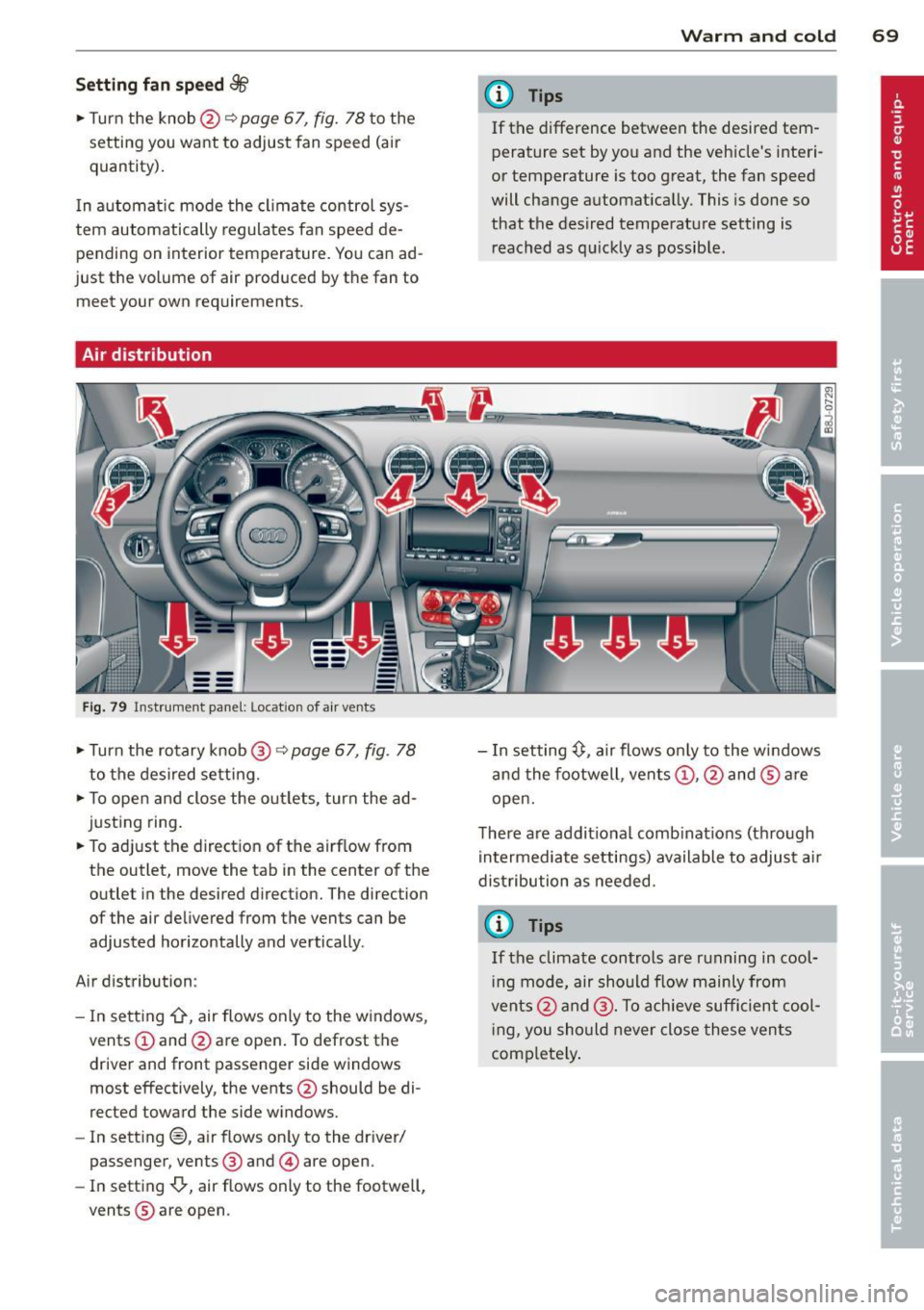
Air distribution
Fi g. 79 Inst rume nt pa ne l: Locat ion of ai r vents
• Turn the rotary knob@¢ page 67, fig. 78
to the des ired setti ng.
• To open a nd close the out lets, turn the ad
justing ring .
• To ad just the direct io n of the airflow from
the outlet, move the tab in the center of the
outlet in the desired d irection. The direction
of the air de livered from the vents can be
adjusted horizontally and vertically.
A ir distribution :
- In sett ing
-0, air flows only to the w indows,
vents (!) and @are open . To defrost the
driver and front passenger side windows
most effectively, the vents @should be di
rected toward the side w indows.
- In sett ing®, a ir flows on ly to the dr iver/
passenger, vents ® and @ are open.
- In sett ing
-Or, air flows only to the footwell,
vents ® are open.
Warm and cold 69
@ Tips
If the difference between the desired tem
perature set by you and the veh icle's interi
or temperature is too great, the fan speed
will change automat ically. This is done so
that the des ired temperature setting is
reached as q uickly as possib le.
- I n setting~. air flows only to the windows
and the footwell, vents (!) , @ and ® are
open.
T he re are addit ional comb inat ions (thro ugh
i ntermediate settings) available to adjust a ir
dist ribution as needed.
{t) Tips
If the climate controls are running in cool
i ng mode, air should flow mainly from
vents @and @. To achieve sufficien t cool
i ng, you sho uld never close these ven ts
complete ly .
Page 75 of 244
you leave your vehicle. This makes a vehicle
theft even more difficult ¢ .&. .
Ign ition key safety lock
Afte r switch ing off the ignition, the ig nit ion
key ca n only be removed from the ig nition
l ock when the se lector lever is in the "P"
(Park) position . After you have removed the
key, the selector lever is locked and cannot be
moved.
Ign ition on (D
If it is diffic ult to turn the key afte r you have
inse rted it into the ignition lock, turn the
steering whee l back and forth. This will take
the load
off the steering lock mechanism and
you will be able to turn the key freely and start the engine.
Starting th e engine @
In this position the engine starts . While the
engine is starting, the power supply to the headlights and other e lectrica l consumers is
temporari ly interrupted to conserve battery
power. After the engine has started, release
the key and it will return to posit io n
(D .
Before the starter can be operated again the
key must be turned back to position @. The
non-repeat lock prevents you from damaging
the starter when the engine is runn ing .
A WARNING
-Never remove the key from the ign ition
lock whi le the vehicle is mov ing . The
steering wheel will lock causing loss of
co ntrol.
- If you have to leave your veh icle - even
for just a m inute - a lways remove t he ig
ni tion key and take it with you. This is es
pecially important if you are going to
leave ch ildren behind in the vehicle. The
children co uld start the engine or use
other vehicle controls. Unsupervised use
of vehicle controls (for example, power
windows) can cause serious personal in
jur ies .
-
On th e ro ad 73
(D Tips
If the vehicle battery has been disconnect
ed and then reconnected, then yo u must
l eave the key in posit ion
(D for about 5
seconds before you can start the engine.
Starting and stopping
the engine
' Starting the engine
The engine can only be started with an origi
nal Audi key .
.,. Se t the par king brake.
.,. Move the selector lever in P or
N q .&_ .
.,. Turn the ignition key to position @
~ page 72, fig. Bl -do not depress the gas
peda l when starting the engine!
.,. Let go of the key as soon as the engine
starts .
A cold engine may at first be loud after it has
been started. This is due to the hydraulic
valves bu ild ing up the oil pressure. Th is nor
mal and no need for concern .
If the engine does not start immediately, stop
trying after 10 seconds and then try to restart
the engine about 30 seconds later.
A WARNING
-Never start or let the eng ine run in a con-
fined o r enclosed area . Exhaust fumes
from the engine co ntain carbon monoxide,
a colorless and odo rless gas. Ca rbon mon
oxide can be f atal if inhaled.
- Never leave the engine id ling unattend
ed. An una ttended veh icle w ith a runn ing
engine poses a danger o f personal injury
or theft .
(D Note
-Avo id high engine speeds, fast accelera
tion or heavy engine loads while the en
gine is still cold. This could damage the
engine.
- The e ngine cannot be started by pushing
or towing the vehicle . .,..
Page 80 of 244
78 On the road
the distance between your vehicle and
other vehicles.
- For safety reasons, the cruise control
should not be used in the city, in stop
and-go traff ic, on twist ing roads and
when road conditions are poor (such as
ice, fog, gravel, heavy rain and hydro
planing) -risk of accident .
- Turn off the cruise control temporarily
when entering turn lanes, highway exit
lanes or in construction zones.
- Please note that inadvertently "resting" your foot on the accelerator pedal causes
the cruise control not to brake. This is
because the cruise control is overridden
by the driver's acceleration.
({) Tips
The cruise control cannot maintain a con
stant speed when driving downhill. The ve
hicle will accelerate under its own weight. Downshift to a lower gear or use the
brakes to slow down .
Changing speed
.. Press leve r in the 0 or O direction
¢ page 77, fig. 85 to increase or decrease
your speed.
.. Release the lever to save that speed.
You can also press the accelerator pedal down
to increase your speed, e.g. if you want to
pass someone. The speed you saved earlier
will resume as soon as you release the acceler
ator pedal.
If, however, you exceed your saved speed by
5 mph (10 km/h) for longer than 5 minutes,
the cruise control will turn off temporarily .
The symbol will go out but the saved speed
will be retained .
Presetting your speed
You con preset your desired speed while the
vehicle is not moving .
.. Turn on the ignition . ..
Pull lever into position
(D ¢ page 77,
fig. 85.
.. Press the lever in the 0 or O direction to
increase or decrease your speed.
.. Release the lever to save that speed.
This function makes it possible, for example,
to save the speed you want before driving on
the highw ay. Once on the highway, activate
the cruise control by pulling the lever toward
(D.
· Switching the system off
Temporary deactivation
.. Press the brake pedal, or
.. Press the lever into position @(not clicked
into place)
¢ page 77, fig . 85 , or
.. Drive for longer than 5 minutes at more
than 5 mph (10 km/h) above the stored
speed.
Switching off completely
.. Press lever into position @ (clicked into
place), or
.. Switch the ignition
off.
The system retains the saved speed if you de
activate the cruise control temporarily. To re
sume the saved speed, release the brake ped
al and pull the leve r to position
(D .
Switching the ignition off erases the saved
speed.
_& WARNING
You should only return to the saved speed
if it is not too fast for the current traffic
conditions -risk of an accident!
Page 87 of 244
If you have selected a lower gear than the cur
rent one, the transmission will only shift down
when the engine cannot be overspeeded .
If kick-down is actuated, the transmission
shifts into a lower gear independent ly of
speed and engine rpm .
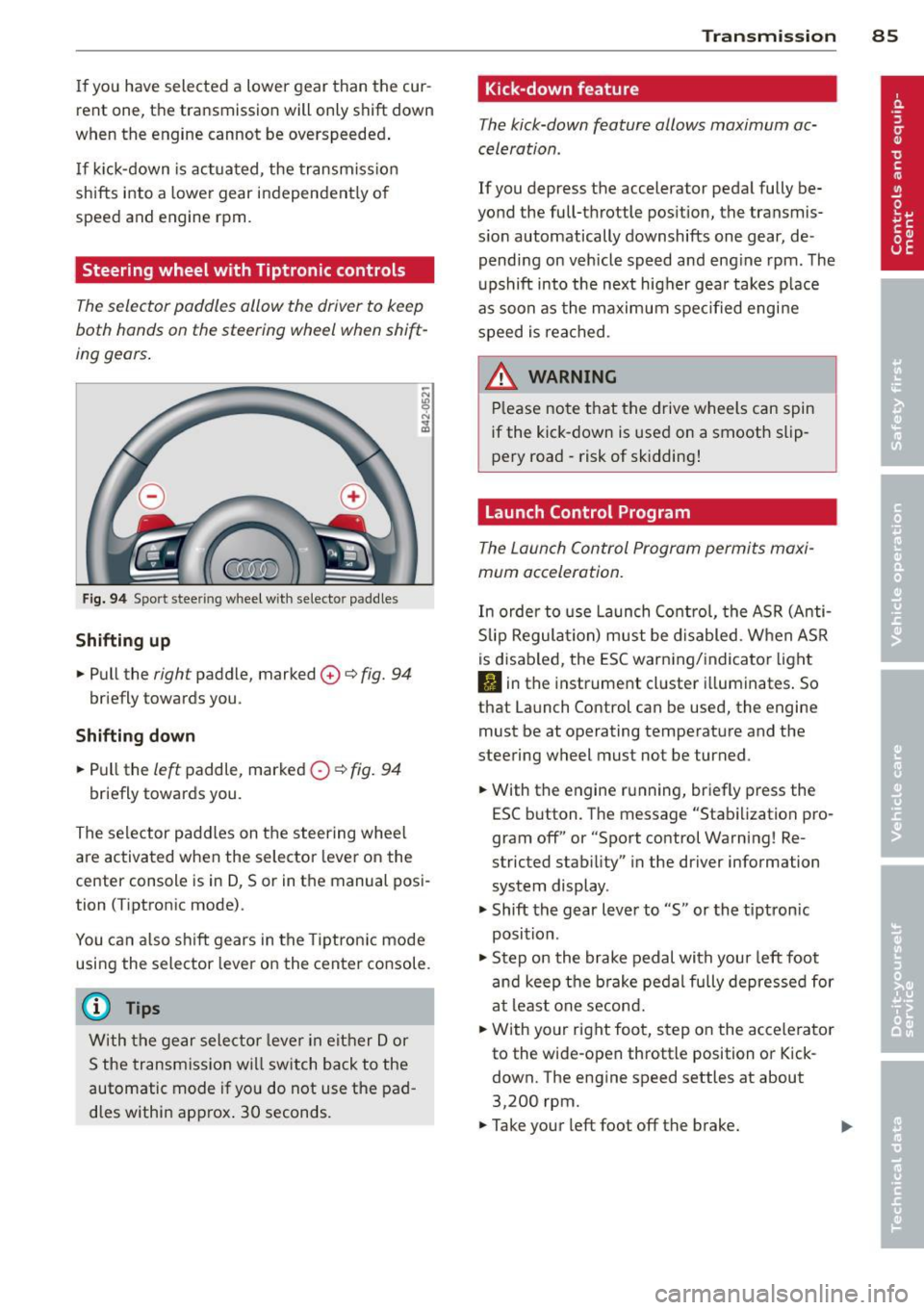
Steering wheel with Tiptronic controls
The selector paddles allow the driver to keep
both hands on the steering wheel when shift
ing gears.
Fig. 94 Sport stee ring wheel with selecto r paddles
Shifting up
.,. Pull the right paddle, marked 0 ¢ fig. 94
briefly towards you .
Shifting down
.. Pull the left paddle, marked 0 ¢ fig. 94
briefly towards you.
The selector paddles on the steering wheel
are activated when the selector lever on the
center console is in D, Sor in the manual posi
tion (Tiptronic mode).
You can also shift gears in the Tiptronic mode
using the selector lever on the center console.
@ Tips
With the gear selector lever in either Dor
S the transmission will switch back to the
automatic mode if you do not use the pad
dles within approx . 30 seconds.
Transmission 85
Kick -down feature
The kick-down feature allows maximum ac
celeration .
If you depress the accelerator pedal fully be
yond the full-throttle position, the transmis
sion automatically downshifts one gear, de
pending on vehicle speed and engine rpm. The
upshift into the next higher gear takes place
as soon as the maximum specified engine
speed is reached.
_&. WARNING
Please note that the drive wheels can spin
if the kick-down is used on a smooth slip
pery road -risk of sk idding!
Launch Control Program
The Launch Control Program permits maxi
mum acceleration.
In order to use Launch Control, the ASR (Anti
Slip Regulation) must be disabled. When ASR
is disabled, the ESC warning/indicator light
I) in the instrument cluster illuminates. So
that Launch Control can be used, the engine must be at operating temperature and the
steering wheel must not be turned .
.. With the engine running, briefly press the
ESC button . The message "Stabilization pro
gram off" or "Sport control Warning! Re
stricted stability" in the driver information
system display.
.. Shift the gear lever to "S" or the tiptron ic
position .
.. Step on the brake pedal with your left foot
and keep the brake pedal fully depressed for
at least one second .
.. With your right foot, step on the accelerator
to the wide-open throttle position or Kick
down. The engine speed settles at about
3,200 rpm.
.. Take your left foot off the brake.
Page 89 of 244
your authorized Audi dealer for assistance, if necessary .
Removing the selector lever boot
.,. Activate the parking b rake .
.,. Carefu lly pry the selector lever boot out of
the tr im @ using a small screwdriver .
.,. Pull both sides of the se lector lever boot up-
ward in the direction of the arrow @ .
.,. Fold the selector lever boot upward.
Selector lever eme rgency re le ase
.,. Press the release lever down and ho ld it in
place ¢ fig . 96 .
.,. Press the release button in the selector lever
© and move the lever into the N position .
.,. Clip the selector lever boot back into the
shift gate after using the emergency re lease.
If the vehicle m ust be pushed or towed due to
a power failure (for example, the battery is
d ischarged), the selector lever must first be
moved to the N pos ition using the emergency
release mechanism .
A WARNING
Only move the se lector lever out of the P
posi tion when the parking b rake is activat
ed. O therw ise, the vehicle could sta rt to
move unintentionally when the selector
lever is moved out of the P position.
Tran sm iss ion 87
Page 95 of 244
~ Always keep both feet in the footwell so
that you are in control of the vehicle at all
times.
For detailed information on how to adjust the
driver's seat, see
c:> page 60.
A WARNING
Drivers who are unbelted, out of position
or too close to the airbag can be seriously
injured by an airbag as it deploys. To help
reduce the risk of serious personal injury:
- Always adjust the driver's seat and the
steering wheel so that there are at least
10 inches (25 cm) between your breast
bone and the steering wheel.
- Always adjust the driver's seat and the
steering wheel so that there are at least
4 inches (10 cm) between the knees and
the lower part of the instrument panel.
- Always hold the steering wheel on the
outside of the steering wheel rim with
your hands at the 9 o'clock and 3 o'clock positions to help reduce the risk of per
sonal injury if the driver's airbag inflates.
- Never hold the steering wheel at the
12 o'clock position or with your hands at
other positions inside the steering wheel
rim or on the steering wheel hub. Hold
ing the steering wheel the wrong way
can cause serious injuries to the hands,
arms and head if the driver's airbag in
flates
- Pointing the steering wheel toward your
face decreases the ability of the supple
mental driver's airbag to protect you in a
collision .
- Always sit in an upright position and nev
er lean against or place any part of your
body too close to the area where the air
bags are located.
- Before driving, always adjust the front
seats and head restraints properly and make sure that all passengers are prop
erly restrained.
- Never adjust the seats while the vehicle
is moving. Your seat may move unexpect-
Driving Safely 93
ed ly and you could lose control of the ve
hicle .
- Never drive with the backrest reclined or
tilted far back! The farther the backrests
are tilted back, the greater the risk of in
jury due to incorrect positioning of the safety belt and improper seating posi
tion .
- Children must always ride in child seats
c:> page 129 . Special precautions apply
when installing a child seat on the front passenger seat
c:> page 108.
Proper seating position for the front
passenger
The proper front passenger seating position
is important for safe, relaxed driving .
For your own safety and to reduce the risk of
injury in the event of an accident, we recom
mend that you adjust the seat for the front
passenger to the following position :
~ Adjust the angle of the seatback so that it is
in an upright position and your back comes
in full contact with it whenever the vehicle is
moving.
~ Adjust the head restraint so that the upper
edge is as even w ith the top of your head as
possible but not lower than eye level and so
that it is as close to the back of your head as
possible
c:> page 94.
~ Keep both feet flat on the floor in front of
the front passenger seat .
~ Fasten and wear safety belts correctly
c:> page 103.
For detailed information on how to adjust the
front passenger's seat, see
c:> page 59 .
A WARNING
Front seat passengers who are unbelted,
out of position or too close to the airbag
can be seriously injured or killed by the air
bag as it unfolds. To help reduce the risk of
serious personal injury:
•
•
Page 98 of 244
96 Driving Safel y
Pedal area
Pedals
The pedals must al ways be free to move and
must n ever be interfered with by a floor mat
or any other object.
Make sure that all pedals move freely without
interference and that nothing prevents them
from returning to the ir original positions .
Only use floor mats that leave the peda l area
free and can be secured with floor mat fasten
ers .
If a brake circuit fails, increased brake peda l
travel is required to bring the vehicle to a full
stop.
A WARNING
Pedals that cannot move freely ca n cause
loss of vehicle control and increase the r isk
of serious injury.
- Never place any objects in the driver 's
footwell. An object could get into the
peda l area and interfere w it h pedal func
ti on. In case of s udden braki ng or an ac
cident, you would not be ab le to bra ke or
accelera te!
- Alw ays make su re th at noth ing c an f all
or move into the dr iver's footwe ll.
Floor mats on the driver side
Always use floor mats that can be securely
at tached to the floor mat fasteners and do
no t interfere with the free movement of the
pedals.
.,. Make su re tha t the floor mats are properly
sec ured and cannot move and inte rfere w ith
the pedals ~.&_ .
Use only floor mats that leave t he pedal a rea
unobstr ucted and that a re firmly secured so
that they cannot s lip out of posi tion. Yo u can
obtain suitable floor mats from your author
ized A udi Dealer.
Fl oor mat f asteners a re i nstalled in you r A udi . Floor mats used in yo
ur vehicle must be at
tached to these fasteners . Properly securing
t h e floor mats will prevent them from sliding
into positions that could interfere with the
pedals or impair safe operat ion of your vehicle
i n other ways.
A WARNING ,-
Pedals tha t ca nnot move free ly can result
i n a loss of vehicle control and inc rease the
r isk of ser ious perso na l inju ry.
- Always make sure that floor mats are
p roperly secu red.
- Never p lace or install floor mats o r other
f loor cove rings in th e vehicle that cannot
be pro pe rly secured in p la ce to prevent
them from slipping and interfer ing wi th
the peda ls o r th e ab ility to cont ro l t he
vehi cle.
- Never p lace or ins tall floor mats or othe r
floor coverings on top o f al ready instal
led floo r mats . Additiona l floor mats and
other coverings will red uce the size of
the peda l area and interfere w ith the
pedals.
- Always properly reinsta ll and secure floor
mats that have been taken out for clean
ing.
- Always make sure that objects cannot
fall into the dr iver footwell while the ve
h icle is moving . Objects can become
trapped under the brake pedal and acce l
erator pedal causing a loss of vehicle
control.
Stowing luggage
Loading the luggage compartment
All luggage and o ther objects mus t be prop
erly stowed and secured in the luggage com
partment.
L oose items in the lugg age compa rtment c an
shift s udden ly, changing vehicle handling
characteristics. Loose items can a lso increase
the risk of serious persona l injury in a sudden
vehicle maneuver or in a co llision.
Page 107 of 244
Pregnant women must also be properly
restrained
The best way to protect the fetus is to make
sure that expectant mothers always wear safety belts correctly -throughout the preg
nancy.
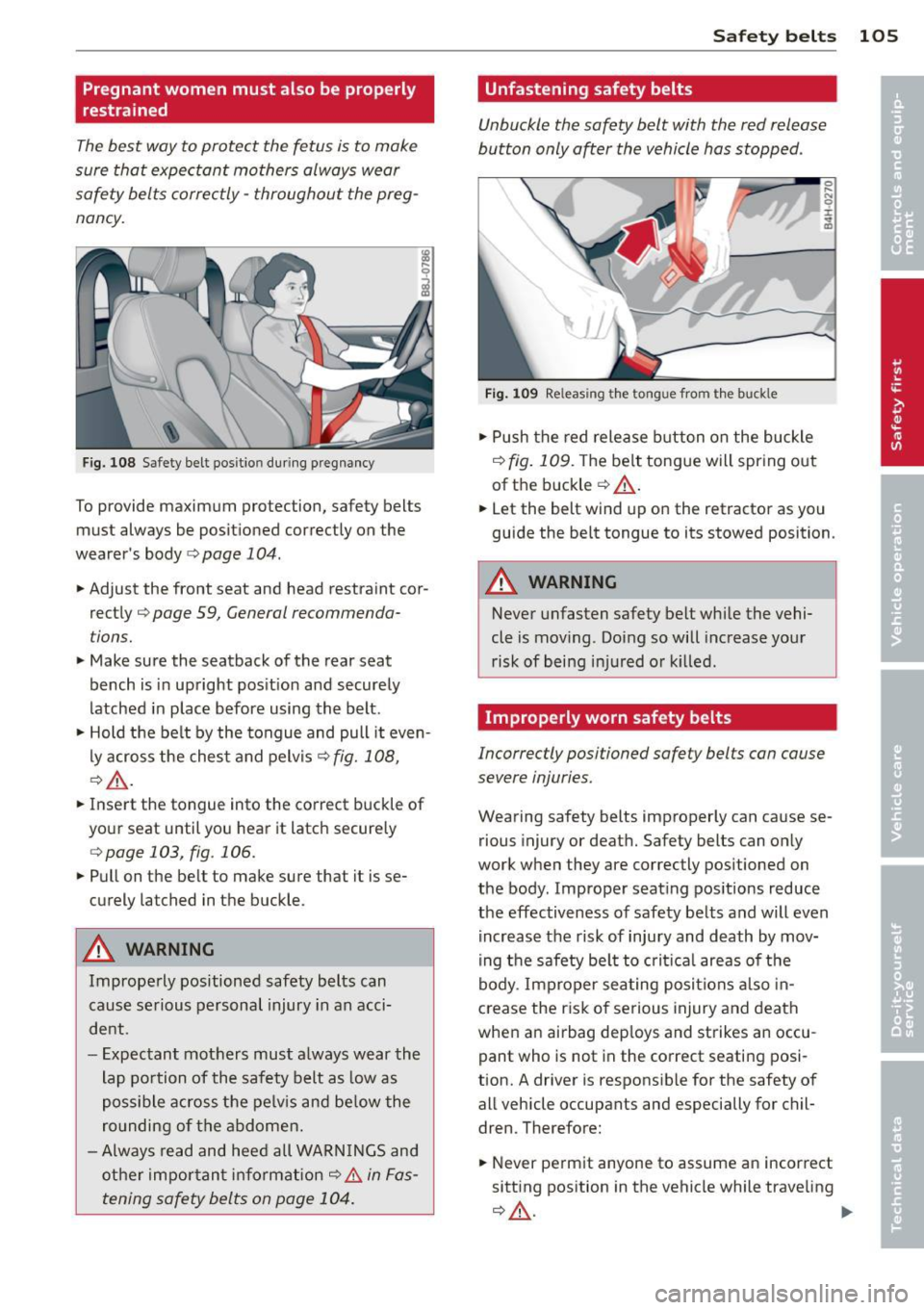
F ig. 108 Safety belt pos itio n during pregnancy
To provide maximum protection, safety belts
must always be posit ioned correctly on the
wearer's body
¢ page 104.
.. Adjust the front seat and head restraint cor
rect ly
¢ page 59, General recommenda
tions .
.. Make sure the seatback of the rear seat
bench is in upright pos it ion and securely
latched in place before using the belt .
.. Hold the be lt by the tongue and pull it even
ly across the chest and pelvis¢
fig. 108,
¢.&, .
.. Insert the tongue into the correct buckle of
your seat until you hear it latch securely
¢ page 103, fig . 106.
.. Pull on the belt to make sure that it is se
curely latched in the buckle .
A WARNING
Improperly positioned safety belts can
cause serious personal injury in an acci
de nt.
- Expectant mothers must always wear the
lap po rtion of the safety belt as low as
poss ible across the pe lv is and be low the
rounding of the abdomen.
- Always read and heed all WARN INGS and
other impor tan t in forma tion¢ .&.
in Fas
tening safety belts on page
104.
Safety belts 105
Unfastening safety belts
Unbuckle the safety belt with the red release
button only o~er the vehicle hos stopped .
Fig . 1 09 Releas ing the tongue from t he buck le
.. Push the red release button on the buckle
¢
fig. 109. T he be lt tongue will spring out
of the buckle ¢ .&, .
.. Let the belt wind up on the retractor as you
guide the belt tongue to its stowed position.
A WARNING
Never unfasten safety belt while the vehi
cle is mov ing . Doing so will increase your
risk of being inj ured or k illed.
Improperly worn safety belts
Incorrectly positioned safety belts can cause
severe injuries.
Wearing safety belts improperly can cause se
rious injury or death. Safety belts can only
work when they are correctly positioned on
the body . Improper seating pos itions reduce
the effectiveness of safety be lts and will even
increase the risk of injury and death by mov
ing the safety be lt to crit ica l areas of the
body. Improper seating positions a lso in
crease the risk of serious injury and death
when an airbag dep loys and strikes an occu
pant who is not in the correct seati ng posi
tion. A driver is respons ible for the safety of
all vehicle occupants and especially for chil
dren. Therefore:
.. Never permit anyone to assume an incorrect
sitting position in the vehicle while traveling
¢ .&, .
~