2015 AUDI TT ROADSTER steering
[x] Cancel search: steeringPage 87 of 244
If you have selected a lower gear than the cur
rent one, the transmission will only shift down
when the engine cannot be overspeeded .
If kick-down is actuated, the transmission
shifts into a lower gear independent ly of
speed and engine rpm .
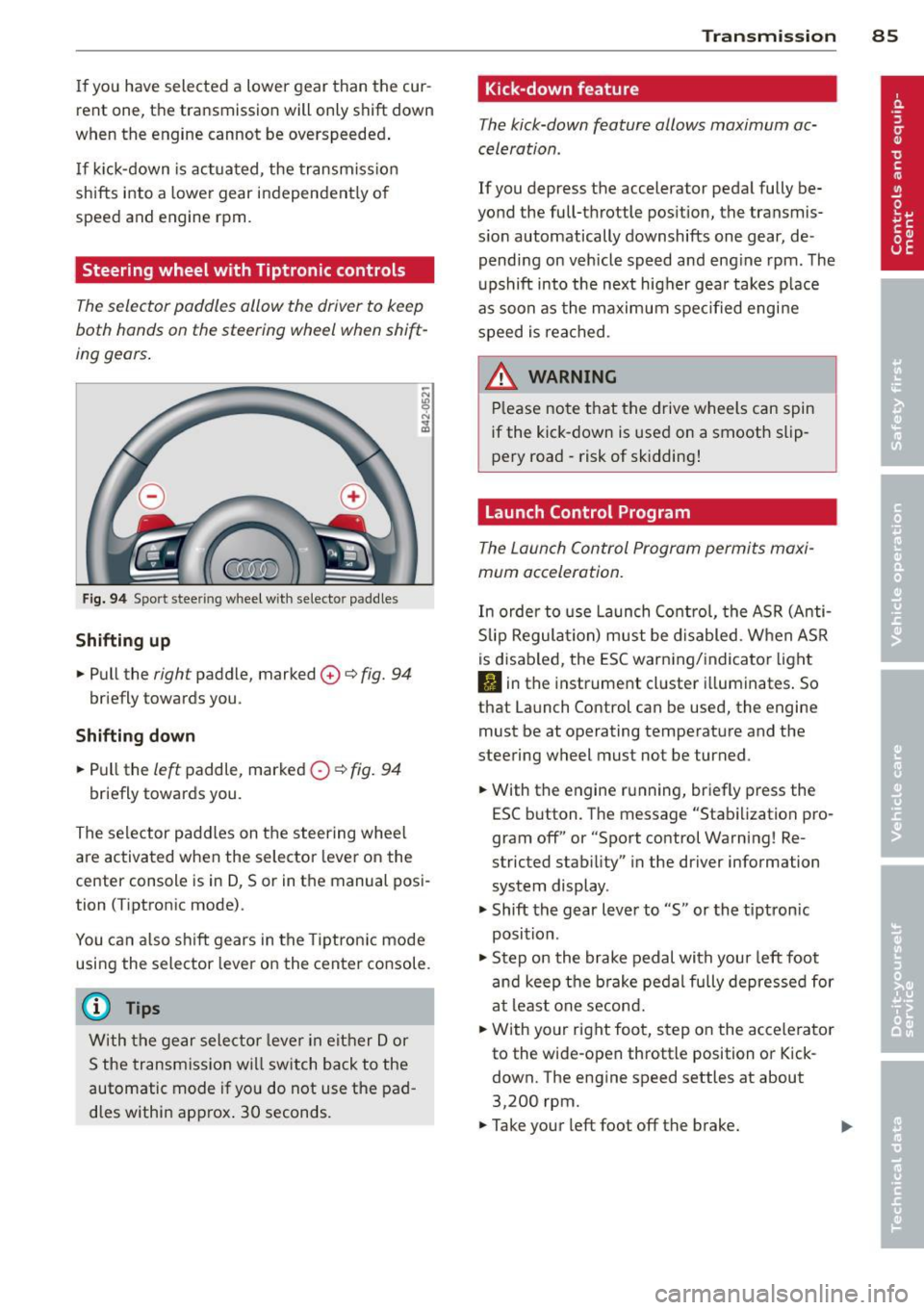
Steering wheel with Tiptronic controls
The selector paddles allow the driver to keep
both hands on the steering wheel when shift
ing gears.
Fig. 94 Sport stee ring wheel with selecto r paddles
Shifting up
.,. Pull the right paddle, marked 0 ¢ fig. 94
briefly towards you .
Shifting down
.. Pull the left paddle, marked 0 ¢ fig. 94
briefly towards you.
The selector paddles on the steering wheel
are activated when the selector lever on the
center console is in D, Sor in the manual posi
tion (Tiptronic mode).
You can also shift gears in the Tiptronic mode
using the selector lever on the center console.
@ Tips
With the gear selector lever in either Dor
S the transmission will switch back to the
automatic mode if you do not use the pad
dles within approx . 30 seconds.
Transmission 85
Kick -down feature
The kick-down feature allows maximum ac
celeration .
If you depress the accelerator pedal fully be
yond the full-throttle position, the transmis
sion automatically downshifts one gear, de
pending on vehicle speed and engine rpm. The
upshift into the next higher gear takes place
as soon as the maximum specified engine
speed is reached.
_&. WARNING
Please note that the drive wheels can spin
if the kick-down is used on a smooth slip
pery road -risk of sk idding!
Launch Control Program
The Launch Control Program permits maxi
mum acceleration.
In order to use Launch Control, the ASR (Anti
Slip Regulation) must be disabled. When ASR
is disabled, the ESC warning/indicator light
I) in the instrument cluster illuminates. So
that Launch Control can be used, the engine must be at operating temperature and the
steering wheel must not be turned .
.. With the engine running, briefly press the
ESC button . The message "Stabilization pro
gram off" or "Sport control Warning! Re
stricted stability" in the driver information
system display.
.. Shift the gear lever to "S" or the tiptron ic
position .
.. Step on the brake pedal with your left foot
and keep the brake pedal fully depressed for
at least one second .
.. With your right foot, step on the accelerator
to the wide-open throttle position or Kick
down. The engine speed settles at about
3,200 rpm.
.. Take your left foot off the brake.
Page 93 of 244
Driving Safely
General notes
Safe driving habits
Please remember -safety first!
This chapter contains important information,
tips, instructions and warnings that you need
to read and observe for your own safety, the
safety of your passengers and others . We have
summarized here what you need to know
about safety belts, airbags, child restraints as
well as child safety. Your safety is for us
priori
ty number 1.
Always observe the information
and warnings in this section - for your own
safety as well as for that of your passengers.
The information in this section applies to all
model versions of your vehicle . Some of the
features described in this sections may be
standard equipment on some models, or may
be optional equipment on others. If you are
not sure, ask your authorized Audi dealer.
A WARNING
- Make certain that you follow the instruc
tions and heed the WARNINGS in this
Manual. It is in your interest and in the
interest of your passengers.
- Always keep the complete Owner's Liter
ature in your Audi when you lend or sell
your vehicle so that this important infor
mation will always be available to the
driver and passengers.
- Always keep the Owner's literature handy
so that you can find it easily if you have
questions.
Safety equipment
The safety features are part of the occupant
restraint system and work together to help
reduce the risk of injury in a wide variety of
accident situations .
Your safety and the safety of your passengers
should not be left to chance. Advances in
technology have made a variety of features
available to help reduce the risk of injury in an
Driving Safely 91
accident. The following is a listing of just a
few of the safety features in your Audi:
- sophisticated safety belts for driver and all
passenger seating positions,
- safety belt pre-tensioners,
- front airbags,
- knee airbags for the front seats,
- side airbags in the front seats,
- LATCH anchorages for child restraints,
- adjustable steering column.
These individual safety features can work to
gether as a system to help protect you and
your passengers in a wide range of accidents.
These features cannot work as a system if
they are not always properly adjusted and
properly used!
Safety is everybody's responsibility!
Important things to do before driving
Safety is everybody's job! Vehicle and occu
pant safety always depends on the informed and careful driver.
For your safety and the safety of your passen
gers,
before driving always:
~ Make sure that all lights and signals are op
erating correctly .
~ Make sure that the tire pressure is correct.
~ Make sure that all windows are clean and af
ford good visibility to the outside.
~ Secure all luggage and other items carefully
c::> page 65.
~ Make sure that nothing can interfere with
the pedals.
~ Adjust front seat, head restraint and mirrors
correctly for your height .
~ Instruct passengers to adjust the head re
straints according to their height .
~ Make sure to use the right child restraint
correctly to protect children¢
page 129,
Child Safety.
~ Sit properly in your seat and make sure that
your passengers do the same¢
page 59,
General recommendations. .,..
•
•
Page 94 of 244
92 Driving Safel y
• Fasten your safety be lt and wear it properly .
Also instruct your passengers to fasten their
safety belts proper ly ¢
page 100.
What impairs driving safety?
Safe driving is directly related to the condi
tion of the vehicle, the driver as well as the
driver's ability to concentrate on the rood
without being distracted.
The driver is responsible for the safety of the
vehicle and all of its occupants. If your ability
to drive is impaired, safety risks for everybody
in the vehicle increase and you also become a
hazard to everyone else on the road ¢
.&,.
Therefore:
• Do not let yourself be distracted by passen
gers or by using a cellular telephone.
• NEVER drive when your dr iving ability is im
paired (by medicat ions, alcohol, drugs, etc.) .
• Observe all traffic laws, rules of the road
and speed limits and plain common sense.
• ALWAYS adjust your speed to road, traffic
and weather conditions.
• Take frequent breaks on long trips . Do not
drive for more than two hours at a stretch .
• Do NOT drive when you are tired , under
pressure or when you are stressed.
A WARNING ,.
Impai red driving safety increases the risk
of serious personal injury and death when
ever a vehicle is being used.
Proper occupant
seating positions
Proper seating position for the driver
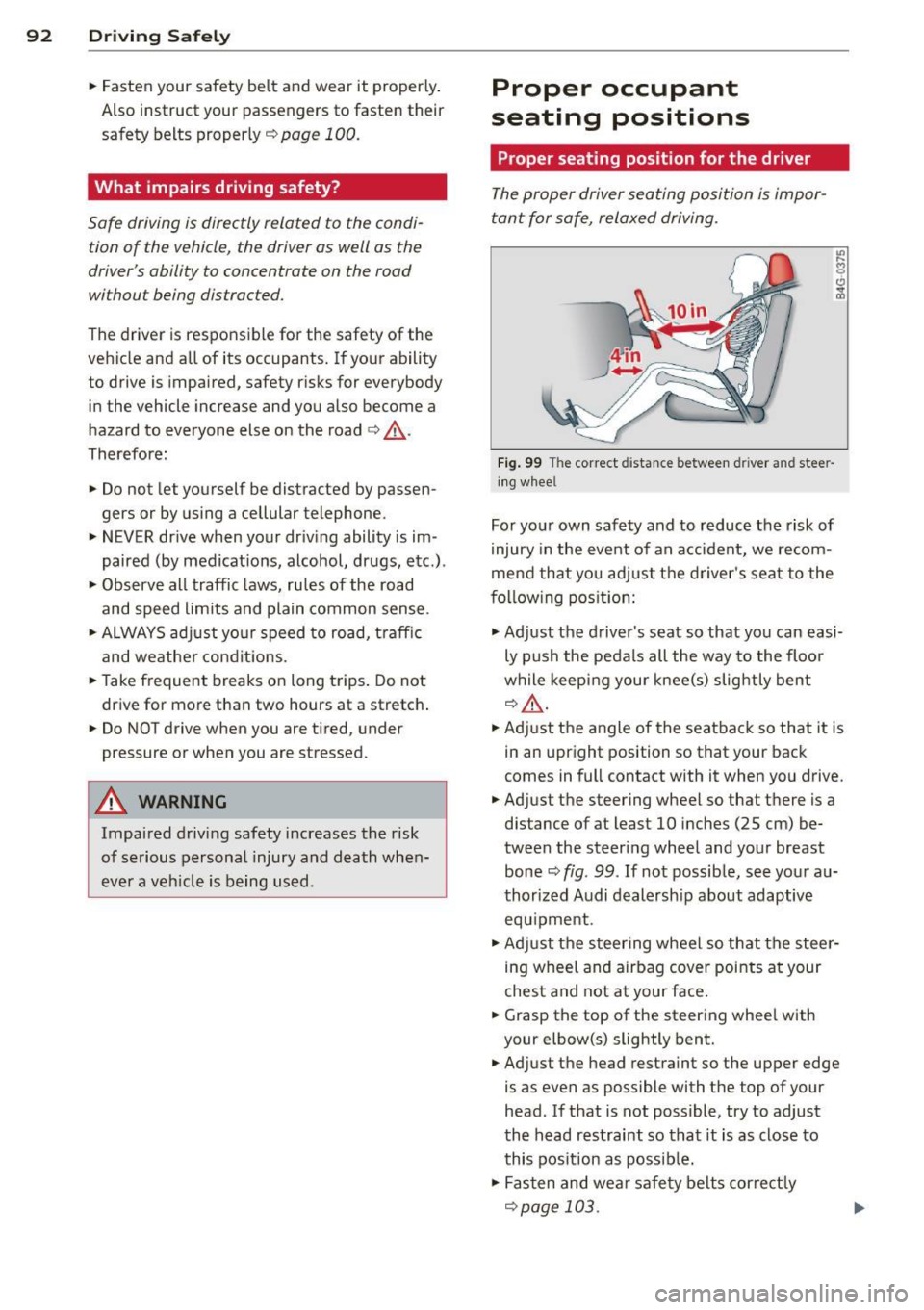
The proper driver seating position is impor
tant for safe, relaxed driving.
Fig. 99 The correct distance between driver and steer
ing whee l
For your own safety and to reduce the risk of
injury in the event of an accident, we recom
mend that you adjust the driver's seat to the
f o llow ing position:
• Adjust the driver's seat so that you can easi
ly push the pedals all the way to the floo r
while keeping your knee(s) slightly bent
q &_.
• Adjust the angle of the seatback so that it is
in an upright position so that your back
comes in full contact with it when you drive.
• Adjust the steering wheel so that there is a
distance of at least 10 inches (25 cm) be
tween the steering wheel and your breast bone¢
fig. 99 . If not possible, see your au
thorized Audi dealersh ip about adaptive
equ ipment.
• Adjust the steering wheel so that the steer
ing wheel and airbag cover points at your
chest and not at your face.
• Grasp the top of the steering whee l with
your elbow(s) slightly bent.
• Adjust the he ad restraint so the upper edge
is as even as possible with the top of your
head . If that is not possible, try to adjust
the head restraint so that it is as close to
this pos ition as possib le.
• Fasten and wear safety belts correctly
¢page 103.
Page 95 of 244
~ Always keep both feet in the footwell so
that you are in control of the vehicle at all
times.
For detailed information on how to adjust the
driver's seat, see
c:> page 60.
A WARNING
Drivers who are unbelted, out of position
or too close to the airbag can be seriously
injured by an airbag as it deploys. To help
reduce the risk of serious personal injury:
- Always adjust the driver's seat and the
steering wheel so that there are at least
10 inches (25 cm) between your breast
bone and the steering wheel.
- Always adjust the driver's seat and the
steering wheel so that there are at least
4 inches (10 cm) between the knees and
the lower part of the instrument panel.
- Always hold the steering wheel on the
outside of the steering wheel rim with
your hands at the 9 o'clock and 3 o'clock positions to help reduce the risk of per
sonal injury if the driver's airbag inflates.
- Never hold the steering wheel at the
12 o'clock position or with your hands at
other positions inside the steering wheel
rim or on the steering wheel hub. Hold
ing the steering wheel the wrong way
can cause serious injuries to the hands,
arms and head if the driver's airbag in
flates
- Pointing the steering wheel toward your
face decreases the ability of the supple
mental driver's airbag to protect you in a
collision .
- Always sit in an upright position and nev
er lean against or place any part of your
body too close to the area where the air
bags are located.
- Before driving, always adjust the front
seats and head restraints properly and make sure that all passengers are prop
erly restrained.
- Never adjust the seats while the vehicle
is moving. Your seat may move unexpect-
Driving Safely 93
ed ly and you could lose control of the ve
hicle .
- Never drive with the backrest reclined or
tilted far back! The farther the backrests
are tilted back, the greater the risk of in
jury due to incorrect positioning of the safety belt and improper seating posi
tion .
- Children must always ride in child seats
c:> page 129 . Special precautions apply
when installing a child seat on the front passenger seat
c:> page 108.
Proper seating position for the front
passenger
The proper front passenger seating position
is important for safe, relaxed driving .
For your own safety and to reduce the risk of
injury in the event of an accident, we recom
mend that you adjust the seat for the front
passenger to the following position :
~ Adjust the angle of the seatback so that it is
in an upright position and your back comes
in full contact with it whenever the vehicle is
moving.
~ Adjust the head restraint so that the upper
edge is as even w ith the top of your head as
possible but not lower than eye level and so
that it is as close to the back of your head as
possible
c:> page 94.
~ Keep both feet flat on the floor in front of
the front passenger seat .
~ Fasten and wear safety belts correctly
c:> page 103.
For detailed information on how to adjust the
front passenger's seat, see
c:> page 59 .
A WARNING
Front seat passengers who are unbelted,
out of position or too close to the airbag
can be seriously injured or killed by the air
bag as it unfolds. To help reduce the risk of
serious personal injury:
•
•
Page 103 of 244
Why safety belts?
Frontal collisions and the law of physics
Frontal crashes create very strong forces for
people riding in vehicles .
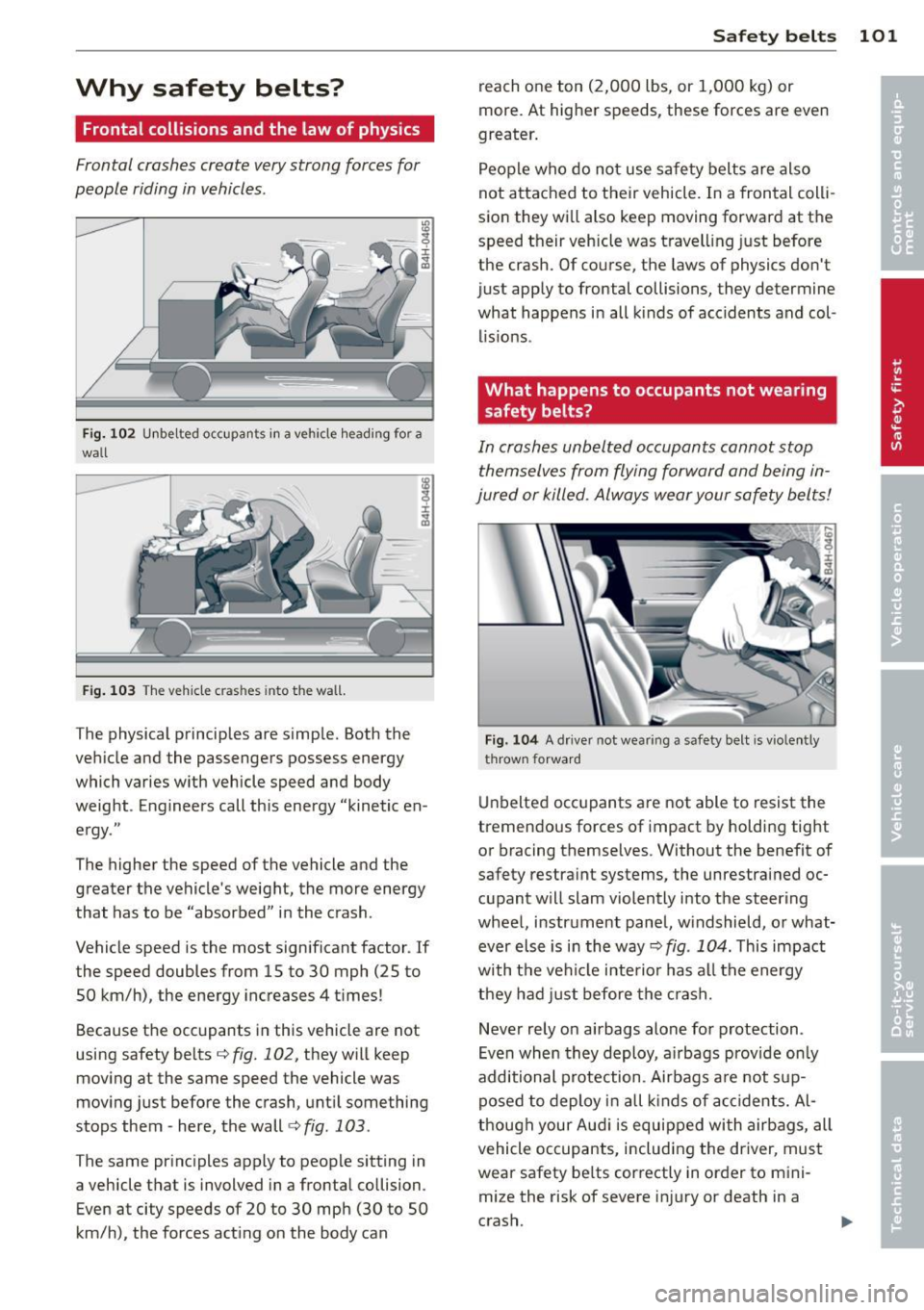
Fig. 102 Unbelted occupants in a ve hicle heading for a
wall
Fig. 103 The vehicle c ras hes into the wall.
The physical principles are simple. Both the
vehicle and the passengers possess energy
which varies with vehicle speed and body
weight . Engineers call this energy "kinetic en
ergy ."
The higher the speed of the vehicle and the greater the vehicle 's weight, the more energy
that has to be "absorbed" in the crash .
Vehicle speed is the most significant factor . If
the speed doubles from 15 to 30 mph (25 to
50 km/h) , the energy increases 4 times!
Because the occupants in this vehicle are not
using safety belts
r::;, fig. 102, they will keep
moving at the same speed the vehicle was
moving just before the crash, until something
stops them -here, the wall
c:> fig . 103 .
The same principles apply to people sitting in
a vehicle that is involved in a frontal collision .
Even at city speeds of 20 to 30 mph (30 to 50
km/h), the forces acting on the body can
Safety belts 101
reach one ton (2,000 lbs, or 1,000 kg) or
more. At higher speeds, these forces are even
greater.
People who do not use safety belts are also
not attached to their vehicle. In a frontal colli
sion they will also keep moving forward at the
speed their vehicle was travelling just before
the crash. Of course, the laws of physics don't
just apply to frontal collisions, they determine what happens in all kinds of accidents and col
lisions .
What happens to occupants not wearing
safety belts?
In crashes unbelted occupants cannot stop
themselves from flying forward and being in
jured or killed. Always wear your safety belts!
Fig. 104 A driver not wear ing a safety belt is v io len tly
thrown forward
Unbelted occupants are not able to resist the
tremendous forces of impact by holding tight
or bracing themselves . Without the benefit of
safety restraint systems, the unrestrained oc cupant will slam violently into the steering
wheel, instrument panel, windshield, or what
ever else is in the way r::;, fig . 104 . This impact
with the vehicle interior has all the energy
they had just before the crash.
Never rely on airbags alone for protection .
Even when they deploy , airbags provide only
additional protection . Airbags are not sup
posed to deploy in all kinds of accidents. Al
though your Audi is equipped with airbags, all
vehicle occupants, including the driver, must
wear safety belts correctly in order to mini
mize the risk of severe injury or death in a
crash.
Page 110 of 244
108 Airbag sys tem
Airbag system
Important things to know
Importance of wearing safety belts and
sitting properly
Airbags are only supplemental restraints. For
airbags to do their job , occupants must al
ways properly wear their safety belts and be
in a proper seating position.
F or your safety and the safety of your passen
gers, before driving off, a lways:
• Adjust the driver's seat and steering wheel
properly
c:> page 92,
• Adjust the front passenger's seat properly
c:> page 60,
• Wear safety be lts properly c:> page 102,
• Always properly use the proper child re-
straint to protect children
c:> page 129.
In a collision airbags must inflate within the
blink of an eye and with considerable force .
The supplemental airbags can cause injuries if
the dr iver or the front seat passenger are not
seated properly . Therefore in order to help the
a ir bag to do its job, it is important, both as a
d river and as a passenge r to sit properly at all
times.
By keeping room between your body and the
steering wheel and the front of the passenger
compa rtment, the airbag can inflate fully and
comp letely and provide supp lemental protec
tion in ce rtain frontal collisions
c:> page 92,
Proper occupant seating positions . For detai ls
on the operat ion of the seat adjustment con
trols
c:> page 60 and c:> page 61.
I t's especially important that children a re
properly restrained
c:> page 129.
There is a lot that the d river and the passen
ger can and must do to help the individua l
safety features ins talled in your A udi work to
gether as a system.
Prope r seat ing pos ition is important so that
the front airbag on the drive r side ca n do i ts
job. If yo u have a physical impa irment or con- dition that prevents you from sitting properly
on the driver seat with the safety belt properly
fastened and reaching the pedals, or if you
have concerns with regard to the function or
operation of the Advanced Airbag System,
please contact your author ized Audi dealer or
qualified workshop, or call Audi Customer Re
lations at 1-800-822-2834 for poss ible modi
fi cat ions to your veh icle.
When the airbag system deploys, a gas gener
ator will f ill the a irbags, break open t he pad
ded cove rs, and inflate between the steering
whee l and the dr ive r and between the instru
ment pane l and the fron t passenger. The a ir
bags will deflate immediately after dep loy
ment so that the front occupants can see
t hr ough the windshie ld again witho ut inter
ruption .
All of th is takes p lace in the b link of an eye, so
fast that many peop le don't even realize that
the airbags have deployed. The airbags a lso
inflate with a great dea l of force and nothing
should be in their way when they deploy.
Front a irbags in combination wi th properly
worn safety belts slow down and lim it the oc
cupant's forward movement . T ogether they
help to prevent the drive r and passenger from
hitting parts of the inside the vehicle while re
ducing the fo rces acting on t he occ upan t dur
ing the crash . In this way they help to reduce
the risk of injury to the head and upper body in the crash. Airbags do not protect the arms
or the lower parts of the body.
Both front airbags wi ll not inflate in all fronta l
collisions . The triggering of the a irbag system
depends on the vehicle dece leration rate
caused by the co llision and registered by the
electron ic control unit. If th is rate is below
the reference value programmed in to the con
trol unit , the airbags will not be triggered ,
even though the car may be badly damaged as
a resu lt of the co llision . Ve hicle damage, re
pair costs o r even the lack of ve hicle damage
is not necessarily an indica tion of whether an
airbag shou ld inflate or not .
It is not possib le to define a range of vehicle
speeds that w ill cove r every possib le kind and .,.
Page 111 of 244
angle of impact that will always trigger the
airbags, since the circumstances will vary con
siderably between one collision and another.
Important factors include, for example, the nature (hard or soft) of the object which the
car hits, the angle of impact, vehicle speed,
etc. The front airbags will also not inflate in
side or rear collisions, or in ro ll-overs .
A lwa ys
rem ember : Airbags will deploy only
once, and only in certa in kinds of collisions .
Your safety belts are always there to offer pro
tection in those s ituations in which airbags
are not supposed to deploy , or when they have
a lready deployed ; fo r example , when yo ur ve
h icle strikes or is struck by another after the
first collision .
This is just one of the reasons why an a irbag is
a supplementary restra int and is not a s ubst i
tute for a safety belt . The airbag system
works most effectively when used with the
safety belts. Therefore, always properly wear
your safety belts
¢ page 100.
A WARNING
Sitting too close to the steer ing wheel or
instrument panel will decrease the effec
tiveness of the airbags and will increase
the risk of pe rsonal injury in a co llision .
- Never sit closer than 10 inches (25 cm)
to the stee ring wheel or instrument pan
el.
- If you cannot sit more than 10 inches
(25 cm) from the steer ing whee l, investi
gate whether adaptive equipment may
be available to held you reach the pedals
and increase your seating dis tance from
the steering wheel.
- If you are unrestrained, lean ing fo rward,
sitting sideways or out of position in any
way, yo ur risk of inj ury is much highe r.
- You w il l also receive serio us inju ries and
cou ld even be killed if you are up against
the airbag or too close to it when it in
flates -even with an Advanced Airbag.
- To reduce the r isk o f injury when an air
bag inflates, a lways wear safety belts
proper ly ¢
page 103, Safety belts .
Airbag sys tem 109
-If ch ildren are not prope rly restrained,
they may be severely injured or killed
when an airbag inflates.
- Never let ch ildren ride unrestra ined or
improperly restrained in the vehicle. Ad
just the front seats properly.
- Always sit as far as possible from the steer ing whee l or the instrument panel
¢ page 92, Proper occupant seating po
sitions.
- Always sit upright with your back against
the backrest of your seat.
- Never p lace your feet on the instrument
panel or on t he seat. Always keep both
feet on the f loor in front of the seat to
help prevent serious in ju ries to the legs
a nd hips if the airbag inflates.
A WARNING
A irbags that have deployed in a crash must
be replaced.
- Use on ly orig inal equipment airbags ap
proved by Aud i and i nstalled by a trai ned
technician who has the ne cessary too ls
and d iagnost ic equipment to properly re
place any airbag in your vehicle and as
sure system effectiveness in a crash.
- Never perm it salvaged or recycled air
bags to be installed in you r vehicle .
Child restraints on the front seat - some
important things to know
.. Be s ure to read the important in forma tion
and head the WARNINGS for important de
tails about ch ildren and Advanced A irbags
¢ page 129.
The airbag on the passenger side makes the
front seat a pote ntially dange rous place for a
c hi ld to ride . The front seat is not the safest
pla ce for a child in a fo rward-facing child safe
ty seat.
It can be a very d angerous place for a n
infant or a chi ld in a rearwa rd -fa cing seat.
The Advanced A irbag System in you r vehicle
has been ce rtified to comply wit h the Require
ments of United States Fede ral Motor Vehicle
1111>
•
•
Page 114 of 244
112 Airbag system
Front airbags
Description of front airbags
The airbag system can provide supplemental
protection to properly restrained front seat occupants.
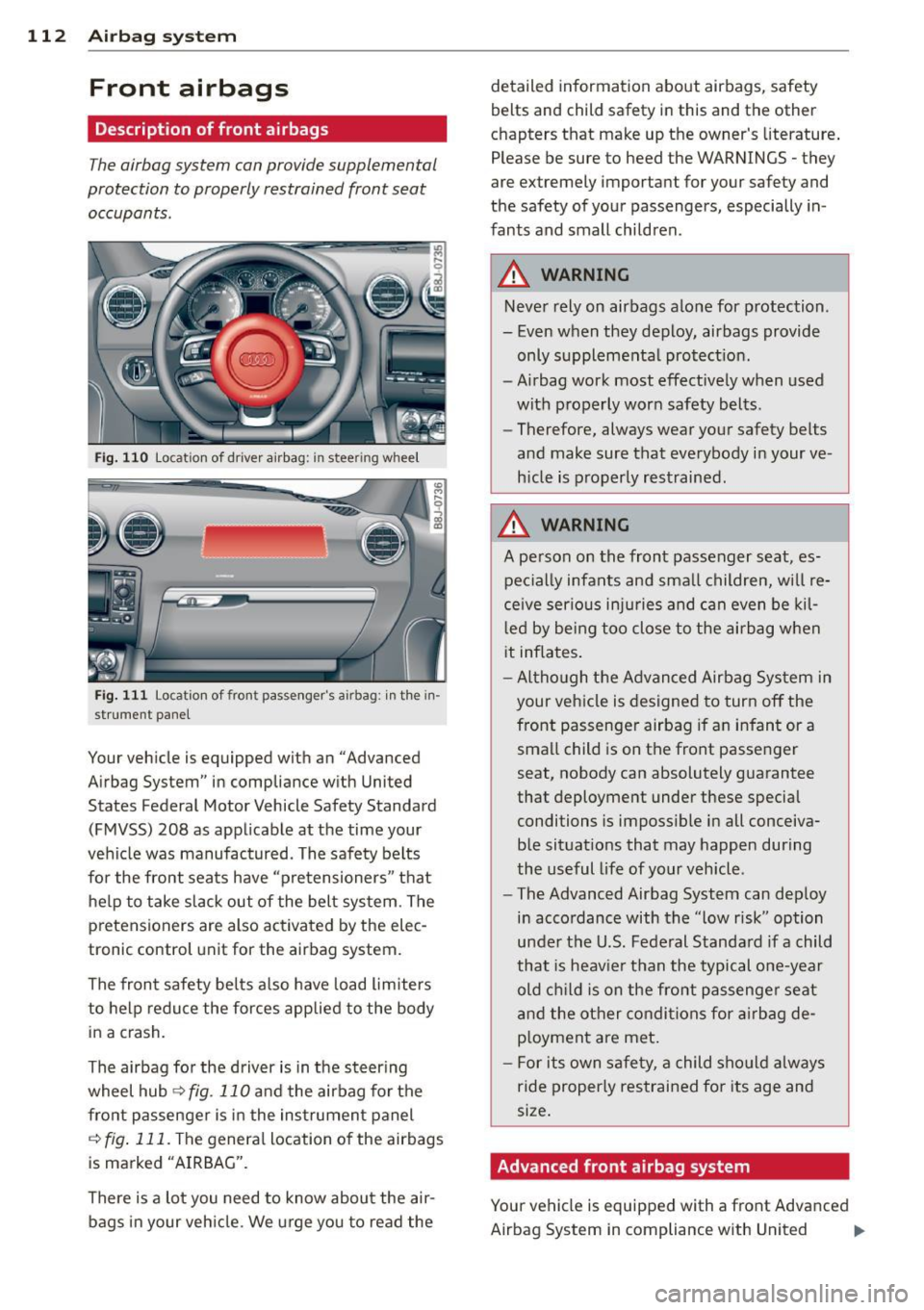
Fig . 110 Locat ion of driver airbag: in steering wheel
Fig. 111 Locatio n of front passenger 's ai rbag: in t he in·
strument panel
Your vehicle is equipped with an "Advanced
Airbag System" in compliance with United
States Federal Motor Vehicle Safety Standard
(FMVSS) 208 as applicable at the time your
vehicle was manufactured . The safety belts
for the front seats have "pretensioners" that
help to take slack out of the belt system. The
pretensioners are also activated by the elec·
tronic control unit for the airbag system.
The front safety belts also have load limiters
to help reduce the forces applied to the body in a crash.
The airbag for the driver is in the steer ing
wheel hub ¢
fig. 110 and the airbag for the
front passenger is in the instrument panel
¢
fig . 111. The general location of the airbags
is marked "AIRBAG".
There is a lot you need to know about the air
bags in your vehicle. We urge you to read the detailed information abo
ut airbags, safety
belts and child safety in this and the other
chapters that make up the owner's literature .
P lease be sure to heed the WARNINGS -they
are extremely important for your safety and
the safety of your passengers, especially in
fants and small children .
A WARNING
Never rely on airbags alone for protection .
- Even when they deploy, airbags provide only supplemental protect ion.
- Airbag work most effective ly when used
with properly worn safety belts.
- Therefore, always wear your safety belts
and make sure that eve rybody in your ve
h icle is p roperly restrained.
A WARNING
A person on the front passenger seat, es
pec ially infants and sma ll children, w ill re
ceive serious injuries and can even be kil
l ed by be ing too close to the airbag when
i t inflates .
- Al tho ugh the Advanced Airbag System in
your veh icle is designed to tur n
off the
front passenger airbag if an infant or a
small child is on the front passenger
seat, nobody can absolutely guarantee
that deployment under these special
conditions is impossible in all conceiva
b le situations that may happen during
the useful life of your vehicle .
- The Advanced Airbag System can dep loy
in accordance with the "low risk" option
under the U.S . Federal Standa rd if a child
that is heav ie r th an the typical one-year
old ch ild is on the front passenger seat
and the other condi tions for a irbag de
p loyment are met .
- F or its own safe ty, a child sho uld always
ride properly restrained for its age and
size .
Advanced front airbag system
-
Your vehicle is equipped with a front Advanced
Airbag System in compliance with United ..,_