2015 AUDI S3 SEDAN ESP
[x] Cancel search: ESPPage 213 of 282

M N
0 > co ,...., \!) 1.1'1
1.1'1
1.1'1
,....,
can be cracked due to ice formation and can leak battery acid.
Battery charging (Maximum charging rate of
30 amps / 14.8 Volt)
When charging at
low voltages (e.g . with a trickl e
charger ), the battery cab les do not have to be
d isconnected first. The battery caps shou ld
not
be opened when charg ing a battery .
It is not necessary to remove the battery from
the luggage compartment, and it is also not nec
essary to disconnect the cables .
Fast charging the battery (charg ing rate
a bo ve 14.8 Volt s)
F or technical reasons do not use a battery charg
er that us es voltage greater than 14 .8 Volts to
charge your vehicle's battery.
A WARNING
Charging a battery can be dangerous.
- Always fo llow the operating instructions
provided by the battery charger manufactur
er when charging y our battery.
- Never charge a frozen battery. It may ex
plode because of gas trapped in the ice. Al
low a frozen battery to thaw o ut first.
- Do not reuse batteries which were frozen .
The battery hous ing may have cracked and
weakened when the battery froze.
- Charge the battery in a well ventilated area .
Keep away from open flame or electrical
spark . Do not smoke. Hyd rogen gas generat
ed by the battery is explos ive .
- To reduce the danger of explosion, never co nnect or disconnect cha rger cables while
the cha rger is operating .
- Fast charg ing a battery is dangerous and
should only be attempted by a competent
tec hnician with the p roper equipment .
- Battery acid that may spill during charg ing
should be washed off w ith a so lution of
wa rm water and baking so da t o n eutrali ze
t he a cid .
Checking and Fillin g
(D Note
Never use a fast charger as a booster to start
the engine . This will ser iously damage sensi
tive electronic components, s uch as control
units, relays, radio, etc., as well as the battery
charger .
Battery replacement
The new bat tery mus t hove the some specifica
tions and dimensions as the original equipmen t
battery.
Intelligent energy management in your vehicle is
responsible for distributing the electrical energy
t h roughout your vehicle
Q page 128 . The intelli
gent energy management system w ill keep the
engine batt ery charged better than vehicles with
out this system. To ma ke s ure t he add it iona l elec
t rical energy is av ailabl e once again afte r yo u
have changed the battery, we recommend tha t
yo u install batteries of the same type and man u
facture on ly (the same as those insta lled at the
t ime yo ur vehicle was delivered). Specifications
are listed on the battery hous ing . Your author
ized dealer must code the battery in the energy
manageme nt system to enab le you to use the en
ergy ma nagement fu nctions cor rectly afte r re
plac ing the battery .
The new battery mus t have the same capacity ,
vo ltage (12 -volts), amperage, construction and
plug seal ing.
When install ing the battery, make sure the ign i
t ion and all electr ica l consumers are switched off.
(D Note
Make sure the ventilat ion hose on the side of
the battery is connected, otherwise f umes or
battery acid can lea k out.
~ For the sake of the environment
Because o f the prob lem of proper disposal of
a battery, we recommend you r authorized
A udi dealer change the battery for you. Bat
teries contain sulfur ic acid and lead and must
always be dispose d of properly in complia nce
with a ll envi ronm ental regulations. Disposing ..,.
211
Page 215 of 282

M N
0 > co ,...., \!) 1.1'1
1.1'1
1.1'1
,....,
Resetting the indicator
Your authorized Audi dealer or authorized Audi
Service Facility will reset the service interval dis
play after performing service.
If you perform an oil change yourself to the Audi
specifications, you must reset the service interval
display.
To reset the display, select the
I MENU I button>
Car > Systems* control button > Service & con
trol
> Service intervals > Reset oil change inter
val.
(1) Note
- Only reset the oil change indicator if the oil
was changed.
- Following the service intervals is critical to
maintaining the service life and value of
your vehicle, especially the engine. Even if
the mileage on the vehicle is low, do not ex
ceed the time for the next service.
- Calculating the time to the next oil change
is interrupted when the vehicle battery is
disconnected. If the vehicle is not driven for
a long period of time, check the mainte
nance schedule so that you can follow the
maintenance intervals.
Checking and Filling
213
Page 218 of 282
Tires and wheels
be happy to provide more infor
mation .
® Mud and snow capabilit y
"M/S" or "M+S" indicates the tire
has characteristics that make it
suitab le for driving on mud and
snow.
& indicates a winter tire.
@ Compos ition of the tire cord
and materi als
The number of plies indicates the
number of rubberized fabric lay
ers in the tire. In general : the
more laye rs, the more weight a
tire can carry. Tire manufacturers
must also specify the materials
used in the tire. These include
steel , nylon, polyester and other
materials.
@ Maximum permitted load
This number indicates the maxi
mum load in kilograms and
pounds that the tire can carry.
@ Uniform tire quality grade
standards for treadwear,
traction and temperature
resistance
Treadwear, traction and tempera
ture ranges r:>
page 231.
@ Running direction
The arrows indicate the running
direction o f unidirectional tires .
216
You m ust always follow the speci
fied runn ing direction
.:> page 245.
@ Maximum permitted
inflation pressure
This number indicates the maxi
mum pressure to which a tire can
be inflated under normal operat
ing condit ions .
Glossary of tire and loading
terminology
Accessory weight
means the combined we ight (in
excess of those standard items
which may be replaced) of auto
matic transmission, power stee r
ing, power brakes , power win
dows, power seats, radio, and heater, to the extent that these
items are available as fac to ry-in
stalled equipment (w hether in
stalled or not).
Aspect ratio
means the ratio of the height to
the width of the tire in percent .
Numbers of 55 or lower ind icate a
low si dewall for imp roved steer
ing response and better overa ll
handling on dry pavement . .,.
Page 223 of 282
Occupant loading and distri
bution for vehicle normal load
for various designated seating
capacities
Refer to the tire inflation pressure
labe l
c:::> page 224, fig. 171 for
the number of seating positions .
Refer to the table
c:::> table on
page 226
for the number of peo
ple that correspond to the vehicle
normal load.
New tires or wheels
Audi recommends having all work on tires or wheels performed by
an authorized Audi dea ler or au
thorized Audi Service Facility.
These facilities have the proper knowledge and are equ ipped with
the required tools and replace
ment parts .
.,,. New tires do not yet have the
opt imum adhesion properties .
Drive carefully and at moderate
speeds for the first 350 m iles
(500 km) with new tires .
.,,. Use tires of the same construc
tion, size (rolling circumference)
and as close to the same tread pattern as possible on all four
wheels .
Tires a nd whe els
.,,. Do not replace tires individually.
At least replace both tires on the same axle at the same time .
.,,. Audi recommends that you use
Audi Original equipment tires. If
you would like to use different
tires, please note that the tires
may perform different ly even if
they are the same size
c:::> ,& .
.,,. If you would like to equip your
vehicle with a tire/rim combina
tion that is different from what
was installed at the factory, con sult with an authorized Audi
dealer or authorized Audi Service
Facility before making a pur
chase
c:::> ..1,. .
The spare tire* is different from
the regular tires installed on the
vehicle -for example, if winter
tires or wide tires are installed -
then only use the spare tire* tem
porarily in case of emergency and
drive carefully while it is in use. It
should be replaced with a regular
tire as soon as possible.
On
all wheel d riv e vehicles, all
four wheels must be equipped
with tires that are the same brand
and have the same construction
and tread pattern so that the drive system is not damaged by
22 1
Page 225 of 282
"' N
~
-Have an authorized Audi dealer or authorized Audi Service Facili
ty check the wheel alignment if
there is unusual wear.
-Have the wheels rebalanced if an imbalance is causing noticeable
vibration in the steering wheel.
If you do not, the tires and other
vehicle components could wear
more quickly .
Treadwe ar indic ato r
Original equipment tires contain
treadwear indicators in the tread pattern, which are bars that are
1/16 inch (1.6 mm) high and are
spaced even ly around the tire per
pend icular to the running direc
tion
¢ fig. 169. The letters "TW I"
or triangles on the tire sidewall indicate the location of the tread
wear indicators.
The tires have reached the mini mum tread depth
l) when they
have worn down to the treadwear
indicators. Replace the tires with
new ones¢ &.
Whe el rot ation
Rotating the wheels regularly is
recommended to ensure the tires
;;; l) Obey any applicable regu lation s in your ~
~ country . ....
Tires and wheels
wear evenly. To rotate wheels, in
stall the wheels from the rear
axle on the front axle and vice ver
sa. This will allow the tires to
have approximately the same
length of service life.
F or unidirectional tires, make sure
the tires are installed according to
the running direction indicated on
the tire sidewall¢
page 245.
Hidden damage
Damage to tires and rims can of
ten occur in locations that are hid
den. Unusual vibrations in the ve
hicle or pulling to one side may
indicate that there is tire damage .
Reduce your speed immed iately .
Check the tires for damage. If no
damage is visible from the out
side, drive slowly and carefully to
the nearest authorized Audi deal
er or authorized Audi Service Fa
cility to have the vehicle inspect
ed.
A WA RNING
-
Tread that has worn too low or
different tread depths on the
tires can reduce driving safety.
This can especially have a
223
Page 233 of 282
M N
0 > co ,...., \!) 1.1'1
1.1'1
1.1'1
,....,
In o rder to m inim ize the occu rrence o f impac t
damage to the t ires of your vehicle, we recom
mend that you observe the following precau
tions :
- Always maintain recommended in flat ion p res
s ur es . Check yo ur tire p ress ure every 2,000
miles (3,000 km) and add air if necessary.
- Drive carefu lly on roa ds with potholes, deep
gul lies or ridges. The impact from driving
th ro ugh or over such obstacles can damage
your tires. Impact with a curb may also cause damage to your tires.
- After any impact, immediately inspect your
tires or have them inspected by the nearest a u
thorized Aud i dea ler . Replace a damaged tire as
soon as poss ible .
- Inspect your t ires every 2,000 miles (3 ,000 km)
for damage and wear. Damage is not always
easy to see. Damage can lead to loss of a ir and
underinflation, which cou ld eventually cause
t ir e fa il ur e.
If yo u be lieve that a ti re may h ave
been d amaged, rep lace the tire as soon as pos
s ible.
= T hese tires m ay we ar m ore q uic kly than ot hers.
- Please a lso remember that, wh ile thes e tir es
deliver respons ive handling, t hey may ride less
c o m fort ably and m ake more noise t han other
cho ices .
Reduced performance in winter/cold season
conditions
All t ires are des igned for cert ain purposes. The
l ow aspec t ratio, u ltra high per formance tires
originally insta lled on yo ur vehicle a re intended
for maximum dry and wet road perfo rmance an d
h andling. They are not suitable for cold, snowy or
icy weather cond it ions . If you drive under those
circumstances , you should equip your vehicle
w ith a ll-season or winter tires , which offer better
traction under those cond itions . We suggest you
use the re commended snow o r a ll-s eason t ires
specified fo r you r vehicle , or the ir eq uivalent.
Refe r to ¢
page 229 for mo re deta iled informa
tion regard ing winter tires .
Uniform tire quality grading
- Tread wear
Tires and wheels
- Traction AA A B C
- Temper ature A BC
Quali ty g rades can be found where applicab le on
t h e tire side wa ll between tread shoulder a nd
max imum sec tion wid th
~ page 214, fig . 168.
For example: Tread wear 200 , Traction AA, Tem
perature
A.
All passenger car t ires must conform to Federa l
Safety Requirements in addition to these grades.
Tread wear
T he tread wear g rade is a comparative rating
based on the wear rate of the t ire when tested
u nder contro lled c onditions on a specified gov
ernment test course.
F or example, a tire gra ded 15 0 wo uld wear one
and one half (1 1/2) times as we ll on the govern
ment course as a t ire g raded 100.
T he re lative per forman ce of tires depends upon
t h e actual cond itions of thei r use, however, and
may depart significantly from the norm due to
variations in driv ing habits, service p ract ices and
differences in road c haracteristics and climate.
Traction
T he traction gra des, from highest to lowest, are
AA , A , Ban d
C. Those g rades represent t he tire's
ability to stop on wet pavement as meas ured un
der contro lled conditions on specified govern
ment test s urfaces of asphalt a nd c oncrete . A tire
marked C may have poor traction performance
~ A .
Temperature
The temperature grades are A (the highest), B,
and C, representing the t ire's resistance to the
generation of heat a nd its ability to diss ipate
heat when tested u nder cont ro lled conditions on
a spec ified indoor labora to ry test wheel.
Sustained h igh temperature can cause the mate
ria l of the tire to degenerate and reduce ti re life,
and excess ive temperature can lead to s udden
t ir e fail ure¢ ,&. . .,,.
231
Page 234 of 282

Tires and wheels
The grade C corresponds to a level of perform
ance which all passenger car tires must meet un
der the Federal Motor Vehicle Safety Standard No.
109 . Grades Band A represent higher levels
of pe rformance on the laboratory test wheel than
the minimum required by law .
A WARNING
The traction grade assigned to this tire is
based on straight-ahead braking traction
tests, and does not include acceleration, cor
nering, hydroplaning or peak traction charac
teristics.
A WARNING
The temperature grade for this tire is estab
lished for a tire that is properly inflated and
not overloaded. Excessive speed, underinfla
tion, or excessive loading, either separate ly or
in combination, can cause heat buildup and
possible tire failure.
A WARNING
Temperature grades apply to tires that are properly inflated and not over or underinflat
ed .
Tire pressure monitoring
system
CD General notes
Applies to veh icles: w ith tire pressure monitoring system
Each tire, including the spare (if provided),
should be checked monthly when cold and inflat
ed to the inflation pressure recommended by the
vehicle manufacturer on the vehicle placard or
tire inflation pressure label.
(If your vehicle has
tires of a different size than the size indicated on
the vehicle placard or tire inflation pressure la
bel, you should determine the proper tire infla
tion pressure for those tires).
As an added safety feature, your vehicle has been
equipped with a tire pressure monitoring system
(TPMS) that illuminates a low tire pressure tell
tale when one or more of your tires is significant
ly under-inflated. Accordingly, when the low tire
pressure telltale illuminates, you should stop and
232
check your tires as soon as possible, and inflate
them to the proper pressure . Driving on a signifi
cantly under-inflated tire causes the tire to over
heat and can lead to tire failure. Under-inflation
also reduces fuel efficiency and tire tread life,
and may affect the vehicle's handling and stop
ping ability .
Please note that the TPMS is not a substitute for
proper tire maintenance, and it is the driver's re
sponsibility to maintain correct tire pressure, even if under-inflation has not reached the level
to trigger illumination of the TPMS low tire pres
sure telltale.
Your vehicle has also been equipped with a TPMS malfunction indicator to indicate when the sys
tem is not operating properly. The TPMS mal
function indicator is combined with the low t ire
pressure tel ltale. When the system detects a
malfunction, the telltale will flash for approxi
mately one minute and then remain continuously
illuminated. This sequence will continue upon
subsequent vehicle start -ups as long as the ma l
function exists .
When the malfunction indicator is illuminated,
the system may not be able to detect or signal low tire pressure as intended. TPMS malfunctions
may occur for a variety of reasons, including the
installation of replacement or alternate tires or
wheels on the vehicle that prevent the TPMS
from functioning properly. Always check the
TPMS malfunction telltale after replacing one or
more t ires or wheels on your vehicle to ensure
that the replacement or alternate tires and
wheels allow the TPMS to continue to function
properly .
Page 235 of 282
....,
N
0 > co
rl I.O
"'
"'
"'
rl
If the Tire Pressure Monitoring System
indicator appears
Applies to vehicles: with t ire p ressure monitoring syste m
The tire pressure indicator in the instrument
cluster informs you if the tire pressure is too low
or if there is a system malfunction.
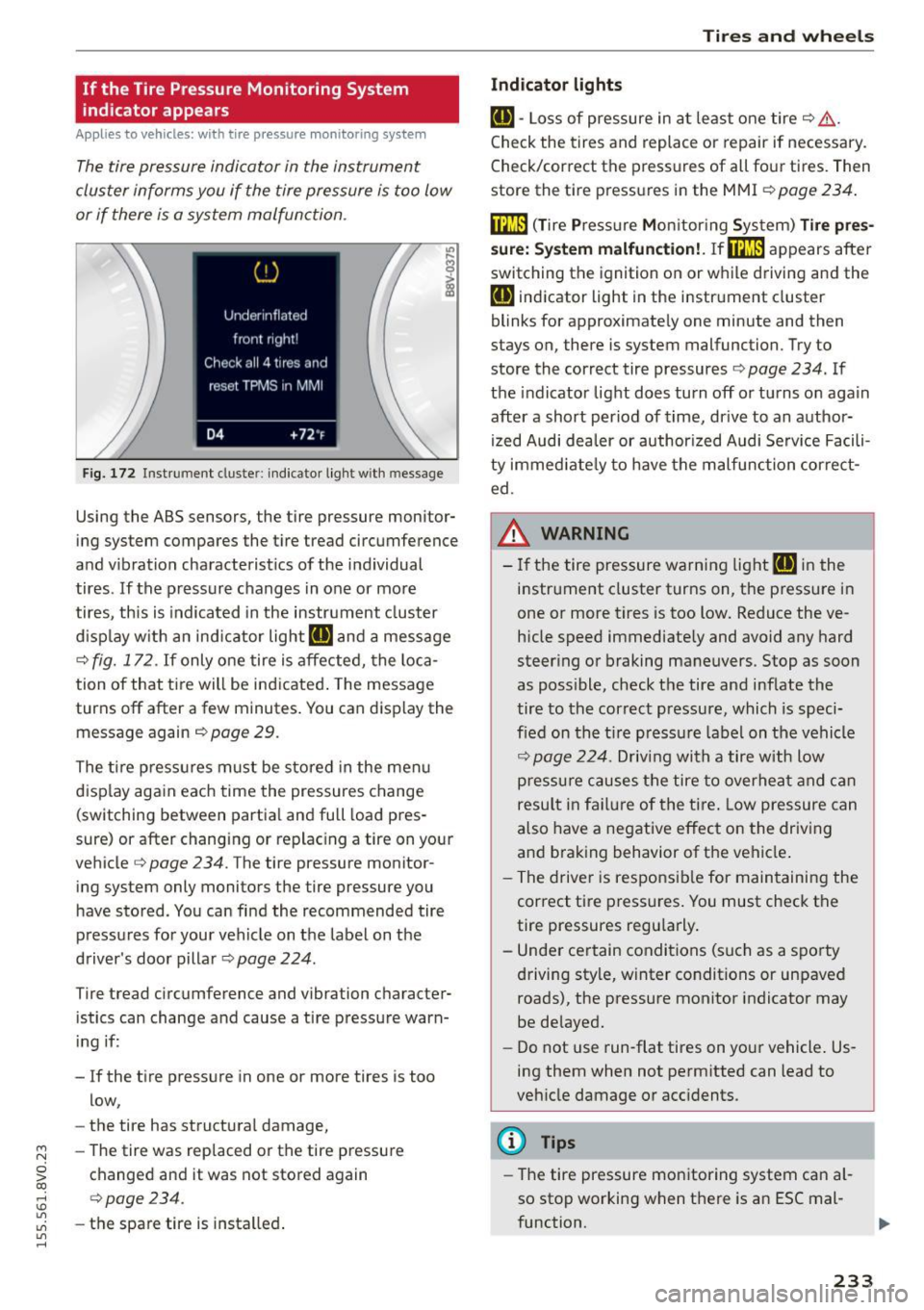
F ig. 172 Instrument cluster: in dicator light w ith message
Using the ABS sensors, the tire pressure monitor
ing system compares the tire tread circumference
and v ibration characterist ics of the ind ividual
tires.
If the pressure changes in one or mo re
tires, th is is indicated in the instrument cluster
d isp lay w ith an ind icator light
RE and a message
¢
fig. 172. If only o ne tire is affected, the loca
tion of that ti re will be indicated . The message
turns off after a few minutes . You can display the
message again
r::;,page 29.
The tire p ressu res m ust be stored in the menu
disp lay aga in each time the pressures change
(switching between partia l and full load pres
sure) or after changing or replac ing a tire on your
ve hicle¢
page 234. The tire pressure monitor
ing system only monitors the tire pressure you
have stored. You can find the recommended tire
pressures for your vehicle on the label on the
driver's door pillar¢
page 224.
Tire tread circumference and vibration character
istics can change and cause a tire pressure warn
in g if:
- If the tire pressure in one or more tires is too
low,
- the tire has structural damage,
- The tire was replaced or the tire pressure
changed and it was not stored again
¢ page 234.
-the spare tire is insta lled .
Tires and wheels
Indicator lights
RE -Loss of pressure in a t least one tire ¢ ,&.
Check the tires and replace or repair if necessary.
Check/correct the pressures of all four t ires. Then
store the tire p ressu res in the MMI ¢
page 234.
film (T ire Pressure Mon itor ing Sys tem) Tire pres
s ure: Sy stem malfunction!. If@m
appears after
switching the ignition on or while driving and the
RE ind icator light in the instr ument cluster
blinks for approximate ly one minute and then
stays on, there is system malfunction. Try to
store the correct tire pressures ¢
page 234. If
the indicator light does turn off or turns on aga in
after a short period of time, dr ive to an author
i zed Audi dea ler or author ized Audi Serv ice Facili
ty immed iate ly to have the malfunction corre ct
ed.
,&. WARNING
- If the tire pressure warning light RE in the
i n str ument cluster turns on, the pressure in
one or more tires is too low . Reduce the ve
h icle speed immediate ly and avoid any hard
steer ing or braking maneuvers. Stop as soon
as poss ible, check the tire and inf late the
tire to the correct pressure, which is speci
fied on the t ire p ress ure label on the vehicle
r::;, page 224. Driv ing with a tire with Low
p ressu re causes the tire to overhea t and c an
resul t in fa il ur e of the tire . Low pressure can
a lso have a negative effect on the driving
and b rak ing behavior of t he vehicle .
- T he drive r is respons ib le for main taining the
correct ti re press ures . You must check the
tire pressures regu larly .
- Under certain conditions (such as a sporty
driving style, winter conditions or unpaved
roads), the pressure monitor indicator may
be de layed.
- Do not use run-flat tires on yo ur vehicle . Us
ing them when not permitted can lead to
veh icle damage or acc idents.
(D Tips
- The tire pressure monitoring system can al
so stop working when t here is an ESC mal-
function. ..,.
233