2015 AUDI S3 SEDAN headlights
[x] Cancel search: headlightsPage 50 of 282
Lig ht a nd Vis ion
outside forces (such as an impact when ma
neuvering), you must use the power folding
funct ion to fold the mir ror all the way out.
You will hear a loud noise when the mirrors
are latched back in place. The mirror hous
i ng must not be moved back into place by
hand because th is would impair the func
tion of the mirror mechanism.
-Applies to vehicles without power fold ing
exterior mirrors: if the mirror housing was moved by outside forces (such as in impact
during maneuve ring), you must move the
mirror ho us ing ba ck into p lace by hand.
- If you wash the veh icle in an automatic car
wash, you m ust fold the exterior m irrors in
to reduce the risk of damage to the mirrors .
Never fold power folding exterior mirrors*
by hand. Only fo ld them in and out using
the power controls.
@ Tips
If the power adjustment fails, both mirrors
can be adjusted by hand by pressing on the
edge of the mirror surface.
Dimming the mirrors
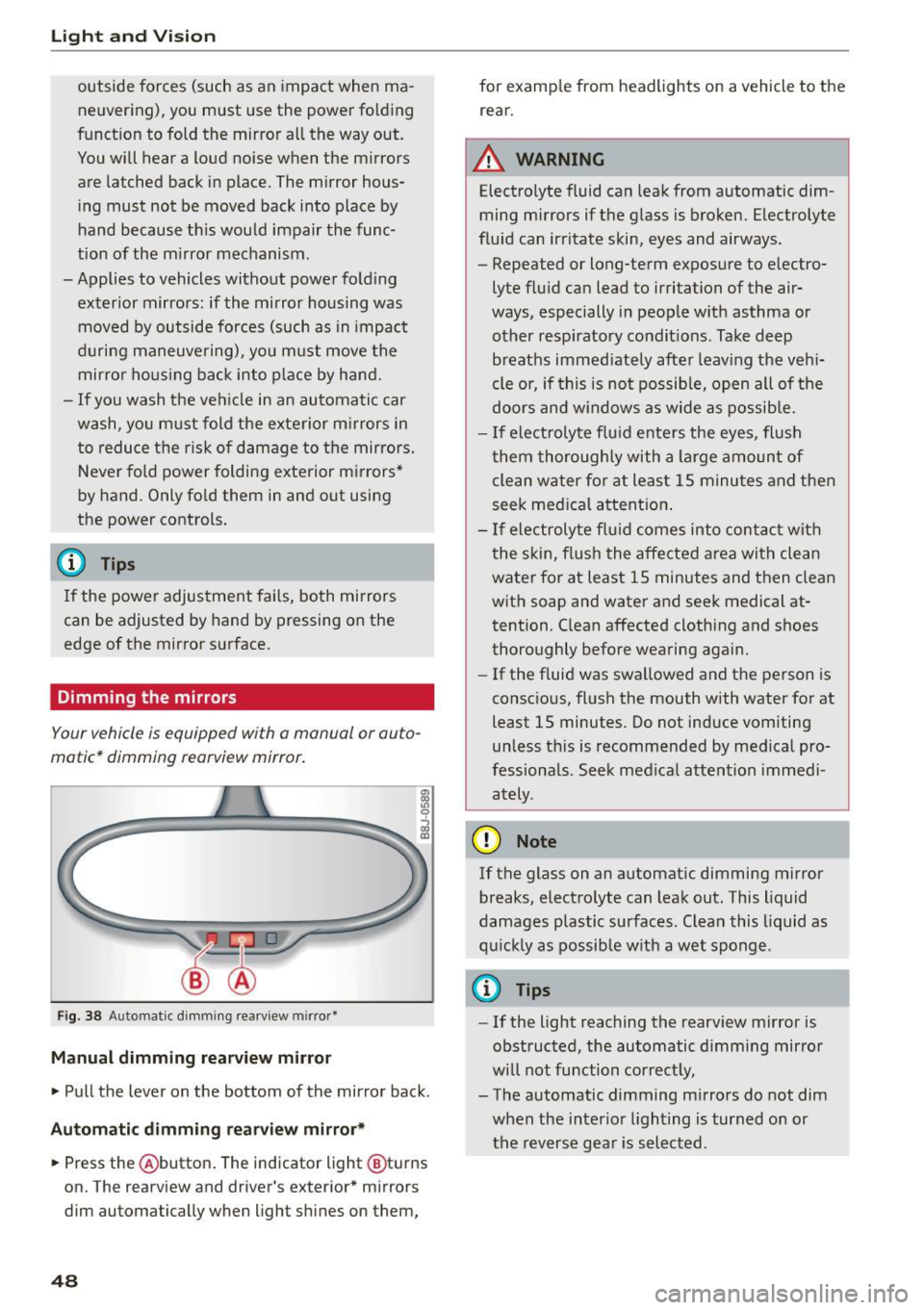
Your vehicle is equipped with a manual or auto
matic* dimming rearview mirror .
Fig. 38 Automatic d imm ing rearv iew mirro r•
M anual dimming rea rvi ew mirror
• Pull the lever on the bottom of the mirror back.
Autom atic dimm ing r ear view mirr or*
• Press the @button . The indicator light @turns
on. The rearview and driver's exterior * mirrors
dim automatically when light sh ines on them,
48
for examp le from headlights on a vehicle to the
rear.
A WARNING
Electrolyte fluid can leak from automatic dim
ming mirrors if the g lass is broken. Electrolyte
flu id can irritate skin, eyes and airways .
- Repeated or long-term exposure to electro
lyte fluid can lead to irritation of the air
ways, especially in people w ith asthma or
other resp iratory condit ions . Take deep
breaths immed iate ly after leav ing the veh i
cle or, if this is not possib le, open all of the
doors and w indows as wide as possib le.
- If electrolyte flu id ente rs the eyes, flush
them thoroughly with a large amount of
clean water for at least 15 m inutes and then
seek med ica l attention .
- If electroly te f lu id comes into contac t with
the skin, flush the affected area with clean
water for at least 15 minutes and then clean
with soap and water and seek medical at
tention. C lean affected clothing and shoes
thoroughly before wearing aga in.
- If the f luid was swa llowed and the person is
consc io us, fl ush the mouth with water for at
least 15 minutes. Do not induce vomiting
unless th is is recommended by med ica l pro
fessiona ls . Seek med ical attention immedi
ately .
(D Note
If the glass on an automat ic dimming m irror
breaks, electro lyte can leak out. This liquid
damages plastic surfaces. C lean this liquid as
q uick ly as possib le w ith a wet sponge .
{D Tips
- If the light reaching the rearview mirror is
obstructed, the automatic d imm ing mirror
w ill not function correct ly,
- The automatic dimming m irrors do not dim
when the interior lighting is turned on or
the reverse gea r is selected .
Page 51 of 282
....,
N
0 > co
rl I.O
"'
"'
"'
rl
Sun visors
C1o... ___ J
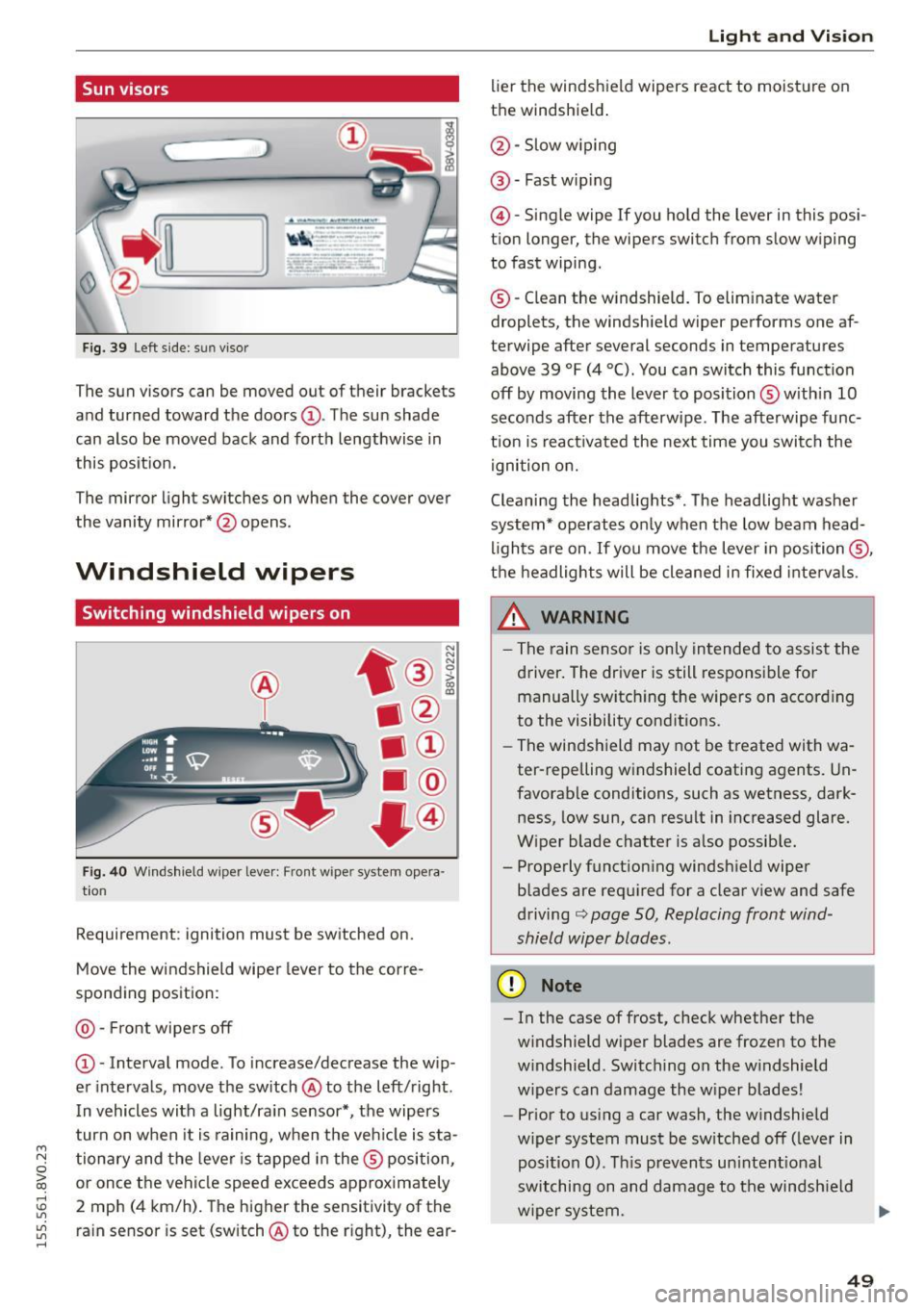
Fig. 39 Left side: su n viso r
The sun visors can be moved out of their brackets
and turned toward the doors@. The sun shade
can also be moved back and forth lengthwise in
this posit ion.
The mirror light switches on when the cover over
the vanity mirror* @opens .
Windshield wipers
Switching windshield wipers on
Fig. 40 Windshield wiper leve r: Front wiper system opera
tion
Requirement : ignition must be switched on.
Move the windshield wiper lever to the corre
sponding position:
@ -Front wipers off
@ -Interval mode. To increase/decrease the w ip
er intervals, move the switch @to the left/right .
I n vehicles with a light/ra in sensor*, the wipers
turn on when it is ra ining, when the veh icle is sta
tionary and the lever is tapped in the ® position,
or once the vehicle speed exceeds approximately
2 mph (4 km/h). The higher the sensitivity of the ra in sensor is set (switch @to the r ight), the ear-
Light and Visio n
lier the windshield wipers react to moisture on
the windshield .
@-Slow w iping
@ -Fast wip ing
@ -Single wipe If you ho ld the lever in this posi
tion longer, the wipers switch from slow wiping
to fast wiping.
® -C lean the w indshield. To elim inate water
droplets, the windsh ield wiper performs one af
terwipe after several seconds in temperatures
above 39 °F (4 °(). You can switch this function
off by moving the lever to position ® with in 10
seconds after the afterwipe. The afterwipe func
t ion is react ivated the nex t time you switch the
ignition on.
Cleaning the headlights*. The headlight washer
system* operates only when the low beam head
li ghts are on . If you move the lever in position @,
t h e headlights will be cleaned in fixed interva ls .
_& WARNING
- The rain sensor is only intended to assist the
driver. The driver is still responsible for manually switch ing the w ipers on according
to the visibility cond itions.
- The windshield may not be treated with wa
ter-repelling w indshield coat ing agents. Un
favorable conditions, such as wetness, dark
ness, low sun, can result in increased glare.
W iper blade chatter is also possib le.
- Properly function ing windsh ield wiper
b lades are req uired for a clear v iew and safe
driving
c::> page 50, Replacing front wind
shield wiper blades .
(D Note
- In the case of frost, check whether the
windshield wiper blades are fr ozen to the
w indshield. Switching on the w indshield
w ipers can damage the w iper blades!
- Prior to using a car wash, the windshield
w iper system must be sw itched off (leve r in
posit ion 0). T his prevents un intent ional
switching on and damage to the windsh ield
w iper system. .,.
49
Page 238 of 282
Care and cleaning
& WARNING
- Only wash the vehicle when the ignition is
off an d follow the i nstructions fr om the car
wash operator to r educe the r isk of acci
dents.
- To reduce the r isk of cuts, protect yourself
from sharp metal components when wash ing the underbody or the inside of the wheel
hous ings.
- After washing the vehicle, the braking effect
may be delayed due to moisture o n the
brake rotors or i ce in the winte r. T he bra kes
mus t be d ried first w ith a few caref ul bra ke
applications .
@ Note
-If you wash the ve hicle in an au tomatic car
wash, you m ust fold the e xterior m irrors in
to reduce the ris k of damage to the mirrors .
Power folding exterior mirrors* must only
be fo lded i n and out using the power folding
funct ion. -
To prevent paint damage, do not wash the
vehicle in direct sunlight.
- T o reduce the r is k of damage to the sur face,
do not use insect remov ing sponges, kitchen
sponges or similar items.
- Mat te finish painted vehicle components:
- To reduce the risk of damage to the sur-
face, do not use po lishi ng agents or hard
wax.
- Never use protective wax.
It can destroy
the matte finish effect.
- Do not place any stickers or magnet ic
signs on vehicle parts painted w ith matte
finish paint. The pa int co uld be damaged
when the sticke rs o r mag nets are re
moved.
@ For the sake of the environment
Only wash the ve hicle in facilities spec ially de
s igned fo r that purpose. This w ill reduce the
r isk of dir ty wa ter co ntaminated w ith oil from
entering the sewe r system.
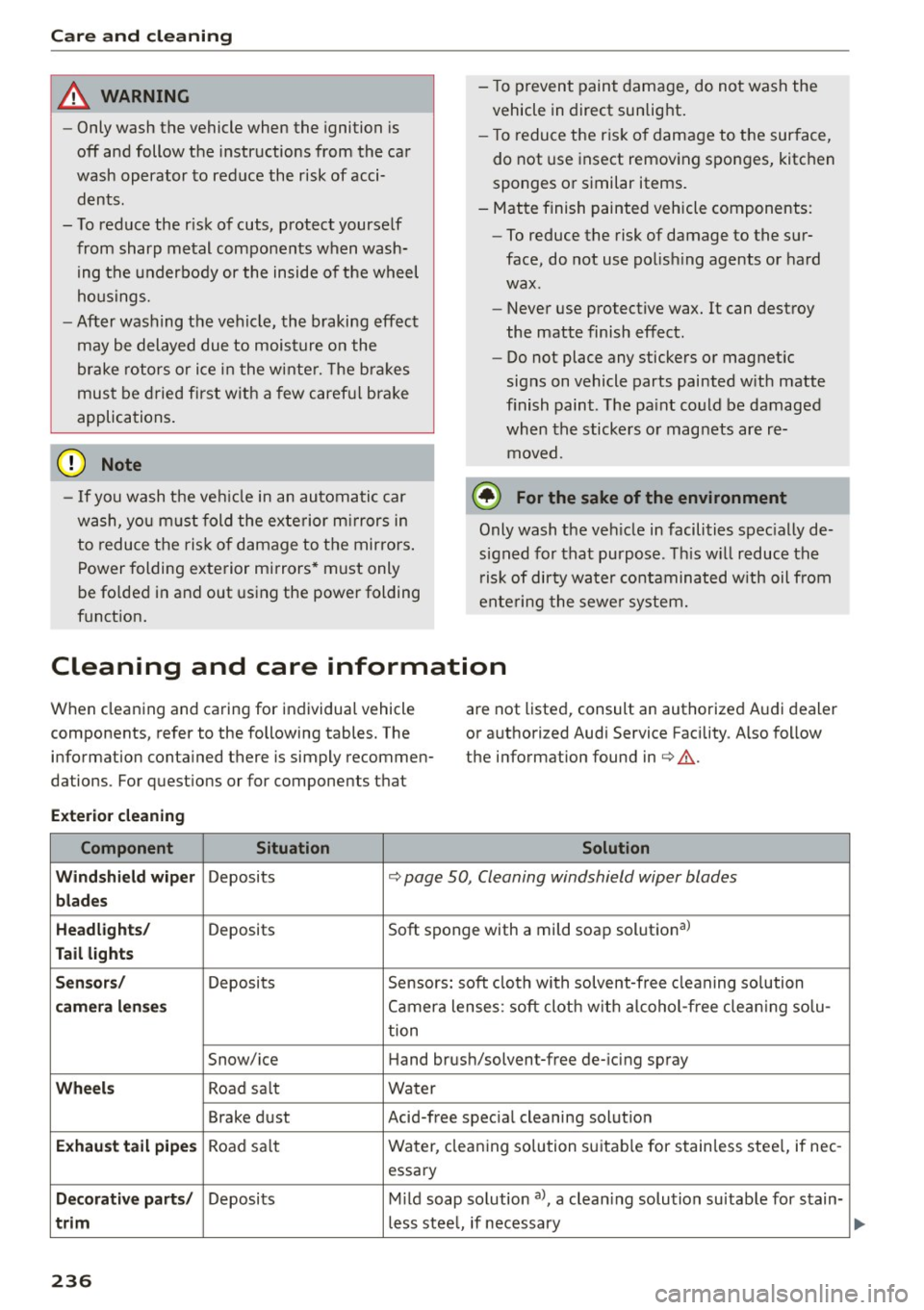
Cleaning and care information
When cleaning and caring for individua l vehicle
components, refer to the following tables. The
information contained there is simply recommen
dations. For quest ions or for components that are not listed,
consult an authorized A udi dealer
or authorized Audi Service Facility . Also follow
the information found in
¢ _6.
Exterio r cleaning
Component Situation Solution
Windshield wiper
Deposits ¢ page 50, Cleaning windshield wiper blades
blades
Headlights /
Deposits Soft sponge with a mild soap
solutiona)
Tail lights
Sensors /
Deposits Sensors: soft cloth with solvent-free cleaning so lution
camera len se s Camera le ·nses : soft clot h w ith a lcohol-free clea ning so lu-
tion
Snow/ ice Hand brush/solvent-free de- icing spray
Wheel s Road sa lt Water
Brake dust Acid-free specia l cleaning solution
E xhau st tail pipe s Road salt Water, clean
ing solution su itab le for stain less stee l, if nee -
essary
D ecorative parts / Deposits Mild soap solution al, a clean ing solution suitable for stain-
trim l ess stee l, if necessary
236
Page 240 of 282
Care and cleaning
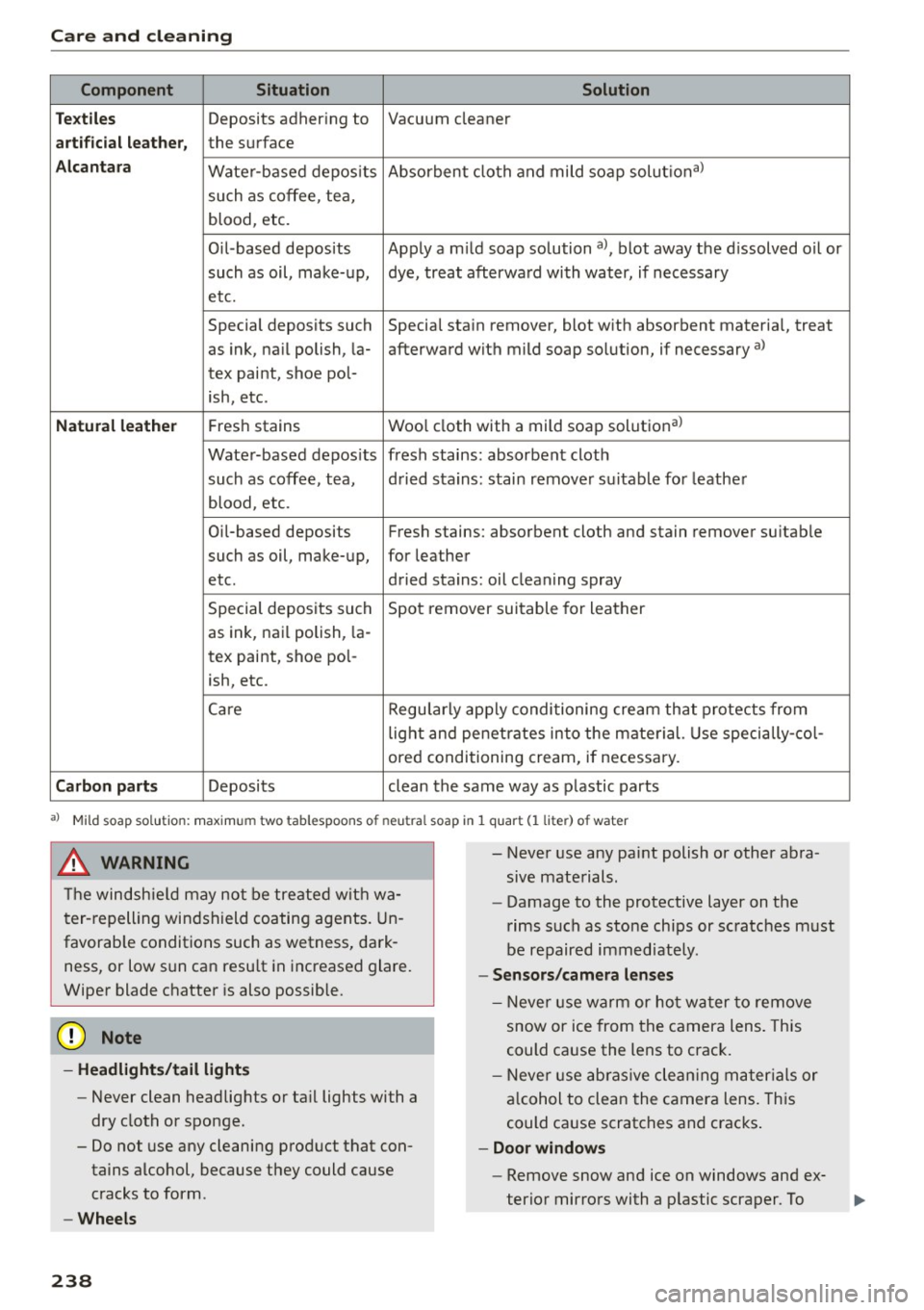
Component S ituation Solution
Te xtiles
Deposits adhering to Vacuum cleaner
arti ficial leath er, the surface
Alca ntara Wate r-based depos its Absorben
t cloth and mild soap solutional
such as coffee, tea,
blood, etc.
Oil-based deposits Apply a m ild soap solution al, blot away the d issolved oil or
such as oil, make-up, dye, treat afterwa rd with water, if necessary
etc.
Special deposits such Special stain remover, blot w ith absorbent materia l, treat
as ink, na il polish, la- afterward with mild soap so lution, if necessary a)
tex paint, shoe pol-
ish, etc.
Natural leather Fres h stains Wool cloth with a mild soap solutional
Wate r-based depos its fresh stains: absorbent clot h
such as coffee, tea, d ried stains: stain remover suitable for leathe r
blood, etc.
Oil-based deposits Fresh stains: absorbent cloth and stain remover suitab le
such as oil, make- up, for leather
etc. dried stains: oil cleaning spray
Special deposits such Spot remover sui table for leather
as ink, nai l polish, la -
tex paint, shoe pol-
ish, etc.
Care Regularly app ly condi tioning cream that protects from
lig ht and penet rates in to the mate rial. Use specially -col -
ored conditioning cream, if necessary.
Carbon part s Deposits clean the same way as plastic parts
al Mild soap sol ution: maxim um two tablespoons of neutral soap in 1 quar t (1 liter ) of water
_& WARNING
The windshie ld may not be tre ate d wit h wa
t er- repelling win dsh ield co ating agents. Un
favorab le conditions such as wetness, dark
ness, or low s un can resu lt in increased glare.
Wiper blade chatter is also possible.
(D Note
- Headlights/tail light s
-Never clean headlights or ta il lights with a
dry cloth or sponge.
- Do not use any cleaning prod uct that con
tains alcohol, because they could cause cracks to form.
- Wheels
238
-
- Never use any paint polish or other abra
sive mate rials.
- Damage to the protective layer on the
rims such as sto ne chips or sc ratches must
be repaired immediately.
- Sensors /camera lenses
- N eve r use warm or ho t w at er to remove
snow or ice from the camera lens . This
could ca use the lens to crack.
- N eve r use abras ive cle an ing m ateria ls or
a lcohol to clea n the camera lens. This
could ca use scratches and cracks .
-Doo r windows
- Remove snow and ice on windows and ex-
terio r mirro rs with a p lastic scraper. To
Page 252 of 282

Fuses and bulbs
No. Equipment
F49 Starter, clutch sensor,
headlight relay coil
F53 Rear window defogger
The power seats* are protected via
circuit break
ers
that automatically switch on after a few sec
onds after the overload has been reduced.
(0 Tips
Note that the following table was accurate at
the time of printing and is subject to change.
Left engine compartment fuse assignment
Fig. 187 Engine compartmen t: fuse assig nme nt
No. Equipment
Fl ESC control module
F2 ESC control module
F3 Engine control module (gasoline/diesel)
Engine cooling, engine components, auxili-
F4 ary heater coil relay (1+2), secondary a ir
injection pump relay
FS Engine components, tank system
F6 Brake light sensor
F7 Engine components, water pumps
F8 Oxygen sensor
250
No. Equipment
F9 E
ngine components, exhaust door, glow
time control module, SULEV valve
Fl0 Fuel injectors, fuel control module
Fll Auxiliary heater heating element 2
F12 Auxiliary heater heating element 3
F13 Automatic transmission control module
FlS Horn
F16 Ign ition coil
F17 ESC
control module, engine contro l mod-
ule
F18 Terminal 30 (reference voltage)
F19 Windshie
ld wipers
F20 Horn
F22 Terminal 50 diagnosis
F23 Starter
F24 Auxiliary heater heating element 1
F31 Vacuum pump
F32 L
ED headlights
(!') Tips
Note that the following tab le was accurate at
the time of printing and is subject to change.
Bulbs
Replacing light bulbs
For your safety , we recommend that you have
your authorized Audi dealer replace burned out
bulbs for you.
It i s becoming increasingly more and more diffi
cu lt to replace vehicle light bulbs s ince in many
cases, other parts of the car must first be re
moved before you are able to get to the bulb.
This applies especially to the light bulbs in the
front of your car which you can only reach
through the engine compartment.
Sheet meta l and bulb holders can have sharp
edges that can cause serious cuts, and pa rts
must be correctly taken apart and then properly
put back together to help prevent breakage of
parts and long term damage from water that can .,,_
Page 253 of 282

M N
0 > co ,...., \!) ..,.,
..,.,
..,., ,....,
enter housings that have not been properly re
sealed .
F or your safety, we recommend that you have
your author ized Audi dealer replace any bulbs for
you, since your dealer has the proper tools, the
correct bulbs and the expertise .
Gas disc har ge la mps (X enon li g ht s):
Due to the high electrical voltage, have the bulbs
replaced by a qualif ied techn ician . H eadlights
with Xenon light can be identified by the high
voltage sticke r.
L ED headlights* requ ire no ma intenance . Please
contact your authorized Audi dealer if a bulb needs to be replaced .
_& WARNING
Contact with high-voltage components of the
electrical system and improper replacement
o f gas discharge (Xenon) headlight bu lbs can
cause serious personal injury and death.
- Xenon bulbs are pressurized and can ex -
plode when being changed.
- C hang ing Xenon lamps requires the spe cial
training, instructions and equipment .
- Only an authorized Aud i dea ler or othe r
qualified workshop shou ld change the bulbs
in gas discharge lamps.
_& WARNING
There are parts with sharp edges on the open ings and on the b ulb holders that can cause
ser ious c uts.
- If you are uncertain about what to do, have
the work performed by an author ized Audi
dealer or other qualif ied workshop. Ser ious
persona l injury may result from improperly
performed work .
- If you still pre fer to replace the light bulbs
yourself, be aware that the engine compart
ment is a hazardous area to work in
i:> page l 98 i:> .&
-It is best to ask your authorized A udi dealer
whenever you need to change a bulb.
Fu ses a nd bulb s
251
Page 255 of 282

....,
N
0 > co
rl I.O
"'
"'
"'
rl
When jump starting or charging the battery,
never connect the negative ground cable to
the battery negat ive post because the battery
manager system must be able to detect the
battery's state of charge. Always connect the
negative g round cab le to the negative ground
post of the battery manager control unit.
Using jump start cables
Connect the jump start cables in the exact order
described below.
Fig. 188 Engine compa rtment: connectors for jump start
cables and a charger
Fig. 189 Ju m p sta rting the battery with anot her veh icle:
@ -drained battery, @-starter battery
The battery is located to the left in the eng ine
compartment.
Do not jump start a frozen or
thawed battery
c> A in Starting with jumper ca
bles on page
252! Replace the battery. The pro
cedure for connecting jump start cables that is
described next is designed to help jump start
your veh icle.
Vehicle with drained battery: .. Read the following carefullyc>
page 252
.. Set the parking brake and place the selector
lever in the P position .
Emergency situations
.. Turn the ignition and electrica l equipment off
in both vehicles.
Connecting the negative terminal(-) to the
negative terminal(-) (black)
.. To reach the battery terminals, flip the battery
cover cap to the side
c> fig . 188 .
1. Clamp the end of the red jump start cable to
the terminal © c>
fig. 189 on the dead bat
tery ®
¢0) in Starting with jumper cables
on page 252 .
2. Clamp the other end of the red jump start ca
ble to the terminal@on the charging bat
tery @.
Connect NEGATIVE (-) to NEGATIVE (-)
(black)
3 . Clamp the black end of the jump start cable
preferably at the ground point , or on the
negative term inal @ on the charg ing battery
® ·
4. Clamp the other black end of the jump start
cable
only on the ground point@) on your
vehicle ®
¢(D.
5. Route the jump start cab les so they cannot
get caught in the moving parts in the engine
compartment .
Starting the engine
6. Start the engine in the vehicle giving the
charge and let it run at idle.
7. Start the engine in the vehicle with the dead
battery and wait two to three minutes until it
"runs smoothly" .
8. If the engine does not start: stop the starting
procedure after
10 seconds and then repeat
it after approximately
30 seconds .
9. In the vehicle that is being jump started,
switch the heater fan and rear window de
froster on to reduce any voltage peaks that
may occur when disconnecting the jumper ca
bles. The headlights must be switched off .
10. With the engines running, remove the cables
in
reverse orde r of the way they were instal
led . Make sure the cables do not get caught
in moving eng ine components .
11. Switch the heater fan and rear w indow de
froster off .
12 . Close the battery cover .
253
Page 268 of 282
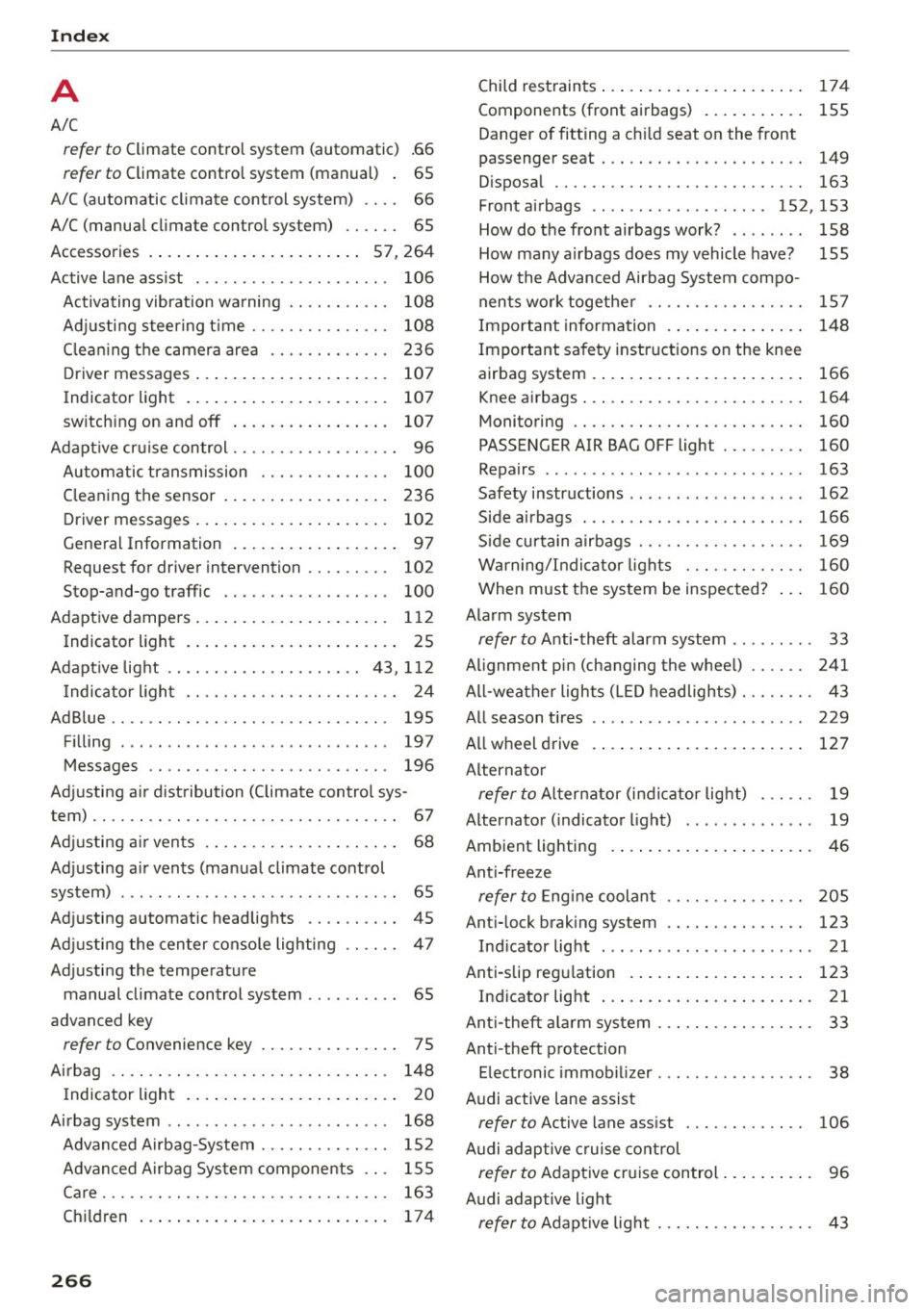
Index
A
A/C
refer to Climate control system (automatic) .66
re fer to Climate control system (manual) . 65
A/C (automatic climate control system) . . . . 66
A/C (manual climate control system) . . . . . . 65
Accessories . . . . . . . . . . . . . . . . . . . . . . . 5 7, 2 64
Active lane ass ist . . . . . . . . . . . . . . . . . . . . . 106
Activating vibration warning . . . . . . . . . . . 108
Adjusting steering time . . . . . . . . . . . . . . . 108
Clean ing the camera area . . . . . . . . . . . . . 236
Driver messages . . . . . . . . . . . . . . . . . . . . . 107
Indicator light . . . . . . . . . . . . . . . . . . . . . . 107
switching on and
off . . . . . . . . . . . . . . . . . 107
Adapt ive cruise control. . . . . . . . . . . . . . . . . . 96
Automatic transmission . . . . . . . . . . . . . . 100
C leaning the sensor . . . . . . . . . . . . . . . . . . 236
Driver messages . . . . . . . . . . . . . . . . . . . . . 102
General Information . . . . . . . . . . . . . . . . . . 97
Request for driver intervention . . . . . . . . . 102
Stop-and-go traffic . . . . . . . . . . . . . . . . . . 100
Adaptive dampers.................. ... 112
Indicator light . . . . . . . . . . . . . . . . . . . . . . . 25
Adaptive light .. .... .... ..... .. .. .. 43, 112
I ndicator l ight . . . . . . . . . . . . . . . . . . . . . . . 24
AdBlue . . . . . . . . . . . . . . . . . . . . . . . . . . . . . . 195
Filling . . . . . . . . . . . . . . . . . . . . . . . . . . . . . 197
Messages . . . . . . . . . . . . . . . . . . . . . . . . . . 196
Adjusting air distribution (Climate control sys-
t em).... .. .. .. ................. .. .... 67
Ad justing air vents . . . . . . . . . . . . . . . . . . . . . 68
Adjusting air vents (manual climate control
system) . . . . . . . . . . . . . . . . . . . . . . . . . . . . . . 65
Adjusting automatic headlights . . . . . . . . . . 45
Adjusting the center console lighting . . . . . . 47
Adjusting the temperature manual climate control system . . . . . . . . . . 65
advanced key
refer to Convenience key . . . . . . . . . . . . . . . 75
Airbag . . . . . . . . . . . . . . . . . . . . . . . . . . . . . . 148
Indicator light . . . . . . . . . . . . . . . . . . . . . . . 20
Airbag system . . . . . . . . . . . . . . . . . . . . . . . . 168
Advanced Airbag-System . . . . . . . . . . . . . . 152
Advanced Airbag System components . . . 155
Ca re. . . . . . . . . . . . . . . . . . . . . . . . . . . . . . . 163
Children . . . . . . . . . . . . . . . . . . . . . . . . . . . 174
266
Child restraints ..... .. .............. . 174
Components (front airbags) . . . . . . . . . . . 155
Danger of fitting a ch ild seat on the front
passenger seat . . . . . . . . . . . . . . . . . . . . . . 149
Disposal . . . . . . . . . . . . . . . . . . . . . . . . . . . 163
Front airbags . . . . . . . . . . . . . . . . . . . 152, 153
How do the front airbags work? . . . . . . . . 158
How many a irbags does my vehicle have? 155
How the Advanced Airbag System compo-
nents work together . . . . . . . . . . . . . . . . . 157
Important information . . . . . . . . . . . . . . . 148
Important safety instructions on the knee
airbag system . . . . . . . . . . . . . . . . . . . . . . . 166
Knee a irbags. . . . . . . . . . . . . . . . . . . . . . . . 164
Monitoring . . . . . . . . . . . . . . . . . . . . . . . . . 160
PASSENGER AIR BAG OFF light . . . . . . . . . 160
Repairs . . . . . . . . . . . . . . . . . . . . . . . . . . . . 163
Safety instructions . . . . . . . . . . . . . . . . . . . 162
Side a irbags . . . . . . . . . . . . . . . . . . . . . . . . 166
Side curtain airbags . . . . . . . . . . . . . . . . . . 169
Warning/Indicator lights . . . . . . . . . . . . . 160
When must the system be inspected? . . . 160
Alarm system
refer to Anti-theft alarm system . . . . . . . . . 33
Alignment pin (changing the whee l) . . . . . . 241
All-weather lights (LED headlights) . . . . . . . . 43
All season tires . . . . . . . . . . . . . . . . . . . . . . . 229
All wheel drive . . . . . . . . . . . . . . . . . . . . . . . 127
Alternator
refer to A lternator (indicator light) . . . . . . 19
Alternator (indicator light) . . . . . . . . . . . . . . 19
Ambient lighting . . . . . . . . . . . . . . . . . . . . . . 46
Ant i-freeze
refer to Engine coolant . . . . . . . . . . . . . . . 205
Anti-lock braking system . . . . . . . . . . . . . . . 123
Ind icator light . . . . . . . . . . . . . . . . . . . . . . . 21
Anti-slip regulation . . . . . . . . . . . . . . . . . . . 123
Indicator light . . . . . . . . . . . . . . . . . . . . . . . 21
Ant i-theft alarm system . . . . . . . . . . . . . . . . . 33
Anti -theft protection
Electronic immobilizer . . . . . . . . . . . . . . . . . 38
Audi active lane assist
refer to Active lane assist . . . . . . . . . . . . . 106
Audi adaptive cruise control
refer to Adaptive cruise control. . . . . . . . . . 96
Audi adaptive light
refer to Adapt ive light . . . . . . . . . . . . . . . . . 43