2015 AUDI S3 SEDAN air condition
[x] Cancel search: air conditionPage 132 of 282
Driving safety
Driving safety
Basics
Safe driving habits
Please remember -safe ty first!
This chapter contains important information,
tips, instructions and warnings that you need to
read and observe for your own safety, the safety
of your passengers and others. We have summar ized here what you need to know about safety
belts, airbags, child restraints as well as child
safety. Your safety is for us
priority number 1. Al
ways observe the information and warnings in
this section - for your own safety as well as that
of your passengers .
The information in this section applies to all
model versions of your vehicle . Some of the fea
tures described in this sections may be standard
equipment on some models, or may be optional
equipment on others. If you are not sure, ask
your authorized Audi dealer.
A WARNING
- Always make sure that you follow the in
structions and heed the WARNINGS in this
Manual.
It is in your interest and in the in
terest of your passengers.
- Always keep the complete Owner's Litera
ture in your Audi when you lend or sell your
vehicle so that this important information
will always be available to the driver and
passengers.
-
- Always keep the Owner's literature handy so
that you can find it easily if you have ques
tions .
- Always adjust your speed to the weather
traffic and conditions. Follow the speed lim
its .
- Always drive in such a way that you can stop
your vehicle safely.
- Always adjust your speed to the general
flow of traffic. Follow the speed limits.
130 ·
Safety equipment
The safety features are part of the occupant re
straint system and work together to help reduce the risk of injury in a wide variety of accident sit
uations.
Your safety and the safety of your passengers
should not be left to chance. Advances in tech
nology have made a variety of features available
to help reduce the risk of injury in an accident.
The following is a list of just a few of the safety
features in your Audi:
- sophisticated safety belts for driver and all pas-
senger seating positions,
- safety belt pretensioners,
- safety belt force limiters for the front seats,
- safety belt height adjustment systems for the
front seats,
- front airbags,
- knee airbags for the front seats*
- side airbags in the front seats and outer rear
seats*,
- side curtain airbags with ejection mitigation
features,
- special LATCH anchorages for child restraints,
- head restraints for each seating position,
- adjustable steering column .
- pre sense basic* (preventative passenger pro- tection)
These individual safety features, can work to gether as a system to help protect you and your
passengers in a wide range of accidents . These
features cannot work as a system if they are not
always correctly adjusted and correctly used .
Safety is everybody's responsibility!
Important things to do before driving
Safety is everybody's job! Vehicle and occupant
safety always depends on the informed and care
ful driver .
For your safety and the safety of your passen
gers,
before driving always:
.. Make sure that all lights and signals are operat
ing correctly .
.. Make sure that the tire pressure is correct. ..,.
Page 133 of 282
....,
N
0 > co
rl I.O
"'
"'
"'
rl
.. Make sure that a ll windows are clean and afford
good visibility to the outside .
.. Secure all luggage and other items carefully
r=> page 59, r=> page 59.
.. Make sure that nothing can interfere with the
pedals.
.. Adjust front seat, head restraint and mirrors
correct ly for your he ight.
.,. Instruct passengers to adjust the head re
stra ints according to their he ight .
.. Make sure to use the right child restraint cor
rect ly to protect children
r=> page 172, Child
safety .
.. Sit properly in your seat and make sure that
your passengers do the same
r=> page 54, Front
seats .
.. Fasten your safety belt and wear it proper ly. Al
so instruct your passengers to fasten their safe
ty belts p roperly
r=> page 140.
What impairs driving safety?
Safe driving is directly related to the condition of
the vehicle, the driver as well as the driver 's abili
ty to concentrate on the road without being dis
tracted.
The driver is respons ible for the safety of the ve
h icle and all of its occupants.
If your ability to
d rive is impaired, safety r isks for everybody in the
veh icle increase and you also become a hazard to
eve ryone else on the road
r=> &, . Therefo re:
.. Do not let you rself be distracted by passengers
or by using a cellular telephone .
.. NEV ER dr ive when your dr iv ing abili ty is im
paired (by medicat ions, alcohol, drugs, etc.).
.. Observe all traffic laws, rules of the road and
speed limits and plain common sense.
.. ALWAYS adjust your speed to road, traffic and
weather conditions.
.. Take frequent breaks on long trips. Do not dr ive
for more than two hours at a stretch .
.,. Do NOT drive when you are t ired, under pres
su re or when you a re stressed.
Dri vin g s afe ty
A WARNING
-Impaired dr iving safety increases the risk of
serious personal injury and death wheneve r a
vehicle is being used .
Correct passenger
seating positions
Proper seating position for the driver
The proper driver seating position is important
for safe, relaxed driving.
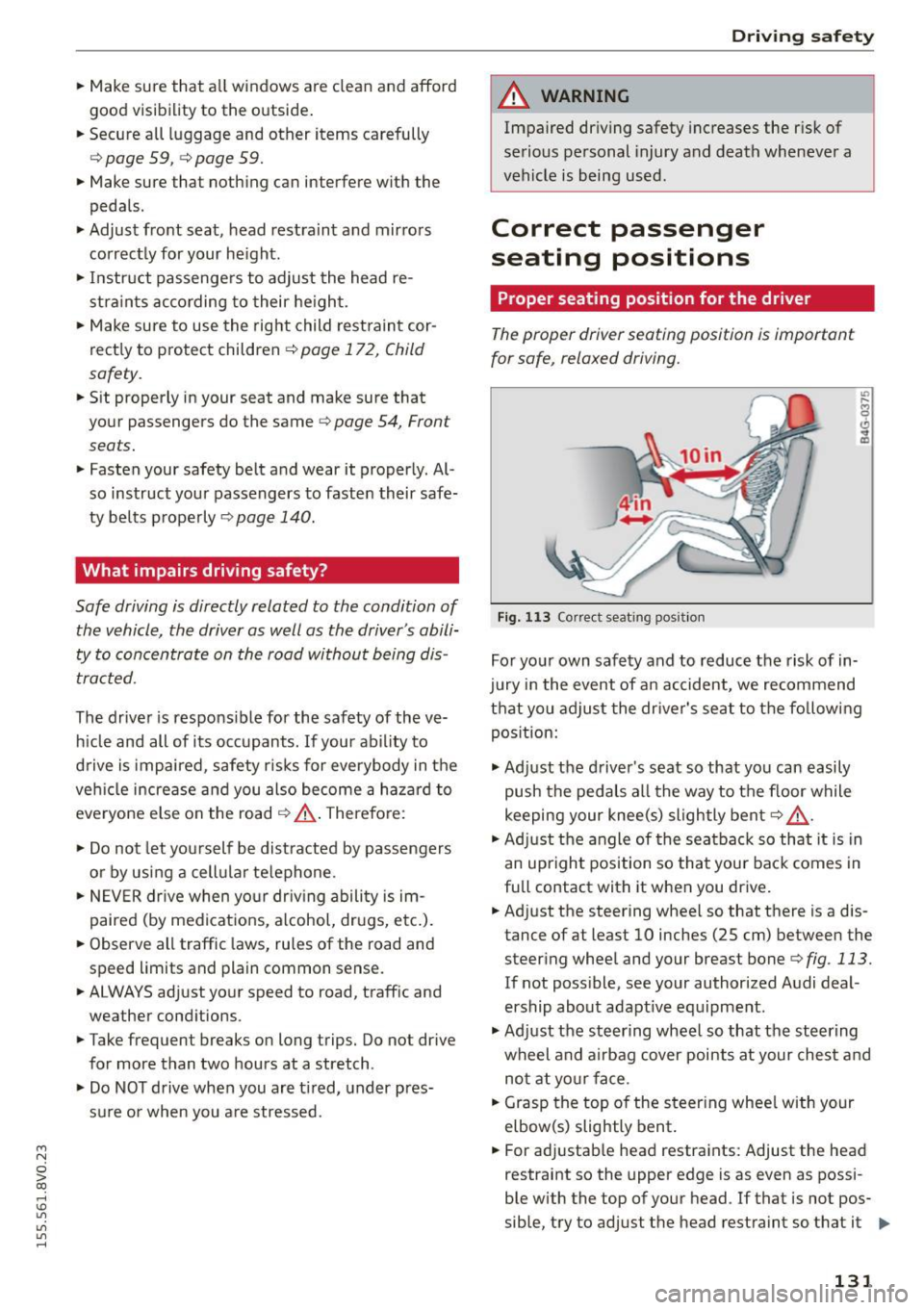
F ig , 1 13 Correct seating pos it ion
For yo ur own safety and to reduce the risk of in
jury in the event of a n accident, we recommend
that you adjust the dr iver's seat to the fo llowing
pos ition:
.,. Ad just the driver's seat so that you can easily
push the pedals all the way to the floor while
keeping your knee(s) slightly bent
r=> &, .
.. Ad just t he angle of the seatbac k so that it is in
an upright position so that your back comes in
full contact with it when you drive .
.. Adjust the steering whee l so that there is a dis
tance of at least 10 inches (25 cm) between the steering wheel and your breast bone
r=> fig. 113.
If not poss ible, see your authorized Audi deal
ership about adapt ive eq uipment.
.,. Ad just the steering wheel so that the steering
wheel and airbag cover points at your che st a nd
no t at yo ur face .
.. Grasp the top of the steer ing whee l with your
elbow(s) slightly bent .
.. For adjustab le head restraints: Adjust the head
restraint so the upper edge is as even as possi-
ble with the top of your head . If that is not pos
sible, try to adj ust the head restraint so that it .,.
131
Page 139 of 282
M N
0 > co ..... \!) 1.1"1
1.1"1
1.1"1
.....
-Please observe information on safe driving
~page 130.
A WARNING
To help prevent poisonous exhaust gas from
being drawn into the vehicle, always keep the
rear lid closed while driving .
- Never transport objects larger than those
fitting completely into the luggage area be
cause the rear lid cannot be fully closed.
- If you absolutely must drive with the rear lid
open, observe the following notes to reduce
the risk of poisoning:
- Close all windows,
- Close the power roof*,
- Open all air outlets in the instrument pan-
el,
- Switch off the air recirculation,
- Set the fresh air fan to the highest speed.
A WARNING
Always make sure that the doors, all windows,
the power roof* and the rear lid are securely
closed and locked to reduce the risk of injury
when the vehicle is not being used.
-After closing the rear lid, always make sure
that it is properly closed and locked.
- Never leave your vehicle unattended espe
cially with the rear lid left open . A child
could crawl into the vehicle through the lug
gage compartment and close the rear lid be
coming trapped and unable to get out. Be
ing trapped in a vehicle can lead to serious
personal injury.
- Never let children play in or around the vehi
cle.
- Never let passengers ride in the luggage
compartment. Vehicle occupants must al
ways be properly restrained in one of the ve hicle's seating positions.
(D Tips
- Air circulation helps to reduce window fog
ging. Stale air escapes to the outside
through vents in the trim panel. Be sure to keep these slots free and open.
Driving safety
-The tire pressure must correspond to the
load. The tire pressure is shown on the tire
pressure label. The tire pressure label is lo
cated on the driver's side B-pillar. The tire
pressure label lists the recommended cold
tire inflation pressures for the vehicle at its
maximum capacity weight and the tires that
were on your vehicle at the time it was man ufactured. For recommended tire pressures
for normal load conditions, please see chap
ter ~
page 224.
' Tie-downs
The luggage compartment is equipped with four
tie-downs to secure luggage and other items.
Use the tie-downs to secure your cargo properly
~page 136, Loading the luggage compartment.
In a collision, the laws of physics mean that even
smaller items that are loose in the vehicle will
become heavy missiles that can cause serious in
jury. Items in the vehicle possess energy which
vary with vehicle speed and the weight of the
item. Vehicle speed is the most significant factor.
For example, in a frontal collision at a speed of
30 mph (48 km/h) , the forces acting on a 10-lb
(4.5 kg) object are about 20 times the normal
weight of the item. This means that the weight
of the item would suddenly be about
200 lbs. (90 kg). You can imagine the injuries
that a 200 lbs. (90 kg) item flying freely through
the passenger compartment could cause in a col
lision like this.
A WARNING
-Weak, damaged or improper straps used to
secure items to tie-downs can fail during hard
braking or in a collision and cause serious per
sonal injury .
- Always use suitable mounting straps and
properly secure items to the tie-downs in
the luggage compartment to help prevent
items from shifting or flying forward as dan
gerous missiles.
- When the rear seat backrest is folded down,
always use suitable mounting straps and
properly secure items to the tie-downs in
137
Page 150 of 282
Airbag system
Airbag system
Important information
Importance of wearing safety belts and
sitting properly
Airbags are only supplemental restraints . For
airbags to do their job, occupants must always
properly wear their safety belts and be in a prop er seating position.
For your safety and the safety of your passen
gers, befo re driving off, always:
"' Adjust the driver's seat and steering wheel
properly
Q page 131,
"'Adjust the front passenger's seat properly
Qpage 54,
"'Wear safety be lts properly C? page 142,
"'Always properly use the proper child restraint
to protect children
Qpage 172.
In a coll is ion, airbags must inflate within the
blink of an eye and with considerable force. The
supp lemental airbags can cause injuries if the
driver or the front seat passenger is not seated
properly . Therefore in order to he lp the airbag to
do its job, it is important, both as a driver and as
a passenger to sit properly at all times.
By keeping room between your body and the
steering whee l and the front of the passenger
compartment, the airbag can inflate fully and
completely and provide supplemental protection
in certain frontal collisions
c> page 131, Correct
passenger seating positions.
Fo r details on the
operation of the seat adjustment controls
c>page54.
It's especially important that children are proper
ly restrained
Qpage 172.
There is a lot that the driver and the passengers
can and must do to help the individual safety fea
tures installed in your Audi work together as a
system .
Proper seat ing position is important so that the
front airbag on the driver side can do its job. If
you have a phys ical impairment or condition that
prevents you from sitt ing properly on the dr iver
seat with the safety be lt properly fastened and
148
reaching the pedals, or if you have concerns with
regard to the function or operation of the Ad
vanced Airbag System, please contact your au
thori zed Audi dea ler or qualified workshop, or
call Audi Customer Relations at 1-800-822-2834
for possible modifications to your vehicle.
When the airbag system dep loys, a gas generator
will fill the airbags, break open the padded cov
ers, and inflate between the steering wheel and
the driver and between the instrument panel and
the front passenger . The air bags w ill deflate im
med iate ly after deployment so that the front oc
cupants can see through the windshield again
without interruption.
All of th is takes place in the blink of an eye, so
fast that many people don't even realize that the
a irbags have deployed. The airbags also inf late
with a grea t deal of force and nothing should be
in their way when they dep loy. Front airbags in
combination with properly worn safety belts s low
down and limit the occupant's forward move
ment . Together they he lp to prevent the driver
and front seat passenger from hitting parts of
the inside of the vehicle while reducing the forces
acting on the occupant during the crash . In this
way they help to reduce the risk of injury to the
head and upper body in the crash . Airbags do not
protect the a rms or the lower parts of the body.
Both front a irbags w ill not inflate in all fronta l
collisions . The triggering of the airbag system de
pends on the veh icle deceleration rate caused by
the collis ion and registered by the electronic con
trol unit. If th is rate is below the reference val ue
programmed into the control unit, the airbags
will not be triggered , even though the car may be
badly damaged as a result of the collision . Vehi
cle damage, repair costs or even the lack of vehi
cle damage is not necessarily an indication of
whether an a irbag should inflate or not.
Since the circumstances will vary considerably between one co llision and another, it is not possi
ble to define a range of vehicle speeds that will
cover every possible kind and angle of impact
that w ill always trigger the airbags . Important
factors include, for example, the nature (hard or
soft) of the object wh ic h the car hits, the angle of
i mpact, vehicle speed, etc. The front airbags will .,.
Page 155 of 282

M N
0 > co ...... \!) 1.1'1
1.1'1
1.1'1
......
_& WARNING
Objects between you and the airbag will in
crease the risk of injury in a crash by interfer
ing with the way the airbag unfolds and/or by
being pushed into you as the airbag inflates.
- Always make sure nothing is in the front air-
bag deployment zone that could be struck
by the airbag when it inflates.
- Objects in the zone of a deploying airbag
can become projectiles when the airbag de
ploys and cause serious personal injury.
- Never hold things in your hands or on your
lap when the vehicle is in use.
- Never place accessories or other objects
(such as cup holders, telephone brackets,
note pads, navigation systems, or things
that are large, heavy, or bulky) on the doors; never attach then to the doors or the wind
shield; never place them over or near or at
tach them to the area marked ,,AIRBAG" on
the steering wheel, instrument panel or the
seat backrests; never place them between
these areas and you or any other person in
the vehicle.
- Never attach objects to the windshield
above the passenger front airbag, such as
accessory GPS navigation units or music
players. Such objects could cause serious in
jury in a collision, especially when the air
bags inflate.
- Never recline the front passenger seat to
transport objects. Items can also move into
the deployment area of the side airbags or
the front airbag during breaking or in a sud den maneuver. Objects near the airbags can
fly dangerously through the passenger com
partment and cause injury, particularly
when the seat is reclined and the airbags in
flate.
_& WARNING
A person on the front passenger seat, espe cially infants and small children, will receive
serious injuries and can even be killed by be
ing too close to the airbag when it inflates.
- Although the Advanced Airbag System in
your vehicle is designed to turn off the front
-
Airbag system
passenger airbag if an infant or a small child
is on the front passenger seat, nobody can
absolutely guarantee that deployment un
der these special conditions is impossible in
all conceivable situations that may happen
during the useful life of your vehicle.
- The Advanced Airbag System can deploy in
accordance with the ,,low risk" option for 3-
and 6-year-old children under the U.S. Fed
eral Standard if a child with electrical capac
itance greater than the combined capaci
tance of a typical one-year old infant re
strained in one of the forward facing or rear
ward-facing child seats with which your ve
hicle was certified is on the front passenger
seat and the other conditions for airbag de
ployment are met.
- Accident statistics have shown that children
are generally safer in the rear seat area than
in the front seating position .
- For their own safety, all children, especially
12 years and younger, should always ride in
the back properly restrained for their age
and size.
Advanced front airbag system
Your vehicle is equipped with a front Advanced
Airbag System in compliance with United States
Federal Motor Vehicle Safety Standard 208 asap
plicable at the time your vehicle was manufac
tured.
The front Advanced Airbag System supplements
the safety belts to provide additional protection
for the driver's and front passenger's heads and
upper bodies in frontal crashes. The airbags in
flate only in frontal impacts when the vehicle de
celeration is high enough.
The front Advanced Airbag System for the front
seat occupants is not a substitute for your safety
belts. Rather, it is part of the overall occupant re
straint system in your vehicle. Always remember
that the airbag system can only help to protect
you, if you are sitting upright, wearing your safe-
ty belt and wearing it properly . This is why you ..,.
153
Page 163 of 282
M N
0 > co ,...., \!) 1.1'1
1.1'1
1.1'1
,....,
The PASSENGER AIR BAG OFF light will show
the status of the front seat passenger's frontal
Advanced Airbag a few seconds after the igni·
tion is switched on and the airbag indicator
light goes off. The PASSENGER AIR BAG OFF
light:
- will stay on if the front passenger seat is not
occupied;
- will stay on if the electrical capacitance meas
ured by the capacitive passenger detection sys
tem for the front passenger seat equals the combined capacitance of an infant up to about
one year of age and one of the rearward-fac ing
or forward-facing child restraints listed in Fed
eral Motor Vehicle Safety Standard 208 wit h
wh ich the Advanced Airbag System in your vehi
cle was certified; For a listing of the child re
stra ints that were used to certify your vehicle's
compliance with the U.S. Safety Standard
¢page 174.
-will go out if the front passenger seat is occu
pied by an adult as registered by the capacitive
passenger detection system.
-The PASSENGER AIR BAG OFF light must come
on and stay on if the ignition is on and ...
- a car bed has been installed on the front pas
senger seat, or
- a rearward-facing chi ld restraint has been in
stalled on the front passenger seat, or
- a forward-facing child restraint has been insta l
led on the front passenger seat,
- and if the electr ical capacitance regis tered on
the front passenger seat is equa l to or less than
the combined capacitance of a typical 1 year
o ld infant and one of the rearward -facing or
forward-facing child restraints listed in Federal
Motor Vehicle Safety Standard 208 with which
the Advanced Airbag System in your vehicle was certified .
If the front passenger seat is not occupied, the
front airbag will not deploy, and the
PASSENGER
AIR BAG OFF
light will stay on. Never install a
rearward -facing child restraint on the front pas ·
senger seat , the safest place for a child in any
kind of child restra int is at one of the seating po
sitions on the rear seat ¢
page 149, Child re-
Airbag system
straints on the front seat -some important
things to know
and ¢ page 172 , Child safety.
If the PASSENGER AIR BAG light comes
on ...
If the PASSENGER AIR BAG OFF light comes on
when one of the conditions listed above is met,
be sure to check the light regularly to make cer
ta in that the
PASSENGER AIR BAG OFF li ght
stays on continuously whenever the ignition is
on . If the
PASSENGER AIR BAG OFF light does
not appea r on and does not stay on all the time,
stop as soon as it is safe to do so and
- reactivate the system by turning the ign ition
off
for more than 4 seconds and then turning it on
aga in;
- remove and reinstall the child restraint. Make
sure that the child restraint is properly installed
and that the safety belt for the front passenger
seat has been correctly routed through the
child restraint as described in the chi ld restraint
manufacturer's instru ction s;
- make sure that the convertible locking retractor
on the s,;1fety belt fo r the front passenger seat
has been activated and that the sa fe ty belt has
been pu lled tight.
- make sure that no electrical device (such as a
laptop, CD player, electronic games device,
power inverter or seat heater fo r child seats) is
placed or used on the front passenger seat if
the device is connected to the 12-volt socket or
the ci garette lighter socket;
- make sure that no seat heater has been retrofit
ted or otherwise added to the front passenger
seat;
- make sure that nothing can interfere with the
safety belt buckles and that they are not ob
structed;
- make sure that there are no wet objects (such as a wet towel) and no water or other liquids on
the front passenger seat cush ion.
If the PASSENGER AIR BAG light still does
not come on ...
If the PASSENGER AIR BAG OFF light still does
not come on and does not stay on continuously
(when the ignition is sw itched on),
111-
161
Page 174 of 282
Child safety
Child safety
Important information
Introduction
The rear seat is generally the safest place in a
collision .
The physical principles of what happens when
your vehicle is in a crash apply also to children
¢ page 141, What happens to occupants not
wearing safety belts? .
But unlike adults and
teenagers, the ir muscles and bones are not fully
developed. In many respects children are at
g reater risk of serious injury in crashes than
adults.
Because children's bod ies are not fully deve loped,
they requ ire restra int systems especially de
signed for their size, weight, and body structure.
Many countr ies and all states of the United
States and provinces of Canada have laws requir
ing the use of approved c hild restraint systems
for infants and small children.
I n a fronta l crash at a speed of 20-35 mph
(30 -56 km/h) the forces acting on a 13 -pound
(6 kg) infant wi ll be more than 20 times the
weight of the child. This means the weight of the child would suddenly be more than 260 pounds
(120 kg). Under these conditions, only an appro
priate child restra int properly used can reduce
the r isk of serious injury . Ch ild restraints, like
adu lt safety be lts, must be used properly to be
effective. Used improperly, they can inc rease the
risk of serious injury in an accident.
Consult the child safety seat manufacturer's in
structions in order to be sure the seat is r ight for
your child's size¢
page 175, Important safety
instructions for using child safety seats .
Please
be sure to read and heed all of the important in
formation and WARNINGS about ch ild safety, Ad
vanced Airbags, and the installation of child re
straints in this chapter.
There is a lot you need to know about the Ad
vanced Airbags in your vehicle and how they work
when infants and children in child restraints are
on the front passenger seat. Because of the large
amount of important information, we cannot re-
172
peat it all here. We urge you to read the detailed
information in this owner's manua l about airbags
and the Advanced Airbag System in your vehicle and the very important information about trans
porting children on the front passenger seat.
Please be sure to heed the WARNINGS -they are
extremely important for your safety and the safe
ty of your passengers, especially infants and
small chi ld ren.
.&_ WARNING
- Accident statistics have shown that children
are generally safer in the rear seat area than
in the front seating position. Always restrain
any child age 12 and under in the rear.
- All vehicle occupants and especially children
m ust be restrained properly whenever riding
in a vehicle. An unrestrained or improperly restrained ch ild could be injured by striking
the inter ior or by be ing ejected from the ve
hicle dur ing a sudden maneuver or impact .
An unrestra ined or improperly restrained
child is a lso at greater risk of injury or death
through contact with an inflating airbag.
- A suitable ch ild restraint properly installed
and used at one of the rear seating posit ions
provides the highest degree of pro tect ion
for infants and small children in most acci
dent sit uations.
.&_ WARNING
Children on the front seat of any car even with
Advanced Airbags can be seriously injured or
even killed when an airbag inflates. A child in
a rearward-facing child safety seat installed
on the front passenger seat will be serious ly
injured and can be killed if the front airbag in
flates.
- The inflating airbag will h it the ch ild safety
seat or infant carr ier with great force and
w ill smash the child safety seat and child
aga inst the backrest, center armrest, or
door.
- Always install rear-fac ing ch ild safety seats
on the rear seat.
- If you must install a rearward fac ing ch ild
safety seat on the front passenger seat in
Page 210 of 282
Checking and F ill in g
sure you are using the correct brake f luid .
The correct type of brake fluid is also indi
cated on the brake fluid reservoir .
- The brake fluid must be new. Heavy use of
the brakes can cause a vapor lock if the
brake fluid is left in the system too long.
This can ser iously affect the effic iency of
the brakes as well as your safety . This
could res ult in an accident.
(D Note
Brake flu id will damage the paint of your vehi
cle .
@ For the sake of the environment
Because of the problem of proper d isposa l of
brake fluid as well as the spec ia l tools re-
quired and the necessary expertise, we rec
ommend tha t you have the b rake fluid
changed by your author ized Audi dealer.
Battery
General information
The battery in yo ur Audi does not need any ma in
tenance under normal operating conditions. Aud i
recommends having the electro lyte level check by
an author ized Audi dealer or author ized Audi
Service Fac ility when the re a re
high outside tem
pe ratu res or when dr iv ing a ll day. The electroly te
leve l sho uld also be checked ea ch t ime the bat
t ery is charged
9 page 210 .
Have the battery checked when you br ing you r ve
hicle in fo r an inspec tio n. It is a good idea to re
p la ce the batte ry if i t is more than 5 ye ars old .
During certai n types of a irbag dep loyments, the
battery is disconnect ed from the vehicle electr i
cal system fo r safety reasons
9 .&. in Repair, care
and disposal of the airbags on page 163.
Disconnecting the battery terminals
Some veh icle functions (such as power windows)
are not ava ilable when the batte ry is disco nnect
ed. These functions must be programmed after
the ba ttery is reconnec ted. To avoid havi ng to do
t his , on ly disconnect the b attery from the veh icle
208
electrica l sys tem when that is necessa ry to pe r
form repairs.
To reprogram the func tion s, proceed as fo llows:
Function Reprogramming
P owe r window one-
9 page 41, Correcting
to uch up/down f unc-power window malfunc-
tion tions
Remote control key o r If the vehicle does not
Conve nience key reac t to the key , it must
be synchronized
9 page 35
Digita l clock 9 page 10
ESC indi cato r light The ind icator lig ht goes
o ut afte r driving a few
meters
Not running the vehicle for long periods of
time
If you do not d rive yo ur vehicle for several days or
weeks, e lectr ica l components are gradua lly re
duced or switched off. Th is red uces energy con
s u mption and maintains the vehicle's ability to
start over a long per iod of t ime ¢
page 128.
Some conven ience functions , such as inter ior
li ght ing or power seats* may not wo rk . These
convenienc e functions w ill be availabl e agai n
o nce you swi tch the ig nition on and sta rt the en
gine.
Winter operation Du ring the winter months , it is common for the
batte ry capaci ty to dec rease as the tempe rat ur es
become lower . This is because more powe r is
needed to start the vehicle and componen ts such
as the he ad lights and the rear window defogger
are used more frequent ly.
Avoid using powe r unnecessar ily, especially in
c ity dr iv ing o r o n short trips . H ave yo ur au thor
iz ed Audi de aler or author ized A udi Se rv ice Facili
ty check the ba ttery capacity before the start of
winter ¢
page 210. A well-charged battery will
not only reduce starting problems in co ld weath
er, but it will a lso last longer .