2015 AUDI S3 SEDAN warning
[x] Cancel search: warningPage 146 of 282
Safety belts
Autom atic safet y belt retractors
Every safety belt is eq uipped w ith an automatic
be lt retractor on the shou lder belt. This feature
locks the belt when the be lt is pulled o ut fast,
during hard brak ing and in an accident . The belt
may also lock when you drive up or down a steep
hill or through a sharp curve. During normal driv
ing the belt lets you move freely.
S afety belt p rete n sioner s
The safety be lts are equipped with a belt preten
sioner that helps to t ighten the safety belt and
remove s lack when the pretensioner is activated
¢ page 146. The funct ion of the pretensioner is
mon itored by a warning light
<=:>page 20.
Converti ble lock ing r etra ctor
Every safety belt except the one on the driver
seat is equipped w ith a convertib le locking retrac
tor that
must be used when the safety belt is
used to attach a child seat. Be sure to read the
important information about this feature
¢page 182 .
.&_ WARNING
Improperly positioned safety belts can cause
serious injury in an accident¢
page 144,
Safety belt posi tion.
- Safety belts offer optimum protection only
when the seatback is upright and belts are
properly positioned on the body.
- Always make sure that the rea r seat back
rest to which t he center rear safety belt* is
attached is securely latched whenever the
rear center safety be lt is being used .
If the
backrest is not securely latched, the passen
ger wi ll move forward with the backrest dur
ing sudden braking, in a sudden maneuver
and especially in a crash.
- Never attach the safety belt to the buck le
for another seat. Attaching the belt to the
wrong buckle will reduce safety be lt effec
t iveness and can cause serious persona l in
jury.
- A passenger who is not properly restrained can be se riously in jured by the safety belt it
self when it moves from the stronger parts
144
of the body into critical areas like the abdo
men.
- Always lock the convertible locking retractor
when you are secur ing a child seat in the ve
hicle
¢page 184.
(D Tips
For information on safety belt pretensioners,
refer to
¢page 146.
Safety belt position
Correct belt position is the key to getting maxi
mum protection from safety belts .
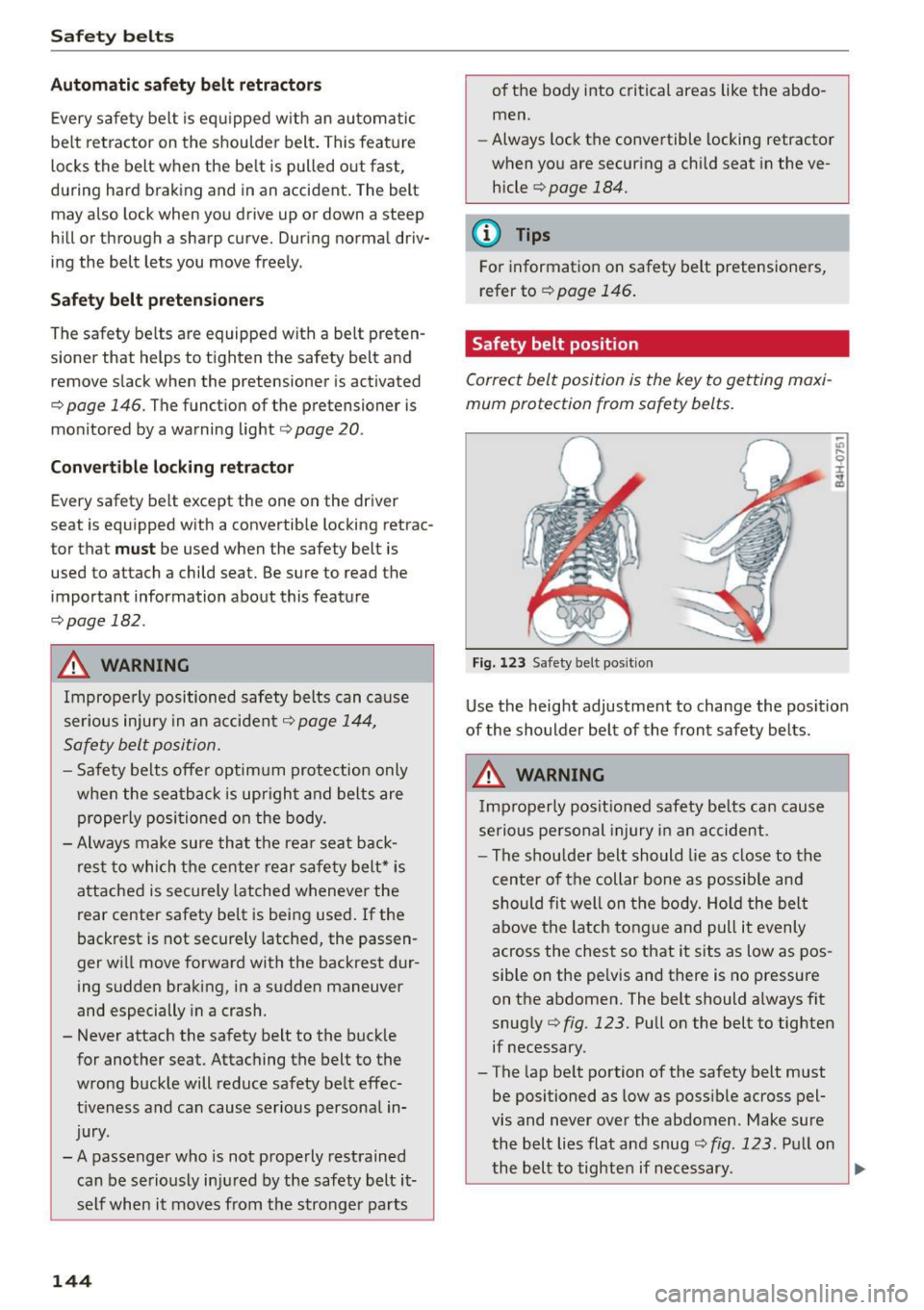
Fig. 123 Safety belt posit ion
Use the height adjustment to change the posit ion
of the shoulder belt of the front safety belts.
.&_ WARNING
I mp roperly posit ioned safety be lts can cause
serio us pe rsonal injury in an accident.
- The shou lder belt should lie as close to the
center of the collar bone as possib le and
should fi t well on the body. Ho ld the bel t
above the latch to ng ue and pull it evenly
across the chest so that it sits as low as pos
sible on the pe lvis and there is no pressure
on the abdomen. The belt should always fit
snug ly¢
fig. 123. Pull on the belt to tighten
if necessary.
- The lap be lt portion of the safety belt must
be positioned as low as poss ible across pel
vis and never over the abdomen. Make sure
the belt lies flat and snug
c::> fig. 123. Pu ll on
the belt to tighten if necessary.
~
Page 147 of 282
....,
N
0 > co
rl I.O
"'
"'
"'
rl
-A loose-fitting safety belt can cause serious
injuries by shifting its position on your body
from the strong bones to more vulnerable,
soft tissue and cause serious injury.
- Always read and heed all WARNINGS and
other important information ¢
page 142.
Pregnant women must also be correctly
restrained
The best way to protect the fetus is to make sure
that expectant mothers always wear safety belts
correctly -throughout the pregnancy .
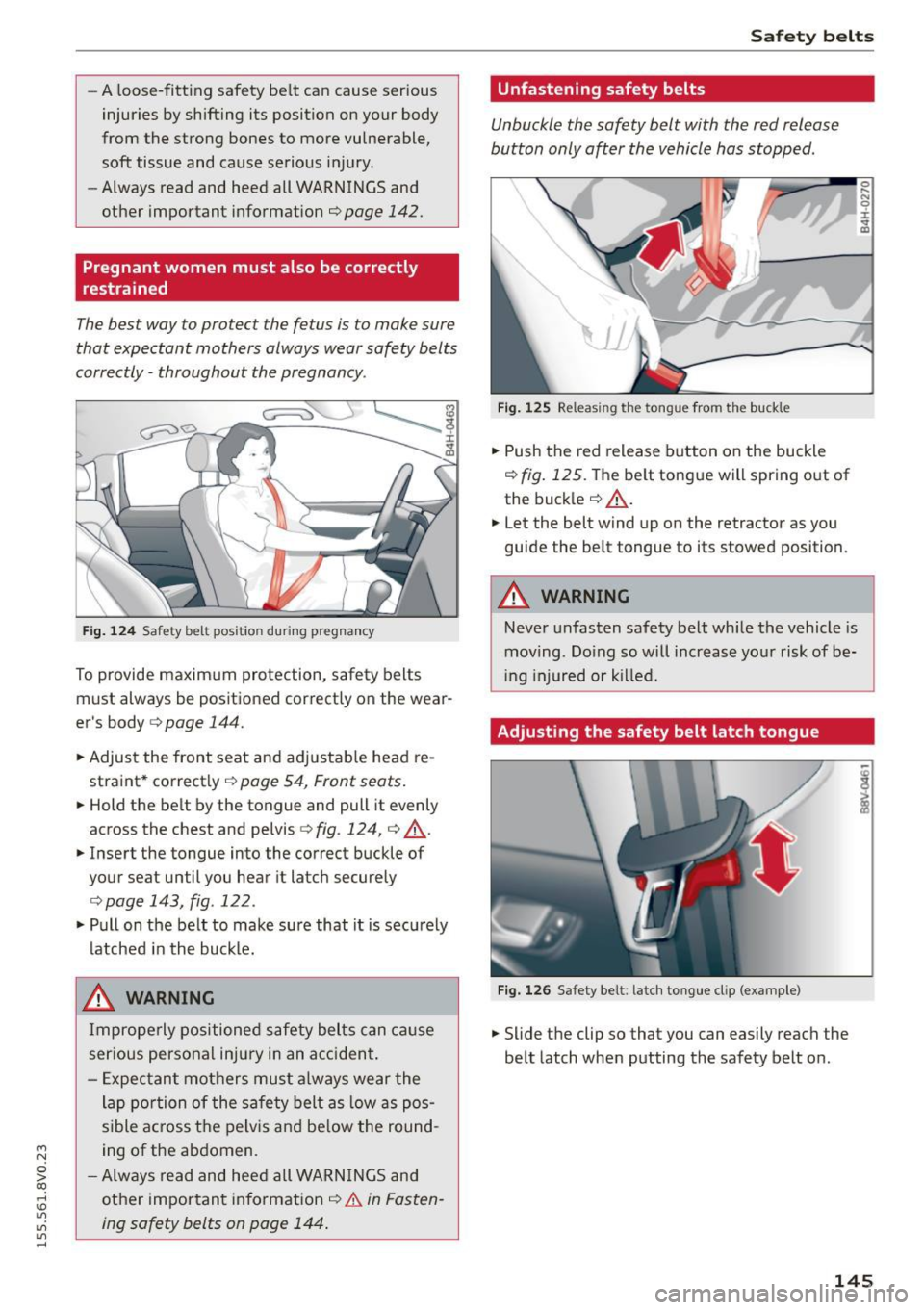
Fig. 124 Safety belt position during pregnancy
To provide maximum protection, safety belts
must always be positioned correctly on the wear
er's body
c:> page 144.
• Adjust the front seat and adjustable head re
straint* correctly¢
page 54, Front seats.
• Hold the belt by the tongue and pull it evenly
across the chest and pelvis ¢
fig. 124, c:> .&_.
• Insert the tongue into the correct buckle of
your seat until you hear it latch securely
¢page 143, fig. 122 .
•Pullon the belt to make sure that it is securely
latched in the buckle.
_& WARNING
Improperly positioned safety belts can cause
serious personal injury in an accident.
- Expectant mothers must always wear the
lap portion of the safety belt as low as pos
sible across t he pelvis and below the round
ing of the abdomen .
- Always read and heed all WARNINGS and
other important information
¢ .&. in Fasten
ing safety belts on page 144.
Safety belts
Unfastening safety belts
Unbuckle the safety belt with the red release
button only a~er the vehicle has stopped .
J-L
Fig. 125 Releasing the tongue from the buckle
• Push the red release button on the buckle
¢
fig. 125. The belt tongue will spring out of
the buckle
c:> .&_ .
• Let the belt wind up on the retractor as you
guide the belt tongue to its stowed position .
_& WARNING
-Never unfasten safety belt while the vehicle is
moving. Doing so will increase your risk of be
ing injured or killed.
Adjusting the safety belt latch tongue
Fig. 126 Safety belt: la tch tongue cl ip (example)
.,.. Slide the clip so that you can easily reach the
belt latch when putting the safety belt on .
0 ..... N 0 :i:
"' CD
145
Page 148 of 282
Safety belts
Adjusting safety belt height
With the aid of the safety belt height adjust
ment, the three point safety belt strap routing
can be fitted to the shoulder area, according to
body size.
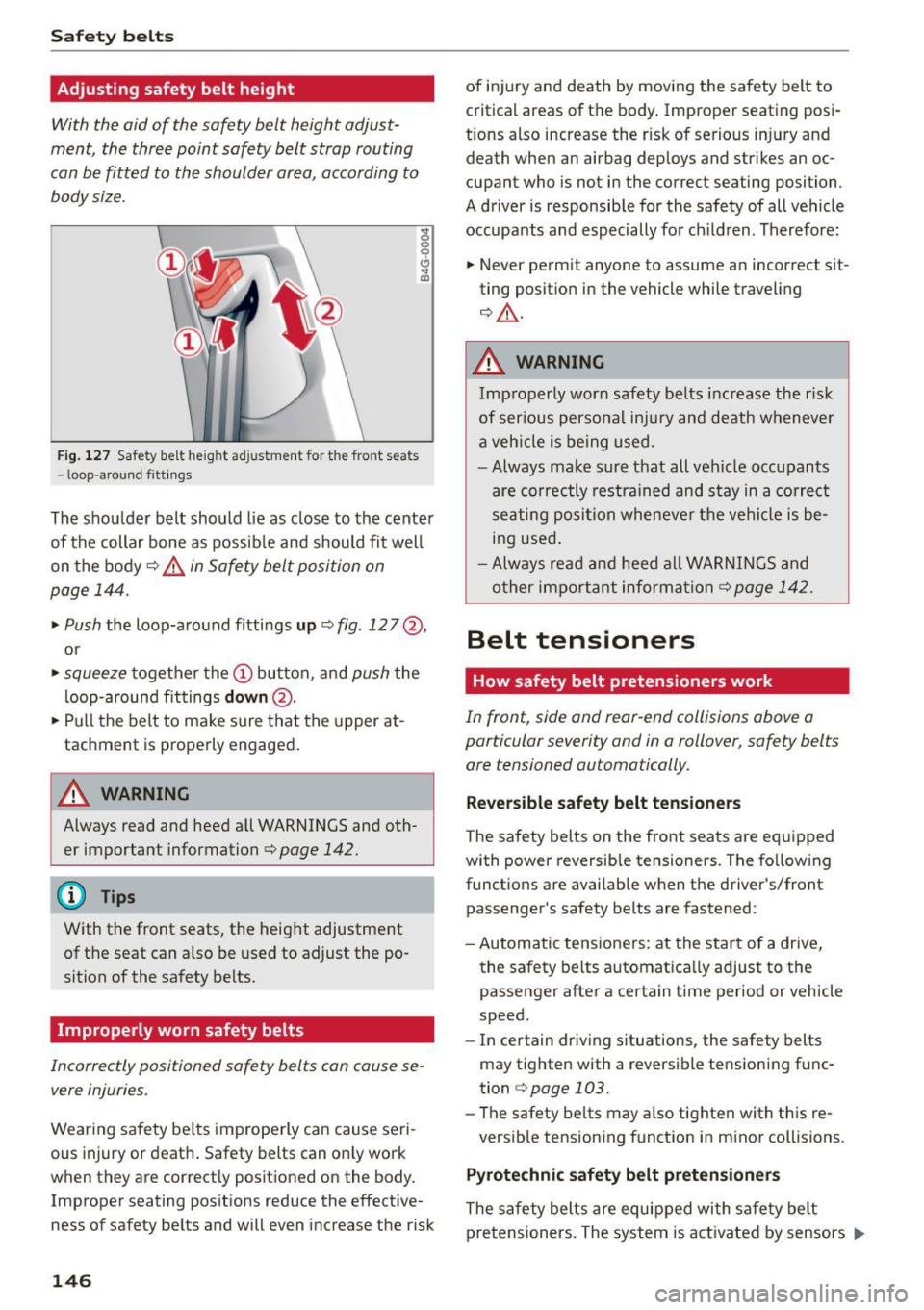
F ig . 127 Safety belt height ad justment for t he front seats
- loop -a round f itt ings
The shou lder belt should lie as close to the center
of the collar bone as possib le and should fit well
on the body¢ .&.
in Safety belt position on
page 144 .
... Push
the loop-around fittings up ¢ fig . 127 @,
or
... squeeze together the (D button, and push the
l oop-around fit tings
down @.
... Pull the belt to make sure t hat the upper at
tachment is properly engaged .
A WARNING
Always read and heed all WARNINGS and oth
er important information
¢ page 142.
(D Tips
With the front seats, the height adjustment
of the seat can a lso be used to adjust the po
sition of the safety belts.
Improperly worn safety belts
Incorrectly positioned safety belts con cause se vere injuries.
Wearing safety be lts imprope rly can cause seri
ous injury or death . Safety belts can on ly work
when they are correctly positioned on the body.
Improper seating positions reduce the effective
ness of safety be lts and will
even i ncrease the risk
146
of injury and death by moving the safety belt to
critical areas of the body . Improper seating posi
tions also increase the risk of serious in jury and
death when an airbag deploys and strikes an oc
cupant who is not in the correct seating position.
A driver is responsible for the safety of all vehicle
occupants and especially for ch ildren . Therefore:
... Never permit anyone to assume an incorrect sit-
ting posit ion in the vehicle while traveling
¢ &_ .
A WARNING
Improperly worn safety belts increase the r isk
of serious personal inju ry and death wheneve r
a veh icle is being used.
- Always make sure that all vehi cle occupants
are correctly restrained and stay in a correct
seating position wheneve r the vehicle is be
ing used .
- Always read and heed a ll WARNINGS and
o ther important informa tion
¢ page 142.
Belt tensioners
How safety belt pretensioners work
In front, side and rear -end collisions above a
particular severity and in a rollover, safety belts are tensioned automatically.
R ev ersib le safety belt t ensione rs
The safety belts on the front seats are equipped
with power reversib le tensioners. The fo llow ing
functions are availab le when the driver's/front
passenger's safety belts are fastened:
- Automatic tensio ners: at the start of a drive,
the safety belts automat ica lly adjust to the
passenger after a certain t ime period or vehicle
speed.
- In certain driving situations, the safety belts
may tighten with a reversible tensioning func
tion
¢page 103.
-The safety belts may a lso tighten with this re-
vers ible tensioning function in minor collisions.
Pyrotechn ic safet y belt pretens ioner s
The safety belts are equipped with safety belt
pretensioners. The system is activated by sensors ..,.
Page 149 of 282
M N
0 > co ,...., \!) 1.1'1
1.1'1
1.1'1
,....,
in front, side and rear-end collisions of great se
verity and in a rollover. This tightens the belt and
takes up belt slack¢.&.
in Service and disposal of
safety bel t pretensioner on page 147.
Taking up
the slack helps to reduce forward occupant movement during a collision.
A WARNING
- It is possible for the pretensioners to deploy
incorrectly .
- The pyrotechnic system can only provide protection for one collision . If the pyrotech
nic pretensioners deploy, the pretensioning
system must be replaced.
(D Tips
The pyrotechnic safety belt pretensioners can
only deploy once .
- The safety belt pretensioners do not deploy
in minor frontal and side collisions, in rear
end collisions, in rollovers and in collisions
involving very little impact force.
-A fine dust is released when the pyrotechnic
safety belt pretensioners deploy. This is nor
mal and is not caused by a fire in the vehi
cle.
- The relevant safety requirements must be
observed when the vehicle or components
of the system are scrapped. A qualified
dealership is familiar with these regulations
and will be pleased to pass on the informa
tion to you.
- Be sure to observe all safety, environmental
and other regulations if the vehicle or indi
vidual parts of the system, particularly the
safety belt or airbag, are to be disposed. We recommend you have your authorized Audi
dealer perform this service for you.
Service and disposal of safety belt preten
sioner
The safety belt pretensioners are parts of the
safety belts on your Audi. Installing, removing,
servicing or repairing of belt pretensioners can
damage the safety belt system and prevent it
from working correctly in a collision.
Safety belts
There are some important things you have to
know to make sure that the effectiveness of the
system will not be impaired and that discarded
components do not cause injury or pollute the
environment.
A WARNING
= -
Improper care, servicing and repair proce
dures can increase the risk of personal injury
and death by preventing a safety belt preten
sioner from activating when needed or acti
vating it unexpectedly:
- The belt pretensioner system can be activat
ed only once. If belt pretensioners have
been activated, the system must be re placed.
- Never repair, adjust, or change any parts of
the safety belt system.
- Safety belt systems including safety belt
pretensioners cannot be repaired. Special
procedures are required for removal, instal
lation and disposal of this system.
- For any work on the safety belt system, we
strongly recommend that you see your au
thorized Audi dealer or qualified technician
who has an Audi approved repair manual,
training and special equipment necessary .
@ For the sake of the environment
Undeployed airbag modules and pretension
ers might be classified as Perchlorate Material
-special handling may apply, see
www.dtsc.ca.gov/hazardouswaste/perchlo
rate. When the vehicle or parts of the re
straint system including airbag modules safe
ty belts with pretensioners are scrapped, all
applicable laws and regulations must be ob
served. Your authorized Audi dealer is familiar
with these requirements and we recommend
that you have your dealer perform this service
for you.
147
Page 151 of 282
M N
0 > co ,...., \!) 1.1'1
1.1'1
1.1'1
,....,
also not inflate in side or rear co llisions, or in roll
overs .
Alwa ys rememb er: Airbag s wi ll deploy on ly once,
and on ly in cer tain kinds of collisions. Your safety
b e lts a re a lways there to offer protection in those
situations in which airbags are not supposed to
deploy, or when they have already deployed; for
examp le, when your vehicle str ikes or is struck by
another vehicle after the first collision.
This is just one of the reasons why an airbag is a
supp lementary restraint and is not a substitute
for a safety belt. The airbag system works most
effectively when used w ith the safety belts.
Therefore, always properly wear your safety belts
c::>page 140.
A WARNING
Sitting too close to the steer ing whee l o r in
strument panel will decrease the effect ive
ness of the airbags and will increase the risk
o f persona l injury in a coll is ion .
- Never sit closer than 10 inches (25 cm) to
the steering wheel or instrument panel.
- If you cannot sit more than 10 inches
(25 cm) from the steer ing whee l, investi
gate whethe r adaptive equipment may be
available to help yo u reach the peda ls and
increase your seating distance from the
steering wheel.
- All veh icle occupants and especially children
must be restrained properly whenever riding
in a vehicle. An unrestrained or improperly
restrained child cou ld be injured by striking
the inte rior or by being ejected from the ve
hicle during a sudden maneuver or impact.
An unrestrained or improperly restrained
child is also at greater risk of injury o r death
thro ugh contact wi th an infla ting airbag.
- If you are unrestrained, lean ing fo rward, sit
t ing s ideways o r ou t of position in any way,
yo ur risk of in jury is much highe r.
- You w ill also receive serio us inju ries and
c ou ld even be killed if you are up against the
airbag or too close to it when it in flates -
even with an Advanced Ai rbag .
-
Airbag syste m
- To reduce the risk of injury when an a irbag
inflates, always wear safety belts properly
c::> page 143, Safety belts.
- Always make certain that ch ildren age 12 or
younger always ride in the rear seat. If chil
dren a re not properly restrained, they may
be severe ly injured or killed when an a irbag
inflates.
- Never let ch ildren ride unrestrained or im
properly rest rained in the vehicle . Ad just the
front seats p roperly .
- Never ride with the backrest reclined.
- Always sit as far as possible from the steer-
ing wheel or the instrument panel
c::> page 131.
- Always sit upright with your back against
the backrest of your seat .
- Never p lace your feet on the instrument
panel or on the seat. Always keep both feet
on the floor in front of the seat to help pre
vent serious injur ies to the legs and hips if
the airbag inflates.
- Never recli ne the front passenger 's seat to
transport objects. Items can also move into
the area of the side airbag or the front air
b ag during bra king or in a sudden maneu
ver . Ob je cts near the airbags can become
p rojectiles and ca use inj ury when an airbag
inflates.
A WARNING
Airbags that have deployed i n a crash must be
replaced.
- Use on ly original equipment airbags ap
proved by Aud i and installed by a trained
technician who has the necessary too ls and
d iagnostic equipment to properly rep lace
any airbag in your vehicle and assure system
effectiveness in a crash.
- Never permit salvaged or recycled airbags to
be installed in you r vehicle.
Child restraints on the front seat - some
important things to know
.,. Be s ure to read the importa nt information and
heed the WARNI NGS for important detai ls
149
Page 153 of 282
M N
0 > co ,...., \!) 1.1'1
1.1'1
1.1'1
,....,
take place at lowe r decelerations as defined in
the electronic contro l unit ¢
page 160, PASSEN
GER AIR BAG OFF light.
Always remember, a chi ld seat or infant carrie r
installed on the front seat may be struck and
knocked out of position by the rapidly inflating
passenger's a irbag in a frontal collision . The air
bag could greatly reduce the effectiveness of the
child restraint and even ser iously injure the ch ild
during inflation .
For this reason, and because the back seat is the
safest place for ch ildren -when properly restrain
ed according to their age and s ize -we strongly
recommend that ch ild ren always s it in the back
seat
¢ page 172, Child safety .
A WARNING
A child in a rearward-facing child seat instal
led on the front passenger seat w ill be seri
ously in jured and can be killed if the front air
bag inflates -even with an Advanced Airbag
System.
- T he inflating a irbag w ill hit the child seat or
infant carrier w ith great force and will
smash the child seat and child against the
backrest, center armrest, door or roof.
-
- Always install rear -facing child seats on the
rear seat.
- If you mus t install a rearward facing child
seat on the front passenger seat beca use of
exceptional circ umstances and the
PASSEN ·
GER AIR BAG OFF
light does not come on
and stay on, immediately install the rear
facing child seat in a rear seating position
and have the a irbag system inspected by
yo ur Audi dealer.
- Forward-fac ing ch ild seats installed on the
front passenger's seat may interfere with
the deployment of the airbag and cause se rious persona l injury to t he ch ild.
A WARNING
If, in exceptional c ircumstances, you mus t in
stall a forward-facing ch ild restraint on the
front passenger's seat :
- Always make sure the forward-fac ing seat
h as been designed and ce rtified by i ts man-
Airbag syste m
ufacturer for use on a front seat with a pas
senger front and s ide a irbag.
- Never put t he fo rward-facing child restraint
up aga inst or very near the instrument pan
el.
- Always move the passenge r seat into its
rearmost pos ition in the seat's fore and aft
ad justment range, as far away from the a ir
bag as possible before installing the for
ward-facing child restraint. The backrest
m ust be adjusted to an upr ight position .
- Make sure that the
PASSENGER AIR BAG
OFF
li ght comes on and stays on all the time
wheneve r the ignit ion is switched on.
A WARNING
= -To reduce the risk of serious inju ry, ma ke su re
that t he
PASSENGER AIR BAG OFF ligh t will
b e d isplayed whenever a ch ild restr aint is in
stalled on the front passenger seat and the
ignition is switched on.
- If the PASSENGER AIR BAG OFF light does
not stay on, pe rform the checks describe d
~ page 160, Monitoring the Advanced Air ·
bag System.
-Take the chi ld restraint off the front passen
ge r seat and install it properly at one of the
rea r seat positions if the
PASSENGER AIR
BAG OFF
light does not stay on.
- Have the airbag system inspected by your
Aud i dealer immediately.
- Always carefu lly follow instr uctions from
child restraint manufacturers when instal
ling child restraints.
A WARNING
If, in except ional circumstances, you m ust in
stall a forward or rearward-fac ing ch ild re
straint on the front passenger's seat:
- Improper installation of ch ild restra ints can
red uce their effectiveness or even prevent
them from providing any pro tect ion.
- An improperly installed ch ild restra int can
interfere with the airbag as it deploys and
serio usly injure or even kill the child -even
with an Advanced A irbag Sys tem.
~
151
Page 154 of 282
Airb ag syst em
-Always carefully follow the manufacturer's
instructions provided with the child seat or
carr ier.
- Always make sure that there is nothing on
the front passenger seat that will cause the
capacit ive passenger detection system in
the seat to signal to the Airbag System that
the seat is occupied by a person when it is
not, or to signa l that it is occupied by some
one who is heav ier than the person actually
sitting on the seat. The presence of addi
tional objects could cause the passenger
front a irbag to be turned on when it should
be off, or could cause the airbag to work in a
way that is different from the way it would have worked without the object on the seat.
Front airbags
Description of front airbags
The airbag system can provide supplemental
protection to properly restrained front seat occu
pants.
F ig. 128 Location of d river ai rbag: in steeri ng w heel
F ig. 129 Location of fro nt passenger's a irbag: in the i nstru
m ent pane l
Your vehicle is equipped w ith an "Advanced Air
bag System" in compliance with United States
152
Federa l Moto r Vehicle Safety Standard
(FMVSS) 208 as applicable at the time your vehi
cle was manufactured. The safety be lts for the
seats have "pretensioners" that help to take slack
out of the belt system. The pretensioners are also
activated by the electronic control unit for the
airbag system.
The front safety belts also have load lim iters to
help reduce the forces applied to the body in a
crash .
The airbag for the driver is in the steering wheel
hub ¢
fig. 128 and the airbag for the front pas
senger is in the instrument panel¢
fig. 129. The
genera l location of the airbags is marked ''AIR
BAG ".
There is a lot you need to know about the a irbags
in your vehicle. We urge you to read the detailed
information about airbags, safety belts and child
safety in this and the other chapte rs that make
up the owner's literature . Please be sure to heed
the WARN INGS - they are extremely important
for your safety and the safety of your passengers,
especially infants and small children .
A WARNING -
Never rely on airbags alone for protection.
- Even when they deploy, airbags provide only
supp lemental p rotection.
- Airbag wor k most effective ly when used
w it h properly worn safety belts.
- Therefore, alw ays wea r your safe ty belts and
ma ke sure that everybody in your vehicle is
properly rest rained.
- Always hold the s teer ing whee l w ith bo th
hands on the outside of the steer ing whee l
r im at the 9:00 o'clock and 3:00 o'clock po
sitions to help reduce the r isk of persona l in
jury if the driver's airbag in flates.
- Never hold the steering wheel at the 12
o'clock position or with your hands any
where inside the steering wheel or on the
steer ing whee l hub. Hold ing the steer ing
wheel the wrong way increases the risk of
severe in jury to the arms, hands , and head if
the dr iver airbag deploys .
ll>
Page 155 of 282

M N
0 > co ...... \!) 1.1'1
1.1'1
1.1'1
......
_& WARNING
Objects between you and the airbag will in
crease the risk of injury in a crash by interfer
ing with the way the airbag unfolds and/or by
being pushed into you as the airbag inflates.
- Always make sure nothing is in the front air-
bag deployment zone that could be struck
by the airbag when it inflates.
- Objects in the zone of a deploying airbag
can become projectiles when the airbag de
ploys and cause serious personal injury.
- Never hold things in your hands or on your
lap when the vehicle is in use.
- Never place accessories or other objects
(such as cup holders, telephone brackets,
note pads, navigation systems, or things
that are large, heavy, or bulky) on the doors; never attach then to the doors or the wind
shield; never place them over or near or at
tach them to the area marked ,,AIRBAG" on
the steering wheel, instrument panel or the
seat backrests; never place them between
these areas and you or any other person in
the vehicle.
- Never attach objects to the windshield
above the passenger front airbag, such as
accessory GPS navigation units or music
players. Such objects could cause serious in
jury in a collision, especially when the air
bags inflate.
- Never recline the front passenger seat to
transport objects. Items can also move into
the deployment area of the side airbags or
the front airbag during breaking or in a sud den maneuver. Objects near the airbags can
fly dangerously through the passenger com
partment and cause injury, particularly
when the seat is reclined and the airbags in
flate.
_& WARNING
A person on the front passenger seat, espe cially infants and small children, will receive
serious injuries and can even be killed by be
ing too close to the airbag when it inflates.
- Although the Advanced Airbag System in
your vehicle is designed to turn off the front
-
Airbag system
passenger airbag if an infant or a small child
is on the front passenger seat, nobody can
absolutely guarantee that deployment un
der these special conditions is impossible in
all conceivable situations that may happen
during the useful life of your vehicle.
- The Advanced Airbag System can deploy in
accordance with the ,,low risk" option for 3-
and 6-year-old children under the U.S. Fed
eral Standard if a child with electrical capac
itance greater than the combined capaci
tance of a typical one-year old infant re
strained in one of the forward facing or rear
ward-facing child seats with which your ve
hicle was certified is on the front passenger
seat and the other conditions for airbag de
ployment are met.
- Accident statistics have shown that children
are generally safer in the rear seat area than
in the front seating position .
- For their own safety, all children, especially
12 years and younger, should always ride in
the back properly restrained for their age
and size.
Advanced front airbag system
Your vehicle is equipped with a front Advanced
Airbag System in compliance with United States
Federal Motor Vehicle Safety Standard 208 asap
plicable at the time your vehicle was manufac
tured.
The front Advanced Airbag System supplements
the safety belts to provide additional protection
for the driver's and front passenger's heads and
upper bodies in frontal crashes. The airbags in
flate only in frontal impacts when the vehicle de
celeration is high enough.
The front Advanced Airbag System for the front
seat occupants is not a substitute for your safety
belts. Rather, it is part of the overall occupant re
straint system in your vehicle. Always remember
that the airbag system can only help to protect
you, if you are sitting upright, wearing your safe-
ty belt and wearing it properly . This is why you ..,.
153