2015 AUDI S3 instrument cluster
[x] Cancel search: instrument clusterPage 92 of 310

90 Audi adaptive cruise control
After each change, the new stored speed ap
pears briefly in the information line
c::> page 88, fig. 80@.
Driving in stop-and-go traffic
Applies to vehicles: with Audi adaptive cruise control
The adaptive cruise control system assists you
in stop-and-go traffic. If an object that is de
tected ahead stops, your vehicle will brake
and stay at a stop, within the limits of the sys
tem.
Starting with adaptive cruise control
1
l
If you veh icle brakes to a stop because an ob
ject is detected ahead, ACC autom. go ap
pears briefly in the instrument cluster display
Your veh icle is in automat ic start mode.
As long as the message ACC autom. go is dis
played and the object detected ahead starts
to move, your vehicle w ill cont inue driving
c::> & .
You can activate ACC autom. go again for a
short time by pulling the lever to posit ion @
r::;, page 90, fig . 82
The start mode ACC autom. go ends when the
brake pedal is pressed .
Criteria for switching off
The adaptive c ruise control switches off for
safety reasons when stationary:
- when the dr iver's door is open,
- when the veh icle is stationary for more than
3 minutes,
- when the dr iver's safety be lt is not fastened .
,&. WARNING
If the message ACC autom . go1l appears,
the vehicle continues driving, even if there
is an obstacle between your vehicle and
the object ahead. This increases the risk of
an accident.
ll This is not available in some co un tri es .
(D Tips
If adaptive cruise contro l is active and your
vehicle does not start driving even though
the message ACC autom. go
1l appears ,
you can start by tapp ing the accelerator
pedal.
- If an obstacle is detected when driving
w ith adaptive cru ise control, the system
w ill request you to begin driving
r::;, page 92 . You vehicle will beg in driv
ing more slowly. This can also happen in
situations where there is no visible ob
stacle.
Interrupting cruise control
Applies to vehicles: wit h Aud i adapt ive c ru ise control
Fig. 82 Operating leve r
Requirement: The adaptive cruise cont ro l is
switched on.
Overriding cruise control
Overriding means exceeding the selected
speed when adaptive cruise control is active,
for example when press ing the accelerator
peda l when pass ing.
.. To accelerate manually, pull the lever to
ward you into position @and hold it there.
The message ACC: override appears. Or
.. press the acce lerator pedal.
.. To resume cruise control, release the lever
or take your foot off the accelerator pedal.
Interrupting cruise control while driving
.. Move the lever into position @. The mes
sage ACC: standby appears. Or
Page 97 of 310

....,
N
0 > co
rl I.O
"'
Warnings
Applies to vehicles: with Audi pre sense fro nt or Audi
adaptive cruise control
Fig . 85 In strum ent cluste r: approac h warnin g
The system recognizes various dangerous sit
uat ions :
- Vehicles with adaptive cruise control: The
distance warning occurs if you drive too
closely to the object ahead for a long period
of time.
If the ob ject ahead brakes strongly,
you would not be able to avo id a coll ision.
T he indicato r light . indicates this.
- The
approach warning occurs when an ob
ject ahead is traveling mo re slowly o r brake s
strongly. When this warning occurs, it may only be possible to avoid a collision by
swerving or braking strongly. The message
Audi pre sense. Distance c::> fig . 85 and a
warning tone will warn you about the dan ger. For vehicles with adaptive cruise con
trol, the. indicator light also turns on.
If you do not react enough or not at all to a
dangerous s ituation that was detected by the
system, pre sense front provides assistance by
applying the brakes .
- If a collision is imminent, the system will
first provide an
acute warning by braking
sharply. You will also be made aware of the
danger by the instrument cluster display
c::> fig. 85. For vehicles with adaptive cruise
control, the. indicator light also turns on .
-If you do not react to the acute warning, pre
sense front can brake with increasing force
within the limits of the system
l)_ This re
duces the vehicle sp eed in th e event of a col-
....,
"' ll Thi s is no t a vailable in some coun tries . rl
Audi pre sense 95
lision . The message Audi pre sense -Input
also app ears .
- At low driving speeds , pre sense front can
begin complete deceleration shortly before
a collision
l) .
-If pre sense front determines that you are
not braking strongly enough when a colli
sion is imminent, it can increase the braking
force.
A WARNING
--- Pre sense front cannot overcome natural
physical laws.
It is a system designed to
assist and it cannot prevent a collision .
The driver must always intervene. The driver is always responsible for braking
at the correct t ime. Do not let the in
creased safety provided tempt you into
taking risks. This could increase your risk
of a collision.
- The system can deploy incorrectly due to
system-specific limits .
- Please note that the sensor does not al
ways detect all objects . This increases
the risk of a collision.
- Pre sense front does not react to people
or animals or objects that are crossing
the vehicle's path or are difficult to de
tect
c::> page 86 , General Information.
- Reflective objects such as guard rails or
the entrance to a tunnel, heavy rain and
ice can affect the function of the radar
sensor and the system's ability to detect
a collision risk .
- Lack of attention can lead to collisions,
other accidents and serious injuries. pre
sense front is an assistance system and
cannot prevent a collision by itself . The
driver must always intervene . The driver
is always responsible for braking at the
right time.
- Always pay attention to traffic, even
when pre sense front is switched on. Al-
ways be ready to intervene and take over
comp lete control of the vehicle whenever .,.
Page 101 of 310

....,
N
0 > co
Switching on and off
Applies to vehicles: with Audi active lane assist
•
Fig. 86 Turn signal lever: butto n fo r act ive la n e ass ist
Fig. 87 Windsh ield: ca mera w indow for act ive lane as
s is t
.. Press the q fig. 86 button to switch the sys
tem on and off. The . or. indicator light
in the instr ument cluster turns on or off.
Indicator lights
• Ready:
The indicator light turns on when
the system is ready for use. The system can
now be operated .
• Not ready: The indicator light turns on if
the system is switched on but is inoperable.
This may be due to the following reasons:
- There is no lane boundary line.
- The relevant lane marker lines are not de-
tected (for example, markings in a construc
tion zone or because they are obstructed by
snow, dirt, water or light ing) .
- The vehicle speed is below the activation
speed of approximately 40 mph (65 km/h)
(the speed may vary depending on your
country) .
- The lane is narrower than 8
ft (2 .5 m) or
wider than 18
ft (5.5 m).
rl 1.0 -The curve is too narrow.
"' ....,
"' rl
Audi active lane assist 99
-The driver's hands are not on the steering
wheel.
a) Tips
- Make sure the camera's field of view
¢ fig. 87 is not obstructed by stickers or
anything else. For information on clean
ing, refer to
¢ page 205.
- Market-specific: In certain countries: If
the system is switched on, it wi ll remain
operab le each time the ignition is switch
ed on.
lane assist display in the instrument
cluster
Applies to vehicles: with Audi active lane assist
Fig. 88 Instrumen t cluster: monoc hrome d ispl ay
Fig. 89 Instrume nt clust er: mult icolor display
The lane assist display can be called up using
the buttons in the
multifunction steering
wheel ¢
page 28.
Monochrome display
Refer to q fig. 88
Page 107 of 310

M N
0 > co ,...., \!) 1.1'1
M 1.1'1 ,....,
@ Tips
-Side assist is not active wh ile you are
making the adjustment.
- Your settings are automati cally stored
and ass igned to the remote control key
being used.
Driver messages
App lies to vehicles: with Audi side assist
If t h e side assist switc hes off automatically, a
message appea rs in the instrument cluster
d is p lay.
@j Audi side assist: currently unavailable
No sensor vision
The radar sensors' vision is affected . Do not
cover the area in front of the senso rs with bike
wheels, s tickers, dirt or other obj ects . Clean
the area in front of the senso rs, if necessa ry
~p age 103, fig. 93.
@j Audi side assist: currently unavailable
Side assist can not be switched o n tempo rar ily
beca use there is a mal func tion (for exam ple,
the battery charge leve l may be too low) .
@j Audi side assist: System fault!
The system cannot guara ntee that it w ill de
tect ve hicles correctly and it is switched
off.
The senso rs have been displaced o r are faulty.
H ave the sys tem check ed by a n authorized
Aud i dea le r or autho rized Aud i S ervic e Facility
soon.
Audi side assist 105
•
Page 109 of 310

....,
N
0 > co
rl I.O
"' ....,
"' rl
Selecting the driving mode
Applies to vehicles: with Audi drive select
You can choose between comfort, auto, dy
namic and individual* .
Fig. 94 Center conso le : drive select button
Fig. 95 MMI: dr ive se lect
.. To set the mode, press the ~:/:a button
N
-N 0 ::> a, Q)
Q fig . 94 repeatedly until the desired mode
is d isplayed in the instrument cluster . Or
Adjusting the Individual mode Audi drive
select 107
.. Select in the MMI: the !MENU I button> Car
> Systems* contro l button > Comfort , Auto ,
Dynamic
or Individual*.
You can change the driving mode when the ve
hicle is stationary or while driving. If traffic
permits, after changing modes, briefly take
your foot off the acce lerator pedal so that the
recently selected mode is also activated for
the engine .
Comfort -provides a comfort-oriented vehicle
setup and is suited for long drives on high
ways.
Auto -provides an overall comfortable yet dy
namic driving feel and is suited for every day
use.
Dynamic -gives the driver a sporty driving
feel and is suited to a sporty driving style.
Individual* -Qpage 107.
The last chosen mode is retained when the ve
hicle is started aga in .
.&_ WARNING
Pay attention to traffic when operating the
drive select to prevent potential risk of an
accident.
You can adjust the vehicle settings to your personal preferences .
.. Select: I MENU I button >Car > Systems* con
trol button >
Set individual control button.
Once you select the menu, you will automat
ically drive in the
Individual* mode.
After you have closed the settings, you are au
tomatically driving in the
individual* driving
mode .
Systems comfort
engine
and transmission comfortable
Steering comfortable
Cornering light* comfortable
Audi adaptive cruise control* comfortable The
equipment in your vehicle will determine
which settings you can adjust . The following
table gives an overview of the characteristics .
auto dynamic
balanced sporty
ba lan ced sporty
ba lanced sporty
ba lanc ed sporty
Page 111 of 310
M N
0 > co ,...., \!) 1.1"1
M 1.1"1 ,....,
Automatic
transmission S tronic-transmission
Introduction
Applies to vehicles: with S tronic transmiss ion
Your vehicle is equipped with an electronical
l y -controlled DSG transmission called S tronic.
T wo independent clutches transfer the power
between the engine and transmission. It al
lows the vehicle to accelerate without a no
ticeable interruption in traction .
T he transmission upshifts or downshifts auto
matically. The driving style continuously influ
ences the selection of the driving program .
When a
moderate driving style is used, the
transmission selects the most econom ica l
driving mode. The transmission upshifts at a
lower RPM and downshifts at a higher RPM to
improve fuel effic iency .
T he transmission switches to a sporty mode
after a kick-down or when the driver uses a
sporty driving style characterized by quick ac
celerator pedal movements, heavy accelera
tion, frequent changes in speed and traveling
at the maximum speed.
If desired, the driver can also select the gears
manually (tiptronic mode) r=> page 114,
Shifting manually (tiptronic mode) .
Selector lever positions
Applies to vehicles: with S tro nic transmission
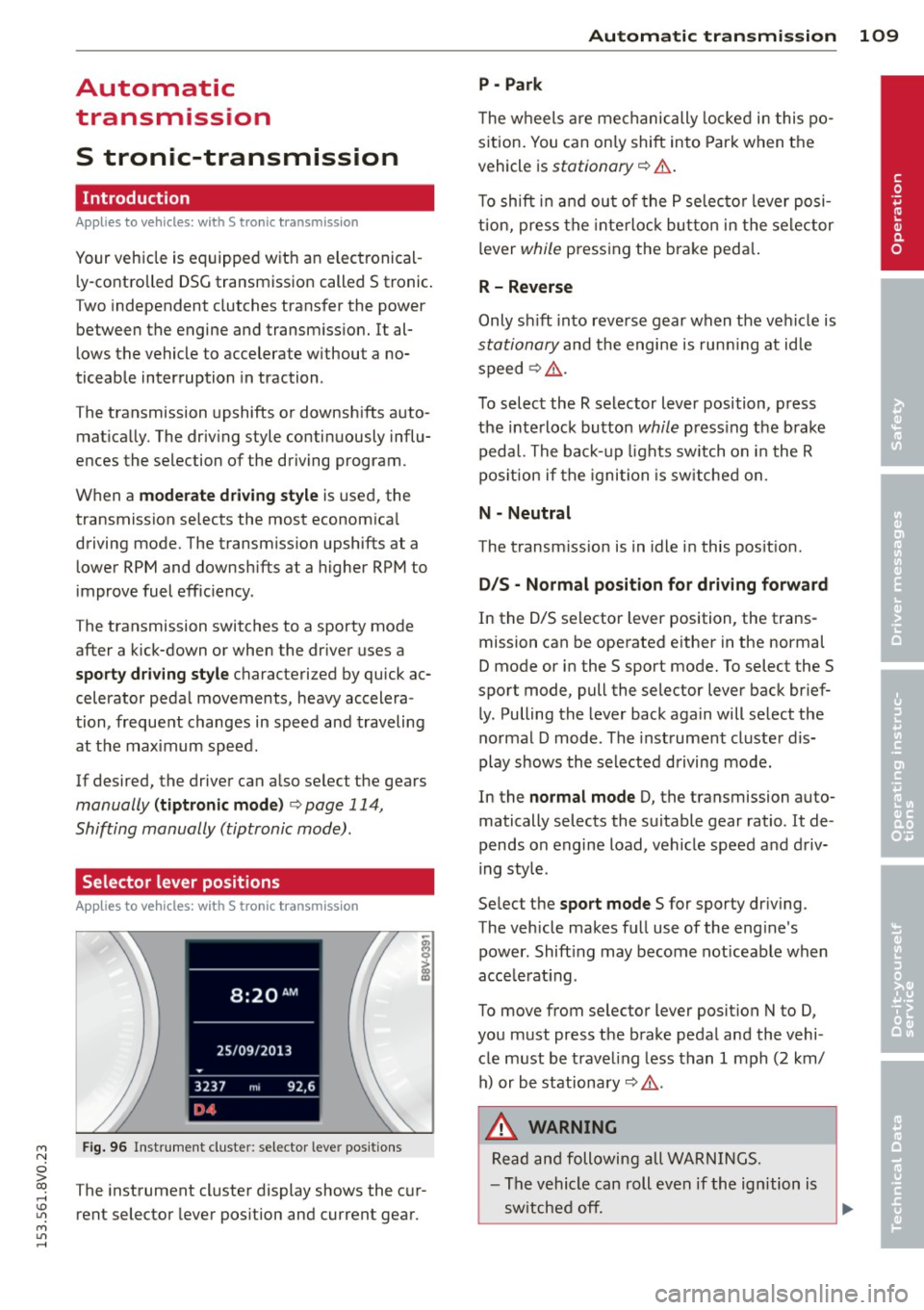
Fig. 96 Instrument cluster: selector leve r positions
The instrument cluster display shows the cur
rent selector lever position and current gear.
Automatic transmission 109
P -Park
The wheels are mechanically locked in this po
sition. You can only shift into Park when the
vehicle is
stationary r=> &..
To shift in and out of the P selector lever posi
tion, press the interlock button in the selector
lever
while pressing the brake peda l.
R- Reverse
Only shift into reverse gear when the vehicle is
stationary and the engine is running at idle
speed
r=> &. .
To select the R selector lever position, press
the interlock button
while press ing the brake
pedal. The back-up lights sw itch on in the R
pos ition if the ignition is switched on .
N -Neutral
The transm iss ion is in idle in this position .
DIS -Normal position for driving forward
In the D/S selector lever position , the trans
mission can be operated either in the normal
D mode or in the S sport mode. To select the S
spor t mode, pull the selector lever back brief
ly. Pulling the lever back again will select the
normal D mode . The instrument cluster dis
play shows the selected driving mode.
In the
normal mode D, the transmission auto
matically selects the suitable gear ratio . It de
pends on engine load, vehicle speed and driv
ing style .
Select the
sport mode S for sporty driving .
The vehicle makes full use of the eng ine's
power. Shift ing may become noticeable when
acce lerat ing.
To move from selector lever position N to D,
you must press the brake pedal and the vehi cle must be traveling less than 1 mph (2 km/
h) or be stationary~ &.-
.&_ WARNING
Read and following all WARNINGS.
- The vehicle can roll even if the ignition is
switched off.
~
•
Page 149 of 310

M N
0 > co ,...., \!) 1.1'1
M 1.1'1 ,....,
Fo r exa mple, the a irbag may depl oy if:
-a small child that is heavier than a typical 1
year-o ld child is on the front passenger seat
(regardless of whether the child is in one of
the chi ld seats listed
page 172), or
- a ch ild who has outgrown child rest raints is
on the front passenger seat.
If the front passenger airbag is turned off, the
P ASS ENGER AIR B AG OFF light comes on in
the instrument cluster and stays on.
If the front passenger airbag deploys, the
Federal Standard requires the airbag to meet
the "low risk" deployment criter ia to reduce
the r isk of injury through interaction with the
airbag. "Low risk" deployment occurs in those
crashes that take place at lower decelerations
as defined in the electronic control unit
r::> page 15 7, PASSENGER AIR BAG OFF light.
Always remember, a chi ld seat or infant carri
er insta lled on the front seat may be struck
and knocked out of position by the rapidly in
flating passenger's airbag in a frontal colli
sion. The airbag could greatly reduce the ef
fectiveness of the child restraint and even se
riously injure the child during inflat ion.
For this reason, and because the back seat is
the safest place for children -when properly
restrained according to their age and size - we
strongly recommend that children always sit in the back seat
r::> page 170, Child Safety .
A WARNING
A child in a rearward-facing child seat in
stalled on the front passenger seat will be
ser iously injured and can be killed if the
front airbag inflates -even with an Ad
vanced Airbag System .
- T he inflating airbag will hit the child seat
or infant carrier with great force and wi ll
smash the child seat and child against
the backrest, center armrest, door or roof.
- Always install rear-facing child seats on
the rear seat.
- If you must install a rearward facing
child seat on the front passenger seat
-
A irbag system 147
because of exceptional circumstances
and the
PA SSENGER AIR BAG OFF light
does not come on and stay on, immed i
ately install the rear-fac ing child seat in a
rear seat ing pos ition and have the airbag
system inspected by your A udi dealer.
- Forward-facing child seats installed on the front passenger's seat may interfere
with the dep loyment of the a irbag and
cause serious persona l injury to the
child.
A WARNING
If, in except iona l circumstances, you must
install a forward -facing child restraint on
the front passenger's seat:
- Always ma ke s ure the forward-facing
seat has been designed and certified by its manufacturer for use on a front seat
with a passenger front and s ide a irbag.
- Never put the forward-facing child re
straint up against or very near the instru
ment panel.
- Always move the passenge r seat into its
rea rmost pos ition in the seat's fore and
aft ad justment range, as far away from
the airbag as possible before installing
the forward-fac ing ch ild restra int. The
backrest must be adjusted to an upright
position.
- Make sure that the
PASSENGER AIR BAG
OFF
l ight comes on and stays on all the
time wheneve r the ig nit ion is switched
on.
A WARNING
To reduce the ri sk of ser ious injury, ma ke
sure that the
PASSENGER AIR BAG OFF
light comes on and stays on whenever a
chi ld restraint is installed on the front pas
senger seat and the ignition is switched
on.
- If the
PA SSENGER AIR BAG OFF light
does not stay on, perform the checks de
scribed¢
page 156, Monitoring the Ad-
vanced Airbag System.
~
•
•
•
Page 154 of 310

152 Airbag sys te m
cause the capacitive passenger detection
system in the seat to s ignal to the A irbag
System that the seat is occupied by a person when it is not, or to signal that it
is occupied by someone who is heavier
than the person actually s itting on the
seat. The presence of additional objects
cou ld cause the passenger front airbag
to be t urned on when it sho uld be off, or
cou ld cause the airbag to work in a way
that is different from the way it wou ld
have worked without the object on the
seat.
- Make sure that the
PA SSENGER AIR BAG
OFF
light comes on and stays on all the
t ime whenever the ignition is switched
on.
Advanced Airbag System components
The front passenger seat in your vehicle has a
lot of very important parts of the Advanced
A irbag System in it . These parts include the
capacitive passenger de tect ion system, wir
ing, b ra ck ets, and more. The cont ro l unit
monitors the system on the front passenger
seat when the ign ition is switched on and
turns the airbag indicato r light on when a
malfunction in the one of the system compo
nents is detected¢
page 157 . Because the
fro nt passenger seat contains important parts
of the Advanced Airbag System, you must
take care to prevent it from being damaged .
Damage to the seat may prevent the Ad
vanced A irbag System for the front passenger
se at from doing i ts job in a c rash.
The front Advanced Airbag System
consists of the following:
- Crash sensors in the fro nt of the ve hicle that
m easure ve hicle accelera tion/de celera tion
to provide info rmation to the Advanced Air
bag System abo ut the seve rity of the crash.
- An electronic cont ro l u nit, with integrated
c rash sensors for front and side impacts.
The cont ro l unit "decides" whether to fire
the front airbags based on the information received from the crash sensors. The contro l unit also "decides" whether the sa
fety belt
pretensioners sho uld be activated.
- An Advanced A irbag w ith gas generato r for
the driver inside the steering wheel h ub.
- An Advance d Airbag w ith g as generato r in
side the inst rument panel for the front pas
senger.
- A capacit ive passenger detection system un
de rneath the front passenger seat cover .
This system meas ures the electrical capac i
tance of the person in the seat. The informa
tion registered is sent cont inuo usly to the
electronic control un it to regu late deploy
ment of the front Advanced A irbag on the
passe nger side .
- An airbag monitor ing system and indicator
light in the instrument cluster¢
page 156 .
-A sensor in each front seat registers the dis
tance betwee n the respective seat and the
steer ing whee l o r inst rument panel. The in
formation registered is sent cont inuous ly to
t he ele ct ron ic contro l unit to regula te de
p loyment of the front Adva nced A irb ags .
- The
PASSENGER AIR BAG OFF light comes
on and stays on in the center of t he instr u
ment p anel ¢
page 217 and t ells yo u when
the fron t Advanced Airbag on the passenge r
side has been turned off.
- A sensor in the safety be lt latch for the driv
er and for the front seat passenger that
senses whether t hat safety belt is latched or
not and transmits this information to the
electronic control un it.
A WARNING
Damage to the front passenger seat can
prevent the front airbag from wor king
p roperly.
- Improper repair or d isassembly of the
front passenge r and dr iver sea t will pre
vent the Advanced Airbag System from
functioning p roperly.
- Repairs to the front passenge r seat must
be pe rformed by qualified and p roperly
trained workshop personnel.
- Never remov e the front passenger o r
d river seat from the vehicle.
-