2015 AUDI RS5 COUPE fuel
[x] Cancel search: fuelPage 186 of 254

Fuel and Refu elin g
CJ) Note
-Methanol fuels which do not meet these re
quirements may cause corros ion and dam
age to plastic and rubber components in the
fuel system.
- Do not use fuels that fail to meet the speci fied criteria in this chapter .
- If you are unable to determine whether or
not a particular fuel blend meets the speci
fications, ask your service station or its fuel supplier.
- Do not use fuel for which the contents can
not be identified.
- Fuel system damage and performance prob lems resulting from the use of fuels differ
ent from those specified are not the respon
s ibility of Audi and are not covered under
the New Vehicle or the Emission Contro l
System Warranties.
- If you experience a loss of fuel economy or
driveability and performance problems due
to the use of one of these fuel b lends, we
recommend that you sw itch to unb lended
fuel.
Gasoline additives
A major concern among many auto manufactur
ers is carbon deposit build-up caused by the type
of gasoline you use .
A lthough gasoline grades differ from one manu
facturer to another, they have certain things in
common. All gasoline grades contain substances
that can cause deposits to collect on vita l engine
parts, such as fuel injectors and intake valves. Al
though most gasoline brands include additives to
keep eng ine and fuel systems clean, they are not
equally effect ive .
Audi recommends using TOP TIER Detergent Gas
oline . For more information on TOP TIER Deter
gent Gasoline, please go to the official webs ite
(www .toptiergas .com).
After an extended period of using inadequate
fuels, built-up carbon deposits can rob your en
g ine of peak performance .
184
(D Note
Damage or malfunction due to poor fuel qual
ity is not covered by the Audi New Vehicle
Limited Warranty.
Refueling
Fuel filler neck
The fuel filler neck is located on the right rear
side panel behind the fuel filler flap .
If the power lock ing system should fail, you can
still open the flap manually - for detailed instruc
tions see
9 page 186.
You can find the fuel tank capacity of your vehicle
in 9 page234.
The label on the inside of the fuel filler flap tells
you the correct fuel for your vehicle . For more in
format ion about fuel specifications, see
9 page 183.
Your vehicle fuel tank has an on-board refuelling
vapor recovery system. This feature helps to pre
vent fuel vapors from escap ing from the tank and
po lluting the environment while you refuel your
vehicle. In order to fi ll the tank properly while
protecting the environment , p lease follow this
r efueling procedure carefully .
_& WARNING
Under normal operating conditions, never car
ry additional fuel containers in your car . Gas
can isters and other containers used to trans
port fuel can be dangerous . Such containers,
full or empty, may leak and could cause a fire in a co llision .
If you must transport fuel to
use for your lawn mower, snow blower, etc .,
be ve ry careful and always observe local and
state laws regarding the use, transportation
and storage of such fue l conta iners . Make cer
tain the container meets industry standa rds
(ANSI/ASTM F8S2 - 86).
@ Note
Neve r drive your veh icle until the fuel tank is
complete ly empty. The ir regular supply of
f u el can cause misfiring. Gasoline could enter ..,.
Page 187 of 254

"' N
0:: loo
rl I.O
"' N
"' rl
the exhaust system and damage the catalytic
converter.
Refuelling
Fig . 155 Rig ht re ar v ehicl e sid e: Op enin g the fuel fille r flap
Fig. 156 Fuel f ill er fla p with atta ched fuel cap
When activating the central locking, the fuel fi ll
er flap is automatically un locked or locked . Re
fuel the veh icle with the ignition turned
off.
Taking the fuel cap off
~T urnoff the ignition.
~ Press the left side of the fue l filler flap to open
it
q fig. 155 -arrow -.
~ Unscrew fuel cap count er-clockw ise and hang it
on the fuel filler flap~
fig. 156.
Refuelling procedure
~ Insert the fuel nozzle from the gasol ine pump
into the fuel filler neck as far as it will go.
~ Select a medium refuelling rate so that the
nozzle switches off automat ica lly when the
tank is full.
Putting the fuel cap back on
~ After filling your tank, tw ist the f uel cap clock
wise as far as it wi ll go.
~ Close the fuel filler flap.
Fuel and Refueling
To avoid fuel spilling or evaporating from the fuel
tank always close fue l cap proper ly and com
pletely .
A WARNING
--
Improper refueling or handling of fuel can
cause fire, explosion and severe burns.
- Fuel is highly flammable and can cause se
vere burns and other injuries.
- Failure to shut the engine off while refuel
ing and/or to insert the pump noz zle fully
into the fue l filler neck could cause fuel to
spray out of filler neck or to overflow . Fuel
spray and overflowing fuel can cause a fire.
- Never use a cellular telephone while refuel
ing. The electromagnetic radiation can
cause sparks that can ignite fuel vapors and
cause a fire .
- Never get back into your vehicle while refu
eling. If in exceptional circumstances you
must get back in your vehicle whi le refuel
ing, make certain that you close the door
and touch metal to discharge static electric
ity before touching the filler nozzle again.
Static electricity can cause sparks that can ignite fue l vapors re leased during refueling.
- Never smoke or have an open f lame any
where in or near your vehicle when refueling
or filling a portable fue l conta iner .
- For your safety, we strongly recommend
that you do not travel with a portable f uel
container in your vehicle. The container, full
or empty may leak and cou ld cause a fire,
especially in a crash.
- If, under exceptional circumstances, you
must transport a portable fuel container,
ple ase observe the following:
- Never fill a portable fuel container while it
is anywhere in or on the veh icle (for exam
ple, in the luggage compartment, or on
the trunk). Static e lectricity can build up
while filling and can ignite fuel vapors
causing a f ire.
- Always place a portab le fue l container on
the ground before filling .
185
Page 188 of 254

Fuel and Refueling
-Always keep the fi ller nozzle completely
inside the portable container before and
during filling.
- If filling a portable container made of
metal, the filler nozzle must always be in
contact with the container. This will help
prevent static electricity from discharging
and cause a fire .
-Never sp ill fuel inside the vehicle or lug
gage compartment. Fuel vapors are highly
flammab le.
-Always observe local and state/provincia l
laws regarding the use, storage and trans
portat ion of fuel containers.
- Make certain the fuel container meets in
dustry standards (ANSI/ ASTM F852 -86) .
(D Note
If any fuel has spilled onto the car, it should
be removed immediately to prevent damage
to the paint .
@ For the sake of the environment
As soon as the correctly operated nozzle
switches off automatically for the first time,
the tank is full. Do not try to add more fuel
because fuel may spill out . In addition, the
expansion space in the fuel tank will be filled·
causing the fuel to overflow when it becomes
warm and pollute the environment.
(j) Tips
- Running your engine while refuelling may
cause vapors to escape or even cause fuel to
sp il l out of the tank . This wo uld then shut
off the fuel nozzle before the tank is full.
- Do not refuel your veh icle with the ignition
turned on. The fuel gauge may otherwise
not indicate the correct fuel level after refu
elling.
- The fuel filler flap of your vehicle is not
l ocked when you lock the vehicle from the
inside .
186
Unlocking the fuel filler flap by hand
You can open the fuel filler flap by hand if the
power locking system should fail .
Fig. 157 Luggage compartme nt: ope ning the side trim
Fig. 158 Luggage compartment: Emer gency open ing of
fuel fil ler flap
The emergency opening mechanism is located
behind the right side trim panel in the luggage
compartment.
Opening the side trim
.. Insert a tool such as a screwdriver ¢page 216
or the emergency key into the right side of the
upper gap¢
fig. 157.
.. Pry upward to release the trim .
Fuel filler door emergency release
.. Loosen the strap from its bracket and pull on it
¢ fig. 158. You can now open the fuel filler flap
as usual
¢page 185.
Page 190 of 254

Checking and Filling
compartment. Wait until no steam or cool
ant can be seen or heard before carefully
opening the hood.
- Keep children away from the engine com
partment.
- Never spill fluids on hot engine compo
nents. They can cause a fire.
- Never touch the radiator fan. The auxiliary
electric fan is temperature controlled and
can switch on suddenly.
- Never open the coolant reservoir cap when
the engine is still warm . The coolant system
is pressurized and hot coolant could spray
out .
- Protect your face, hands and arm from
steam or hot engine coolant by placing a
thick rag over the cap when you open the coolant reservoir .
- Do not remove the engine cover under any
circumstances . This increases the risk of
burns .
- If work on the fuel system or the electrical
system is necessary :
= Always disconnect the battery.
- Never smoke or work near heaters or open
flames. Fluids in the engine compartment
could start a fire.
- Keep an approved fire extinguisher imme
diately available.
- To avoid electrical shock and personal injury
while the engine is running or being started,
never touch:
- Ignition cables
- Other components of the high voltage
electronic ignition system.
- If you must perform a check or repair with
the engine running:
- First, fully apply the parking brake, move
selector lever of automatic transmission
to "P" (Park) .
- Always use extreme caution to prevent
clothing, jewelry, or long hair from getting
188
caught in the radiator fan, V-belts or other
moving parts, or from contacting hot
parts. Tie back hair before starting, and do
not wear clothing that will hang or droop
into the engine.
- Minimize exposure to emission and chemi
cal hazards
¢ A .
A WARNING
California Proposition 65 Warning:
- Engine exhaust, some of its constituents,
and certain vehicle components contain or
emit chemicals known to the State of Cali
fornia to cause cancer and birth defects and
reproductive harm. In addition, certain flu
ids contained in vehicles and certain prod
ucts of component wear contain or emit
chemicals known to the State of California
to cause cancer and birth defects or other
reproductive harm.
- Battery posts, terminals and related acces
sories contain lead and lead compounds,
chemicals known to the State of California
to cause cancer and reproductive harms.
Wash hands after handling.
([) Note
When adding fluids, always make sure that
they are poured into the proper container or
filler opening, otherwise serious damage to
vehicle systems will occur.
@ For the sake of the environment
To detect leaks in time, inspect the vehicle
floor pan from underneath regularly. If you
see spots from oil or other vehicle fluids, have
your vehicle inspected by an authorized Audi dealer .
Page 192 of 254

Checking and F ill in g
Using the proper engine o il is important for the
functionality and service life of the engine. Your
engine was factory-fi lled w ith a high-quality o il
which can usually be used throughout the ent ire
year.
@) Note
Your L imited New Vehicle Warranty does not
cover damage or malfunctions due to failure
to follow recommended ma intenance and use
requ irements as set forth in the Audi Ow ne r's
Manual and Wa rranty
& Ma intenance booklet .
- Use only a high quality eng ine oil t hat ex-
pressly comp lies w ith the Audi o il quality
standard specified for your vehicle's e ngine .
Using a ny other oil can cause se rious engine
damage.
- Do not mix any lubricants o r othe r addit ives
i nto the engine oil. Doing so can cause en
g ine damage.
(D Tips
If you need to add oil and there is none availa
ble that meets the Audi o il quality standard
y o ur eng ine requires, you m ay add a total of
no more than 0.5 quart/li ter o f a h igh-quali ty
"synthet ic"oil that meets the fo llowing speci
fications .
- V ehicles wi th gasoline engine: AC EA A3 o r
API SM with a viscosity grade of SAE 0W- 30,
SAE SW -30 or SAE SW-40 .
- Fo r more informa tion abo ut engine oi l that
has been approved for your vehicle, please
contact either you r a uthorized Aud i dea ler
or Audi Customer Relations at
1 (800) 822-2834 or visit o ur web site at
www .aud iusa.com or www .aud icanada .ca .
Engine oil consumption
The engine in your vehicle depends on an ade
quate amount of oil to lubricate and cool all of
its moving parts .
In order to provide effective lubrication and cool
i n g of in ternal engine components, all interna l
combustion engines consume a certai n amount
of oil. O il consumption var ies from engine to en
g ine and may change significant ly ove r the life of
190
the engine. Typically, eng ines with a specif ied
break-in period (see
¢ page 177) consume mo re
o il dur ing the b reak -in per iod than they consume
after oil consumption has stabili zed.
U nder normal cond itions , the rate of oi l con
s u mption depends on t he qu ality and viscosity of
the oil, the RPM (revolutions per minute) at
which the engine is operated, the ambient tem
perature and road condit ions. Further factors are
the amount of o il di lution from water condensa
tion or fuel residue and the ox idat ion level of the
o il. As any engine is s ubject to wear as mileage
builds up, t he oil consump tion may inc rease ove r
t ime unt il rep lacement of wo rn component s may
become necessary.
With a ll these va riab les coming into p lay, no
sta ndard ra te of oil consumpt ion can be estab
li shed or spe cified . There i s no altern ative to reg
u la r and freq uent checking o f the oil leve l, see
Note .
If the yellow e ngine oi l leve l wa rning symbo l El
in the instr ument cluster lights up, yo u should
chec k the o il level as soon as possible
¢ page 191 . Top off the oil at your ear liest con
venience ¢page 191.
A WARNING
Before you chec k anything in the eng ine com
partment, always read and heed a ll WARN
INGS¢ .&. in Working in the engine compart
ment on page 187 .
@ Note
Driving with an insufficient oi l level is likely to
cause severe damage to the engine.
(D Tips
- The oil pressu re warning display. is not
an indicator of the oil level. Do not rely on
it . Instead, check the oil level in your en
gine at regular intervals, preferably each
time you refuel, and always before going on a long trip.
- If you have the impression yo ur engine con
sumes excessive amounts of oil, we r ecom-
mend that yo u consult an au tho rized Audi .,.
Page 203 of 254

Wheels
Wheels and Tires
General information
.,.Che ck your tires regularly for
damage (punctures, cuts, cracks
and bulges). Remove foreign ob
jects from the tire tread.
.,. If driving over curbs or similar
obstacles, drive slowly and ap
proach the curb at an angle.
.,.Have faulty tires or rims re
placed immediately.
"'Protec t your tires from oil,
grease and fuel.
.,.Ma rk tires before removing
them so that the same running direction can be maintained if
they are reinstalled .
.,.Lay tires flat when storing and
store them in a cool, dry location
with as little exposure to light as
possible.
(D Note
-Please note that summer and
winter tires are designed for
the conditions that are typical
in those seasons. Audi recom
mends using winter tires dur
ing the winter months. Low
temperatures significantly de crease the elasticity of summ
er tires, which affects traction
Wheels
and braking ability. If summer
tires are used in very cold tem
peratures, cracks can form on
the tread bars, resulting in
permanent tire damage that
can cause loud driving noise
and unbalanced tires.
-Burnished, polished or
chromed rims must not be
used in winter driving condi
tions. The surface of the rims
does not have sufficient corro
sion protection for this and
could be permanently dam
aged by road salt or similar
substances.
Tire designations
Fig. 169 T ir e designations on the sid e-
wall ,..
201
Page 209 of 254

A WARNING
Always adapt the tire pressure
to your driving style and vehicle load.
-Overloading can lead to loss of
vehicle control and increase the risk of an accident. Read
and follow the important
safety precautions in
¢ page 208, Tires and vehicle
load limits.
-The tire must flex more if the tire pressure is too low or if the vehicle speed or load are
too high. This heats the tire up too much. This increases the
risk of an accident because it
can cause the tire to burst and result in loss of vehicle con
trol.
Tire pressure table
Please note that the information
contained in the following table
was correct at the time of print
ing, and the information is sub
ject to change. If there are differ
ences between this information
and the tire pressures specified
on the label on the driver's side B
pillar, always follow the specifica
tion on the B-pillar label
¢ page 206, fig . 171 .
Wheels
-Incorrect tire pressure increas
es tire wear and has a negative
effect on driving and braking behavior, which increases the
risk of an accident.
(D Note
Replace lost valve caps to re
duce the risk of damage to the
tire valves.
@ For the sake of the environment
Tire pressure that is too low in
creases fuel consumption.
(D Tips
Audi recommends using the
tire pressure specified for a nor
mal load¢
page 207 or for a
full load when the vehicle is
partially loaded.
Make sure that the tire designa
tion on your tire matches the des
ignation on the tire pressure label
and the tire pressure table.
The following table lists recom
mended tire pressures in cold
tires according to the load and
the size of the tires installed.
207
Page 210 of 254
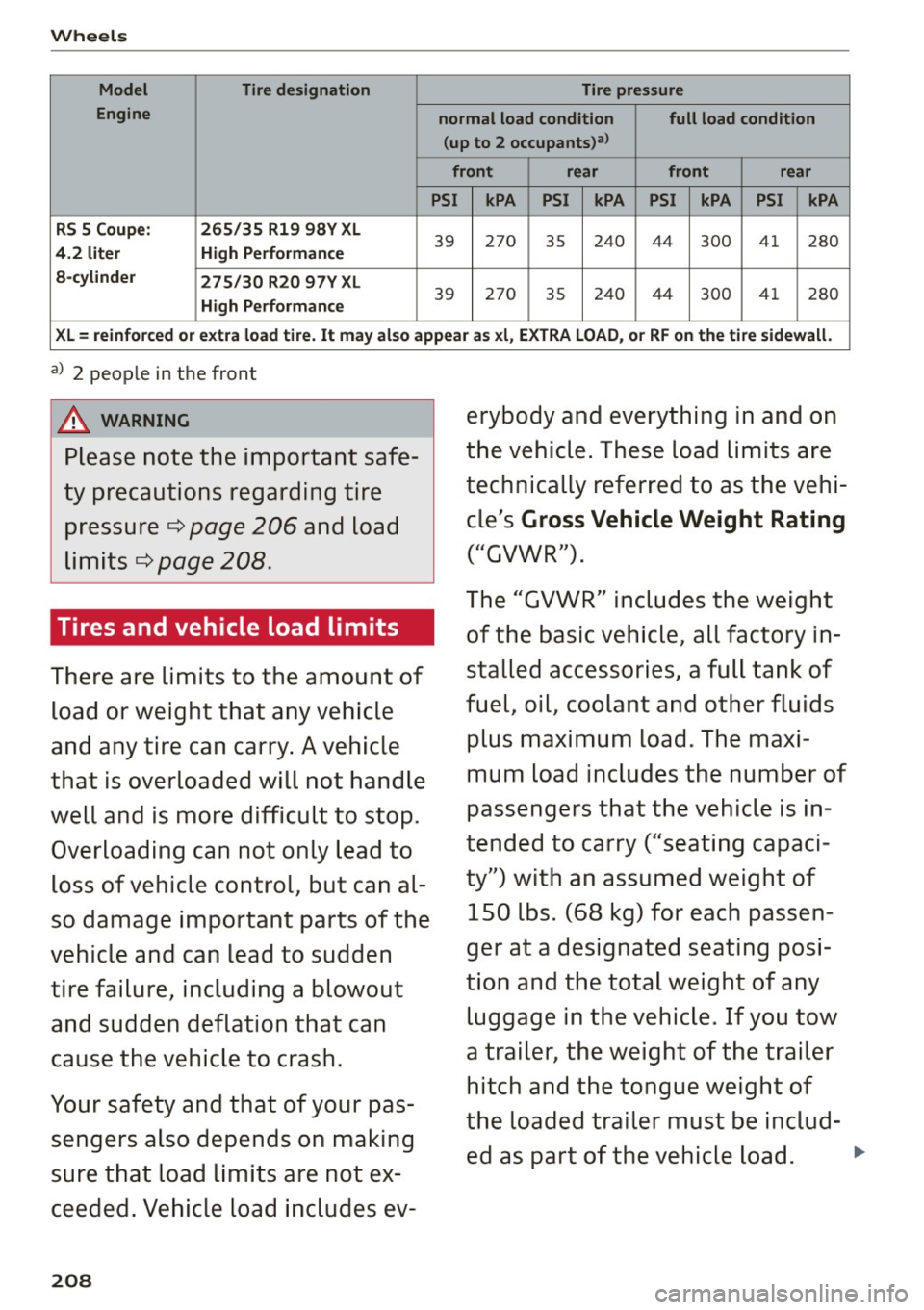
Wheels
Model Tire designation Tire pressure
Engine normal load condition full load condition
(up to 2 occupants)a l
front rear front rear
PSI kPA PSI kPA PSI kPA
PSI kPA
RS 5 Coupe: 265/35 Rl9 98V XL
4.2 liter High Performance
39 27
0
35 2
40 44
300 41
280
8-cylinder
275/30 R20 97V XL
High Performance
39 270 35 240
44 300 41 280
XL= reinforced or extra load tire. It may also appear as xl, EXTRA LOAD, or RF on the tire sidewall.
a) 2 people in the front
_& WARNING
Please note the important safe
ty precautions regarding tire pressure ¢
page 206 and load
limits ¢
page 208.
Tires and vehicle load limits
There are limits to the amount of
load or weight that any vehicle
and any tire can carry. A vehicle
that is overloaded will not handle
well and is more difficult to stop. Overloading can not only lead to
loss of vehicle control, but can al
so damage important parts of the
vehicle and can lead to sudden
tire failure, including a blowout and sudden deflation that can
cause the vehicle to crash .
Your safety and that of your pas sengers also depends on making
sure that load limits are not ex
ceeded. Vehicle load includes ev-
208
erybody and everything in and on
the vehicle. These load limits are
technically referred to as the vehi cle's
Gross Vehicle Weight Rating
("GVWR").
The "GVWR" includes the weight of the basic vehicle , all factory in
stalled accessories, a full tank of
fuel, oil, coolant and other fluids plus maximum load . The maxi
mum load includes the number of
passengers that the vehicle is in
tended to carry ("seating capaci
ty") with an assumed weight of
150 lbs. (68 kg) for each passen
ger at a designated seating posi
tion and the total weight of any luggage in the vehicle . If you tow
a trailer, the weight of the trailer hitch and the tongue weight of
the loaded trailer must be includ- ed as part of the vehicle load. ..,.