2015 AUDI Q5 change time
[x] Cancel search: change timePage 226 of 302

Checking and F ill in g
Audi oil quality standard
Gas oline VW 502 00 or
engi ne
vw 504 00
Die sel
vw 50 7 00
e n g in e
Using the proper engine o il is important for the
functionality and serv ice life of the engine. Your
engine was facto ry-filled with a high-qua lity oil
which can usually be used throughout the entire
year.
(D Note
Your Limited New Vehicle Warranty does not
cover damage or malfunctions due to failure
to follow recommended maintenance and use
requirements as set forth in the Audi Owner's Manual and Warranty
& Ma intenance booklet.
- Use only a high qua lity eng ine oil that ex-
pressly complies w ith the Audi o il quality
standard specified for your vehicle's engine.
Using any other oil can cause serious engine
damage.
- Do not mix any lubricants or other additives
into the engine oil. Doing so can cause en
gine damage.
(D Tips
If you need to add oil and there is none availa
ble that meets the Audi o il quality standard
your eng ine requires, you may add a total of
no more than 0.5 quart/liter of a h igh-quality
"synthe tic"oil that meets the followi ng speci
fications.
- Vehicles with gasoli ne engine: AC EA A3 o r
API SM wi th a viscosity g rade of SAE OW-30,
SA E SW-30 or SAE SW-40 .
- Vehicles wi th d iesel engine: AC EA C3 o r
API CF wi th a v iscosi ty grade of SA E OW-30
or SAE SW-30.
- Fo r more information abo ut eng ine oil t hat
has been approved for your vehicle, please
contact eithe r your a uthorized Audi dea le r
or A udi Customer Relations at
1 (800) 822-2834 or visit our web site at
www.aud iusa.com or www .aud icanada.ca.
224
· Eng ine oil consumption
The engine in your vehicle depends on an ade
quate amount of oil to lubricate and cool all of
its moving parts.
In order to prov ide effective lubrication and coo l
i ng of internal engine components, all internal
combust ion engines consume a certa in amount
of oil. Oil consumpt ion va ries from engine to en
gine and may change sig nificantly over the life of
the engine. Typically, eng ines wi th a specified
break -in period (see¢
page 198) consume mo re
o il during t he b reak-in period than they co nsume
after oil consumption has stabilized .
Un der normal cond itions, the rate o f oi l con
sumption depends on the q uality and viscos ity o f
the oil, the RPM (revolutions per min ute) at
which the engine is operated, the ambient tem perature and road condit ions. Further factors are
the amount of o il dilution from water condensa
tion or fuel residue and the ox idat ion leve l of the
o il. As any engine is subject to wear as mileage
builds up, the oil consumption may inc rease over
time unt il rep lacement of worn compone nts may
become necessary.
With a ll these variab les coming into p lay, no
standard rate of oil consumpt ion can be estab
li shed or spec ified. There is no alte rnative to reg
u lar and frequent checking of the oil leve l, see
Note .
If the yellow engine oil leve l warning symbo l in
the i nstrument cluster
II lights up, you should
c h ec k t he o il level as soon as poss ible
cf> page 2 25. Top off the oil at your ear liest con
venience
r:!> page 225.
A WARNING
Before you check anything in the engine com
partment, always read and heed a ll WARN
INGS¢ .&.
in Working in the engine compart
ment on page 221.
(D Note
Driving wit h an insufficient oi l level is likely to
cause severe damage to the engine.
liJJ,
Page 228 of 302

Checking and F ill in g
- The oi l fi ller cap mus t be pr operly secured to
p re vent oil from being sprayed on the hot
engine and exhaust system when the engine
is running - fire hazard!
- If your skin has come in contact with the en
gine oil, you must subsequently clea nse it
tho roughly .
CD Note
-Check the o il level using the radio or the
MMI*. If the message
Please reduce oil lev
el
appears, contact your authorized Audi
dealer or other qualified wo rkshop to have
excess oil ext racted if necessa ry .
- Audi does not recommend the use of oil
additive s. They may damage the engine
and adversely affect your New Vehicle War
ranty .
@ For the sake of the environment
- Under no circ umstances ca n the o il come in
contact w ith the sewage network o r the soil.
- Observe and fo llow lega l regu lations whe n
dispos ing of empty oil co ntaine rs .
Changing the engine oil
We recommend that have your oil changed by an
authorized Audi dealer or a qualified service sta
tion .
Before you check any thing in the engine compart
ment,
always read and heed all WARNINGS c> .&.
in Working in the engine compartment on
page 221 .
The engine oil must be changed according to the i n terva ls specified in your Warranty
& Mainte
nance booklet . This is ve ry impo rtant because the
lubricat ing propert ies of o il diminish gradua lly
du ring normal ve hicl e use.
Unde r some circumstances the eng ine o il should
be changed more frequent ly. Change oil more of
ten if yo u drive most ly short distances, operate
t he vehicle in d usty areas or unde r predom inan tly
s top-and-go traff ic co ndit io ns, o r have you r vehi
cle where tem peratures rema in be low freezing
for extended periods .
226
Detergent additives in the oil will make fresh oil
l ook dark after the engine has been running fo r a
short time. Th is is norma l and is not a reason to
c h ange the oi l more often than recommended.
Beca use o f the p rob lem of p roper disposal, along
with t he specia l too ls and necessary expertise re
quired, we strongly recommend that yo u have
your oi l changed by an authori zed
Audi dealer or
a q ua lified service station.
If you choose to change your oil yourself , please
note the fo llow ing important info rmat ion:
_& WARNING
To reduce the risk of personal inj ur y if you
must change the eng ine oil in your vehicle
yourself:
- Wear eye protect ion.
- To reduce t he risk of burns from hot eng ine
oil, let the engine coo l d own to the to uch.
-
- W hen removing the o il dra in p lug with your
fingers, stay as far away as possible. Always
keep you r forearm parallel t o the ground to
he lp prevent hot o il from running down your
arm .
- Dra in the oil i nto a container designed for
this purpose , one large enough to hold at
l e ast the tota l amount o f oil in you r engine.
- Engine oil is poisonous. Keep it we ll out of
the reach of ch ildren .
- Continuous contact w it h used eng ine oi l is
ha rmf ul to your skin . Always protect your
skin by washi ng oil off tho roughly wi th soap
a nd wate r.
CD Note
N eve r mix oil additives with you r engine oil.
These add itives can damage your engine and
adverse ly affec t your Aud i Lim ited New Vehi
cle Warranty.
@ For the sake of the environment
-Before changi ng your oil , first make sure
you know wh ere you ca n prope rly dispose of
t h e us ed oil.
- Always disp ose of used eng ine oil properly.
Do not dump it o n garden soi l, wooded
Page 232 of 302

Checking and F ill in g
The brake fluid reservoir is located at the rear
partition of the engine compartment on t he left
side ¢
page 223.
The fl uid level may drop slightly after some time
due to the automatic adjustment of the brake
pads. This is not cause for alarm.
If the b ra ke fluid level fal ls considerably below
the "MIN" mark, the brake warn ing/indicator
light (U.S. models:
1111 , Canadian models: . )
will come on¢
page 18 and ¢ page 28 . Do not
continue to operate the vehicle . The complete
brake system shou ld be thoroughly checked by an
author ized Audi dealer or qualif ied workshop and
the cause corrected. If the brake fluid level is too low, the brake warning/indicator light will illum i
nate. Contact an authorized Aud i dealer
immedi
a tel y.
Changing brake fluid
Have the brake fluid changed by an experienced technician.
Brake flu id abso rbs moisture from the a ir . If the
water content in the brake fluid is too high, cor rosion in the b rake system may result after a pe ri
od of time. The boiling point of the bra ke fluid
will also decrease conside rably and decrease
b ra ki ng per fo rmance .
Therefore, th e brake flu id must be changed
ev ery
tw o years .
Always use new b rake fluid w hich con
forms to Fede ra l Motor Vehicle Standa rd " FMVSS
1 16 DOT 4".
The brake fluid rese rvoir can be difficult to reach,
therefo re, we recommend that yo u have the
b rake fluid changed by your authori zed
Audi
dealer .
Your dealer has the cor rect too ls, the
right brake f luid and the know -how to do t his for
you.
A WARNING
- Brake fluid is po isonous. It must be stored
only in the closed orig inal container out of
the reach of children!
- Brake fai lure can result from old or inappro
pr iate brake fluid . Observe these precau
t ions:
230
- Use only brake fluid that meets SAE spec i
ficat io n
J 1703 and conforms to Federal
Motor Vehicle Sta ndard 116 . Always check
with your aut horized Aud i dea ler to make
su re you are using the correct brake fl uid .
The co rrect type of brake f lu id is also ind i
cated on t he b rake fluid reservoir.
- The brake fl uid must be new. Heavy use of
the b rakes can cause a vapor lock if the
brake fluid is left in t he system too long.
This can se riou sly affec t the efficiency of
the b rakes as well as yo ur sa fety. This
could result in an acc ident .
(D Note
Bra ke fluid will damage the pai nt of you r vehi
cle.
@ For the sake of the environment
B ecause of the prob lem of prope r disposal of
b rake fluid as well as the spe cial tools re
q ui red and the necessary ex pert ise, we rec
ommend that you have the brake f lu id
cha nged by yo ur autho rize d Aud i dea le r.
Battery
General information
U nder normal operat ing conditions , the battery
i n you r Aud i does not need any maintenance.
With
high outside tem pera tures or long d aily
drives we recommend that you have the e lectro
l yte level checked by an a utho rized Audi dea le r or
qualified workshop. The electrolyte leve l should
a lso be checked each time the battery is charged
¢ page 232.
Have the battery checked when yo u take your ve
hicle in for service. You a re well advised to re
place a battery that is older than 5 years.
With cer tain types of airbag deployment, t he bat
tery is disconnected from the vehicle elect rical
system for safety reasons
Q &. in Repair, care
and disposal of the airbags on page 165.
Hybrid drive *: yo u can find important information
abo ut the high voltage battery under ¢
page 98 . ..,.
Page 234 of 302
Checking and Filling
-Do not interchange the positive and nega
tive cables .
- When working on the battery, be sure not to
short-circuit the terminals with tools or oth
er metal objects. This would cause the bat
tery to heat up very quickly, which could
lead to damage or explosion and personal
injury .
- When a battery is charged, it produces hy
drogen gas which is explosive and could
cause personal injury.
- Always keep the battery well out of the
reach of children .
- Before work is done on the electrical sys
tem, disconnect the negative ground cable .
- Before performing any work on the electri
cal system, switch off the engine and igni
tion as well as any electrical equipment. The
negative cable on the battery must be dis
connected. If you are just going to replace a
light bulb, then it is enough to switch off
the lights.
- Before disconnecting the battery, switch off
the anti-theft alarm system! Otherwise you
will set off the alarm.
- When disconnecting the battery, first dis
connect the negative cable and then the
positive cable.
- Before reconnecting the battery, make sure
all electrical consumers are switched off. Re
connect the positive cable first and then the
negative cable . Never interchange the ca
bles -this could start a fire!
- Never charge a frozen or a thawed-out bat
tery. It could explode! If a battery has fro
z en, then it must be replaced . A discharged
battery can freeze over at 32°F (O°C).
- Make sure the vent hose is always attached
to the opening on the side of the battery .
- Never use batteries which are damaged.
There is the danger of an explosion! Always
replace a damaged battery.
A WARNING
California Proposition 65 Warning:
- Battery posts, terminals and related acces
sories contain lead and lead compounds,
232
chemicals known to the State of California
to cause cancer and reproductive problems.
Wash hands after handling.
(D Note
- Do not disconnect the vehicle battery when
the ignition is switched on or when the en
gine is running, otherwise , you will damage
electronic components in the electrical sys
tem .
- If your vehicle is going to stand for a long
period of time without being driven, protect
the battery from "freezing", otherwise it
will be damaged and will then have to be re placed.
Battery charging
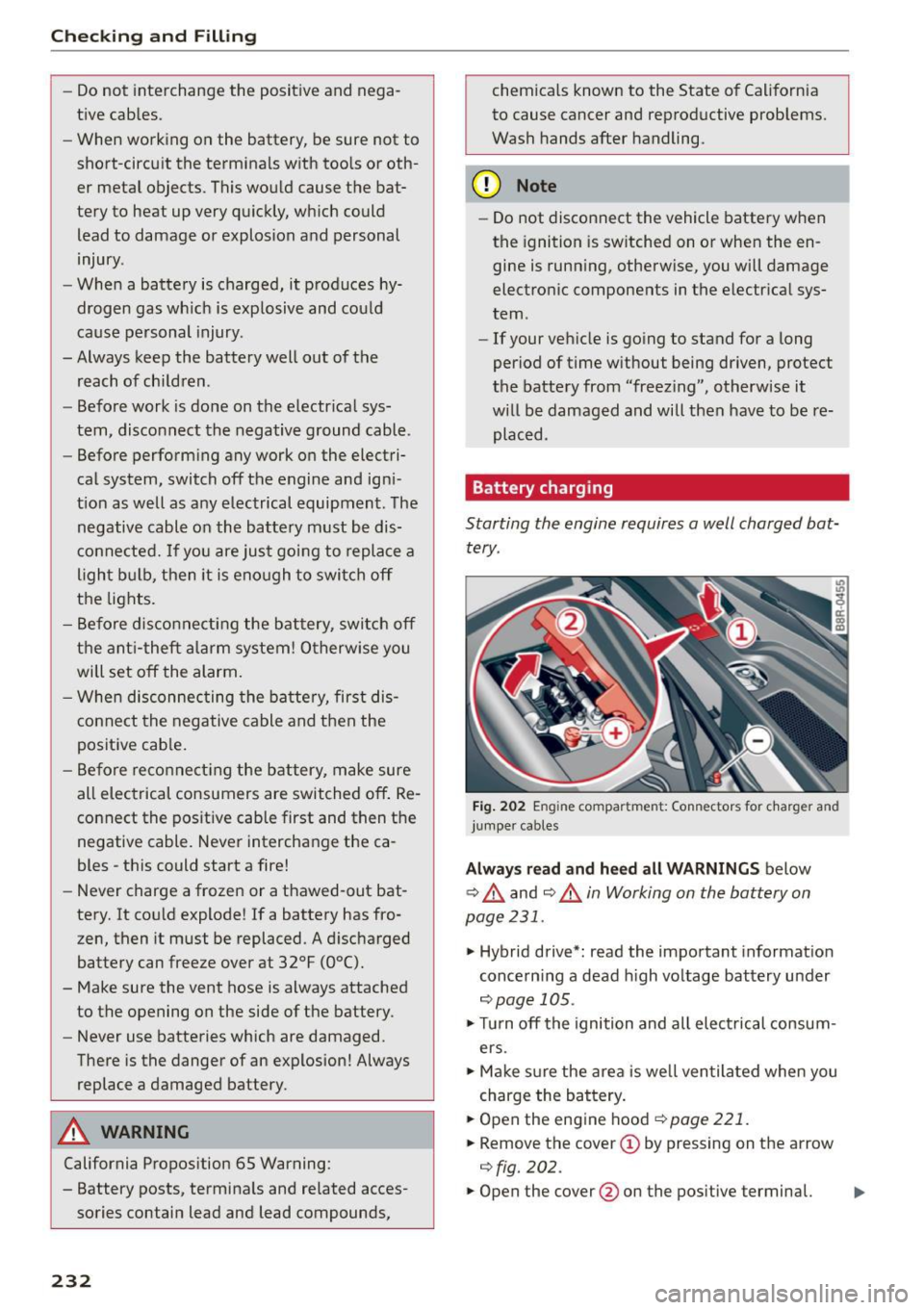
Starting the engine requires a well charged battery .
Fig. 202 Engin e compar tment : Co nnec tors fo r char ger and
jumper cables
Always read and heed all WARNINGS below
¢ .&. and
¢.&. in Working on the battery on
page 231 .
.. Hybrid drive*: read the important information
concerning a dead high voltage battery under
¢ page 105.
.. Turn off the ignition and all electrical consum
ers.
.. Make sure the area is well ventilated when you
charge the battery .
.. Open the engine hood
¢ page 221.
.. Remove the cover(!) by pressing on the arrow
¢fig. 202 .
.. Open the cover @on the positive terminal. .,.
Page 248 of 302

Wheels
and follow the important
safety precautions in
c::> page 247, Tires and vehicle
load limits.
-The tire must flex more if the
tire pressure is too low or if
the vehicle speed or load are
too high. This heats the tire up
too much. This increases the
risk of an accident because it
can cause the tire to burst and
result in loss of vehicle con
trol.
-Incorrect tire pressure increas
es tire wear and has a negative
effect on driving and braking
Tire pressure table
Please note that the information
contained in the following table
was correct at the time of print
ing, and the information is sub
ject to change. If there are differ
ences between this information
and the tire pressures specified
on the label on the driver's side 8-pillar, always follow the specifica
tion on the 8-pillar label
c::> page 245, fig. 206.
246
behavior, which increases the
risk of an accident.
(D Note
Replace lost valve caps to re
duce the risk of damage to the
tire valves.
@ For the sake of the environment
Tire pressure that is too low in
creases fuel consumption.
(D Tips
Audi recommends using the
tire pressure specified for a nor
mal load
c::> table on page 247
or for a full load when the vehi
cle is partially loaded.
Make sure that the tire designa
tion on your tire matches the des ignation on the tire pressure label
and the tire pressure table.
The following table lists recom
mended tire pressures in cold
tires according to the load and the size of the tires installed. .,.
Page 255 of 302

M N
co
a:
co
,...., \!) ..,.,
N ..,., ,....,
also reduces fuel efficiency and tire tread life,
and may affect the vehicle's handling and stop
ping ability .
Please note that the TPMS is not a substitute for
proper tire maintenance, and it is the driver's re
sponsibility to maintain correct tire pressure,
even if under-inflation has not reached the level
to trigger illumination of the TPMS low tire pres
sure telltale.
Your vehicle has also been equipped with a TPMS malfunction indicator to indicate when the sys
tem is not operating properly. The TPMS mal
function indicator is combined with the low tire pressure telltale . When the system detects a
malfunct ion, the telltale will flash for approxi
mately one minute and then remain continuously
illuminated. This sequence will continue upon
subsequent veh icle start-ups as long as the mal
function exists.
When the malfunction indicator is illuminated,
the system may not be able to detect or signal
low tire pressure as intended. TPMS malfunctions
may occur for a variety of reasons, including the
installation of replacement or alternate tires or
wheels on the vehicle that prevent the TPMS
from functioning properly. Always check the
TPMS malfunction telltale after replacing one or more tires or wheels on your vehicle to ensure
that the replacement or alternate tires and
wheels allow the TPMS to continue to function properly.
Wheels
If the Tire Pressure Monitoring System
indicator appears
Appl ies to vehicles : wi th t ir e p ress ure mo nito rin g system
The tire pressure indicator in the instrument
cluster informs you if the tire pressure is too low
or if there is a system malfunction.
Fig. 208 Instrument cluster: i ndicator light with message
Using the ABS sensors, the tire pressure monitor
ing system compares the tire tread circumference
and vibration characteristics of the individual
tires .
If the pressure changes in one or more
tires, this is indicated in the instrument cluster
display with an indicator light
RIJ and a message
¢fig. 208. If only one tire is affected, the loca
tion of that tire will be indicated.
The tire pressures must be stored in the Infotain
ment system again each time the pressures
change (switching between partial and full load
pressure) or after changing or replacing a tire on
your vehicle ¢
page 254. The tire pressure moni
toring system only monitors the tire pressure you have stored. Refer to the tire pressure label for
the recommended tire pressure for your vehicle
¢ page 245, fig . 207.
Tire tread circumference and vibration character
istics can change and cause a tire pressure warn
ing if:
- the tire pressure in one or more tires is too low .
- the tire has structural damage.
- the tir e was replaced or the tire pressure
changed and it was not stored again
c:!;> page 254.
-the collapsible spare* tire is installed.
253
Page 256 of 302
![AUDI Q5 2015 Owners Manual Wheels
Indicator lights
ti] Loss of pressure in at least one tire c::> &
Check the tires and replace or repa ir if necessary.
Check/correct the pressures of all four tires and
store](/manual-img/6/57635/w960_57635-255.png "AUDI Q5 2015 Owners Manual Wheels
Indicator lights
ti] Loss of pressure in at least one tire c::> &
Check the tires and replace or repa ir if necessary.
Check/correct the pressures of all four tires and
store")
Wheels
Indicator lights
ti] Loss of pressure in at least one tire c::> &
Check the tires and replace or repa ir if necessary.
Check/correct the pressures of all four tires and
store the pressure again in the Infotainment sys
tem
c::> page 254 .
ffim (Tire Pressure Monitoring System) Tire pres
sure: System malfunction!. If
iUm appears after
switching the ignition on or while driving and the
ti] indicator light in the instrument cluster
blinks for approximately one minute and then
stays on, there is system malfunction. Try to
store the correct tire pressures
c::> page 254 . If
the indicator light does turn off or turns on again
after a short period of time, drive to your author ized Audi dealer or qualified repair facility imme
diately to have the malfunction corrected.
A WARNING
- If the tire pressure indicator appears in the
display, reduce your speed immediately and
avoid any hard steering or braking maneu
vers. Stop as soon as possible and check the
tires and their pressure.
- The driver is responsible for maintaining the
correct tire pressure. You must check the
ti re pressure regularly.
- Under certain conditions (such as a sporty driving style, winter conditions or unpaved
roads), the tire pressure monitoring system
indicator may be delayed .
(D Tips
- The tire pressure monitoring system can al
so stop working when there is an ESC mal
function .
- Using snow chains may result in a system
malfunction.
- The Tire Pressure Monitoring System in your Audi was calibrated with "Audi Original
Equipment tires"
c::> page 242 . We recom
mend that you use these tires .
254
· Storing tire pressures
Applies to vehicles: with tire pressure monitor ing system
If the tire pressure changes or a tire is replaced,
it must be confirmed in the Infotainment sys
tem .
.,. Make sure before storing that the tire pressures
of all four tires meet the spec ified values and
are adapted to the load <=:>page 245.
.,. Switch the ignition on.
.,. Select: the
I CAR I funct ion key > Tir e Pressure
Monitoring System
> Yes, store now. Or
.,. Select: the
I CARI function button > Car Sys
tems*
control button > Servicing & checks >
Tire pressure monitoring > Store tire pressures
> Yes, store now.
(D Tips
Do not store the tire pressures if snow chains
are installed.
Page 293 of 302

M N
co
a:
co
,...., \!) ..,.,
N ..,., ,....,
Hill descent control . . . . . . . . . . . . . . . . . . . 126
Homelink (garage door opener) . . . . . . . . . . 48
Hood Opening . . . . . . . . . . . . . . . . . . . . . . . . . . . 221
Release lever . . . . . . . . . . . . . . . . . . . . . . . 221
Horn . . . . . . . . . . . . . . . . . . . . . . . . . . . . . . . . . 8
H ow are child restraint system anchors relat-
ed to chi ld safety . . . . . . . . . . . . . . . . . . . . . 184
How many airbags does my vehicle have? . . 158
How safety belt pretensioners work . . . . . . 150
H ybrid drive . . . . . . . . . . . . . . . . . . . . . . . . . . . 98
12 volt batter ies . . . . . . . . . . . . . . . . . . . . 105
Consumption display . . . . . . . . . . . . . . . . . 105
Efficient drive mode . . . . . . . . . . . . . . . . . . 102
Energy flow display . . . . . . . . . . . . . . . . . . 104
EV mode . . . . . . . . . . . . . . . . . . . . . . . . . . . 101
High voltage battery . . . . . . . . . . . . . . 98, 105
High voltage system . . . . . . . . . . . . . . . . . . 98
Operating modes . . . . . . . . . . . . . . . . . . . . 101
Power meter . . . . . . . . . . . . . . . . . . . . . . . . . 99
Starting the vehicle . . . . . . . . . . . . . . . . . . . 99
Transport . . . . . . . . . . . . . . . . . . . . . . . . . . 106
I
Ignition
Sw itch ing on/off . . . . . . . . . . . . . . . . . . . . . 84
Ignition key Emergency unlocking . . . . . . . . . . . . . . . . . . 38
I gnition lock . . . . . . . . . . . . . . . . . . . . . . . . . . 84
Malfunction . . . . . . . . . . . . . . . . . . . . . . 30, 34
Imbalance (wheels) . . . . . . . . . . . . . . . . . . . 243
Important things to do before driving . . . . 135
I mp roperly worn safety be lts. . . . . . . . . . . . 150
Indicator lights . . . . . . . . . . . . . . . . . . . . 14, 100
A irbag system . . . . . . . . . . . . . . . . . . . . . . 162
PASSENGER AIR BAG OFF . . . . . . . . . . . . . 162
Infant seats . . . . . . . . . . . . . . . . . . . . . . . . . 177
Inflatable spare tire . . . . . . . . . . . . . . . . . . . 256
Inflating . . . . . . . . . . . . . . . . . . . . . . . . . . . 257
Inflation pressure (tires) . . . . . . . . . . . . . . . 245
Install ing the upper tether strap on the an
chorage . . . . . . . . . . . . . . . . . . . . . . . . . . . . . 188
I nstrument cluster . . . . . . . . . . . . . . . . . . . . . 99
Indicator lights . . . . . . . . . . . . . . . . . . . . . . 14
Messages . . . . . . . . . . . . . . . . . . . . . . . . . . . 14
I nstrument illum inat ion . . . . . . . . . . . . . . . . 56
Index
Instruments . . . . . . . . . . . . . . . . . . . . . . . . . . 10
Instruments and controls General illustration . . . . . . . . . . . . . . . . . . . . 8
Interior lights
Front. .. .. .. .. .. .... .... .... ... .. .. . 55
Rear . . . . . . . . . . . . . . . . . . . . . . . . . . . . . . . 55
Interval wiping .... ................ ... . 57
Rain sensor . . . . . . . . . . . . . . . . . . . . . . . . . . 57
J
Jump-starting . . . . . . . . . . . . . . . . . . . . . . . . 271
Jumper cables . . . . . . . . . . . . . . . . . . . . . . . . 272
Jump starting 105
K
Key.............. .. ................ .. 36
Battery replacement . . . . . . . . . . . . . . . . . . 37
Check light . . . . . . . . . . . . . . . . . . . . . . . . . . 3 7
Emergency key . . . . . . . . . . . . . . . . . . . . . . . 86
Ignition/eng ine on/off. . . . . . . . . . . . . . . . . 84
Key replacement . . . . . . . . . . . . . . . . . . . . . 36
Master key with remote control . . . . . . . . . 36
Mechan ical key.................. .. . .. 37
Removing . . . . . . . . . . . . . . . . . . . . . . . . . . . 86
Kick-down tiptron ic . . . . . . . . . . . . . . . . . . . . . . . . . . . 127
L
Lane Change Assistant
refer to Side assist . . . . . . . . . . . . . . . . . . . 116
LATCH ......... .. .. .............. ... 184
Description . . . . . . . . . . . . . . . . . . . . . . . . . 185
Installing a child restraint . . . . . . . . . . . . . 186
Location . . . . . . . . . . . . . . . . . . . . . . . . . . . 185
Mounting and releasing the anchorage
hook . . . . . . . . . . . . . . . . . . . . . . . . . . . . . . 186
Latera l ang le . . . . . . . . . . . . . . . . . . . . . . . . . 202
Leather care/cleaning................ .. 211
Left hand drive . . . . . . . . . . . . . . . . . . . . . . . . 54
Lifting jack . . . . . . . . . . . . . . . . . . . . . . . . . . 262
Light Coming home . . . . . . . . . . . . . . . . . . . . . . . . 53
Daytime running lights . . . . . . . . . . . . . . . . 53
Driving light contro l. . . . . . . . . . . . . . . . . . . 52
Emergency flashers . . . . . . . . . . . . . . . . . . . 54
291