2015 AUDI Q5 roof rack
[x] Cancel search: roof rackPage 4 of 302

Table of contents
Owner's Literature
About this Owner's Manual ... .. .
Operation ....... ........... .. .. .. .
Cockpit ... .. ...... ......... .. .. .. .
Gene ral illus tra tion . ..... ... .. .. .. .. .
Instruments and indicator lights
Instruments .. .. ...... ..... .. .. .. .. .
I ndicator ligh ts .... ..... ... .. .. .. .. .
Driver information system ... .. .
In troduct ion .... ... ..... ... .. .. .. .. .
Trip computer ... ... ..... ... .. .. .. .. .
Efficiency program .. ..... ... .. .. .. .. .
On Board Diagnostic System (OBD) . .. .. .
Electronic speed lim it er ........ .. .. .. .
Auto Check Control ... ...... .. .. .. .. .
Open ing and closing ...... .. .. .. .
Keys .. .. .. .. .. ............. .. .. .. .
Ce ntra l locki ng .. ... .. ... ..... .. .. .. .
Opening and clos ing rear lid ........ .. .
5
6
8
8
8
10
10
1 4
20
20
22
25
26
26
27
36
36
38
4 3
Automatic rear lid/t runk lid ope rat ion 44
E me rgency unlocki ng of the luggage
compa rtmen t lid . . . . . . . . . . . . . . . . . . . . 45
Ch ild safety . . . . . . . . . . . . . . . . . . . . . . . . 45
P owe r Windows . . . . . . . . . . . . . . . . . . . . . 46
Panorama s un roof . . . . . . . . . . . . . . . . . . .
47
Garage doo r opener (Homelink) . . . . . . . . 48
Lights and Vision . . . . . . . . . . . . . . . . . 52
E xterior lighting . . . . . . . . . . . . . . . . . . . . . 52
Interior lighting . . . . . . . . . . . . . . . . . . . . . 55
V1s1on . . . . . . . . . . . . . . . . . . . . . . . . . . . . . 56
W indshield wipe rs . . . . . . . . . . . . . . . . . . . 57
Mi rror . . . . . . . . . . . . . . . . . . . . . . . . . . . . . 59
D ig ita l compass . . . . . . . . . . . . . . . . . . . . .
6 1
Seats and storage . . . . . . . . . . . . . . . . 63
Gene ral info rmat ion . . . . . . . . . . . . . . . . . 63
Fr ont sea ts . . . . . . . . . . . . . . . . . . . . . . . . . 64
M emory f unct ion . . . . . . . . . . . . . . . . . . . . 64
Rear seat . . . . . . . . . . . . . . . . . . . . . . . . . . 66
Head res traints . . . . . . . . . . . . . . . . . . . . . 67
Center a rm rest . . . . . . . . . . . . . . . . . . . . . . 68
Luggage compartment . . . . . . . . . . . . . . .
69
2
Roo f rack ... .... .. .. ... . .. .... ... . .
Beverage holders ... .... .. .... ... .. . .
Climatized cupholders ... . ..... ... .. . .
(upholders in the doo r pockets ....... . .
A sh tray ... .. .. .. .. ............... . .
Cigarette lighter/soc ket .............. .
Stor ing ... .. .. .. .. .. .... .... ..... . .
Warm and cold .. ... .. ..... ... .. . .
Cl imate control system ... ... ... ... .. .
Dnv1ng ......... .. ............... . .
Steering ...... .. ... ............. .. .
Ig nition lock . .. ... ................. .
Convenience key .. .. .. ...... ... .. .. . .
D rive r mes sage s .. .. .. ........... .. . .
E lectromech anic al par king br ake ... .. . .
Star t/Stop sys tem .. .... . ..... ... .. . .
Speed warning system ... . ..... ... .. . .
Cruise contro l system .... . .... ... .. . .
Hybrid ... .. .... .. .. ... .. ..... ... . .
Hybrid dr ive ..... .. .... .. .... ... .. . .
72
74
75
76
76
76
77
80
80
84
84
84
87
88 89
91
94
95
98
98
Audi adaptive cruise control and
braking guard . . . . . . . . . . . . . . . . . . . .
107
Introduction . . . . . . . . . . . . . . . . . . . . . . . . 107
General information . . . . . . . . . . . . . . . . . 107
Audi adap tive cruise control . . . . . . . . . . . 109
Audi braking guard . . . . . . . . . . . . . . . . . . 113
Messages . . . . . . . . . . . . . . . . . . . . . . . . . . 114
Audi side assist . . . . . . . . . . . . . . . . . . 116
S ideass ist .. .. .. .. ... .. ... ... ... ... 116
Audi drive select . . . . . . . . . . . . . . . . . 120
D riving settings . . . . . . . . . . . . . . . . . . . . . 120
Automatic transmission . . . . . . . . . 123
tiptron ic . . . . . . . . . . . . . . . . . . . . . . . . . . . 123
Parking system . . . . . . . . . . . . . . . . . . . 129
Parking system plus wit h rearv iew camera 129
Adjus ting the d isplay and warn ing tones . 134
T rai le r hitch . . . . . . . . . . . . . . . . . . . . . . . . 134
Er ror messages . . . . . . . . . . . . . . . . . . . . . 134
Page 74 of 302
Seats and storage
Removing the cargo floor, installing
.. To remove, lift the cargo floor folded together
and pull it toward the rear lid.
.. To install, place the folded cargo floor into both
retainers and unfo ld it.
Grab the protective tray on the hand les and pull
it out. You can also install a divider to divide@
the storage area. Depending on the vehicle
equipment level, the protective tray can have dif
ferent si zes and shapes.
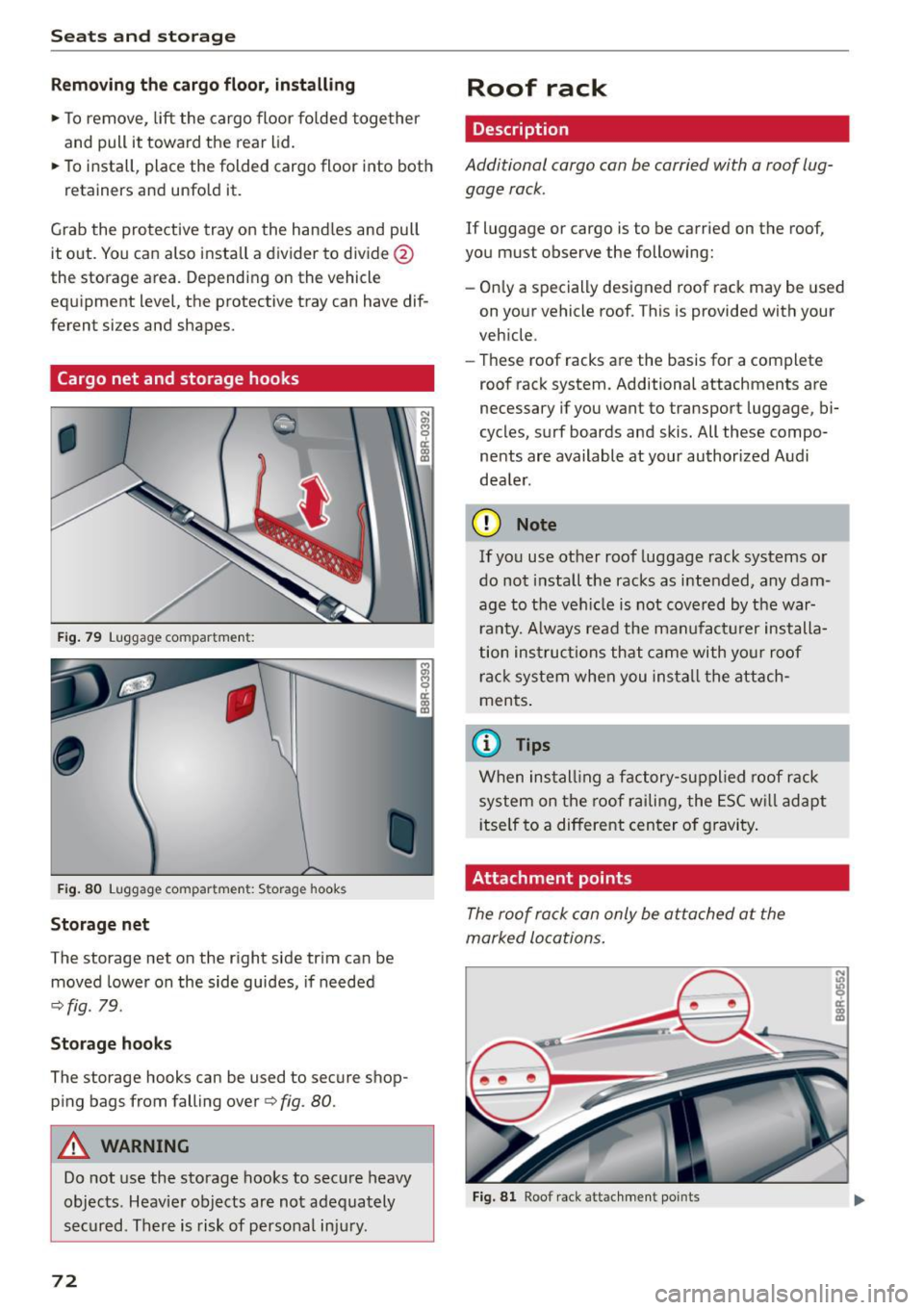
Cargo net and storage hooks
Fig. 79 Luggage co mpa rtm en t:
•
Fig. 80 Luggage co mpa rtment : S torag e hooks
Storage net
The storage net on the right side trim can be
moved lower on the side guides, if needed
-:;, fig . 79.
Storage hooks
The storage hooks can be used to secure shop
ping bags from falling over -:;,
fig. 80.
A WARNING
Do not use the storage hooks to secure heavy
objects . Heavier objects are not adequately
secured . There is risk of personal injury.
72
Roof rack
Description
Additional cargo can be carried with a roof lug
gage rack .
If luggage or cargo is to be carried on the roof,
you must observe the following:
- On ly a specially designed roof rack may be used
on your vehicle roof . This is provided with your
vehicle .
- These roof racks are the basis for a compl ete
roof rack system. Additional attachments are
necessary if you want to transport luggage, bi·
cycles, surf boards and skis. All these compo
nents are available at your authorized Audi
dea le r.
(D Note
If you use other roof luggage rack systems or
do not install the racks as intended, any dam
age to the veh icle is not covered by the war
r anty. Always read the manufacturer installa
tion instructions that came with your roof
rack system when you install the attach
ments.
(D Tips
When installin g a factory-supplied roof rack
system on the roof railing, the ESC will adapt
it self to a different center of gravity.
Attachment point s
The roof rack can only be attached at the
marked locations.
Fig. 81 Roof rack attachmen t po ints
Page 75 of 302

M N
co ~ co
rl I.O
"' N
"' rl
Attach the roof rack only at the attachment
points on the roof railing. On the inside of the
roof railing there are two holes for attaching the
rear end of the roof rack. To prevent confusing
the front and rear roof rack attachments, there are three holes on the left and two holes on the
right for mounting the front part of the roof rack
q fig. 81.
The roof racks have a sticker on the left side un
derneath to identify front and rear.
A WARNING
When installing the roof rack, make sure the
st icker is on the left side of the vehicle and
faces the stamped arrow in the drive direc
tion.
Installing a roof rack
Fig. 82 Roof ra iling: pos it io ni ng the roof rack
Fig. 83 Roof ra iling: install ing a roof rack
The roof rack set consists of a front and rear roof
rack, the cover profi le and a socket wrench .
• Open the cap
(D q fig . 83 .
• Before mounting the roof rack, use the socket
wrench @and loosen the left and right screw
in the direction of@ .
Seats and storage
• Clean the attachment points on the roof railing
as well as the roof rack rubber washers @.
• Carefully place the roof rack over the holes in
the roof railing
q fig. 82.
• Place the pins @ into the holes. The claw ®
must engage into the edge of the roof railing .
"' Make sure the rubber washer@ lays flat on the
roof railing .
"' Tighten the left and right screws using the
socket wrench @ in direct ion @.
"' To reach the
4 ft lb (6 Nm) tightening specifi
cation needed, both arrows on the socket
wrench must align.
"' Repeat this procedure on the second roof rack.
A WARNING
Check all the roof rack connections each time
before each trip and re-tighten or re-adjust if
necessary. If you are going to be driving or
rough terrain, you will have to check the at
tachments more often. If you do not do this,
the risk of you r luggage coming loose and
falling off is greater.
(D Note
The pins and the roof rack claws must engage
securely into the holes and into the edge of
the roof railing when you tighten the screws!
(0 Tips
You can adjust the width of the roof rack by
using a hexagon wrench and turning the
screws on the top. Let you r authorized Audi
dealer help you with this.
Installing the attachments
Fig. 84 Roof railing : insta lling cove r profi le into th e roof
rack
a)
"' 9 a: a) m
73
Page 76 of 302
Seats and storag e
Install ing th e attachm ent s
.. Remove the cap @¢ fig. 84.
.. Slide the attachment into the T -groove (V .
.. Tighten the attachment accord ing to the roof
rack installation instructions.
.. Close the cap .
Inst a lling th e cov er p ro fil e
.. Seal the openings in the T-groove 0 with the
cover profile @ after having installing the at
tachments .
.. If you not want to use the attachment, seal the
whole T-groove
0 with the cover profile @.
.. Cut the cover profile to the length needed, if
necessary .
Roof load
The cargo on the roof must be securely attached.
Handling characteristics change when cargo is transported .
The permissible roof load for your vehicle is
165 lbs (75 kg ). The roof load is the total of the
weight of the roof rack, the attachments and the
cargo you are carry ing .
.,&. WARNING
-The cargo must be secure ly attached on the
roof rack, otherwise you r is k an acc ident .
- Distribute the load as evenly as possible and
do not make the roof rack wider than the
maximum permitted.
- You must under no circumstances exceed
the permiss ible roof load, the permissib le
axle loads and the permissib le overall
weight of your vehicle - risk of an accident.
- Mount the attachments to the roof rack on ly
afte r you have placed the roof rack on the
vehicle.
- Cons ider tha t when transport ing heavy ob
jects or one wi th a la rge surface, the han
dling characteristics change due to shift in
the center of gravity or the greater surface
exposed to the wind. So adapt your driving
and your speed to prevailing condit ions . We
recommend that you do not drive faster
than 80 mph (130 km/h) .
74
- Mounting a roof rack changes the height of
your veh icle. Keep this in mind when parking
your veh icle in your garage, or when driving
through a tunnel or under an overpass .
(D Note
-Make sure the rear lid does not hit the cargo
on the roof rack when you open it. On
vehicles with automat ic rear lid/trunk lid
operation* you may have to adjust the open
posit ion of the rear lid ¢
page 44 .
-Remove the roof rack and attachment be
fore taking your vehicle through an auto
matic car wash to avoid damage .
@ For the sake of the environment
As a result of the increased wind resistance
created by a roof rack, your vehicle is using
fuel unnecessarily. So remove the roof rack af
te r using it .
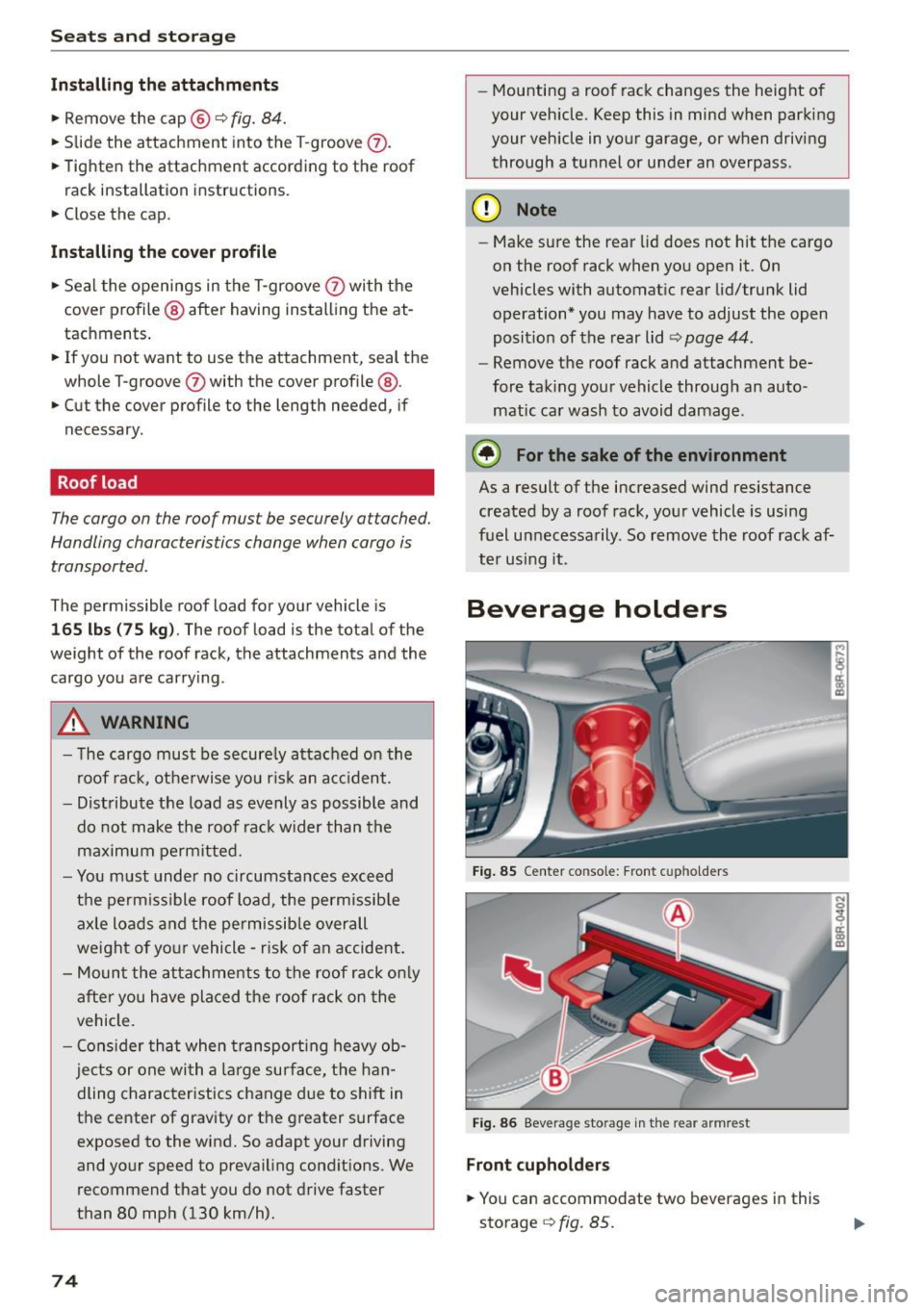
Beverage holders
Fig. 85 Center co nsole: F ront c upholder s
Fig . 86 Beverage sto rage in the re ar a rm rest
Front cuphol der s
.. You can accommodate two beverages in this
storage
<=> fig . 85.
Page 160 of 302
Airbag syste m
-a small adu lt or teenager is on the front pas
senger seat
- a passenger who is not sitting upright with
their back against a non -reclined backrest with
their feet on the vehicle floor in front of the
seat is on the front passenger seat.
I f the front passenger airbag deploys, the Federal
Standard req uires the airbag to meet the " low
risk" deployment criteria to help reduce the risk
of injury through interaction with the airbag .
"Low risk" deployment occurs in those crashes
that take place at lower decelerations as defined in the electron ic control unit . ¢ page
162
Alw ays re member: Even though your vehicle is
equ ipped w ith Advanced Airbags, the safest place
for children is properly restrained on the back
seat . Please be sure to read the important infor
mat ion in the sections that follow and be sure to
heed a ll of the WARNINGS.
_& WARNING
To reduce the ris k of injury when an airbag in
fla tes, always wear safety belts proper ly.
- If you are unrestrained, leaning fo rward, s it
t ing s ideways or out of position in any way,
your risk of injury is much higher .
- You w ill also receive serious inju ries and
could even be killed if you are up against the
airbag or too close to it when it inflates -
even with an Advanced Airbag ¢page
152.
_& WARNING
A child in a rearward-facing child safety seat
installed on the front passenger seat will be
ser iously injured and can be killed if the front
airbag inflates - even w ith an Advanced Airbag
System.
- Although the Advanced Airbag System in
your vehicle is designed to turn off the front
airbag when a rearward -facing child re
straint has been installed on the front pas
senger seat, nobody can absolutely guaran
tee that deployment is impossible in al l con
ceivable s ituations that may happen dur ing
the usef ul life o f your vehicle .
- The inflating a irbag w il l hit the child safety
seat or infant carrier wi th great force and
158
w ill smash the child safety seat and child
aga inst the backrest, center armrest, door,
or roof.
- Always install rearward-facing chi ld re
straints in the back seat.
- If you must insta ll a rearward fac ing ch ild
safety seat on the front passenger seat be
cause of exceptional circumstances and the
PAS SENGER AIR BAG OFF light does not
come on and stay on, immediately install
the rear-facing child safety seat in a rear
seating position and have the airbag system
inspected by your au thorized Aud i dealer .
_& WARNING
If, in exceptiona l circumstances, you must in
stall a forwa rd-facing child restra int on the
front passenger's seat:
- Always ma ke sure the forward-facing sea t
has been des igned and certif ied by its man
ufacturer for use on a front seat with a pas
senger front and s ide a irbag .
- Never p ut the fo rward-facing child restraint
up against or very near the instrument pan
el.
-Always move the passenger seat into its
rearmost position in the seat's fore and aft
ad justment range, as far away from the a ir
bag as poss ible, before insta lling the for
ward-facing child restraint. The backrest
must be adjusted to an upr ight position .
- Make sure that the
PASSENGER AIR BAG
OFF
li ght comes on and stays on all the time
whenever the ign it ion is switched on.
Advanced Airbag System components
The front passenger seat in your vehicle has a lot
of ve ry impo rtant parts of the Advanced A irbag
System in it. These pa rts include the we ight
sensing mat, senso rs, w iring, bracke ts, and more.
The function of the system in the front passenge r
seat is checked by the e lectronic control unit
when the ignition is on. The control unit mon itors
the Advanced Airbag System and turns the airbag i ndicator light on when a malfunct io n in the sys
tem components is detected. The function of the
a irbag indicator light is described in greate r
Page 171 of 302

M N
co ~ co
rl I.O
"' N
"' rl
-Damage (cracks, deep scratches etc .) to the
original seat covers or to the seam in the
area of the side airbag module must always
be repaired immediately by an authorized
Audi dealer .
-If children are seated improperly, their risk
of injury increases in the case of an acc ident
¢ page 172, Child safety .
-Never attempt to modify any components of
the a irbag system in any way.
- In a side collision, s ide a irbags w ill not func
tion properly if sensors cannot correctly
measu re increasing air pressure inside the
doors when air escapes through larger, un
closed openings i n the door pane l.
- Never d rive with interior door trim pane ls
removed.
- Never drive when parts have been re
moved from the inside door panel and the
openings they leave have not been proper ly closed.
- Never drive when loudspeakers in the
doors have been removed unless the
speaker holes have been properly closed.
-Always make certain that openings are covered or filled if additional speakers or
other equ ipment is installed in the inside
door panels .
- Always have work on the doors done by an
authorized Audi dealer or qualified work
shop.
Ai rb ag system
Side curtain airbags
Description of side curtain airbags
The side curtain airbag system can provide sup
plemental protection to properly restrained oc
cupants.
,ft QOD'
8i 0 ci: a, m
F ig . 1 7 1 Side curtain system, d river 's s ide: s ide cu rta in a ir
bag locat io n
The side curtain airbags are located on both sides
of the inter ior above the front and rear side w in
dows ¢
fig. 171. They are identified by the word
"A IRBAG" on the w indshie ld frame and the cen
ter roof pi llar.
The side c urta in airbag system supplements the
safety belts and can help to reduce the ris k of in
j u ry for occ upants' heads and upper torso on the
s ide of the vehicle that is str uck in a s ide coll i
s io n. The side c urtain airbag inflates in side im
pacts and only when the vehicle acce leration reg
istered by the contro l unit is high enough. If this
rate is below the reference va lue programmed in
to the control un it, the side curtain airbag will
not be triggered, even though the car may be
badly damaged as a result of the collis ion . It is
not possible to define an airbag triggeri ng range
that w ill cove r every possible ang le of impact,
s ince the circumstances w ill vary considerably be
tween one collision and another. Important fac
tors include, for examp le, the nat ure (hard or
soft) of the impacting object, the angle of im
pact, vehicle speed, etc.
¢ page 170, How side
curtain airbags work.
Aside from their normal safety f unction, sa fety
belts work to he lp keep the driver or front pas
senger in position in the event of a collision so
that the side curtain airbags can provide protec-
t ion. ..,.
169
Page 194 of 302

Smart Technology
wheels can spin even with these assistance
systems that cannot always help to reduce
the risk of loss of vehicle control.
@ Tips
-ABS and ASR only work correctly when all
four whee ls are equipped with identical
Switching on/off
tires . Different tire sizes can lead to a reduc
tion in engine power .
- You may hear noises when the systems de
scribed are working.
- When installing a factory-supplied roof rack
system on the roof railing, the ESC will
adapt itself to a different center of gravity.
ESC turns on automatically when you start the engine.
Fig. 185 Version A: Lower center console, YJ. OFF butto n
The fo llow ing situations are exceptions where it
may be useful to sw itch on offroad mode to allow
the wheels to spin:
- Rocking the vehicle to free it when it is stuck
- Driving in deep snow or on loose ground
Offroad mode on
Fig. 186 Ve rs ion B: Upper center co nsole, YJ. O FF button
-Driving with snow chains
- Driving downhill while braking on loose ground
- Driving on rough terrain when much of the car's
weight is lifted off the wheels (axle articula
tion)
Offroad mode off
Behavior
The ESC and ASR stabilization functions are The full stabilization function of the ESC
limited
c> & .
Operation Press the l.13 OFF I button.
Indicator Ill turns on.
lights
Driver mes· Stabilization control (ESC): Offroad .
sages Warning! Restricted stability
A WARNING
- You should only switch offroad mode on if
your driving abilit ies and road conditions
permit.
- The stabilization function is limited when offroad mode is switched on. The driving
wheels cou ld spin and the vehicle could
swerve, especially on slick or slippery road
surfaces.
192
and ASR is availab le again.
Press the
1.$ OFF I button again.
II turns off.
Stabilization control (ESC): On
(D Tips
Offroad mode cannot be switched on when
adaptive cruise control" is switched on .
Page 291 of 302

M N
co
a:
co
,...., \!) ..,.,
N ..,., ,....,
Electronic Stabilization Control . . . . . . . . . . 191
Electronic Stabilization Control (ESC)
H ill descent assist . . . . . . . . . . . . . . . . . . .
193
Offroad mode . . . . . . . . . . . . . . . . . . . . . . . 192
Warn ing/ indicator lights . . . . . . . . . . . . . . . 15
Emergency braking . . . . . . . . . . . . . . . . . . . . . 91
Emergency flasher . . . . . . . . . . . . . . . . . . . . . 54
Warning/indicator lights . . . . . . . . . . . . . . . 16
E mergency key . . . . . . . . . . . . . . . . . . . . . . . . 36
Starting engine . . . . . . . . . . . . . . . . . . . . . . 86
Emergency locking of the doors . . . . . . . . . . . 42
Emergency operation
Luggage compartment lid . . . . . . . . . . . . . .
45
Emergency release
Selector lever ...................... .
E t . mergency s artmg ........... .... ... .
Emergency unlocking
128
271
Ignition key . . . . . . . . . . . . . . . . . . . . . . . . . 38
Energy management . . . . . . . . . . . . . . . . . . 196
Engine
Compartment . . . . . . . . . . . . . . . . . . . . . . .
223
Coolant . . . . . . . . . . . . . . . . . . . . . . . . . . . . 227
H ood . . . . . . . . . . . . . . . . . . . . . . . . . . . . . . 221
Jump starting . . . . . . . . . . . . . . . . . . . . . . . 105
Starting . . . . . . . . . . . . . . . . . . . . . . 84, 87, 99
Startingwithjumpercab les . ... .. .. ... 271
Stopping . . . . . . . . . . . . . . . . . . . . . . 86, 88, 99
E . ngine compartment . . . . . . . . . . . . . . . . . . 223
Safety instructions . . . . . . . . . . . . . . . . . . . 221
Working the engine compartment ... .. . 221
E . l ngine coo ant system . . . . . . . . . . . . . . . . . 227
Adding coolant . . . . . . . . . . . . . . . . . . . . . . 228
Checking coolant leve l . . . . . . . . . . . . . . . . 227
Malfunction . . . . . . . . . . . . . . . . . . . . . . . . . 29
Radiator fan . . . . . . . . . . . . . . . . . . . . . . . . 229
Engine coolant temperature
Temperature gauge . . . . . . . . . . . . . . . . . . .
10
Engine hood
Closing .. .. .. .... ...... ... .. .. .. .. .
How to release the hood ...... .. .... . .
Engine oil Adding
Additives . .. ................. .. .... .
Changing .. ................. .. .... .
Check oil level .............. .... ... .
221
221
223
225 225
226 225
Consumption . . . . . . . . . . . . . . . . . . . . . . . 225
Level . . . . . . . . . . . . . . . . . . . . . . . . . . . . . . . 33
Index
Oil consumption . . . . . . . . . . . . . . . . . . . . . 224
Pressure malfunction . . . . . . . . . . . . . . . . . . 30
Sensor defective . . . . . . . . . . . . . . . . . . . . . . 33
Specification and viscosity . . . . . . . . . . . . . 223
Engine speed limitation . . . . . . . . . . . . . . . . . 33
Environment
Catalytic converter . . . . . . . . . . . . . . . . . . .
198
Diesel particulate filter . . . . . . . . . . . . . . . 199
Disposing of your vehicle battery . . . . . . . 233
Driving at high speeds . . . . . . . . . . . . . . . . 200
Fuel...... .... .. .. .............. ... 216
Leaks under your vehicle . . . . . . . . . . . . . . 221
Letting the vehicle stand and warm up . . . 200
Proper disposal of drained brake fluid . . . 230
Proper disposal of drained engine coolant 228
Proper disposal of drained engine oil 225, 226
Recycling used engine oil. . . . . . . . . . . . . . 225
Roof rack . . . . . . . . . . . . . . . . . . . . . . . . . . . 7 4
Unleaded fuel.. .. ... .......... .. .. ..
213
What shou ld I do with an old battery? . . . 233
EPC
refer to Electronic power control . . . . . . . . 15
ESC
refer to Electronic Stabilization
Control (ESC) . . . . . . . . . . . . . . . . . . . . . . . .
15
Ethyl alcohol (Fuel) . . . . . . . . . . . . . . . . . . . . 214
Event Data Recorder (EDR) . . . . . . . . . . . . . . 190
Expansion tank . . . . . . . . . . . . . . . . . . . . . . . 227
Explanation of some technical terms . . . . . 202
Exterior lighting . . . . . . . . . . . . . . . . . . . . . . . 52
Exterior mirrors
Adjusting . . . . . . . . . . . . . . . . . . . . . . . . . . .
59
D . . ,mmmg ...... .. ............. .... .. . 60
Heating . . . . . . . . . . . . . . . . . . . . . . . . . . . . . 59
Eyeglasses compartment . . . . . . . . . . . . . . . . 79
F
Fall line
Fan Radiator
Fastening 202
229
Booster seats . . . . . . . . . . . . . . . . . . . . . . . 180
Convertible child safety seats . . . . . . . . . . 178
Infant seats . . . . . . . . . . . . . . . . . . . . . . . . 177
Flexib le fue l . . . . . . . . . . . . . . . . . . . . . . . . . 214
Floor mats . . . . . . . . . . . . . . . . . . . . . . . . . . . 140
289