2015 AUDI Q5 height
[x] Cancel search: heightPage 182 of 302
Child safety
Booster seats and safety belts
Properly used booster seats can help protect
children weighing between about 40 lbs. and 80
lbs. (18 kg and 36 kg) who are less than 4
ft. 9
in. (57 inches/1.45 meters) tall .
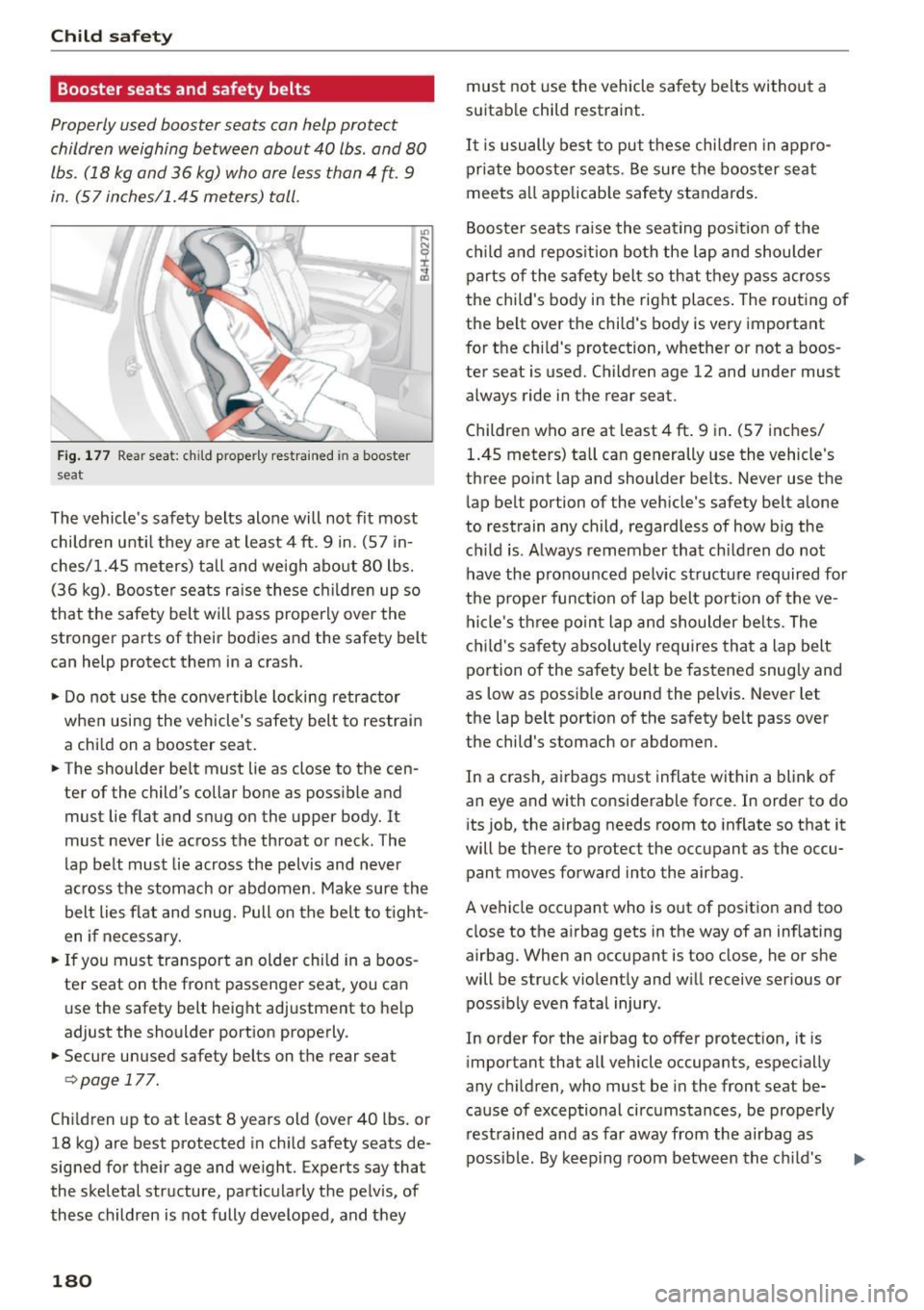
Fig. 177 Rear seat: child prope rly restrained in a booste r
seat
The vehicle's safety belts alone will not fit most
children until they are at least 4
ft. 9 in . (57 in
ches/1.45 meters) tall and weigh about 80 lbs. (36 kg) . Booster seats raise these children up so
that the safety belt will pass properly over the
stronger parts of their bodies and the safety belt
can help protect them in a crash .
• Do not use the convertible locking retractor
when using the vehicle's safety belt to restrain
a child on a booster seat.
• The shoulder belt must lie as close to the cen
ter of the child's collar bone as possible and
must lie fla t and snug on the upper body. It
must never lie across the throat or neck . The
lap belt must lie across the pelvis and never
across the stomach or abdomen . Make sure the
belt lies flat and snug. Pull on the belt to tight
en if necessary.
• If you must transport an older child in a boos
ter seat on the front passenger seat, you can
use the safety belt height adjustment to help
adjust the shoulder portion properly .
• Secure unused safety belts on the rear seat
c> page 177.
Children up to at least 8 years old (over 40 lbs. or
18 kg) are best protected in child safety seats de
signed for their age and weight. Experts say that
the skeletal structure, particularly the pelvis, of
these children is not fully developed, and they
180
must not use the vehicle safety belts without a
suitable child restra int .
It is usually best to put these children in appro
priate booster seats . Be sure the booster seat
meets all applicable safety standards.
Booster seats raise the seating position of the
child and reposition both the lap and shoulder
parts of the safety belt so that they pass across
the child's body in the right places. The routing of
the belt over the child's body is very important
for the child's protection, whether or not a boos
ter seat is used. Children age 12 and under must
always ride in the rear seat .
Ch ildren who are at least 4
ft. 9 in. (57 inches/
1.45 meters) tall can generally use the vehicle's
three point lap and shoulder belts. Never use the
lap belt portion of the vehicle's safety belt alone
to restrain any child, regardless of how big the
child is. Always remember that children do not
have the pronounced pelvic structure required for
the proper function of lap belt portion of the ve
hicle's three point lap and shoulder belts . The
child's safety absolutely requires that a lap belt
portion of the safety belt be fastened snugly and
as low as possible around the pelvis. Never let
the lap belt portion of the safety belt pass over
the child 's stomach or abdomen.
In a crash, airbags must inflate within a blink of
an eye and with considerable force . In order to do
its job, the airbag needs room to inflate so that it
will be there to protect the occupant as the occu
pant moves forward into the airbag .
A vehicle occupant who is out of position and too
close to the airbag gets in the way of an inflating
airbag. When an occupant is too close, he or she
will be struck violently and will receive serious or possibly even fatal injury .
In order for the airbag to offer protection, it is
important that all vehicle occupants, especially
any children, who must be in the fron t seat be
cause of exceptional circumstances, be properly
restrained and as far away from the airbag as
possible. By keeping room between the child's .,,.
Page 211 of 302

M N
co
a:
co
,...., \!) ..,.,
N ..,., ,....,
wash operator to reduce the risk of acci
dents.
- To reduce the risk of cuts, protect yourself
from sharp metal components when wash
ing the underbody or the inside of the wheel
housings.
- After washing the vehicle, the braking effect
may be delayed due to moisture on the
brake rotors or ice in the w inter. The brakes
must be dried first w ith a few careful brake
applications.
- If you wash the vehicle in an automatic car
wash, you must fold the exterior m irrors in
to reduce the risk of damage to the mirrors.
Power folding exterior mirrors* must only
be fo lded in and out us ing the power folding
funct ion.
- To reduce the risk of damage to the rims
and tires, compare the width between the
whee ls on your vehicle w ith the distance be
tween the g uide rails in the car wash .
- To red uce the risk of damage, compare the
height and width of yo ur vehicle with the
Care and cleaning
height and w idth of the inside of the car
was h.
- T o prevent paint damage, do not wash the
vehicle in direct sunlight.
- To reduce the ris k of damage to the sur face,
do not use insect remov ing sponges, kitchen
sponges o r similar items.
- Matte finish painted veh icle components:
- To reduce the risk of damage to the sur-
face, do not use polishing agents or hard
wax.
- Never use protective wax. It can destroy
the matte finish effect.
- Do not place any stickers or magnetic
signs on vehicle parts painted w ith matte
finish paint. The paint could be damaged
when the stickers or magnets are re moved.
@ For the sake of the environment
Only wash the vehicle in facilities spec ially de
s igned for that purpose. Th is w ill reduce the
r isk of dirty water contaminated w ith oil from
entering the sewe r system.
Cleaning and care information
When clea ning and caring for individual vehicle
components, refer to the following tables. The
information conta ined there is simply recommen -dations. For questions or for components that
are not listed, refer to an authorized A
udi dealer.
Also follow the information found in
¢ A.
Ext erior cl eaning
Component Situation Solution
Wind shi eld wiper
Deposits ¢ page 58, Cleaning windshield wiper blades
blades
H eadlight s/
Deposits Soft sponge with a mild soap solutional
tail light s
S ensors /
Deposits Sensors: soft cloth with solvent-free cleaning solution
camera le nses Camera lenses: soft cloth with alcohol-free clean ing solu-
tion
Snow/ice Hand brush/solvent-free de -ic ing spray
Whe els Road salt Water
Brake dust Acid-free special cleaning
solution
Exhau st tail p ipe s Road salt Water, cleaning solution suitable for stainless steel, if nee-
essary
209
Page 238 of 302

Wheels
(D Tires for passenger vehicles
(if applicable)
P indicates a tire for a passenger
vehicle. T indicates a tire desig
nated for temporary use .
@ Nominal width
Nominal width of the tire be
tween the sidewalls in millime
ters . In general: the larger the
number, the wider the tire.
@ Aspect ratio
Height/width ratio expressed as a
percentage.
@ Tire construction
R indicates a radial tire.
® Rim diameter
Size of the rim diameter in inches .
@ Load index and speed rating
The load index indicates the tire's
load-carrying capacity.
The speed rating indicates the
maximum permitted speed
¢ & in
W inter tires on page 250 .
"EXTRA LOAD", "xl" or "RF" indi
cates that the tire is reinforced or
is an Extra Load tire.
Speed rat- Maximum permitted speed
ing
p
up to 93 mph (150 km/h)
Q up to 99 mph (160 km/h)
236
Speed rat- Maximum permitted speed
Ing
R up t o 106 mph (170 km/h)
s up to 110 mph (180 km/h)
T up to 118 mph (190 km/h)
u up to 124 mph (200 km/h)
H up to 130 mph (210 km/h)
V up to 149 mph (240 km/h)a>
z above 149 mph (240 km/h)a)
w up to 168 mph (270 km/h)a)
y up to 186 mph (300 km/h)a)
a) For tires above 149 mph (240 km/h),
tire manufacturers sometimes use the
code "ZR".
(J) US DOT number (TIN) and
manufacture date
The manufacture date is listed on
the tire sidewall (it may only ap
pear on the inner side of the tire) :
DOT ... 4514 ...
means , for example, that the tire
was produced in the 45th week of
the year 2014.
@ Audi Original equipment
tires
Audi Original equipment tires
with the designation "AO" or "RO"
have been specially matched to
your Audi. When used correctly,
these tires meet the highest standards of safety and handling.
Your authorized Audi dealer will
be happy to provide more infor
mation.
Page 239 of 302

® Mud and snow capability
"M/S" or "M+S" indicates the tire
has characte ris tics that make it
suitable for driving on mud and snow .
& indica tes a winter tire.
@ Composition of the tire cord
and materials
T he number of plies indicates the
number of rubber ized fabric lay
ers in the tire . In general: the
more layers, the more weight a
tire can carry. Tire manufacturers
must also specify the mater ials
used in the ti re. These include
stee l, nylon, polyester and other
materials.
@ Maximum permitted load
This number indicates the maxi
mum load in kilograms and
pounds that the tire can carry .
@ Uniform tire quality grade
standards for treadwear,
traction and temperature resistance
Treadwear , traction and tempera
ture ranges
c::::> page 251 .
@Running direction
The arrows ind icate the running
direction of unidirect ional tires.
You must always follow the speci- fied running direction
c::::> page 264.
€3) Ma
ximum permitted
inflation pressure
Whe els
This number indicates the maxi
mum pressure to which a tire can
be inflated unde r normal operat
ing conditions .
Glossary of tire and loading
terminology
Accessory weight
means the combined weight (in
excess of those standard items
which may be replaced) of auto matic transmission, power steer
ing, power brakes, power win
dows, power seats, radio, and
heater, to the extent that these
items are available as factory-in
stalled equipment (whether in
stalled or not).
Aspect ratio
means the ratio of the height to
the width of the tire in percent. Numbers of 55 or lower indicate a
low s idewall for improved steer
ing response and better overall
handling on dry pavement . .,.
237
Page 253 of 302

M N
co
a:
co
,...., \!) 1.1'1
N 1.1'1 ,....,
& WARNING
Using incorrect snow chains or installing snow
chains incorrectly can result i n loss of vehicle
contro l, wh ich inc reases the r is k of an acci
dent.
(D Note
Snow chains can dama ge the r ims/wheel cov
ers * if t he chains come into d irect contact
w it h them . Remove the whee l covers * fir st .
Use coated snow chains.
Low aspect ratio tires
Your Audi is factory-equipped with low aspect ra
tio tires . These tires have bee n thoroughly tested
and been selected specifically fo r yo ur model fo r
the ir supe rb pe rformance, road feel and handling
u nder a va riety o f drivi ng conditions. Ask yo ur au
thor ized Audi de aler for mo re det ail s.
The low aspect ratio of these tires is indica ted by
a numeral of
55 or less i n t he tire's si ze des igna
tion . Th e nu mera l represents the rat io of the
tire's sidewall he igh t in relation to i ts tre ad wid th
expressed in percentage. Convent iona l tires have
a height/wi dth ratio of 6 0 or mo re .
The performan ce of low-a spe ct-rati o tires i s par
ticularly sensitive to improper inflation pre s
sure . It is therefore important that low a spect
ratio tires are inflated to the specified p ressure
and that the inflation pressure is regularly
checked and maintained. Ti re pressures should
be checked at least once a month and always
before a long trip
c:> page 245.
What you can do to avoid tire and rim damage
Low aspect ratio t ires can be damaged more easi
ly by impact with potholes, curbs , gullies or
ridges on the road , par ticu la rly if the t ire is un
de rinflate d.
In order to m inim ize the occurrence of impact
damage to the t ires of your vehicle, we recom
mend that you observe the following precau
tions:
Wheels
- Always ma inta in recommended inflation pres
sures. Chec k your tire pressure every 2,000
m iles (3,000 km) and add a ir if necessa ry .
- Drive carefully on roads with potholes, deep
gu llies o r ridges. T he impact from dr iving
through or over such obstacles can damage
your tires. Impact with a curb may also cause damage to your tires.
-After any impact, immed iate ly inspect your
tires or have them inspected by the nearest au
thorized Audi dealer . Replace a damaged t ire as
soon as poss ible .
- Inspect your tires every 2,000 m iles (3,000 km)
for damage and wear. Damage is no t always
easy to see . Damage can lead to loss o f air and
un derinflation, wh ic h could even tually caus e
t ire failure. If you believe tha t a tir e may have
been dam age d, rep lace the t ire as soon as pos
sible.
- These ti res may wear more quickly tha n oth ers.
- Please also remember that, wh ile these tir es
delive r respo nsive handling, they may ride less
c omfortably and m ake mo re no ise th an ot her
choices .
Reduced performance in winter/cold season
conditions
All tires a re designe d for cer ta in p urpo ses. The
l ow as pect ra tio, ultra high pe rformance tires
o rigi na lly installed on your vehicle are intende d
for maximum d ry and wet road performance and
handling. They are not suitab le f or co ld, snowy or
icy weather conditions. If you dr ive under those
c ircumstances, you shou ld equ ip your vehicle
with all-season or winter tires, wh ich offe r better
t raction unde r those co ndit ions . We suggest you
u se the recommende d snow or all-season tires
spe cified for your veh icle, o r th eir equiva le nt.
Refer to
c:> page 250 for more detailed informa
t io n regarding w in te r tir es.
Uniform tire quality grading
- Tread wea r
- Traction AA A B C
- Temperature ABC
251
Page 280 of 302

Technical data
Gross Axle Weight Rating
The Gross Axle Weight Rating is the maximum
load that can be applied at each axle of the vehi
cle ¢& .
Vehicle capacity weight
The vehicle capacity we ight (max. load) is listed
on the driver's side 8 -p ill ar.
_& WARNING
- T he actual Gross Axle Weight Rating at the
front and rear axles should not exceed the
permissible weights, and their combination
must not exceed the Gross Vehicle Weight
Rating.
Dimensions
Length in (mm)
Width in (mm)
Width (across mirrors) in (mm)
Height (unloaded)al in (mm) -
Exceeding permissible weight ratings can
result in veh icle damage, acc idents and per
sonal injury.
(D Note
- The vehicle capacity weight figures apply
when the load is distributed evenly in the
vehicle (passengers and luggage). When
transporting a heavy load in the luggage
compartment, carry the load as near to the
rear axle as possible so that the vehicle's
hand ling is not impaired.
- Do not exceed the maximum permissible
axle loads or the maximum gross veh icle
we ight. Always remember that the vehicle's
hand ling will be affected by the extra load.
T herefore, adjust your speed accordingly.
- Always observe local regulations .
QS/QS hybrid SQS
182.6 (4639) 183 .0 (4647)
74.7 (1898) 75 .2 (1911)
82.2 (2089) 82 .2 (2089)
65 .2 (1655) 65.3 (1658)
al T h e he ight of t he ve hicl e depends on the tires and the su spens ion.
When driving up steep ramps, on rough roads,
over curbs, etc. it is important to remember that
some parts of your vehicle, such as spo ilers or ex- haust system components, may be close
to the
ground . Be careful not to damage them.
Capacities
QS/SQS QS hybrid
Fuel tank: total capacity gal (liters) approx. 19.8 (75) approx. 19.0 (72)
Windshield and headlight* quarts (liters) approx.
4.9 (4.6) approx. 4.9 (4.6)
washer fluid container
278