2015 AUDI Q5 heating
[x] Cancel search: heatingPage 202 of 302

Driving and th e environment
consumption by 10-15 percent. This section will
give you some tips on how you can help the envi ronment and your pocketbook.
(D Tips
The consumption estimates as published by ENVIRONMENTAL PROTECTION AGENCY (EPA)
and Transport Canada may not correspond to
your actual consumption on the road, wh ich
w ill vary depend ing upon vehicle load and
speed, road and weather conditions, trip
length, etc .
Drive smoothly and keep a lookout ahead
Vehicles use the most fuel when they are acceler
ating .
"'Avoid unnecessary accelerating and braking.
Vehicles use the most fuel when they are acceler
ating . If you anticipate what is going to happen
next, you will need to brake less and, thus, accel
erate less. Let the vehicle coast whenever possi
ble -for example when you see that the next traf
fic light is red .
Avoid full throttle
Driving at moderate speeds saves fuel and im
proves your mileage.
"' Try and keep well be low your car's max imum
speed.
Accelerating gently reduces fuel consumption,
engine wear, and does not disturb the environ
ment.
Fue l consumption, exhaust emissions and engine
noise increase disproportionately at high speeds.
If you drive at approximately three quarters of
top speed, fuel consumpt ion w ill be reduced by
one half. Never dr ive faster than the posted
speed lim it and weather conditions permit .
200
· Reducing unnecessary idling
Even when your car is just idling it burns up fuel .
"'Shut the engine off when you are not driving
the vehicle.
"' Do not warm up the vehicle by letting the en-
gine run at idle .
The idling phase is automatically reduced for
vehicles with the Start-Stop-System*. It is effi c ient to sw itch off the eng ine in vehicles w ithout
the Start-Stop-System* when stopped at railroad
crossings and long red lights. Turn ing the engine
off for just 30-40 seconds saves more fuel than is
burned by start ing the eng ine again.
It takes a long t ime for the engine to warm up
fully when it is runn ing at id le . However, wear
and noxious emissions are especia lly high when
the engine is warming up. So you sho uld drive
away as soon as you start the eng ine and avoid
running at high rpms whi le the engine is s till
warming up.
Q) Note
Do not leave engine id ling unattended after
starting. If warning lights should come on to
indicate improper operation, they would go
unheeded. Extended idling also produces
heat, which could result in overheating or oth
er damage to the veh icle or other property.
· Regular maintenance
A badly tuned engine unnecessarily wastes a lot
of fuel.
"' Have your vehicle serviced at regu lar intervals.
By having your veh icle reg ularly serv iced by an
authorized Aud i dea le r helps to ensure that i t
runs proper ly and economica lly. The condition of
your vehicle not on ly affects its safety and ability
to hold its value, it also affects
fuel consump
t ion .
Chec k your oil ea ch t ime y ou fill your tank.
The amount of o il used is re lated to engine load
and speed. .,.
Page 214 of 302

Care and cleaning
avoid scratches, move the scraper on ly in
one direction and not back and forth.
- Never remove snow or ice from door win
dows and mirrors using warm or hot water
because this could cause cracks to form.
- To avoid damage to the rear window de fogger, do not apply any stickers on the
heating wires on the inside of the window .
- Decorati ve p art s/ trim
- Never use chrome care or clean ing prod-
ucts .
- Paint
- To reduce the ris k of sc ratches, the veh icle
must be free of d irt and dust befo re po l
ishing or waxing .
- T o prevent paint damage, do not polish o r
wax the veh icle in direct sun light.
- To reduce the ris k of paint damage, do not
polish away rust spots.
- Remove cosmet ics and sunscreen immedi
ately -these could damage the paint.
- Di spla ys
- To avoid scratches, do not use dry cleaning
methods on displays.
- Control s
- Make sure that no flu ids enter the con-
tro ls, because this cou ld cause damage.
- Safety belt s
- Do not remove the safety be lts to clean
them.
- Never clean safety belts or the ir compo
nents chemically or wi th cor rosive f luids
or so lvents and never al low sha rp objects
t o come into con ta ct w ith the safe ty belts.
T his could cause damage to the belt web
bing .
-If there is damage to the webbing, the
connections, the retractors or the b uckles,
have them replaced by an autho rized deal
er.
- Textiles /artificial le athe r/Alcantara
- Never treat artificia l leather/Alcantara
w ith leather care products, solvents, floor
polish, shoe polish, spot remove or simi lar
products.
- Have a specialist remove stubborn stains
to prevent damage.
212
- Neve r use steam cleaners, brushes, hard
sponges, etc . when cleaning .
- D o not turn on the seat heating* to dry
the seat.
- Objects w ith sharp edges s uch as zippe rs,
rivets on clothing or be lts can cause dam
age to the surface.
- Open hook and loop fasteners, for exam
p le on clothing, can damage seat covers .
Make sure hook and loop fasteners are
closed.
- Natu ral leathe r
- Never treat leather w ith solvents, floor
polish, shoe polish, spot remover or simi
lar p roducts .
- Objects w ith sharp edges such as zippers,
rivets on clothing or be lts can cause dam
age to the surface .
- Neve r use steam cleaners, brushes, hard
sponges, etc. when cleaning .
- Do not turn on the seat heating * to dry
the seat.
- To help prevent the leather from fad ing,
do not leave the vehicle in d irect sunlight
for long periods of time . If leaving the ve
h icle parked for long periods of t ime, you
should cove r the leathe r to protect it from
d irect sunlight.
{D Tips
- Insects are easier to remove from paint that
has been fresh ly waxed.
- Regular waxing can prevent rust spots from
forming.
Placing your vehicle out
of service
If you would like to take your vehicle out of serv
ice for a longer time, contact your authorized
A udi dealer or qualified repair facility. They will
advise you of important measures, such as corro
s ion protection, maintenance and storage proce
dures. Also follow the information about the bat
tery~
page 230 .
Page 217 of 302

M N
co
a:
co
,...., \!) 1.1'1
N 1.1'1 ,....,
Gasoline additives
Appl ies to vehicles: with gaso line engine
A major concern among many auto manufactur
ers is carbon deposit build-up caused by the type
of gasoline yo u use.
Although gasoline grades differ from one manu
facture r to another, they have certa in things in
common. A ll gasoline grades contain substances
that can cause deposits to collect on v ita l engine
parts, such as fue l injectors and intake va lves. A l
though most gasoline brands include additives to
keep engine and fuel systems clean, they are not
equally effective.
Audi recommends using TOP TIER Detergent Gas
oline. For more information on TOP TIER Deter
gent Gasoline, please go to the official website
(www.toptiergas.com).
After an extended period of using inadequate
fuels, built-up carbon deposits can rob your en
gine of peak performance .
CD Note
-Damage or malf u nction due to poor fuel
quality is not covered by the Audi New Vehi
cle Limited Warranty.
- Do not add aftermarket fuel additive prod
ucts to your fuel tank.
Diesel fuel
Applies to veh icles: with d iesel e ng in e
Always use ULSD (Ultra Low Sulfur Diesel) No. 2.
The ULSD No. 2 meets the ASTM O97S.
Diesel fuel with concentrat ions of biodiesel high
er than S
% such as B11, B2O or B1OO are strictly
prohibited.
Service station fuel pumps are labeled w ith the
correct fuel information for easy recognition by
the user .
If the diesel fuel pump is not labeled
ask the station operator what fuel is being d is
pensed before filling up your vehicle.
ULSD No. 2 may not be ava ilab le outside the USA
and Canada. Be sure to check before traveling to
other countries .
Fuel and Refueling
ULSD No. 2 can become thicker in very cold tem
peratures, and this can impair the engine's start
ing and running. Depend ing on the season, gas
stations provide ULSD No. 2 that flows better in cold temperatures so that you can cont inue oper
ating your vehicle as usual.
CD Note
- Your vehicle's diesel engine was designed
soley for use w ith ULSD No. 2. Therefore,
never use gasoline, heating oil, other fuels
or flow improvers. These contain substances
that will severe ly damage the fuel system
and the engine. Such damage will not be
covered by your New Vehicle Limited War
ranty.
- If you put any amount of incorrect fuel in
the fuel tank, do not start the engine under
any circumstances. Immediately contact the
nearest authorized Audi dealer or author
ized Aud i Service Facility for assistance .
These fuels contain substances that can se
vere ly damage the fuel system and the en
gine if the engine is started.
Refueling
Fuel filler neck
The fue l filler neck is located on the right rear
side panel behind the fuel filler flap .
If the power lock ing system should fail, you can
still open the flap manually -for detailed instruc
tions see
¢ page 217.
You can find the fuel tank capacity of your vehicle
in
¢ page 278.
The label on the inside of the fuel f iller flap tells
you the correct fuel for your veh icle. For more in
formation about fuel specifications, see
¢page 213.
Your vehicle fuel tank has an on-board refuelling
vapor recovery system. This feature helps to pre
ven t fu el vapors from escap ing from the tank and
polluting the environment while yo u refuel your
vehicle. In order to fill the tank properly while
protecting the environment, please follow this
refueling procedure carefully .
215
Page 229 of 302

M N
co
a:
co
,...., \!) 1.1'1
N 1.1'1 ,....,
areas, into open streams or down sewage
drains.
- Recycle used engine oil by taking it to a used
engine oil collection facility in your area, or
contact a service station.
Cooling system
Coolant
T he engine coolant performs two functions: it
keeps the engine from overheating and it pro
tects the engine from freezing in the winter .
The cooling system is sealed and generally re
qu ires little attention .
T he cooling system has been filled at the factory
with a permanent coolant which doe s not need to
be changed . T he cool ant consists of a mixture of
specia lly condit io ned water and the ma nufactur
e r's g lycol-basedcoo lant additive G 13 antifreeze
w ith a nticorros ion add itives (50% for USA mod
e ls; 60% for Canadian models) . Thi s m ixt ure bot h
a ssures the ne cessary frost protection and pro
tec ts meta l components in the engine 's cooling
system from corrosion and sca ling. It a lso raises
the boiling point of the coolant.
D o not red uce the conce ntra tion o f th e coo lant i n
the summer by add ing p la in wa ter.
The propor
tion of coolant additive must be at least 50% but not more than 60 %
to maintain antifreeze
protection and cooling efficiency . If the coolant
frost protection is too low, the coolan t could
freeze and damage t he vehicle heat ing and en
g ine cooling system .
For yea r-round driving, antifree ze is added at the
factory for tempe ratu res down to:
- -31°F ( -35°C) USA
- - 4 0°F ( - 40°C) C anada .
I f yo u mu st add coo lant, use a m ixt ure of wate r
a nd coolant add it ive. Mixing the coolant additive
with d istilled water is recommende d.
_& WARNING
Be fore yo u check any thing i n the engine com
par tment, always read and hee d all WAR N-
Checking and Fillin g
IN GS ¢ .& in Working in the engine compart
ment on page 221.
@ Note
- Be fore winte r sets in , have the coo lant
checke d to see if the coolant additive in you r
vehicle is sufficient to meet the climate con diti ons. This is espec ia lly important if you
live in a region where the winter is extreme
ly cold . If necessary, increase the p ropo rtion
o f coolan t addi tive to 60%.
- Whe n adding coolant additive to your cool
ing system, remember :
- We recommend using o nly coo lan t add i
tive G12++ o r G13 fo r yo ur vehicle . This
coolant ad dit ive is available at author ized
A ud i dealers . Othe r types of antifreeze ca n
significantly reduce cor rosion protect ion .
The resulting cor rosion can ca use a loss of
coolant a nd serious e ngine damage .
- Do not add any type of rad iator leak sealant
to your vehicle's engine coolant. Adding ra diat or repa ir flu id may adverse ly affect the
function and perfo rmance of your cooling
system and cou ld result i n damage not cov
ere d by your New Vehicle Lim ited W arra nty .
Checking the engine coolant level
Th e engine coolant level can be checked with a
quick glance.
Fi g. 200 Engin e compar tmen t: cov er on th e coo lant ex pan
s io n ta nk
Befo re you ch eck a nyth ing in the eng in e compart
me nt,
always read and heed all WARNINGS
¢ ,& in Working in the engine compartmen t on
page 221.
~
227
Page 230 of 302

Checking and Filling
"'Park your vehicle on a level surface.
"'Turn off the ignition.
"'Read the engine coolant level from the coolant
expansion tank
c:> fig . 200, <=> page 223,
fig. 197. With a cold engine, the coolant level
should be between the "MIN" and "MAX" mark
ings . When the engine is warm, the level may
be slightly above the "MAX" marking .
The location of the coolant expansion tank can be
seen in the engine compartment illustration
<=> page 223 .
To obtain an accurate reading, the engine must
be switched off.
The expansion tank in your vehicle is equipped
with an electric coolant level sensor.
When the coolant level is too low, the warning
light in the Auto-Check System
c::> page 29 will
blink until you add coolant and the level has been
restored to normal. Even though there is an elec
tric coolant level sensor, we still recommend you
check the coolant level from time to time .
Coolant loss
Coolant loss may indicate a leak in the cooling
system. In the event of coolant loss, the cooling
system should be inspected immediately by your
authorized Audi dealer. It is not enough merely
to add coolant .
In a
sealed system, losses can occur only if the
boiling point of the coolant is exceeded as a re
sult of overheating.
0 Note
Do not add any type of radiator leak sealant
to your vehicle's engine coolant . Adding radia
tor repair fluid may adversely affect the func
tion and performance of your cooling system
and could result in damage not covered by
your New Vehicle Limited Warranty .
Adding coolant
Be very careful when adding engine coolant.
Before you check anything in the engine compart
ment,
always read and heed all WARNINGS
228
c::> A in Working in the engine compartment on
page
221.
Requirement: There must be a residual amount
of coolant in the expansion tank
<=>(i) .
"'Turn off the engine.
"' Let the engine cool down.
"' Place a thick rag over the coolant expansion
tank
c::> page 22 7, fig. 200 and carefully turn
the cap counter-clockwise
c::> .&, .
"'Add coolant mixed in the correct ratio
c::> page 22 7, Coolant up to the MAX marking.
"'Make sure that the fluid level remains stable.
Add more coolant if necessary .
"'Twist the cap on again
tightly.
Replacement engine coolant must conform to ex
act specifications
c::> page 22 7, Coolant.
We recommend using only coolant additive Gl2+
+, Gl3
or in an emergency Gl2+. Do not use a
different additive. In an emergency use plain wa
ter until you can get the correct additive and can
restore the correct ratio. This should be done as
soon as possible.
If you have lost a considerable amount of cool
ant, then you should add cold antifree ze and cold
water only when the engine is cold.
Always use
new engine coolant when refilling.
Do not fill coolant above the "MAX" mark. Excess
coolant will be forced out through the pressure
relief valve in the cap when the engine becomes
hot.
A WARNING
- The cooling system is under pressure and
can get very hot. Reduce the risk of scalding
from hot coolant by following these steps.
- Turn off the engine and allow it to cool
down.
- Protect your face, hands and arms from
escaping fluid and steam by covering the
cap with a large, thick rag.
- Turn the cap slowly and very carefully in a
counter-clockwise direction while applying
light, downward pressure on the top of
the cap.
ll-
Page 259 of 302

M N
co ~ co
rl I.O
"' N
"' rl
_& WARNING
-Never use the spare tire if it is damaged or if
it is worn down to the tread wear ind icators .
-If the inflatable spare tire is more than 6
years old, use it only in an emergency and
with extreme caution and careful dr iving .
- The inflatable spare tire is intended only for
temporary and short -term use . It should be
replaced as soon as possib le w ith the nor
mal wheel and tire .
- The tire pressure value for the inflatable
spare t ire is Located on the driver's side
B
pillar ¢ page 245, fig. 207 .
-Maximum pe rm issible speed is 50 mph
(80 km/h) .
-Avoid full -throttle acce lerat ion, heavy brak
ing, and fast cornering .
- When the air is let out of the inflatable
spare wheel, it does not assume its folded
shape for severa l hours . Until then, it cannot
be placed back in the spare whee l well and
stowed secu rely.
- Never drive with more than one inflatable
spare t ire.
- For technical reasons, the use of tire chains
on the inf latab le spare tire is not permitted.
If it is necessary to dr ive with tire chains,
the inflatable spare whee l must be moun ted
on the front axle in the event of a flat in a rear tire. The new ly available front wheel
must then be i nstalled in place of the rear
w heel with the flat tire. Insta lling the t ire
chain before mounting the wheel and tire is
recommended .
- Loose items in the passenger compartment
can cause ser ious personal injury during
hard braking or in an accident. Never store
the inflatable spare tire or jack* and too ls in
the passenger compa rtment.
CD Note
- The inf latable spare tire has been developed
spec ifically for this vehicle model.
It must
not be exchanged or used for other veh icle
models. Simi la rly , inflatable tires from oth
er vehicle model s must not be used.
Em erg en cy ass is tan ce
- Norma l summer or w inter t ires m ust not be
installed on the inflatable tire rim .
Inflating inflatable spare tire
Applies to vehicles: w it h in flatable spa re tire
F ig . 2 13 Lu ggage compa rtm en t l eft s ide: co mpre sso r
.,. Remove the left tr im pane l in t he luggage com
pa rtment.
.. Open the Velc ro strap and remove the compres
sor
<=> fig. 213.
.. Unscrew the valve stem from the spare tire.
.. Screw the tire filler hose from the compressor
firmly onto the valve of the spare tire .
.,. Insert the plug from the comp ressor into a
socket of the vehicle
<=> page 77 .
.. Switch the comp resso r o n.
.,. Let the compressor r un unt il the va lue specified
on the tire pressure labe l is reached
c::> page 245, fig . 207 . Switch the compressor
off after running for 12 minutes at th e most -
danger of overheating!
_& WARNING
-
The compressor and the tire f iller hose can
become extremely hot while t hey are running
- danger of bu rns!
CD Note
Switch the compressor off after running for
12 minutes at the most -danger of overheat
i ng ! Allow the compressor to cool down for a
few m inutes before you use it agai n.
-
257
Page 269 of 302

M N
co ~ co
rl I.O
"' N
"' rl
Left cockpit fuse assignment
Fig. 224 Left side of the cockpit: fuse panel with plastic
clip
Fuse panel @ (black )
No. Equipment
1 Dynamic steering
2 ESC control module
A/C system pressure sensor, electrome-
3 chanical park
ing brake, Homelink, auto-
matic dimming interior rearview mirror, air
quality/outside air sensor, ESC button
5 Sound
actuator/exhaust sound tuning
6 Headlight range contro l/cornering light
7 Headlight (cornering light)
Control modu les (e lectromechanical park-
8 ing brake, shock absorber, quattro Sport,
trailer hitch), DCDC converter
9
Adaptive cruise control or high voltage
battery (hybrid drive)
11 Side assist
12 Headlight range control, parking system
13 Airbag
14 Rear w iper
15 Auxi
liary fuse (instrument panel)
1 6 Auxiliary fuse terminal 15 (engine area) Fuses
and bulbs
Fuse panel @ (brown)
No . Equipment
1 Electric exhaust door
2 Brake light sensor or brake pedal
move-
ment sensor (hybr id drive)
3 Fuel pump
4 AdBlue pumps
or brake booster power
supply (hybrid dr ive)
5 Left seat heating with/without seat venti-
lation
6 ESC
7 Horn
8 Left
front door (window regulator, central
locking, mirror, switch, lighting)
9 Wiper motor
10 ESC
11 Left
rear door (window regu lator, switch,
lighting)
12 Rain and light sensor
Fu
se panel © (re d)
No . Equipment
3 Lumbar support
4 Dynamic steering
5 Climatized cupholder
6 Windshie
ld washer system, headlamp
washer system
7 Vehicle electr ical system control module 1
8 Vehicle e
lectrica l system control module 1
9 Panorama sunroof
10 Vehicle e lectrica l system control module 1
11 Sun shade (pano rama sunroof)
12 Anti-theft a
larm system
267
Page 271 of 302
M N
co
a:
co
,...., \!) 1.1'1
N 1.1'1 ,....,
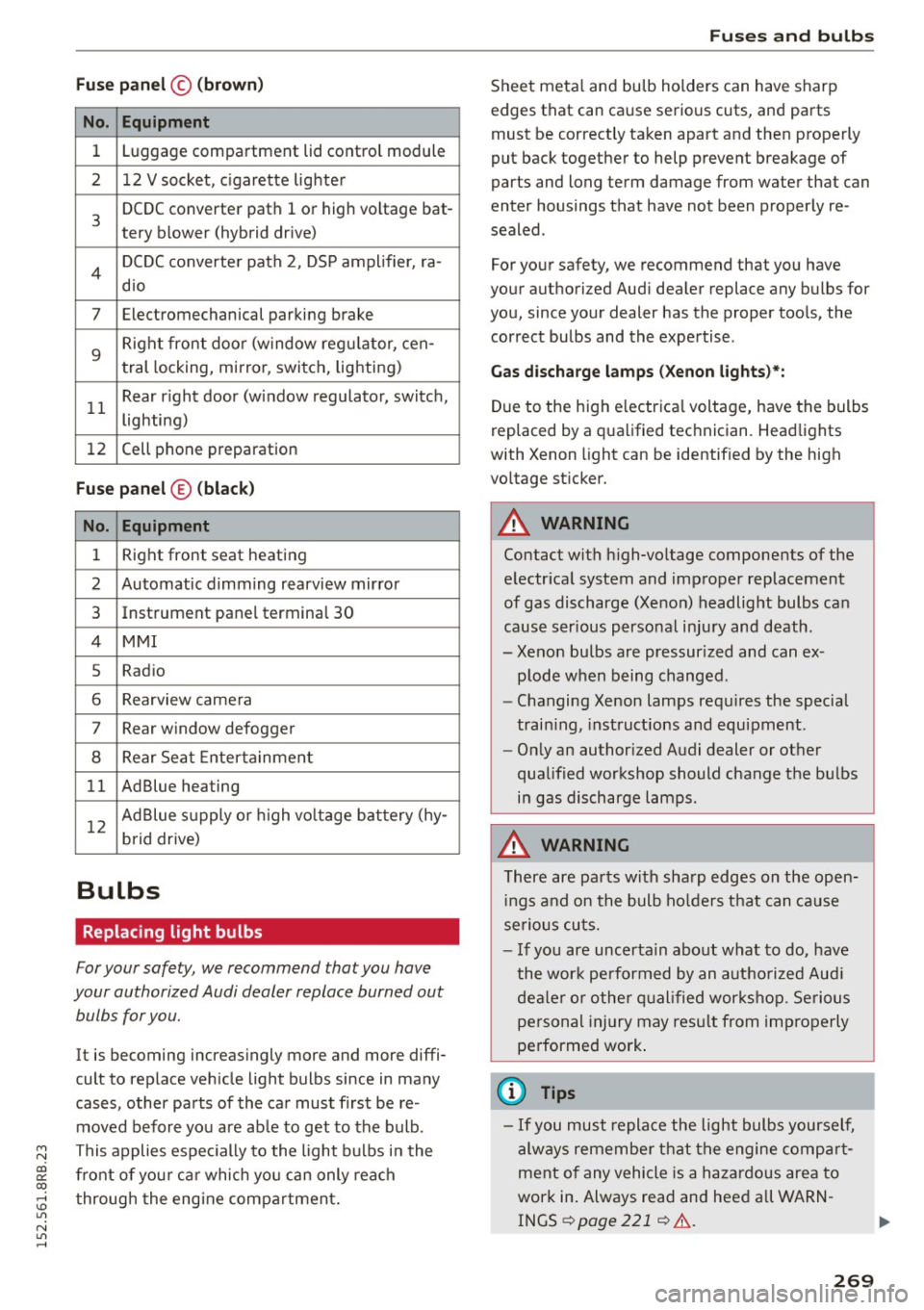
Fuse panel© (brown)
No. Equipment
1 Luggage compartment lid control module
2 12 V socket, c igarette lighter
3
DCDC converter path 1 or high vo ltage bat-
tery blower (hybrid drive)
4 DCDC converter path 2, DSP amplifier, ra-
dio
7 Electromechanical parking brake
9
Right front doo r (window reg ulator, cen-
tral locking, mirror, switch, lighting)
11 Rear r
ight door (window regulator, switch,
lighting)
12 Cell phone
preparation
Fuse panel ® (black)
No. Equipment
1 Right front seat heating
2 Automatic dimming rearview mirror
3 Instrument panel terminal 30
4 MMI
5 Radio
6 Rearview came
ra
7 Rear window defogger
8 Rear Seat Entertainment
11 AdBlue heating
12 Ad
Blue supply or high voltage battery (hy-
brid drive)
Bulbs
Replacing light bulbs
For your safety, we recommend that you have
your authorized Audi dealer replace burned out bulbs for you.
It is becoming increasingly more and more diffi
cult to replace vehicle light bulbs since in many
cases, other parts of the car must first be re
moved before you are ab le to get to the bulb.
This applies espec ially to the light bulbs in the
front of you r car which you can only reach
through the engine compartment.
Fuses and bulbs
Sheet metal and bulb holders can have sharp
edges that can cause serious cuts, and parts
must be correctly taken apart and then properly
put back together to help prevent breakage of
parts and long term damage from water that can
enter housings that have not been proper ly re
sealed .
For your safety, we recommend that you have
your authorized Aud i dealer replace any bulbs for
you, since your dealer has the proper too ls, the
correct bulbs and the expertise .
Gas discharge lamps (Xenon lights )*:
Due to the high e lectrica l voltage, have the bulbs
replaced by a qualified technician. Headlights
with Xenon light can be identif ied by the high
vo ltage sticker.
A WARNING
Contact with high-voltage components of the
electr ical system and improper replacement
of gas discharge (Xenon) headlight bulbs can
cause ser ious personal injury and death.
- Xenon bulbs are pressur ized and can ex-
plode when being changed.
- Changing Xenon lamps requ ires the special
train ing, instructions and equipment.
- Only an authorized Audi dealer or other
qualified workshop should change the bulbs
in gas discharge lamps.
A WARNING "'--
There are parts with sharp edges on the open-
in gs and on the bulb holders that can cause
serious cuts.
- If you are uncertain about what to do, have
the wor k performed by an authorized Aud i
dealer or other qualified workshop. Serious
personal injury may resu lt from improperly
performed work .
(D Tips
-If you must replace the light bulbs yourself,
always remember that the engine compart
ment of any vehicle is a hazardous area to
work in . Always read and heed all WARN
INGS¢ page 221 ¢ .&,.
269