2014 VOLVO V60 ECO mode
[x] Cancel search: ECO modePage 197 of 442

07 Driver support
07
}}
* Option/accessory, for more information, see Introduction.195
Adaptive Cruise Control* - Queue Assist
The adaptive cruise control (ACC – Adaptive Cruise Control) helps the driver to maintain aneven speed and a safe distance from the vehi-cle ahead. Queue Assist also provides theAdaptive Cruise Control with enhanced func-tionality at speeds below 30 km/h.. In cars with automatic gearbox the adaptive cruise control is supplemented with theQueue Assist function (also referred to as"Queue Assist"). Queue Assistant has the following functions:
• Extended speed range - also below 30 km/h and when stationary
• Change of target
• Automatic braking ceases when station-ary
• Automatic activation parking brake.
Note that the lowest programmable speed for the adaptive cruise control is 30 km/h - eventhough it is capable of following another vehi-cle down to a standstill, a lower speed can-
not be selected.
Extended speed range
NOTE
In order to activate the cruise control the driver's door must be closed and the drivermust be wearing the seatbelt.
With an automatic gearbox, the adaptive cruise control can follow another vehiclewithin the range 0-200 km/h.
NOTE
Activation of the cruise control below 30 km/h requires a vehicle in front within areasonable distance.
For shorter stops in connection with inching in slow traffic or at traffic lights driving isautomatically resumed if the stops do notexceed about 3 seconds - if it takes longerbefore the car in front starts moving againthen the Adaptive cruise control is set instandby mode with automatic braking. Thedriver must then reactivate it in one of the fol-lowing ways:
• Press the steering wheel button
.
or
• Depress the accelerator pedal.
> The cruise control will then resume fol- lowing the vehicle in front.
NOTE
Queue Assist can hold the car stationary for a maximum of 4 minutes - then theparking brake is applied and Cruise Con-trol is disengaged.
• The driver has to release the parking brake before the cruise control can bereactivated.
Change of target
If the target vehicle in front suddenly turns then there may be stationary traffic in front.
When the adaptive cruise control is following another vehicle at speeds below 30 km/h and
changes target from a moving to a stationaryvehicle, the cruise control will slow down forthe stationary vehicle.
ProCarManuals.co’
Page 198 of 442

||
07 Driver support
07
196* Option/accessory, for more information, see Introduction.
WARNING
When the cruise control is following another vehicle at speeds in excess of
30 km/h and the target is changed from amoving vehicle to a stationary vehicle, thecruise control will ignore the stationaryvehicle and instead select the storedspeed. • The driver must intervene him/herself and brake.
Automatic standby mode with change of target
The adaptive cruise control is disengaged and set in standby mode:
• when the speed is below 5 km/h and cruise control is not sure whether the tar-get object is a stationary vehicle or someother object, e.g. a speed bump.
• when the speed is below 5 km/h and thevehicle in front turns off so the cruisecontrol no longer has a vehicle to follow.
Termination of automatic braking at a
standstill
In certain situations, Queue Assist stops automatic braking at a standstill. This meansthat the brakes are released and the car maystart to roll - the driver must therefore inter-vene and brake the car himself/herself inorder to maintain its position. Queue Assist releases the foot brake and setsthe adaptive cruise control in standby modein the following situations:
• the driver puts his/her foot on the brake pedal
• the parking brake is applied
• the gear selector is moved to
P, N or R
position
• the driver sets the cruise control instandby mode.
Automatic activation parking brakeIn certain situations Queue Assist applies the parking brake in order to keep the car remain-ing stationary. This takes place if:
• the driver opens the door or takes off his/her seatbelt
• DSTC is changed from
Normal to Sport
mode
• Queue Assist has held the car stationaryfor more than 4 minutes
• the engine is switched off
• the brakes have overheated.
Related information
•Adaptive cruise control - ACC* (p. 188)
• Adaptive cruise control* - overview (p.190)
• Adaptive cruise control* - function (p.189)
Adaptive cruise control* - switch cruise control functionality
The adaptive cruise control (ACC – Adaptive Cruise Control) helps the driver maintain asafe distance from the vehicle ahead.
Changing from ACC to CCWith one press of the button the adaptivepart (spacing system) in the cruise control isdeactivated, at which point the car just fol-lows the set speed.
• Give a
long press on the steering wheel
button
- the combined instrument
panel's symbol changes from
to .
> By these means the standard cruise con- trol (p. 185) CC (Cruise Control) is activated.
WARNING
The car no longer brakes automatically after switching from ACC to CC - it merelyfollows the set speed.
Changing back from CC to ACCSwitch off cruise control with 1-2 presses on
in accordance with the deactivation
instructions (p. 194). The next time the sys- tem is switched on it is the Adaptive cruisecontrol that is activated.
ProCarManuals.co’
Page 202 of 442

07 Driver support
07
200* Option/accessory, for more information, see Introduction.
Adaptive cruise control* - symbols and messages
The adaptive cruise control (ACC – Adaptive Cruise Control) helps the driver to maintain an even speed and a safe distance from the vehi-cle ahead. Sometimes the adaptive cruisecontrol may display a symbol and/or text
message. Here are several examples - followthe recommendation given if appropriate:
SymbolMessageSpecification
The symbol is GREENThe car maintains the stored speed.
The symbol is WHITEAdaptive cruise control is set to standby mode.
Standard cruise control is selected manually.
DSTC Normal to enable CruiseThe adaptive cruise control cannot be activated until the Stability and Traction Control system (DSTC) (p. 175) has been set in Normal mode.
Cruise control Cancel- ledThe adaptive cruise control has been deactivated - the driver has to regulate the speed himself.
Cruise control Unavail- ableThe adaptive cruise control cannot be activated. This could be due to:
• brake temperature is high
• the radar sensor is blocked by e.g. wet snow or rain.
Radar blocked See manualThe adaptive cruise control is temporarily disengaged.
• The radar sensor is blocked and cannot detect other vehicles. For example, in the event of heavy rain or if slush has collected in front of the radar sensor.
The driver can then choose to switch to (p. 196) normal Cruise control (CC) - a text message provides information on appropriate alternatives. Read about radar sensor limitations (p. 197).
ProCarManuals.co’
Page 204 of 442

07 Driver support
07
202* Option/accessory, for more information, see Introduction.
Distance Warning*
Distance Warning (Distance Alert) is a function that informs the driver about the time intervalto vehicles in front. Distance Warning is active at speeds above 30 km/h and only reacts to vehicles driving infront of the car, in the same direction. No dis-tance information is provided for oncoming,slow or stationary vehicles.
Orange-coloured warning lamp 12
.
An orange-coloured warning lamp in the
windscreen illuminates with a constant glow if the distance to the vehicle in front is shorterthan the set time interval.
NOTE
Distance warning is deactivated during the time the adaptive cruise control is active.
WARNING
Distance warning only reacts if the dis- tance to the vehicle ahead is shorter thanthe preset value - the speed of the driver'svehicle is not affected.
Operation
Press the button in the centre console to switch the function on or off. The function isswitched on if one lamp is illuminated in thebutton. Some combinations of the selected equip- ment leave no vacant space for a button inthe centre console - in which case the func- tion is handled by the car's menu system
MY
CAR , see MY CAR (p. 103).
Set time interval
Controls and symbol for time interval.
Time interval - Increase/decrease.
Time interval - On.
Different time intervals to the vehicle in front can beselected and shown in thecombined instrument panelas 1-5 horizontal lines - themore lines the longer thetime interval. One line corre-
sponds to approximately 1 second to thevehicle in front, 5 linesapproximately 3 seconds.
12 NOTE: The illustration is schematic - details may vary depending on car model.
ProCarManuals.co’
Page 206 of 442

07 Driver support
07
204* Option/accessory, for more information, see Introduction.
Distance Warning* - symbols and messages
Distance Warning (Distance Alert) is a function that informs the driver about the time interval to vehicles in front. The function has certainlimitations.
Symbol
AMessageSpecification
Radar blocked See manualDistance Warning temporarily disengaged. The radar sensor is blocked and cannot detect other vehicles, e.g. in the event of heavy rain or if slush has collected in front of the radar sensor. Read about radar sensor limitations (p. 197).
Collision warn. Service requiredDistance Warning and Collision Warning with Auto Brake fully or partially disengaged. Visit a workshop if the message remains - an authorised Volvo workshop is recommended.
A
Symbols are schematic - may vary by market and car model.
Related information
• Distance Warning* (p. 202)
• Distance Warning* - limitations (p. 203)
ProCarManuals.co’
Page 225 of 442
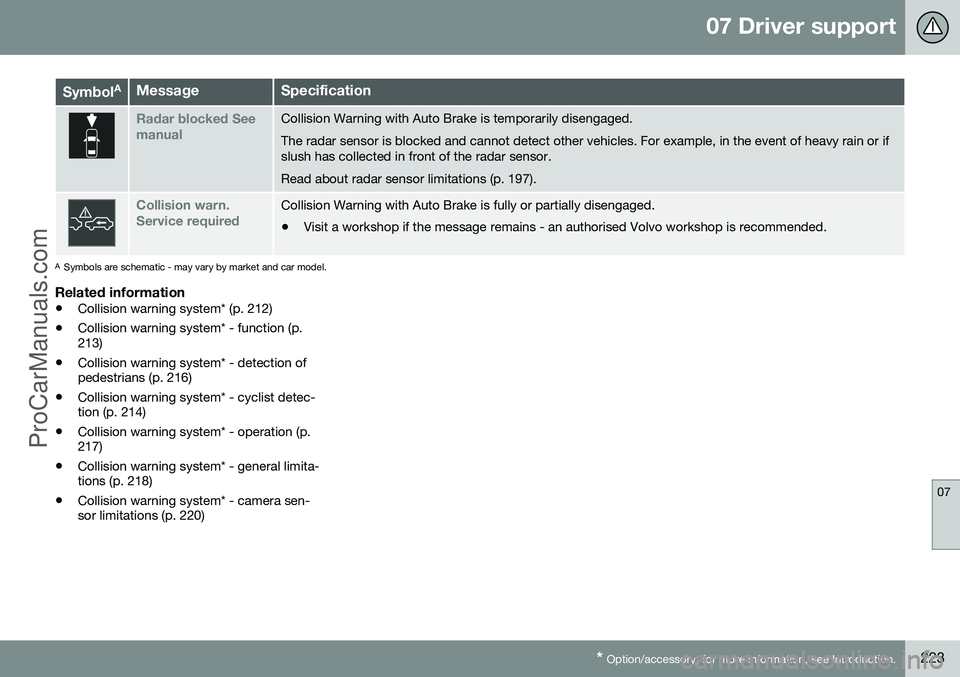
07 Driver support
07
* Option/accessory, for more information, see Introduction.223
Symbol AMessageSpecification
Radar blocked See manualCollision Warning with Auto Brake is temporarily disengaged. The radar sensor is blocked and cannot detect other vehicles. For example, in the event of heavy rain or if slush has collected in front of the radar sensor. Read about radar sensor limitations (p. 197).
Collision warn. Service requiredCollision Warning with Auto Brake is fully or partially disengaged.
• Visit a workshop if the message remains - an authorised Volvo workshop is recommended.
A
Symbols are schematic - may vary by market and car model.
Related information
• Collision warning system* (p. 212)
• Collision warning system* - function (p. 213)
• Collision warning system* - detection ofpedestrians (p. 216)
• Collision warning system* - cyclist detec-tion (p. 214)
• Collision warning system* - operation (p.217)
• Collision warning system* - general limita-tions (p. 218)
• Collision warning system* - camera sen-sor limitations (p. 220)
ProCarManuals.co’
Page 226 of 442

07 Driver support
07
224* Option/accessory, for more information, see Introduction.
Driver Alert System*
The Driver Alert System is intended to assist drivers whose driving ability is deteriorating orwho are inadvertently leaving the lane they aredriving on. The Driver Alert System consists of different functions which can either be switched on atthe same time or individually:
• Driver Alert Control - DAC (p. 225).
• Lane Departure Warning - LDW (p. 229).
• Lane Keeping Aid - LKA (p. 234)
A switched-on function is set in standbymode and is not activated automatically untilspeed exceeds 65 km/h. The function is deactivated again when speed decreases to below 60 km/h. Both functions use a camera which is dependent on the lane having side markingspainted on each side.
WARNING
Driver Alert System does not work in all situations but is designed merely as a sup-plementary aid. The driver always bears ultimate responsi- bility for ensuring that the vehicle is drivensafely.
Related information
• Driver Alert Control (DAC)* (p. 224)
• Driver Alert Control (DAC)* - symbols and messages (p. 227)
• Driver Alert Control (DAC)* - operation (p.225)
• Lane Departure Warning (LDW)* (p. 229)
• Lane Keeping Aid (LKA)* (p. 234)
Driver Alert Control (DAC)*
The DAC function is intended to attract the driver's attention when he/she starts to driveless consistently, e.g. if he/she becomes dis-tracted or starts to fall asleep. The objective for DAC is to detect slowly deteriorating driving ability and it is primarilyintended for major roads. The function is notintended for city traffic.
A camera detects the side markings painted on the carriageway and compares the sectionof the road with the driver's steering wheelmovements. The driver is alerted if the vehicledoes not follow the carriageway evenly. In some cases driving ability is not affected despite driver fatigue. In which case theremay not be any warning issued for the driver.For this reason it is always important to stopand take a break in the event of any signs of
ProCarManuals.co’
Page 229 of 442

07 Driver support
07
}}
* Option/accessory, for more information, see Introduction.227
Driver Alert Control (DAC)* - symbols and messages
DAC (p. 224) can show symbols and text messages on the combined instrument panel or in the centre console's display screen indifferent situations.
Combined instrument panel
Symbol
AMessageSpecification
Driver Alert Time for a breakThe vehicle has been driven inconsistently - the driver is alerted by an acoustic warning signal + text.
Windscreen Sensors blockedThe camera sensor is temporarily disengaged. Shown in the event of snow, ice or dirt on the windscreen for example.
• Clean the windscreen surface in front of the camera sensor.
Read about camera sensor limitations (p. 220).
Driver Alert Sys Service requiredThe system is disengaged.
• Visit a workshop if the message remains - an authorised Volvo workshop is recommended.
A
Symbols are schematic - may vary by market and car model.
Display
Sym-
bol AMessageSpecification
Driver Alert OFFThe function is disengaged.
Driver Alert AvailableThe function is activated.
ProCarManuals.co’