2014 VOLVO V60 power steering
[x] Cancel search: power steeringPage 259 of 442
07 Driver support
07
* Option/accessory, for more information, see Introduction.257
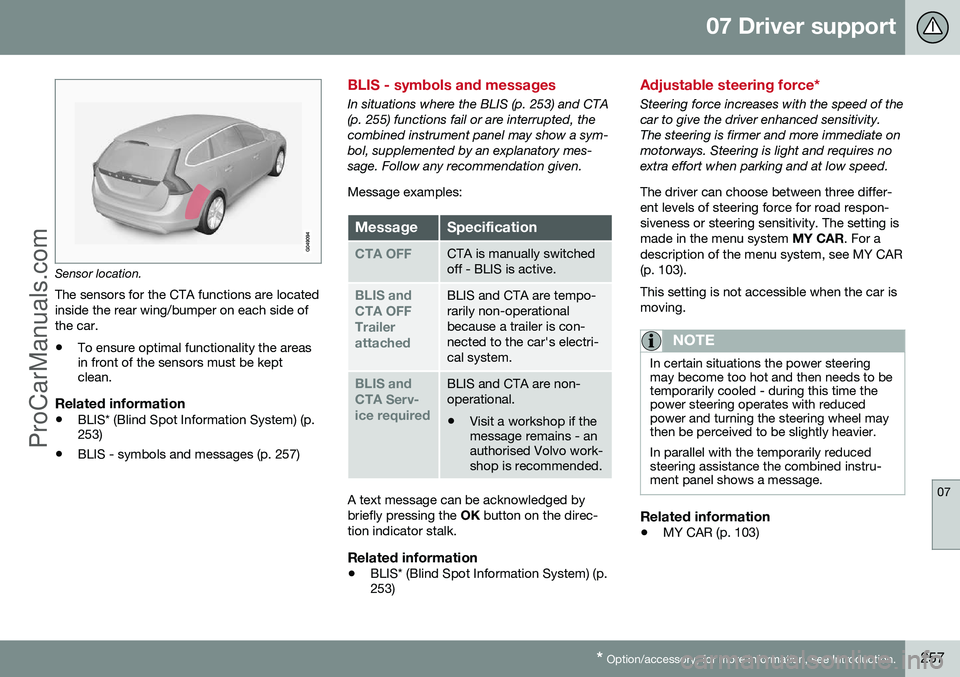
Sensor location.
The sensors for the CTA functions are located inside the rear wing/bumper on each side ofthe car.
• To ensure optimal functionality the areas in front of the sensors must be keptclean.
Related information
•BLIS* (Blind Spot Information System) (p.253)
• BLIS - symbols and messages (p. 257)
BLIS - symbols and messages
In situations where the BLIS (p. 253) and CTA (p. 255) functions fail or are interrupted, thecombined instrument panel may show a sym-bol, supplemented by an explanatory mes-sage. Follow any recommendation given. Message examples:
MessageSpecification
CTA OFFCTA is manually switched off - BLIS is active.
BLIS and CTA OFFTrailerattachedBLIS and CTA are tempo- rarily non-operationalbecause a trailer is con-nected to the car's electri-cal system.
BLIS and CTA Serv-ice requiredBLIS and CTA are non- operational.
• Visit a workshop if the message remains - anauthorised Volvo work-shop is recommended.
A text message can be acknowledged by briefly pressing the
OK button on the direc-
tion indicator stalk.
Related information
• BLIS* (Blind Spot Information System) (p. 253)
Adjustable steering force*
Steering force increases with the speed of the car to give the driver enhanced sensitivity.The steering is firmer and more immediate onmotorways. Steering is light and requires noextra effort when parking and at low speed. The driver can choose between three differ- ent levels of steering force for road respon-siveness or steering sensitivity. The setting ismade in the menu system
MY CAR. For a
description of the menu system, see MY CAR(p. 103). This setting is not accessible when the car is moving.
NOTE
In certain situations the power steering may become too hot and then needs to betemporarily cooled - during this time thepower steering operates with reducedpower and turning the steering wheel maythen be perceived to be slightly heavier. In parallel with the temporarily reduced steering assistance the combined instru-ment panel shows a message.
Related information
• MY CAR (p. 103)
ProCarManuals.co’
Page 308 of 442

||
08 Starting and driving
08
306* Option/accessory, for more information, see Introduction.
• For lowest fuel consumption, activate ECO (p. 288)* 16
.
• Use the ECO Guide which indicates how fuel-efficiently the car is being driven, seeEco guide & Power guide* (p. 63).
• Drive in the highest gear possible, adap-ted to the current traffic situation androad - lower engine speeds result in lowerfuel consumption. Use the gear indicator(p. 272).
• Avoid sudden unnecessary accelerationand heavy braking.
• High speed results in increased fuel con-sumption - the wind resistance increaseswith speed.
• Do not run the engine to operating tem-perature at idling speed, but rather drivewith a light load as soon as possible - acold engine consumes more fuel than awarm one.
• Drive with the correct air pressure in thetyres and check this regularly - selectECO tyre pressure for best results, seeTyres - approved tyre pressures (p. 407).
• Choice of tyres can affect fuel consump-tion - seek advice on suitable tyres from adealer.
• Remove unnecessary items from the car -the greater the load the higher the con-sumption. •
Use engine braking to slow down, when itcan take place without risk to other roadusers.
• A roof load and ski box increase air resis-tance, leading to higher consumption -remove the load carriers when not in use.
• Avoid driving with open windows.
For information about Volvo Car Corpora- tion's environmental philosophy, see VolvoCars' environmental philosophy (p. 19). For more information about fuel consumption, see Fuel consumption and CO2 emissions (p.403).
WARNING
Never switch off the engine while moving, such as downhill, this deactivates impor-tant systems such as the power steeringand brake servo.
Related information
• Fuel - handling (p. 301)
• Fuel consumption and CO2 emissions (p. 403)
• Fuel tank - volume (p. 402)
Driving with a trailer
When driving with a trailer there are a number of important points to think about regardinge.g. the towing bracket, the trailer and howthe load is positioned in the trailer. Payload depends on the car's kerb weight. The total of the weight of the passengers andall accessories, e.g. towbar, reduces the car'spayload by a corresponding weight. For moredetailed information on weights, see Weights(p. 390). If the towing bracket is mounted by Volvo, then the car is delivered with the necessaryequipment for driving with a trailer. • The car's towing bracket must be of an approved type.
• If the towbar is retrofitted, check withyour Volvo dealer that the car is fullyequipped for driving with a trailer.
• Distribute the load on the trailer so thatthe weight on the towing bracket com-plies with the specified maximum towballload.
• Increase the tyre pressure to the recom-mended pressure for a full load. For tyrepressure label location, see Tyres - airpressure (p. 328).
• The engine is loaded more heavily thanusual when driving with a trailer.
16
Only applies to cars with automatic gearbox.
ProCarManuals.co’
Page 314 of 442

||
08 Starting and driving
08
312
Push in the locking wheel and turn it
anticlockwise
until you hear a click.
Turn the locking wheel down fully, until it comes to a stop. Hold it in this positionwhile pulling the towbar rearward andupward.
WARNING
Secure the towbar safely if it is stored in the car, see Detachable towbar - storage(p. 309).
G018929
Push the protective cover until it snaps tight.
Related information
• Detachable towbar - storage (p. 309)
• Detachable towbar - specifications (p. 309)
• Driving with a trailer (p. 306)
Trailer stabiliser - TSA 17
The trailer stability assist (TSA - Trailer Stability Assist) function is designed to stabi-lise the car and trailer combination if it beginsto snake. The trailer stability assist is included in the stability and traction control system (p. 175)(DSTC - Dynamic Stability and TractionControl).
FunctionThe snaking phenomenon can occur with anycar/trailer combination. Snaking normallyoccurs at high speeds. But, there is a risk of itoccurring at lower speeds (70-90 km/h) if thetrailer is overloaded or the load is improperlydistributed, e.g. too far back. In order for snaking to occur, there must be a triggering factor, e.g.:
• Car with trailer subjected to a sudden and powerful side wind.
• Car with trailer drives on an uneven roadsurface or in a pothole.
• Sweeping steering wheel movements.
OperationIf snaking has started, it could be difficult or even impossible to suppress. This makes thecar/trailer combination difficult to control andthere is a risk that you could, for example,
17
Included in the installation of Volvo genuine towbar.
ProCarManuals.co’
Page 315 of 442

08 Starting and driving
08
313
end up in the wrong lane or leave the car- riageway. The trailer stability assist continually monitors the car's movements, particularly lateralmovements. If snaking is detected, the frontwheels are individually braked. This serves tostabilise the car/trailer combination. This isoften enough to help the driver regain controlof the car. If snaking is not eliminated the first time the trailer stability assist comes into action, thecar/trailer combination is braked with allwheels and engine power is reduced. Oncesnaking has been gradually suppressed andthe car/trailer combination is stable onceagain, the system stops regulating and thedriver once again has full control of the car.For more information, see Stability and trac-tion control system (DSTC) - operation (p.176)
MiscellaneousThe trailer stability assist can engage withinthe speed interval 60-160 km/h.
NOTE
TSA function is switched off if the driver selects Sport mode, see Stability and
traction control system (DSTC) (p. 175).
The trailer stability assist may fail to engage if the driver uses sudden steering wheel move-ments to try to rectify the snaking because in such a situation the system cannot determinewhether it is the trailer or the driver that iscausing the snaking.
When the trailer stability assist isworking, the combined instrument
panel's DSTC symbol flashes.
Related information
•Stability and traction control system (DSTC) - symbols and messages (p. 178)
Towing
During towing, one vehicle is towed by another vehicle using a tow rope.
IMPORTANT
Note that the car must always be towed with the wheels rolling forward. Do not tow the vehicle at speeds higher than 80 km/h or for distances in excess of80 km.
Find out the statutory maximum speed limit for towing before towing begins.
1. Unlock the steering lock by inserting the
remote control key in the ignition switch and giving a long press on the START/
STOP ENGINE button - key position II is
activated, see Key positions (p. 70) formore information about key positions.
2. The remote control key must remain in the ignition switch while the car is beingtowed.
3. Keep the towline taut when the towing vehicle reduces speed by holding yourfoot gently pressed on the brake pedal -thereby avoiding unnecessary jerking.
4. Be prepared to brake to stop.
ProCarManuals.co’
Page 316 of 442

||
08 Starting and driving
08
314
WARNING
•Check that the steering lock is unlocked before towing.
• The remote control key must be in keyposition
II - in position I all airbags are
deactivated.
• Never remove the remote control keyfrom the ignition switch when the caris being towed.
WARNING
The brake servo and power steering do not work when the engine is switched off - thebrake pedal needs to be depressedabout 5 times more heavily and the steer-ing is considerably heavier than normal.
Manual gearboxPrior to towing:
–Move gear lever into neutral and release the parking brake.
Automatic gearbox GeartronicPrior to towing:
–Move the gear selector to position
N and
release the parking brake.
Automatic gearbox PowershiftThe model with Powershift transmission should not be towed as it is dependent on theengine running in order to receive sufficient lubrication. If towing still has to take place,the route must be as short as possible andthen with very low speed. In the event of uncertainty as to whether or not the car is equipped with Powershift trans-mission, this can be verified by checking thedesignation on the gearbox label under thebonnet, see Type designations (p. 386). Thedesignation ”MPS6” means that it isPowershift transmission - otherwise it isGeartronic automatic transmission.
IMPORTANT
Avoid towing.
• However, the car can be towed for a short distance at low speed to move itfrom a dangerous position - not furtherthan 10 km and not faster than10 km/h. Note that the car mustalways be towed with the wheels roll-ing forward.
• In the event of moving a longer dis-tance than 10 km, the car must betransported with the drive wheelsraised from the road - professionalrecovery is recommended.
Prior to towing:
–Move the gear selector to position
N and
release the parking brake.
Jump startingDo not tow the car to bump start the engine. Use a donor battery if the battery is dis-charged and the engine does not start, seeJump starting with battery (p. 270).
IMPORTANT
The catalytic converter may be damaged during attempts to tow-start the engine.
Related information
• Towing eye (p. 315)
ProCarManuals.co’
Page 346 of 442

||
10 Maintenance and service
10
344
WARNING
The ignition system has very high voltage and output. The voltage in the ignition sys-tem is highly dangerous. The car's electri-cal system must always be in key position0 when work is being performed in the
engine compartment; see Key positions -functions at different levels (p. 70). Do not touch the spark plugs or ignition coil when the car's electrical system is inkey position II or when the engine is hot.
Engine compartment except 4 cyl. 2.0 l 2
The appearance of the engine compartment may differ depending on engine variant.
Coolant expansion tank
Power steering fluid reservoir
Engine oil dipstick
3
Radiator
Filling engine oil
Reservoir for brake and clutch fluid (located on the driver's side)
Battery
Relay and fuse box
Filling washer fluid
Air filter
WARNING
The ignition system has very high voltage and output. The voltage in the ignition sys-tem is highly dangerous. The car's electri-cal system must always be in key position0
when work is being performed in the
engine compartment; see Key positions -functions at different levels (p. 70). Do not touch the spark plugs or ignition coil when the car's electrical system is inkey position II or when the engine is hot.
Related information
• Bonnet - opening and closing (p. 343)
• Engine compartment - checking (p. 344)
Engine compartment - checking
Some oils and fluids should be checked at regular intervals.
Regular checkingCheck the following oils and fluids at regularintervals, e.g. when refuelling:
• Coolant
• Engine oil
• Power steering fluid (not cars with 4-cyl. 2.0 litre engine 4
)
• Washer fluid
WARNING
Remember that the radiator fan (located at the front of the engine compartment,behind the radiator) may start automati-cally some after the engine has beenswitched off. Always have the engine cleaned by a workshop. There is a risk of fire if theengine is hot.
Related information
• Bonnet - opening and closing (p. 343)
• Engine compartment - overview (p. 343)
• Coolant - level (p. 349)
• Engine oil - checking and filling (p. 346)
2
Also applies to the B4204T7 engine.3 Engines with electronic oil level sensor do not have a dipstick (5-cyl. diesel).
4 However, does apply to the B4204T7 engine.
ProCarManuals.co’
Page 347 of 442

10 Maintenance and service
10
345
•
Power steering fluid - level (p. 351)
• Washer fluid - filling (p. 361)
Engine oil - general
An approved engine oil must be used in order that the recommended service intervals canbe applied.
Volvo recommends:
When driving under adverse conditions, see Engine oil - adverse driving conditions (p.395).
IMPORTANT
In order to fulfil the requirements for the engine's service intervals all engines arefilled with a specially adapted syntheticengine oil at the factory. The choice of oilhas been made very carefully with regardto service life, starting characteristics, fuelconsumption and environmental impact. An approved engine oil must be used in order that the recommended service inter-vals can be applied. Only use a prescribedgrade of oil for both filling and oil change,otherwise you will risk affecting service life,starting characteristics, fuel consumptionand environmental impact. Volvo Car Corporation disclaims all war- ranty liability if engine oil of the prescribedgrade and viscosity is not used. Volvo recommends that oil changes are carried out at an authorised Volvo work-shop.
Volvo uses different systems for warning of low/high oil level or low/high oil pressure.Certain engine variants have an oil pressuresensor, and then the combined instrumentpanel's warning symbol for low oil pressure isused. Other variants have an oil level sensor,when the driver is informed via the instru- ment's warning symbol
and display
ProCarManuals.co’
Page 353 of 442

10 Maintenance and service
10
351
Filling
The fluid reservoir is located on the driver's side.The fluid reservoir is protected under the cover over the cold zone in the engine com-partment. The round cover must be removedfirst before the reservoir cap can be reached.
Turn and open the cover located on the covering.
Unscrew the reservoir cap and fill the fluid. The level must be between the MIN
and MAX marks, which are located on
the inside of the reservoir.
IMPORTANT
Do not forget to refit the cap.
Power steering fluid - level
The power steering fluid level must be between the MIN and MAX marks. The fluid
does not need to be changed. Cars with the 4-cyl. 2.0 litre engine have no oil reservoir for the power steering 9
.
IMPORTANT
Keep the area around the power steering fluid reservoir clean when checking. Thecover must not be opened.
Check the level frequently. The fluid does not require changing. The fluid level must bebetween the MIN and MAX marks. For rec-
ommended fluid grade, see Power steeringfluid - grade (p. 401).
NOTE
If a fault should arise in the power steering system, or if the engine is switched off andmust be towed, then the car can still besteered.
9 However, cars with the B4204T7 engine have an oil reservoir for the power steering.
ProCarManuals.co’