2014 VOLVO V60 engine
[x] Cancel search: enginePage 363 of 442

10 Maintenance and service
10
361
1. Fold out the wiper arm.
2. Grip the inner section of the blade (by the arrow).
3. Turn anticlockwise to use the blade's end position against the wiper arm as a lever to detach the blade more easily.
4. Press the new wiper blade into position. Check that it is firmly installed.
5. Lower the wiper arm.
CleaningFor cleaning wiper blades and windscreen,see Car washing (p. 379).
IMPORTANT
Check the blades regularly. Neglected maintenance shortens the service life ofthe wiper blades.
Related information
• Washer fluid - filling (p. 361)
Washer fluid - filling
Washer fluid is used for cleaning the head- lamps and windows. Washer fluid with anti-freeze must be used during winter.
The windscreen and headlamp washers share a common reservoir.
IMPORTANT
Use washer fluid with antifreeze during the winter to avoid freezing in the pump, reser-voir and hoses.
For capacities, see Washer fluid - quality and volume (p. 401).
Related information
•Wiper blades (p. 359)
Battery
The service life and function of the battery is influenced by factors such as the number ofstarts, discharging, driving style, driving con-ditions, climatic conditions etc. The starter battery is a traditional 12 V bat- tery.
• Never disconnect the battery when the engine is running.
• Check that the cables to the battery arecorrectly connected and properly tight-ened.
WARNING
•The battery can generate oxyhydrogen gas, which is highly explosive. A sparkcan be formed if a jump lead is con-nected incorrectly, and this can beenough for the battery to explode.
• The battery contains sulphuric acid,which can cause serious burns.
• If sulphuric acid comes into contactwith eyes, skin or clothing, flush withlarge quantities of water. If acidsplashes into the eyes - seek medicalattention immediately.
IMPORTANT
Only a traditional battery charger should ever be used when charging the battery.
ProCarManuals.co’
Page 367 of 442

10 Maintenance and service
10
* Option/accessory, for more information, see Introduction.365
For more information on the car's battery - Electrical system (p. 410).
Battery - Start/Stop
Cars with the Start/Stop function are equip- ped with two 12 V batteries - one extra pow-erful battery for starting and one support bat-tery that helps during the Start/Stop func-tion's starting sequence. For more information on Start/Stop - see Start/Stop* (p. 279). For more information on the car's battery - see Jump starting with battery (p. 270) andStarter battery - specification (p. 411).
BatteryStartingAuxiliary
Cold start capacity
A
,
CCA (A)760180
Size B
,
L×W×H (mm)278×175×190150×90×130
Capacity (Ah)7010
A In accordance with the SAE standard.
B Largest possible size.
IMPORTANT
When replacing batteries in cars with the Start/Stop function, the AGM 12
type bat-
teries must be fitted.
NOTE
• The higher the current take-off in the car (extra cooling/heating, etc.) themore the batteries must be charged =increased fuel consumption.
• When the capacity of the battery hasfallen below the lowest permissiblelevel then the Start/Stop function isdisengaged.
Temporarily reduced Start/Stop function due to high current take-off means: •
The engine starts automatically 13
without
the driver depressing the clutch pedal (manual gearbox).
• The engine starts automatically withoutthe driver lifting his/her foot off the footbrake pedal (automatic gearbox).
12
Absorbed Glass Mat
13 Automatic starting can only take place if the gear lever is in neutral position.
ProCarManuals.co’
Page 368 of 442
||
10 Maintenance and service
10
366
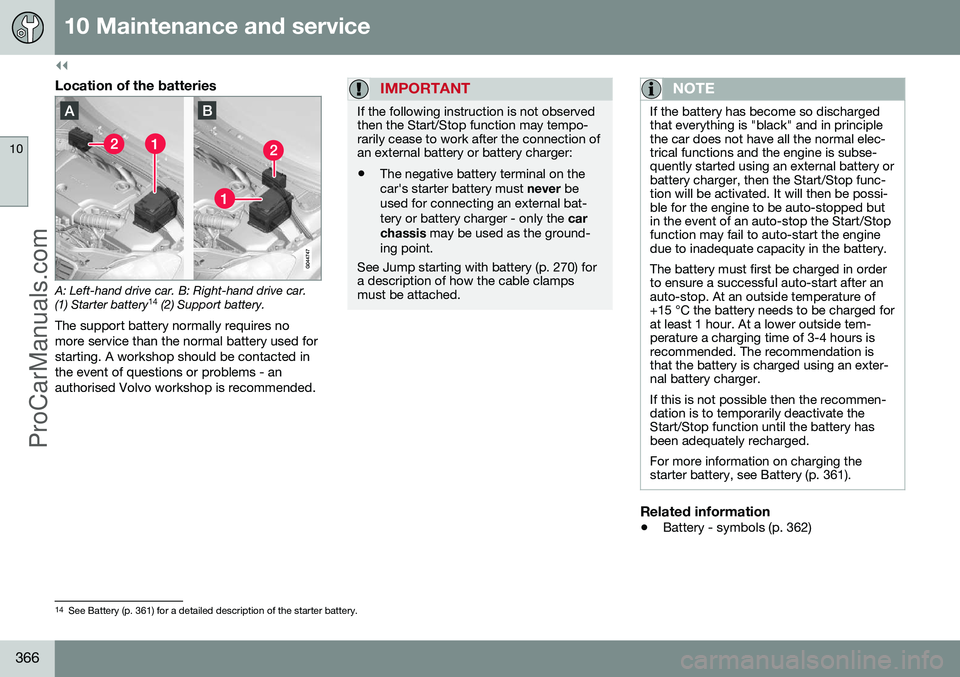
Location of the batteries
A: Left-hand drive car. B: Right-hand drive car. (1) Starter battery14
(2) Support battery.
The support battery normally requires no more service than the normal battery used forstarting. A workshop should be contacted inthe event of questions or problems - anauthorised Volvo workshop is recommended.
IMPORTANT
If the following instruction is not observed then the Start/Stop function may tempo-rarily cease to work after the connection ofan external battery or battery charger:
• The negative battery terminal on the car's starter battery must
never be
used for connecting an external bat-tery or battery charger - only the car
chassis may be used as the ground-
ing point.
See Jump starting with battery (p. 270) for a description of how the cable clampsmust be attached.
NOTE
If the battery has become so discharged that everything is "black" and in principlethe car does not have all the normal elec-trical functions and the engine is subse-quently started using an external battery orbattery charger, then the Start/Stop func-tion will be activated. It will then be possi-ble for the engine to be auto-stopped butin the event of an auto-stop the Start/Stopfunction may fail to auto-start the enginedue to inadequate capacity in the battery. The battery must first be charged in order to ensure a successful auto-start after anauto-stop. At an outside temperature of+15 °C the battery needs to be charged forat least 1 hour. At a lower outside tem-perature a charging time of 3-4 hours isrecommended. The recommendation isthat the battery is charged using an exter-nal battery charger. If this is not possible then the recommen- dation is to temporarily deactivate theStart/Stop function until the battery hasbeen adequately recharged. For more information on charging the starter battery, see Battery (p. 361).
Related information
• Battery - symbols (p. 362)
14
See Battery (p. 361) for a detailed description of the starter battery.
ProCarManuals.co’
Page 369 of 442

10 Maintenance and service
10
367
Fuses - general
All electrical functions and components are protected by a number of fuses in order toprotect the car's electrical system from dam-age by short circuiting or overloading. If an electrical component or function does not work, it may be because the component'sfuse was temporarily overloaded and failed. Ifthe same fuse fails repeatedly then there is afault in the circuit. Volvo recommends thatyou visit an authorised Volvo workshop forchecking.
Changing1. Look in the fuse diagram to locate thefuse.
2. Pull out the fuse and check from the side to see whether the curved wire hasblown.
3. If this is the case, replace it with a new fuse of the same colour and amperage.
WARNING
Never use a foreign object or a fuse with an amperage higher than that specifiedwhen replacing a fuse. This could causesignificant damage to the electrical systemand possibly lead to fire.
Location of central electrical units
Central electrical unit locations in a left-hand drive car. In a right-hand drive car the centralelectrical units under the glovebox changesides.
Engine compartment
Under the glovebox
Under the glovebox
Cargo area under the cargo floor
Engine compartment cold zone (only Start/Stop)
Related information
• Fuses - in engine compartment (p. 368)
• Fuses - under glovebox (p. 372)
• Fuses - in the control module under the glovebox (p. 374)
• Fuses - in cargo area (p. 376) •
Fuses - in the engine compartment's coldzone (p. 377)
ProCarManuals.co’
Page 370 of 442

10 Maintenance and service
10
368
Fuses - in engine compartment
Fuses in the engine compartment protect engine and brake functions, amongst otherthings.
ProCarManuals.com
Page 371 of 442

10 Maintenance and service
10
}}
* Option/accessory, for more information, see Introduction.369
General fuses, engine compartmentOn the inside of the cover there are tweezers that facilitate the procedure for the removaland fitting of fuses.
Positions (see preceding illustration)Engine compartment, upper
Engine compartment, front
Engine compartment, lower
These fuses are all located in the engine com- partment box. The fuses in (C) are locatedunder (A). On the inside of the cover is a label that shows the location of the fuses. • Fuses 1-7 and 42-44 are of the "Midi Fuse" type and must only be replaced by a workshop 15
.
• Fuses 8-15 and 34 are of the "JCASE" type and should be replaced by a work- shop 15
• Fuses 16-33 and 35-41 are of the "Mini Fuse" type.
FunctionA
Primary fuse for the central electronic module (CEM) under the glovebox A50
Primary fuse for the central electronic module (CEM) underthe glovebox50
Primary fuse for central electri- cal unit in cargo area
A60
Primary fuse for relay/fuse box under the gloveboxA60
Primary fuse for relay/fuse box under the gloveboxA60
––
Electric additional heater* A100
Heated windscreen*, left-hand side40
Windscreen wipers30
Parking heater*25
Ventilation fanA40
Heated windscreen*, right- hand side40
FunctionA
ABS pump40
ABS valves20
Headlamp washer*20
Headlamp levelling*; Active Xenon headlamps - ABL*10
Primary fuse for the central electronic module (CEM) underthe glovebox20
ABS5
Adjustable steering force*5
Engine control module; Trans- mission control module; Air-bags10
Heated washer nozzles*10
––
Light switches5
––
––
––
15
An authorised Volvo workshop is recommended.
ProCarManuals.co’
Page 372 of 442

||
10 Maintenance and service
10
370* Option/accessory, for more information, see Introduction.
FunctionA
Relay coils5
Auxiliary lamps*20
Horn15
Relay coil in main relay for engine management system;Engine control module (4-cyl. 2.0 l B
, 5, 6-cyl.)10
Transmission control module15
Solenoid clutch A/C (not 4-cyl. 2.0 l C
, not 5-cyl. diesel); Sup-
porting coolant pump (4-cyl. 2.0 l diesel)15
Relay coil in relay for solenoid clutch A/C (not 5-cyl. diesel);Relay coil in relay for coolantpump (1.6 l petrol Start/Stop);Relay coils in central electricalunit in engine compartmentcold zone (Start/Stop)5
Start relay A30
FunctionA
Ignition coils (1.6 l petrol, engine B4204T7); Glow controlmodule (5-cyl. diesel)10
Engine control module (4-cyl. 2.0 l
B
); Ignition coils (5, 6-cyl.
petrol); Capacitor (6-cyl.)20
Engine control module (petrol except 4-cyl. 2.0 l C
)10
Engine control module (1.6 l diesel, 5-cyl. diesel)15
Engine control module (4-cyl. 2.0 l B
)20
FunctionA
Valves (1.6 l petrol); mass air flow sensor (1.6 l, 4-cyl. 2.0 l B
);
Thermostat (4-cyl. 2.0 l pet-rol B
); EVAP valve (4-cyl. 2.0 l
petrol B
); Cooling valve for cli-
mate control system (4-cyl. 2.0 l diesel); Cooling pump for EGR(4-cyl. 2.0 l diesel) Mass air flow sensor (engine D4162T); Control valve, fuelflow (engine D4162T)10
Mass air flow sensor (5-cyl. diesel, 6-cyl.); Control valves(5-cyl. diesel); Injectors (5, 6-cyl. petrol); Engine controlmodule (5-cyl. petrol, 6-cyl.)15
ProCarManuals.co’
Page 373 of 442

10 Maintenance and service
10
371
FunctionA
Solenoid clutch A/C (5, 6-cyl.); Valves (1.6 l, engine B4204T7;5-cyl., 6-cyl.); Engine controlmodule (6-cyl.); Solenoids (6-cyl. without turbo); Actuatormotors, intake manifold (6-cyl.without turbo); Mass air flowsensor (engine B4204T7; 5-cyl.petrol); Oil level sensor (5-cyl.diesel)10
Valves (4-cyl. 2.0 lB
); Oil pump
(4-cyl. 2.0 l petrol B
); Lambda-
sond, centre (4-cyl. 2.0 l pet- rol B
); Lambda-sond, rear (4-cyl.
2.0 l diesel)15
Lambda-sonds (1.6 l petrol, engine B4204T7); Lambda-sond (5-cyl. diesel); Controlmodule, radiator roller cover(1.6 l diesel, 5-cyl. diesel)10
Lambda-sond, front (4-cyl. 2.0 l B
); Lambda-sond, rear (4-
cyl. 2.0 l petrol B
); EVAP valve
(5, 6-cyl. petrol); Lambda- sonds (5, 6-cyl. petrol)15
FunctionA
Coolant pump (1.6 l petrol Start/Stop); Crankcase ventila-tion heater (5-cyl. petrol); Oilpump automatic gearbox(5-cyl.petrol Start/Stop)10
Ignition coils (4-cyl. 2.0 l pet- rol B
)15
Diesel filter heater20
Control module, radiator roller cover (5-cyl. petrol)5
Crankcase ventilation heater (5-cyl. diesel); Oil pump auto-matic gearbox (5-cyl. dieselStart/Stop)10
Solenoid clutch A/C (4-cyl. 2.0 l B
); Glow control module (4-
cyl. 2.0 l diesel); Oil pump (4- cyl. 2.0 l diesel)15
Coolant pump (4-cyl. 2.0 l pet- rol B
)50
Glow plugs (diesel)70
FunctionA
Cooling fan (1.6 l, 4-cyl. 2.0 l petrol, 5-cyl. petrol)60
Cooling fan (6-cyl., 4-cyl. 2.0 l diesel, 5-cyl. diesel)80
Power steering100
A For cars with the Start/Stop function this fuse location is empty - see instead Fuses - in the engine compartment'scold zone (p. 377).
B Does not apply to the B4204T7 engine.
C However, does apply to the B4204T7 engine.
Related information
• Fuses - under glovebox (p. 372)
• Fuses - in the control module under the glovebox (p. 374)
• Fuses - in cargo area (p. 376)
ProCarManuals.co’