2014 VOLVO V60 light
[x] Cancel search: lightPage 281 of 442
08 Starting and driving
08
* Option/accessory, for more information, see Introduction.279
Related information
• Automatic gearbox -- Geartronic* (p. 273)
• Automatic gearbox -- Powershift* (p. 276)Hill start assist (HSA)* 12
The foot brake can be released before setting off or reversing uphill - the HSA (Hill StartAssist) function means that the car does notroll backwards. The function means that the pedal pressure in the brake system remains for several secondswhile the driver's foot is moved from brakepedal to accelerator pedal. The temporary braking effect releases after several seconds or when the driver acceler-ates.
Related information
•
Starting the engine (p. 264)
Start/Stop*
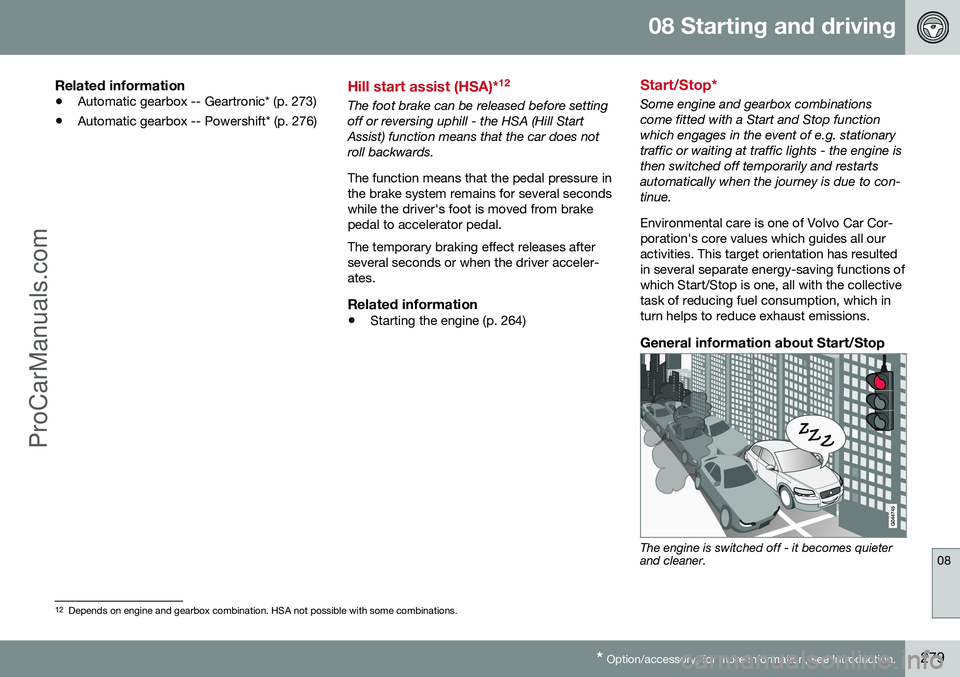
Some engine and gearbox combinations come fitted with a Start and Stop functionwhich engages in the event of e.g. stationarytraffic or waiting at traffic lights - the engine isthen switched off temporarily and restartsautomatically when the journey is due to con-tinue. Environmental care is one of Volvo Car Cor- poration's core values which guides all ouractivities. This target orientation has resultedin several separate energy-saving functions ofwhich Start/Stop is one, all with the collectivetask of reducing fuel consumption, which inturn helps to reduce exhaust emissions.
General information about Start/Stop
The engine is switched off - it becomes quieter and cleaner.
12
Depends on engine and gearbox combination. HSA not possible with some combinations.
ProCarManuals.co’
Page 282 of 442

||
08 Starting and driving
08
280* Option/accessory, for more information, see Introduction.
The Start/Stop function gives the driver the opportunity for a more active environmentallyconscious way of driving the car by means ofbeing able to allow the engine to stop auto-matically, whenever appropriate. Manual or Automatic Note that there are differences in the Start/Stop function depending on whether thegearbox is manual or automatic.
Related information
• Start/Stop* - function and operation (p. 280)
• Starting the engine (p. 264)
• Start/Stop* - settings (p. 285)
• Start/Stop* - the engine does not auto-start (p. 284)
• Start/Stop* - the engine auto-starts (p.283)
• Start/Stop* - the engine does not stop (p.282)
• Start/Stop* - involuntary engine stoppagemanual gearbox (p. 284)
• Start/Stop* - symbols and messages (p.286)
• Battery - Start/Stop (p. 365)
Start/Stop* - function and operation
Some engine and gearbox combinations are equipped with a Start/Stop function whichengages in the event of e.g. stationary trafficor waiting at traffic lights. The Start/Stopfunction is activated automatically when theengine is started with the key.
The Start/Stop function isactivated automatically whenthe engine is started with thekey. The driver is madeaware of this by the func-tion's symbol illuminating inthe combined instrumentpanel and the On/Off buttonlamp illuminating. All of the car's normal sys-
tems such as lighting, radio, etc. work as nor- mal even with an engine that has stoppedautomatically, except that some equipmentmay have the function temporarily reduced,e.g. the climate control system's fan speed orextremely high volume on the audio system.
Engine auto-stopThe following is required for the engine to auto-stop:
ConditionsM/A A
Declutch, set the gear lever in neu- tral position and release the clutchpedal - the engine stops automati-cally.M
Stop the car with the foot brake, and then keep your foot on thepedal - the engine auto-stops.A
AM = Manual gearbox, A = Automatic gearbox.
If the ECO function is acti- vated then the engine mayauto-stop before the car iscompletely stationary.
As verification and reminder that the engine is auto-stopped the com-bined instrument panel's symbol forthe Start/Stop function illuminates.
ProCarManuals.co’
Page 284 of 442

08 Starting and driving
08
282* Option/accessory, for more information, see Introduction.
Start/Stop* - the engine does not stop
Some engine and gearbox combinations are equipped with a Start/Stop function whichengages in the event of e.g. stationary trafficor waiting at traffic lights. Although theStart/Stop function is activated, the enginedoes not always stop automatically. The engine does not auto-stop if:
ConditionsM/A A
the car has not first reached approx. 8 km/h after a key start orthe last auto-stop.M + A
the driver has unbuckled the seat- belt.M + A
battery capacity is below the mini- mum permitted level.M + A
the engine does not have normal operating temperature.M + A
outside temperature is below freezing point or aboveapprox. 30 °C.M + A
the windscreen's electric heating is activated.M + A
ConditionsM/AA
the environment in the passenger compartment deviates from thepreset values - indicated by theventilation fan running at a highspeed.M + A
the car is reversed.M + A
the starter battery temperature is below the freezing point or is toohigh.M + A
the driver makes greater steering wheel movements.M + A
the exhaust system's particulate filter is full - the temporarily disen-gaged Start/Stop function is reac-tivated as soon as an automaticcleaning cycle has been per-formed (see Diesel particle filter(DPF) (p. 305)).M + A
the road is very steep.M + A
a trailer is connected electrically to the car’s electrical system.M + A
the bonnet has been opened
B
.M + A
the gearbox does not have normal operating temperature.A
ConditionsM/A A
the atmospheric air pressure is less than equivalent to 1500-2500metres above sea level - the cur-rent air pressure varies with theprevailing weather conditions.A
adaptive cruise control Queue Assist is activated.A
the gear selector is in
S position C
or " +/-".A
A
M = Manual gearbox, A = Automatic gearbox.
B With certain engines only.
C Sport mode.
Related information
• Start/Stop* (p. 279)
• Start/Stop* - function and operation (p. 280)
• Starting the engine (p. 264)
• Start/Stop* - settings (p. 285)
• Start/Stop* - the engine does not auto-start (p. 284)
• Start/Stop* - the engine auto-starts (p.283)
• Start/Stop* - involuntary engine stoppagemanual gearbox (p. 284)
• Start/Stop* - symbols and messages (p.286)
• Battery - Start/Stop (p. 365)
ProCarManuals.co’
Page 285 of 442

08 Starting and driving
08
* Option/accessory, for more information, see Introduction.283
Start/Stop* - the engine auto-starts
Some engine and gearbox combinations are equipped with a Start/Stop function whichengages in the event of e.g. stationary trafficor waiting at traffic lights. An auto-stoppedengine may restart in certain cases withoutthe driver having decided that the journeyshould continue. In the following cases the engine also starts automatically if the driver has not depressedthe clutch pedal (manual gearbox) or takeshis/her foot off the brake pedal (automaticgearbox):
ConditionsM/A A
Misting forms on the windows.M + A
The environment in the passenger compartment deviates from thepreset values.M + A
There is a temporarily high current take-off or battery capacity dropsbelow the minimum permittedlevel.M + A
Repeated pumping of the brake pedal.M + A
The bonnet is opened
B
.M + A
ConditionsM/A A
The car starts to move, or increa- ses speed slightly if the car auto-stopped without being fully sta-tionary.M + A
The driver's seatbelt buckle is opened with the gear selector in
D
or N position.A
Steering wheel movements B
.A
The gear selector is moved out of the D position to S position C
, R or
" +/- ".A
The driver's door is opened with the gear selector in D position - a
"ping" sound and text messageinform that the Start/Stop functionis active.A
A M = Manual gearbox, A = Automatic gearbox.
B With certain engines only.
C Sport mode.
WARNING
Do not open the bonnet when the engine has stopped automatically - the enginemay suddenly start automatically. Firstswitch off the engine as normal using theSTART/STOP ENGINE button before
opening the bonnet.
Related information
• Start/Stop* (p. 279)
• Start/Stop* - function and operation (p. 280)
• Starting the engine (p. 264)
• Start/Stop* - settings (p. 285)
• Start/Stop* - the engine does not auto-start (p. 284)
• Start/Stop* - the engine does not stop (p.282)
• Start/Stop* - involuntary engine stoppagemanual gearbox (p. 284)
• Start/Stop* - symbols and messages (p.286)
• Battery - Start/Stop (p. 365)
ProCarManuals.co’
Page 286 of 442

08 Starting and driving
08
284* Option/accessory, for more information, see Introduction.
Start/Stop* - the engine does not auto-start
Some engine and gearbox combinations are equipped with a Start/Stop function whichengages in the event of e.g. stationary trafficor waiting at traffic lights. The engine doesnot always auto-start after having auto-stop-ped. In the following cases the engine does not auto-start after having auto-stopped:
ConditionsM/
A A
A gear is engaged without declutching - a display textprompts the driver to set the gearlever in neutral position in order toenable auto-start.M
The driver is unrestrained, the gear selector is in
P position and the
driver’s door is open - a normalengine start must take place.A
A M = Manual gearbox, A = Automatic gearbox.
Related information
• Start/Stop* (p. 279)
• Start/Stop* - function and operation (p. 280)
• Starting the engine (p. 264)
• Start/Stop* - settings (p. 285) •
Start/Stop* - the engine auto-starts (p.283)
• Start/Stop* - the engine does not stop (p.282)
• Start/Stop* - involuntary engine stoppagemanual gearbox (p. 284)
• Start/Stop* - symbols and messages (p.286)
• Battery - Start/Stop (p. 365)
Start/Stop* - involuntary engine stoppage manual gearbox
Some engine and gearbox combinations are equipped with a Start/Stop function whichengages in the event of e.g. stationary trafficor waiting at traffic lights. In the event that astart-up fails and the engine stops, proceed inaccordance with the below:
1. Depress the clutch pedal again - the
engine starts automatically.
2. In certain cases the gear lever must be set in neutral position. The combined instrument panel then shows the text
Put
gear in neutral.
Related information
• Start/Stop* (p. 279)
• Start/Stop* - function and operation (p. 280)
• Starting the engine (p. 264)
• Start/Stop* - settings (p. 285)
• Start/Stop* - the engine does not auto-start (p. 284)
• Start/Stop* - the engine auto-starts (p.283)
• Start/Stop* - the engine does not stop (p.282)
• Start/Stop* - symbols and messages (p.286)
• Battery - Start/Stop (p. 365)
ProCarManuals.co’
Page 287 of 442

08 Starting and driving
08
* Option/accessory, for more information, see Introduction.285
Start/Stop* - settings
Some engine and gearbox combinations are equipped with a Start/Stop function whichengages in the event of e.g. stationary trafficor waiting at traffic lights. The car's MY CAR menu system, under the
DRIVe heading, con-
tains information about Volvo's Start-Stop system, as well as recommendations forenergy-saving driving techniques.
Related information
• Start/Stop* (p. 279)
• Start/Stop* - function and operation (p. 280)
• Starting the engine (p. 264)
• Start/Stop* - the engine does not auto-start (p. 284)
• Start/Stop* - the engine auto-starts (p.283) •
Start/Stop* - the engine does not stop (p.282)
• Start/Stop* - involuntary engine stoppagemanual gearbox (p. 284)
• Start/Stop* - symbols and messages (p.286)
• Battery - Start/Stop (p. 365)
ProCarManuals.co’
Page 290 of 442

08 Starting and driving
08
288* Option/accessory, for more information, see Introduction.
ECO*
ECO is an innovative Volvo function for auto- matic-gearbox cars, capable of reducing fuelconsumption by up to 5%, depending on thedriver's driving style. The function gives thedriver the option of a more active environ-mentally conscious way of driving.
GeneralThe following are changedupon activation of the ECOfunction:
• Gearbox gearshift points.
• Engine management and response from the accelerator pedal.
• Start/Stop function - the engine can alsoauto-stop before the car has stopped tobeing fully stationary.
• The Eco Coast function is activated -engine braking ceases.
• Climate control system settings - someelectricity consumers are deactivated oroperate at reduced power.
NOTE
When the ECO function is activated, sev- eral parameters in the climate control sys-tem's settings are changed, and severalelectricity consumer functions are reduced- a press of the
AC button resets the cli-
mate control system, but then withreduced AC function.
ECO - Operation
ECO On/Off
ECO symbol
The ECO function is deactivated when the engine is switched off, and must therefore beactivated after each time the engine isstarted. There are exceptions for certainengines. However, it is easily verified bymeans of both the combined instrument panel
ECO symbol and the ECO button lamp
illuminating when the function is activated.
ECO function On or OffDisengaged ECO function is indicated by the combined instrument panel
ECO sym-
bol and the ECO button lamp extinguishing. The function isthen switched off until it isreactivated with the ECObutton.
Eco Coast - FunctionThe Eco Coast subfunction means in practice that engine braking is deactivated, meaning inturn that the car's kinetic energy is used tocoast for longer distances. When the driverreleases the accelerator pedal the gearbox isautomatically disengaged from the enginewhose speed is reduced to idling speed withminimum consumption. This function is intended for use in the event of an anticipated reduction in speed, e.g. toroll forward to an intersection or a red light. Eco Coast enables proactive driving where the driver can use the so-called "Pulse &Glide" technique and a minimum of braking. Combination On and Off A combination of Eco Coast and temporarily deactivated ECO function can also collec-tively contribute to reduced consumption.Accordingly:
• Active Eco Coast: Long coasting
without
engine braking = Low consumption
ProCarManuals.co’
Page 293 of 442

08 Starting and driving
08
291
WARNING
If and illuminate at the same
time, there may be a fault in the brake sys- tem. If the level in the brake fluid reservoir is normal at this stage, drive carefully to thenearest workshop and have the brake sys-tem checked - an authorised Volvo work-shop is recommended. If the brake fluid is below the MIN level in
the brake fluid reservoir, do not drive fur- ther before topping up the brake fluid. The reason for the loss of brake fluid must be investigated.
Related information
• Parking brake (p. 293)
• Foot brake - emergency brake lights and automatic hazard warning flashers (p.291)
• Foot brake - emergency brake assistance(p. 292)
• Foot brake - anti-lock braking system (p.291)
Foot brake - anti-lock braking system
The anti-lock braking system, ABS (Anti-lock Braking System), prevents the wheels fromlocking up during braking. The function allows steering ability to be maintained, and it is easier to swerve to avoida hazard for example. Vibration may be felt inthe brake pedal when this is engaged and thisis normal. A short test of the ABS system is made auto- matically after the engine has been startedwhen the driver releases the brake pedal. Afurther automatic test of the ABS system maybe made when the car reaches 10 km/h. Thetest may be experienced as pulses in thebrake pedal.
Related information
•Foot brake (p. 290)
• Parking brake (p. 293)
• Foot brake - emergency brake lights and automatic hazard warning flashers (p.291)
• Foot brake - emergency brake assistance(p. 292)
Foot brake - emergency brake lights and automatic hazard warningflashers
Emergency brake lights are activated to alert vehicles behind about sudden braking. Thefunction means that the brake light flashesinstead of - as in normal braking - shining witha constant glow. Emergency brake lights are activated at speeds above 50 km/h in the event of suddenbraking. After the car's speed has beenslowed below 10 km/h the brake light returnsfrom flashing to the normal constant glow -while at the same time the hazard warningflashers (p. 86) are activated, and they flashuntil the driver changes engine speed with theaccelerator pedal or they are deactivated withtheir button.
Related information
•Foot brake (p. 290)
• Parking brake (p. 293)
• Foot brake - emergency brake assistance (p. 292)
• Foot brake - anti-lock braking system (p.291)
ProCarManuals.co’