Page 43 of 201
Seats, restraints41Rear seats
Rear seat access
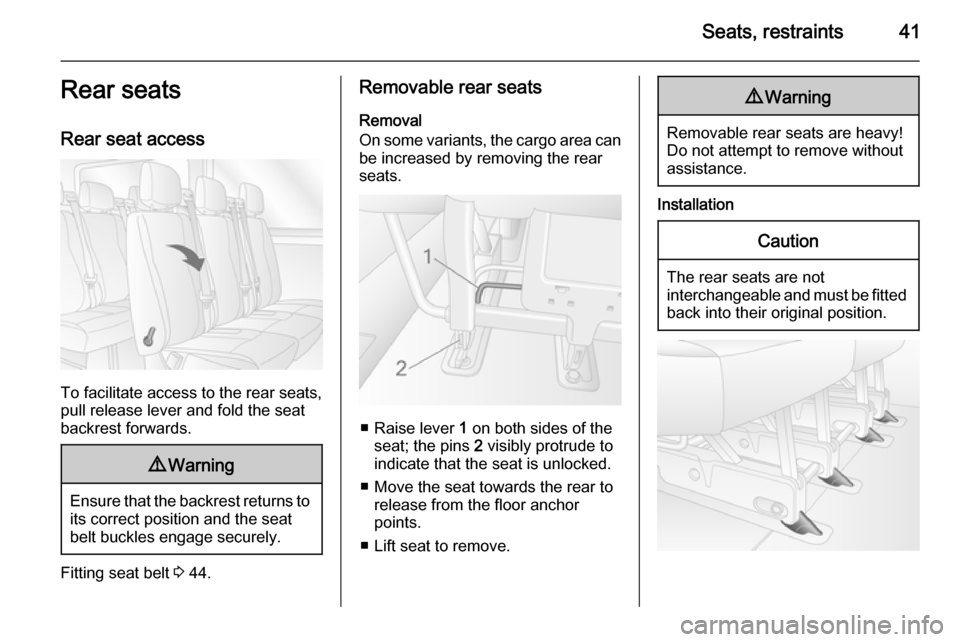
To facilitate access to the rear seats,
pull release lever and fold the seat backrest forwards.
9 Warning
Ensure that the backrest returns to
its correct position and the seat
belt buckles engage securely.
Fitting seat belt 3 44.
Removable rear seats
Removal
On some variants, the cargo area can
be increased by removing the rear
seats.
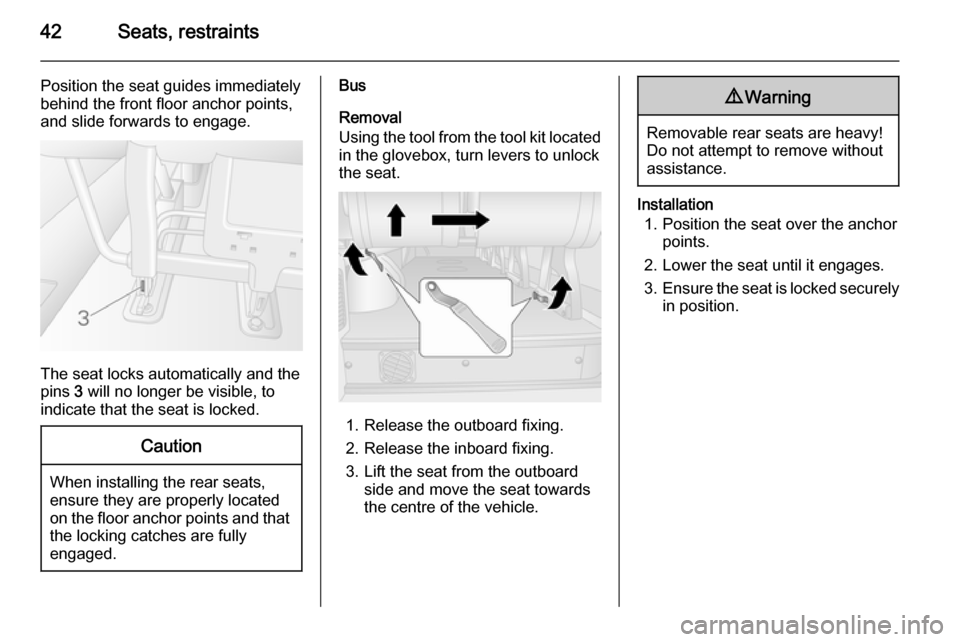
■ Raise lever 1 on both sides of the
seat; the pins 2 visibly protrude to
indicate that the seat is unlocked.
■ Move the seat towards the rear to release from the floor anchor
points.
■ Lift seat to remove.
9 Warning
Removable rear seats are heavy!
Do not attempt to remove without assistance.
Installation
Caution
The rear seats are not
interchangeable and must be fitted back into their original position.
Page 44 of 201
42Seats, restraints
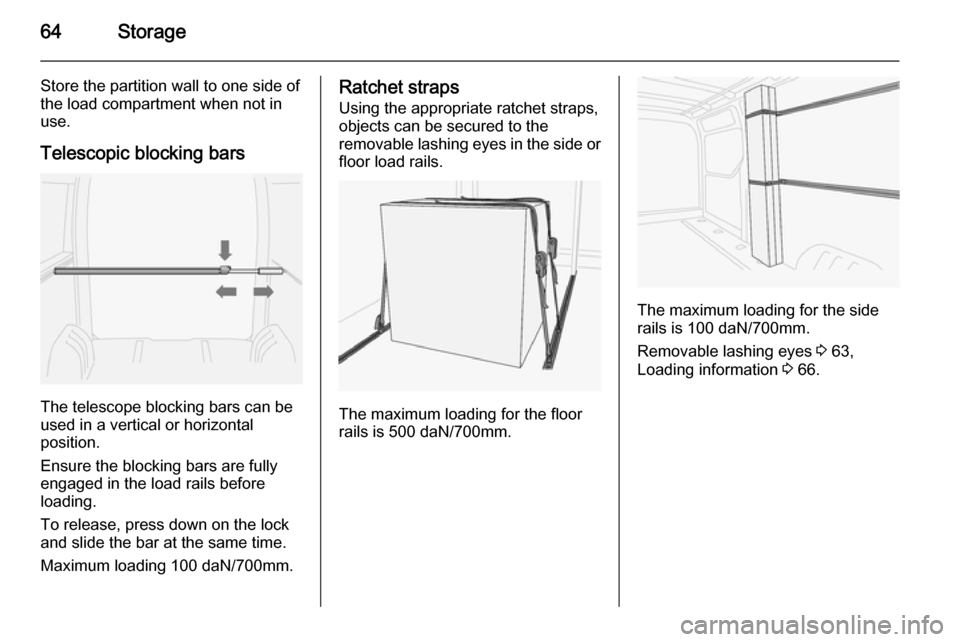
Position the seat guides immediately
behind the front floor anchor points,
and slide forwards to engage.
The seat locks automatically and the
pins 3 will no longer be visible, to
indicate that the seat is locked.
Caution
When installing the rear seats, ensure they are properly located
on the floor anchor points and that
the locking catches are fully
engaged.
Bus
Removal
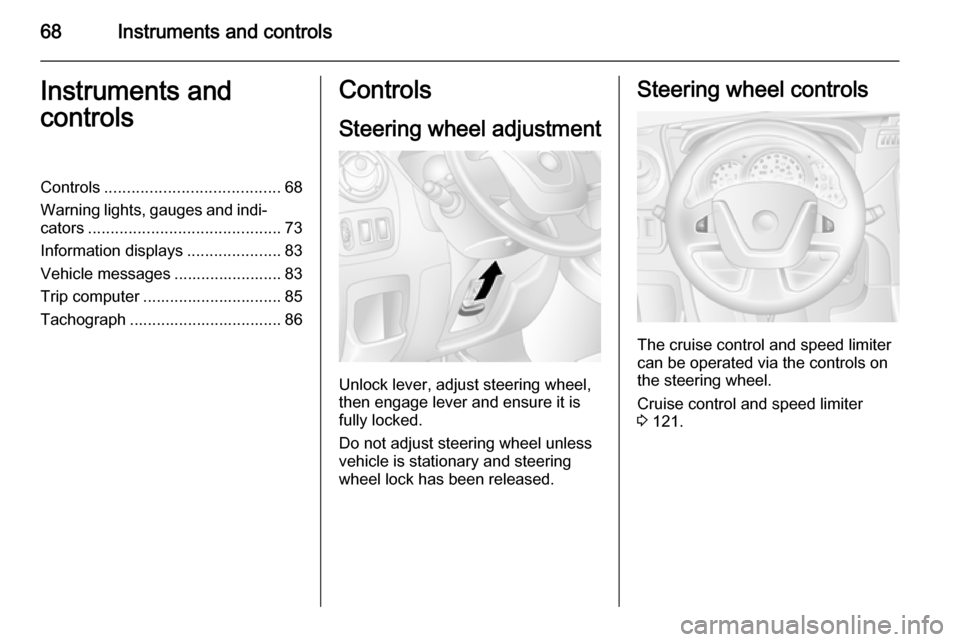
Using the tool from the tool kit located
in the glovebox, turn levers to unlock
the seat.
1. Release the outboard fixing.
2. Release the inboard fixing.
3. Lift the seat from the outboard side and move the seat towards
the centre of the vehicle.
9 Warning
Removable rear seats are heavy!
Do not attempt to remove without assistance.
Installation
1. Position the seat over the anchor points.
2. Lower the seat until it engages.
3. Ensure the seat is locked securely
in position.
Page 45 of 201
Seats, restraints43Seat belts
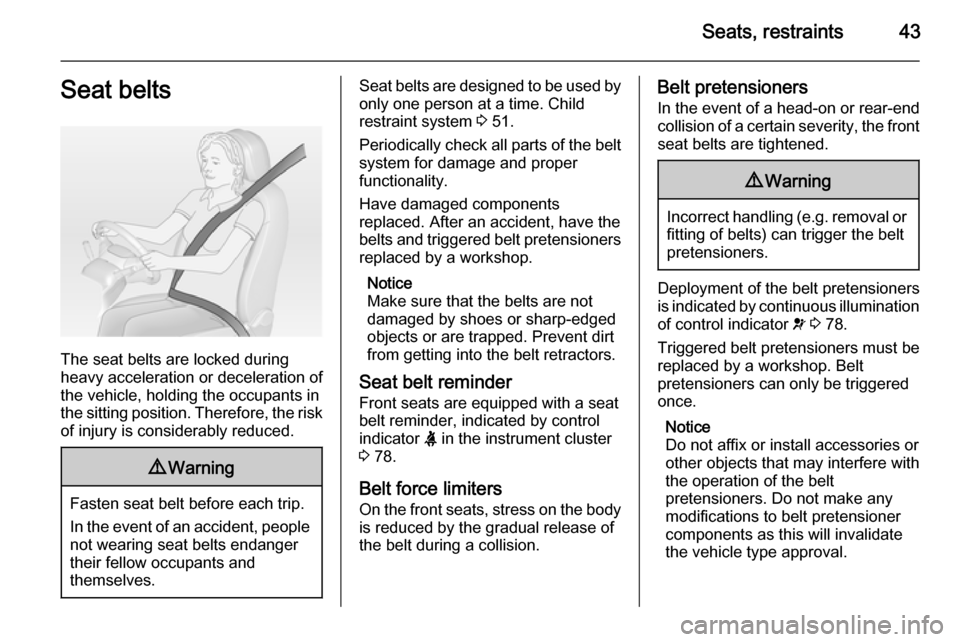
The seat belts are locked during
heavy acceleration or deceleration of
the vehicle, holding the occupants in
the sitting position. Therefore, the risk of injury is considerably reduced.
9 Warning
Fasten seat belt before each trip.
In the event of an accident, people
not wearing seat belts endanger their fellow occupants and
themselves.
Seat belts are designed to be used by only one person at a time. Child
restraint system 3 51.
Periodically check all parts of the belt
system for damage and proper
functionality.
Have damaged components
replaced. After an accident, have the
belts and triggered belt pretensioners replaced by a workshop.
Notice
Make sure that the belts are not
damaged by shoes or sharp-edged
objects or are trapped. Prevent dirt
from getting into the belt retractors.
Seat belt reminder Front seats are equipped with a seat
belt reminder, indicated by control
indicator X in the instrument cluster
3 78.
Belt force limiters
On the front seats, stress on the body is reduced by the gradual release of
the belt during a collision.Belt pretensioners
In the event of a head-on or rear-end
collision of a certain severity, the front
seat belts are tightened.9 Warning
Incorrect handling (e.g. removal or
fitting of belts) can trigger the belt
pretensioners.
Deployment of the belt pretensioners
is indicated by continuous illumination
of control indicator v 3 78.
Triggered belt pretensioners must be replaced by a workshop. Belt
pretensioners can only be triggered
once.
Notice
Do not affix or install accessories or
other objects that may interfere with
the operation of the belt
pretensioners. Do not make any
modifications to belt pretensioner
components as this will invalidate
the vehicle type approval.
Page 52 of 201
50Seats, restraints9Warning
Keep the area in which the airbag
inflates clear of obstructions.
Notice
Only use protective seat covers that have been approved for the vehicle.Be careful not to cover the airbags.
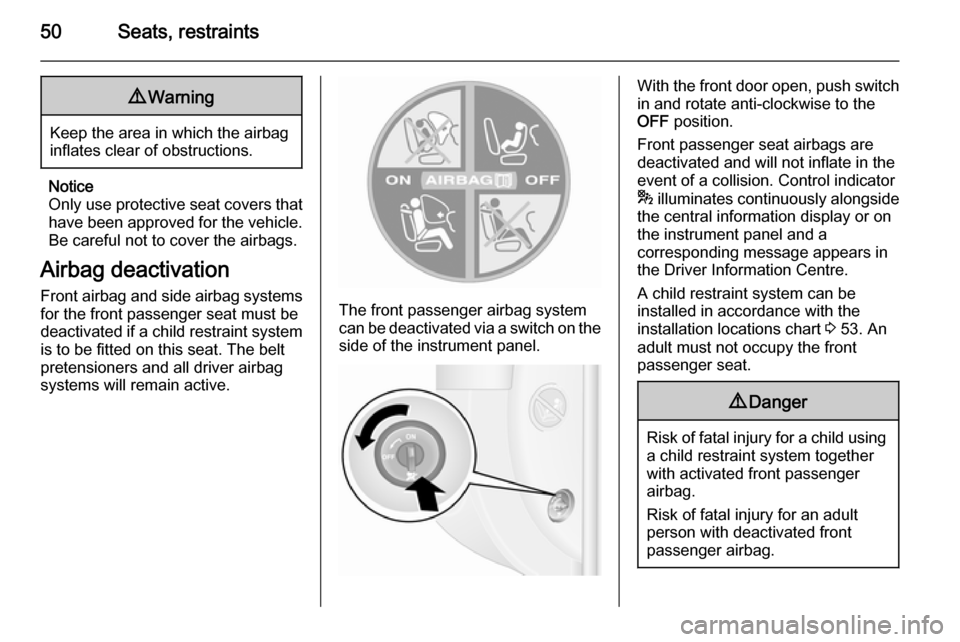
Airbag deactivation Front airbag and side airbag systems
for the front passenger seat must be
deactivated if a child restraint system is to be fitted on this seat. The belt
pretensioners and all driver airbag
systems will remain active.
The front passenger airbag system
can be deactivated via a switch on the
side of the instrument panel.
With the front door open, push switch in and rotate anti-clockwise to the
OFF position.
Front passenger seat airbags are
deactivated and will not inflate in the event of a collision. Control indicator
* illuminates continuously alongside
the central information display or on
the instrument panel and a
corresponding message appears in
the Driver Information Centre.
A child restraint system can be
installed in accordance with the
installation locations chart 3 53. An
adult must not occupy the front
passenger seat.9 Danger
Risk of fatal injury for a child using
a child restraint system together
with activated front passenger
airbag.
Risk of fatal injury for an adult
person with deactivated front
passenger airbag.
Page 66 of 201
64Storage
Store the partition wall to one side of
the load compartment when not in
use.
Telescopic blocking bars
The telescope blocking bars can be
used in a vertical or horizontal
position.
Ensure the blocking bars are fully
engaged in the load rails before
loading.
To release, press down on the lock
and slide the bar at the same time.
Maximum loading 100 daN/700mm.
Ratchet straps
Using the appropriate ratchet straps,
objects can be secured to the
removable lashing eyes in the side or floor load rails.
The maximum loading for the floor
rails is 500 daN/700mm.
The maximum loading for the side
rails is 100 daN/700mm.
Removable lashing eyes 3 63,
Loading information 3 66.
Page 70 of 201
68Instruments and controlsInstruments and
controlsControls ....................................... 68
Warning lights, gauges and indi‐
cators ........................................... 73
Information displays .....................83
Vehicle messages ........................ 83
Trip computer ............................... 85
Tachograph .................................. 86Controls
Steering wheel adjustment
Unlock lever, adjust steering wheel,
then engage lever and ensure it is fully locked.
Do not adjust steering wheel unless
vehicle is stationary and steering
wheel lock has been released.
Steering wheel controls
The cruise control and speed limiter
can be operated via the controls on
the steering wheel.
Cruise control and speed limiter
3 121.
Page 73 of 201
Instruments and controls719Warning
The road surface may already be
icy even though the display
indicates a few degrees above 0
°C.
Clock
Depending on vehicle, the current
time and/or date may appear in the
information display 3 83 or the
Driver Information Centre 3 83.
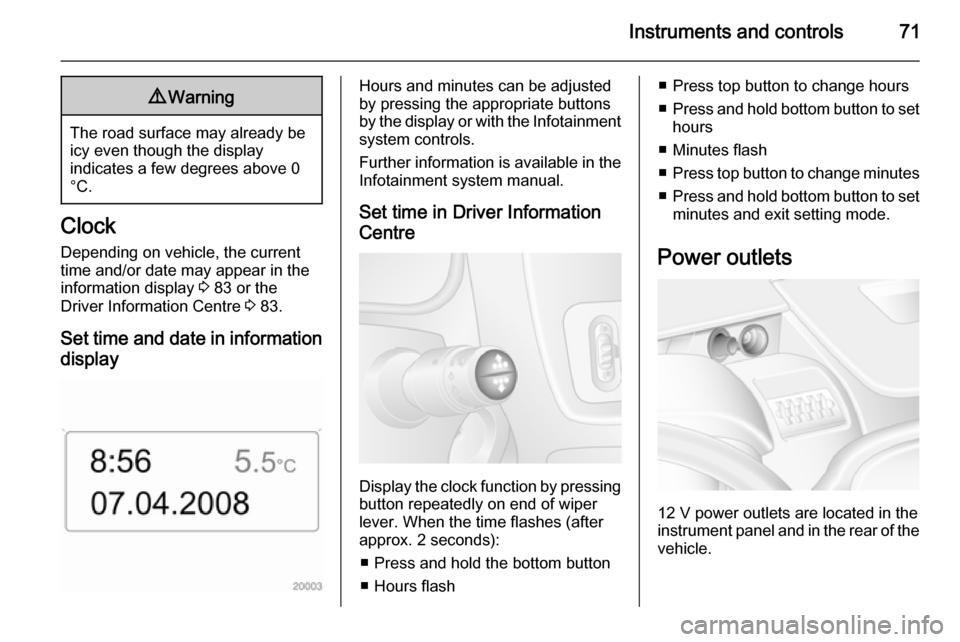
Set time and date in information display
Hours and minutes can be adjusted
by pressing the appropriate buttons
by the display or with the Infotainment
system controls.
Further information is available in the
Infotainment system manual.
Set time in Driver Information
Centre
Display the clock function by pressing button repeatedly on end of wiper
lever. When the time flashes (after
approx. 2 seconds):
■ Press and hold the bottom button
■ Hours flash
■ Press top button to change hours
■ Press and hold bottom button to set
hours
■ Minutes flash
■ Press top button to change minutes
■ Press and hold bottom button to set
minutes and exit setting mode.
Power outlets
12 V power outlets are located in the instrument panel and in the rear of the
vehicle.
Page 82 of 201

80Instruments and controls9Warning
Stop. Do not continue your
journey. Consult a workshop.
Brake system 3 118.
Brake pad wear
F illuminates yellow.
Illuminates when the brake pads are
worn 3 118.
Seek the assistance of a workshop.
Antilock brake system
(ABS)
u illuminates yellow.
Illuminates briefly when the ignition is switched on. The system is ready for
operation when u extinguishes.
If control indicators u and A
illuminate with the messages CHECK
ABS and CHECK ESP in the Driver
Information Centre 3 83, there is a
fault in the ABS. The brake system
remains operational but without ABS
regulation.
If control indicators u, A , R and
C illuminate, the ABS and ESP are
deactivated and the message
BRAKING FAULT is displayed. Seek
the assistance of a workshop.
Antilock brake system 3 118.
Upshift k or j illuminates yellow.
Illuminates when gearshifting is
recommended for fuel saving
reasons.
Electronic Stability
Program
v flashes or illuminates yellow.
Illuminates for a few seconds when
the ignition is switched on.Flashing during driving
The system is actively engaged.
Engine output may be reduced and
the vehicle may be braked
automatically to a small degree
3 120.
Illuminates during driving The system is switched off. The
message ESP OFF will also appear in
the Driver Information Centre 3 83.
ESP® Plus
3 120, Traction Control
system 3 119.
Engine coolant
temperature
W illuminates red.
Illuminates when the engine is
running If W illuminates (possibly in
combination with control indicator
C ), stop vehicle and switch off
engine.