Page 417 of 563
414 4-3. Do-it-yourself maintenance
CAUTION
■To prevent system breakdowns and vehicle fire
Observe the following precautions.
Failure to do so may cause damage to the vehicle, and possibly a fire or
injury.
●Never use a fuse of a higher amperage rating than that indicated, or use
any other object in place of a fuse.
● Always use a genuine Toyota fuse or equivalent.
Never replace a fuse with a wire, even as a temporary fix.
● Do not modify the fuses or fuse boxes.
■ Fuse box near the power control unit
Never check or replace the fuses as there are high voltage parts and wiring
near the fuse box.
Doing so may cause electric shock, resulting in death or serious injury.
NOTICE
■Before replacing fuses
Have the cause of electrical overload determined and repaired by your
Toyota dealer as soon as possible.
Page 418 of 563
415
4-3. Do-it-yourself maintenance
4
Maintenance and care
Light bulbs
You may replace the following bulbs by yourself. The difficulty level
of replacement varies depending on the bulb. As there is a danger
that components may be damaged, we recommend that replacement
is carried out by your Toyota dealer.
■Preparing for light bulb replacement
Check the wattage of the light bulb to be replaced. ( P. 505)
■ Front bulb locations
Front side
marker
lights
Front turn signal lights
Parking lights
Headlights (low beam)
Headlights (high beam) and daytime running lights
Front fog lights (if equipped)
Page 420 of 563
417
4-3. Do-it-yourself maintenance
4
Maintenance and care
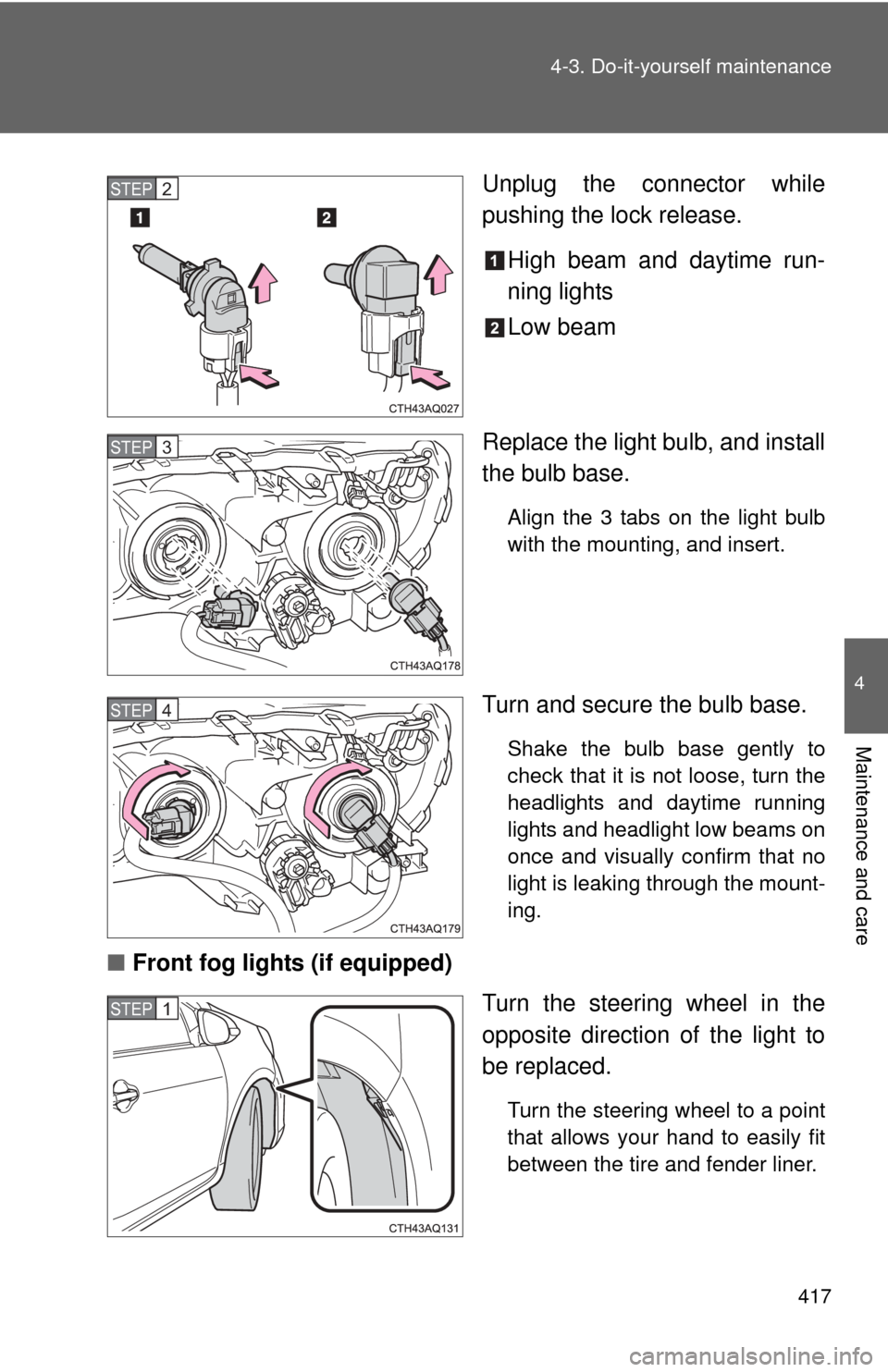
Unplug the connector while
pushing the lock release.
High beam and daytime run-
ning lights
Low beam
Replace the light bulb, and install
the bulb base.
Align the 3 tabs on the light bulb
with the mounting, and insert.
Turn and secure the bulb base.
Shake the bulb base gently to
check that it is not loose, turn the
headlights and daytime running
lights and headlight low beams on
once and visually confirm that no
light is leaking through the mount-
ing.
■ Front fog lights (if equipped)
Turn the steering wheel in the
opposite direction of the light to
be replaced.
Turn the steering wheel to a point
that allows your hand to easily fit
between the tire and fender liner.
STEP2
STEP3
STEP4
STEP1
Page 422 of 563
419
4-3. Do-it-yourself maintenance
4
Maintenance and care
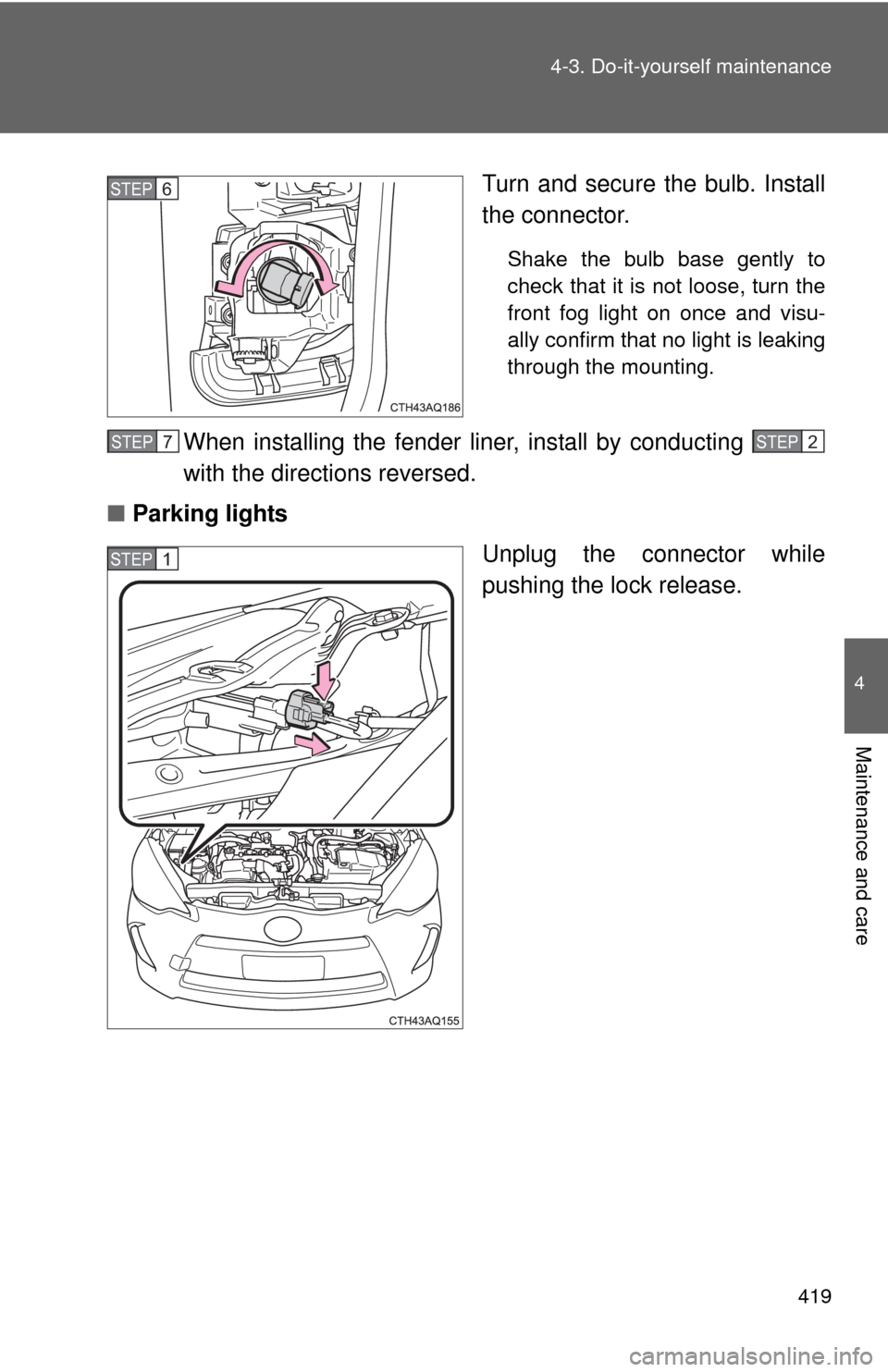
Turn and secure the bulb. Install
the connector.
Shake the bulb base gently to
check that it is not loose, turn the
front fog light on once and visu-
ally confirm that no light is leaking
through the mounting.
When installing the fender liner, install by conducting
with the directions reversed.
■ Parking lights
Unplug the connector while
pushing the lock release.
STEP6
STEP5STEP7STEP5STEP7STEP2
STEP1
Page 442 of 563
5
When trouble arises
439
5-2. Steps to take in an emergency
Follow the correction procedures.
After taking the specified steps to correct the suspected problem,
check that the warning light goes off.
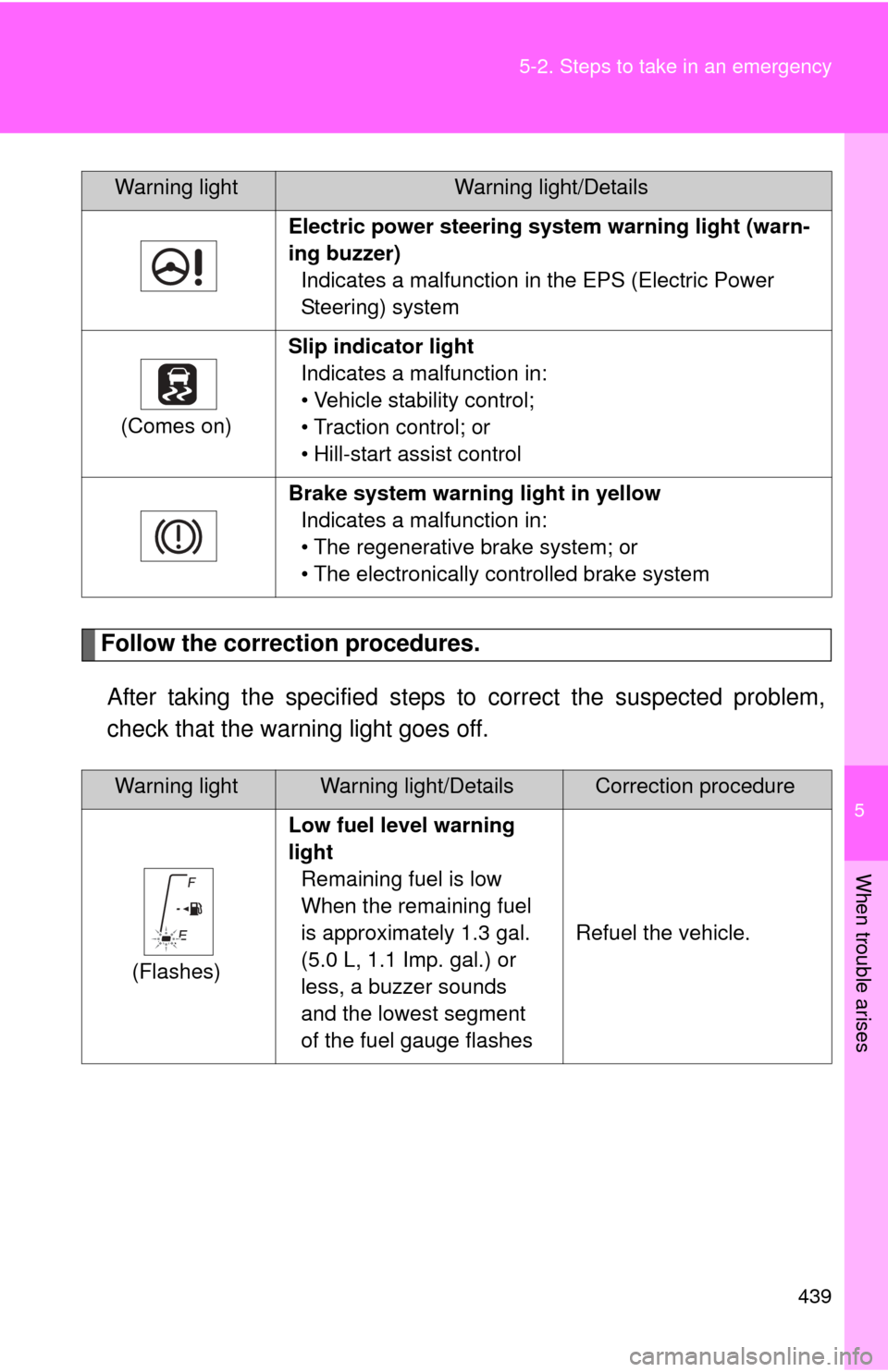
Electric power steering syst em warning light (warn-
ing buzzer) Indicates a malfunction in the EPS (Electric Power
Steering) system
(Comes on) Slip indicator light
Indicates a malfunction in:
• Vehicle stability control;
• Traction control; or
• Hill-start assist control
Brake system warning light in yellow Indicates a malfunction in:
• The regenerative brake system; or
• The electronically controlled brake system
Warning lightWarning light/DetailsCorrection procedure
(Flashes) Low fuel level warning
light
Remaining fuel is low
When the remaining fuel
is approximately 1.3 gal.
(5.0 L, 1.1 Imp. gal.) or
less, a buzzer sounds
and the lowest segment
of the fuel gauge flashes Refuel the vehicle.
Warning lightWarning light/Details
Page 443 of 563
440 5-2. Steps to take in an emergency
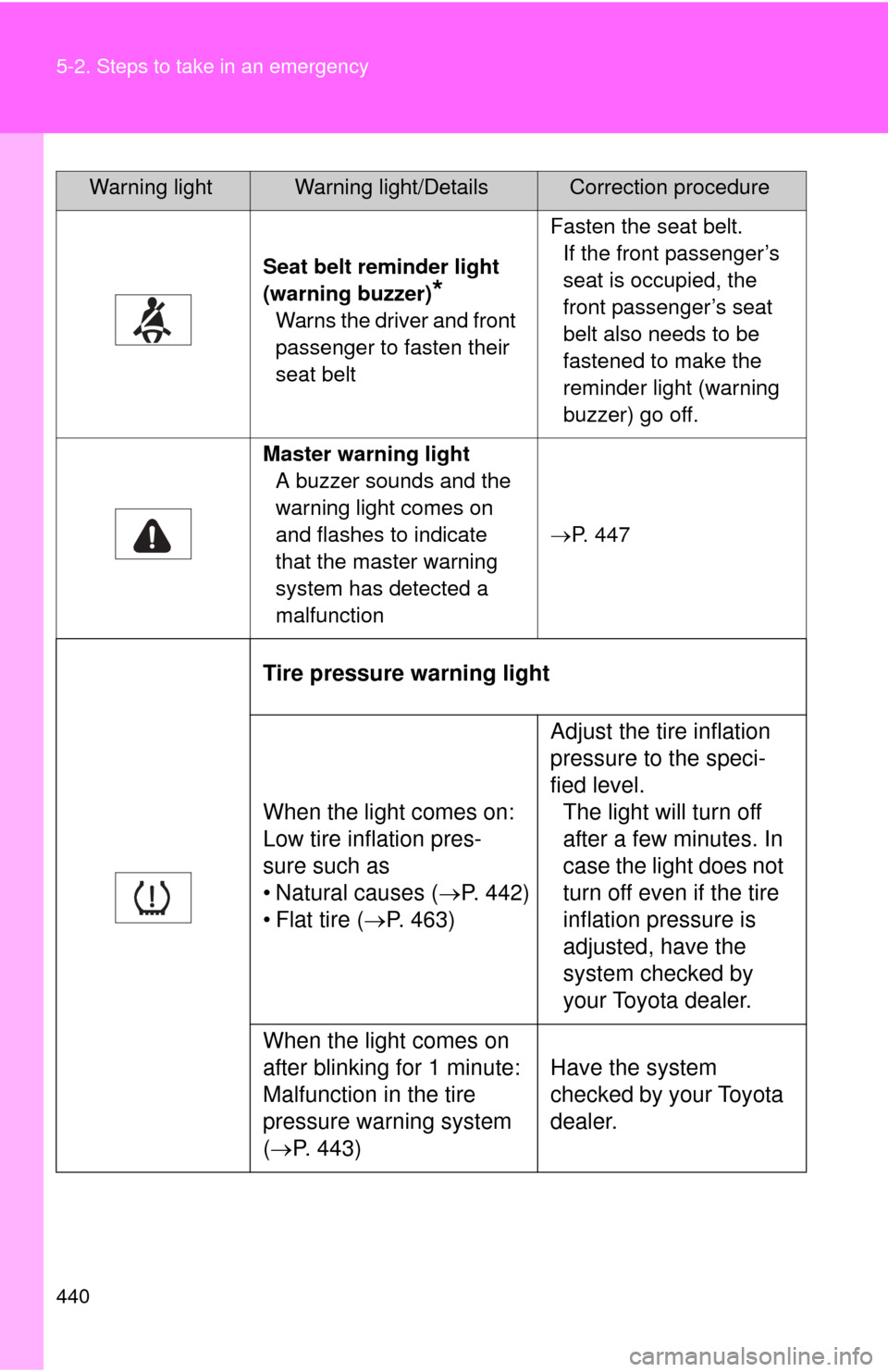
Seat belt reminder light
(warning buzzer)
*
Warns the driver and front
passenger to fasten their
seat beltFasten the seat belt.
If the front passenger’s
seat is occupied, the
front passenger’s seat
belt also needs to be
fastened to make the
reminder light (warning
buzzer) go off.
Master warning light A buzzer sounds and the
warning light comes on
and flashes to indicate
that the master warning
system has detected a
malfunction
P. 447
Tire pressure warning light
When the light comes on:
Low tire inflation pres-
sure such as
• Natural causes ( P. 442)
• Flat tire ( P. 463) Adjust the tire inflation
pressure to the speci-
fied level.
The light will turn off
after a few minutes. In
case the light does not
turn off even if the tire
inflation pressure is
adjusted, have the
system checked by
your Toyota dealer.
When the light comes on
after blinking for 1 minute:
Malfunction in the tire
pressure warning system
( P. 443) Have the system
checked by your Toyota
dealer.
Warning lightWarning light/DetailsCorrection procedure
Page 445 of 563
442 5-2. Steps to take in an emergency
■If the malfunction indicator lamp comes on while driving
The malfunction indicator lamp will come on if the fuel tank cap becomes
loose. If the fuel tank cap is loose, tighten it securely. The malfunction indica-
tor lamp will go off after several trips.
If the malfunction indicator lamp does not go off even after several trips, con-
tact your Toyota dealer as soon as possible.
■
When the tire pressure warning light comes on
Check the tire inflation pressure and adjust to the appropriate level.
Pushing the tire pressure warning reset switch will not turn off the tire
pressure warning light.
■The tire pressure warning light may come on due to natural causes
The tire pressure warning light may come on due to natural causes such
as natural air leaks and tire inflat ion pressure changes caused by tem-
perature. In this case, adjusting the tire inflation pressure will turn off the
warning light (after a few minutes).
■When a tire is replaced with a spare tire
The compact spare tire is not equipped with a tire pressure warning
valve and transmitter. If a tire goes flat, the tire pressure warning light will
not turn off even though the flat tire has been replaced with the spare
tire. Replace the spare tire with the re paired tire and adjust the tire infla-
tion pressure. The tire pressure wa rning light will go off after a few min-
utes.
Page 446 of 563

5
When trouble arises
443
5-2. Steps to take in an emergency
■If the tire pressure warning system is not functioning
The tire pressure warning system will be disabled in the following condi-
tions:
(When the condition be
comes normal, the system will work properly.)
●If tires not equipped with tire pressure warning valves and transmit-
ters are used
●If the ID code on the tire pressure warning valves and transmitters is
not registered in the tire pressure warning computer
●If the tire inflation pressure is 73 psi (500 kPa, 5.1 kgf/cm2 or bar) or
higher
The tire pressure warning system may be disabled in the following condi-
tions:
(When the condition be comes normal, the system will work properly.)
●If electronic devices or facilities using similar radio wave frequencies
are nearby
●If a radio set at a similar frequency is in use in the vehicle
●If a window tint that affects the radio wave signals is installed
●If there is a lot of snow or ice on the vehicle, particularly around the
wheels or wheel housings
●If non-genuine Toyota wheels are used (Even if you use Toyota
wheels, the tire pressure warning system may not work properly with
some types of tires.)
●If tire chains are used
■If the tire pressure warning light frequently comes on after blinking
for 1 minute
If the tire pressure warning light frequently comes on after blinking for 1
minute when the engine switch is tu rned to the “ON” position (vehicles
without a smart key system) or the “POWER” switch is turned to ON
mode (vehicles with a smart key syst em), have it checked by your
Toyota dealer.
■ Customization that can be co nfigured at Toyota dealer
The vehicle speed linked seat belt reminder buzzer can be disabled. (Cus-
tomizable features P. 522) However, Toyota recommends that the seat
belt reminder buzzer be operational to alert the driver and front passenger
when seat belts are not fastened.