Page 324 of 426
The front tie-down hooks are locatedbetween each of the front tires and thefront bumper.
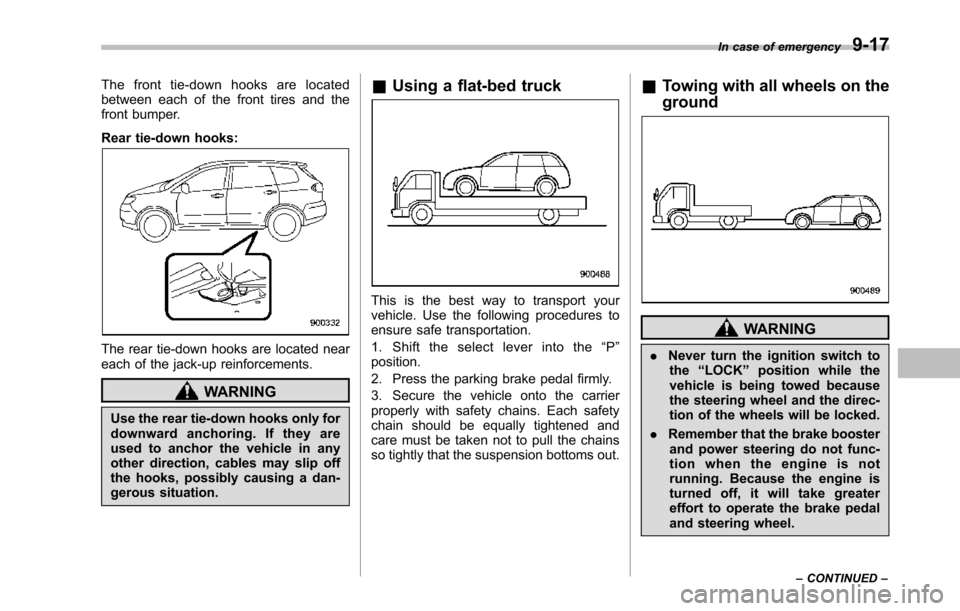
Rear tie-down hooks:
The rear tie-down hooks are located neareach of the jack-up reinforcements.
WARNING
Use the rear tie-down hooks only fordownward anchoring. If they areused to anchor the vehicle in anyother direction, cables may slip offthe hooks,possibly causing a dan-gerous situation.
&Using a flat-bed truck
This is the best way to transport yourvehicle. Use the following procedures toensure safe transportation.
1. Shift the select lever into the“P”position.
2. Press the parking brake pedal firmly.
3. Secure the vehicle onto the carrierproperly with safety chains. Each safetychain should be equally tightened andcare must be taken not to pull the chainsso tightly that the suspension bottoms out.
&Towing with all wheels on the
ground
WARNING
.Never turn the ignition switch tothe“LOCK”position while thevehicle is being towed becausethe steeringwheel and the direc-tion of the wheels will be locked.
.Remember that the brake boosterand power steering do not func-tion when the engine is notrunning. Because the engine isturned off, it will take greatereffort to operate the brake pedaland steering wheel.
In case of emergency9-17
–CONTINUED–
Page 325 of 426
9-18In case of emergency
CAUTION
.If transmission failure occurs,transport your vehicle on a flat-bed truck.
.Do not run the engine while beingtowed using this method. Trans-mission damage could result ifthe vehicle is towed with theengine running.
.The traveling speed must belimited to less than 20 mph (30km/h) and the traveling distanceto less than 31 miles (50 km). Forgreater speeds and distances,transport your vehicle on a flat-bed truck.
1. Release the parking brake and put thetransmission in neutral.
2. The ignition switch should be in the“Acc”position whilethe vehicle is beingtowed.
3. Take up slack in the towline slowly toprevent damage to the vehicle.
Rear gate–if the rear gate
cannot be unlocked
In the event that you cannot unlock therear gate by operating the power doorlocking switches or the remote keylessentry system, you can unlock it from insidethe cargo area.
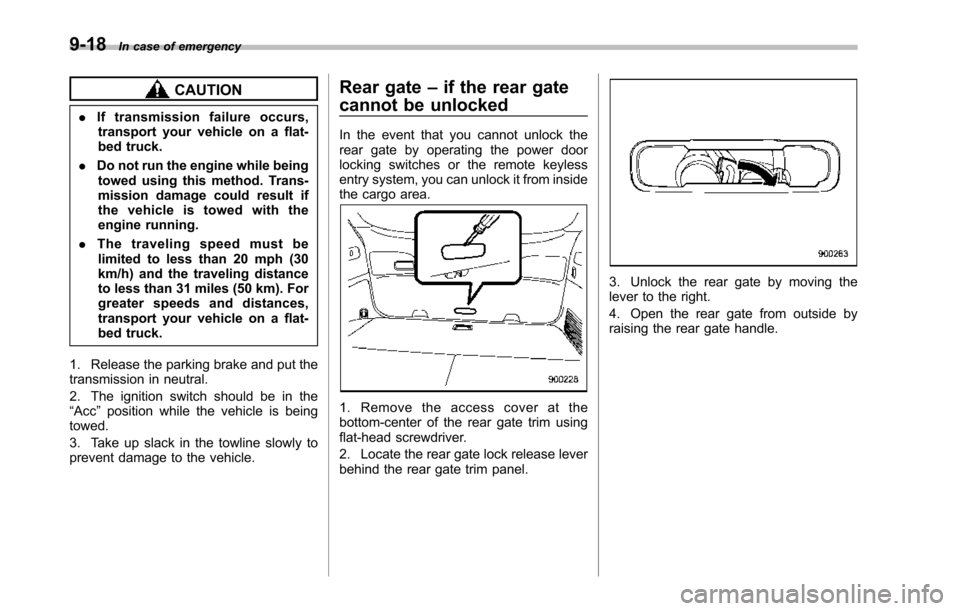
1. Remove the access cover at thebottom-center of the rear gate trim usingflat-head screwdriver.
2. Locate the rear gate lock release leverbehind the reargate trim panel.
3. Unlock the rear gate by moving thelever to the right.
4. Open the rear gate from outside byraisingthe rear gate handle.
Page 326 of 426
Maintenance tools
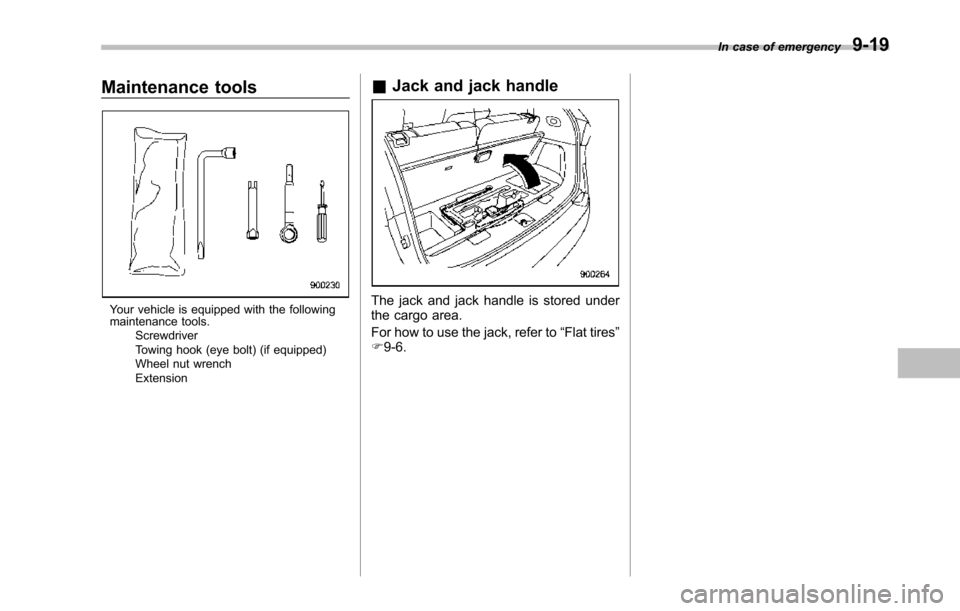
Your vehicle is equipped with the followingmaintenance tools.ScrewdriverTowing hook (eye bolt) (if equipped)Wheel nut wrenchExtension
&Jack and jack handle
The jack and jack handle is stored underthe cargo area.
For how to use the jack, refer to“Flat tires”F9-6.
In case of emergency9-19
Page 338 of 426
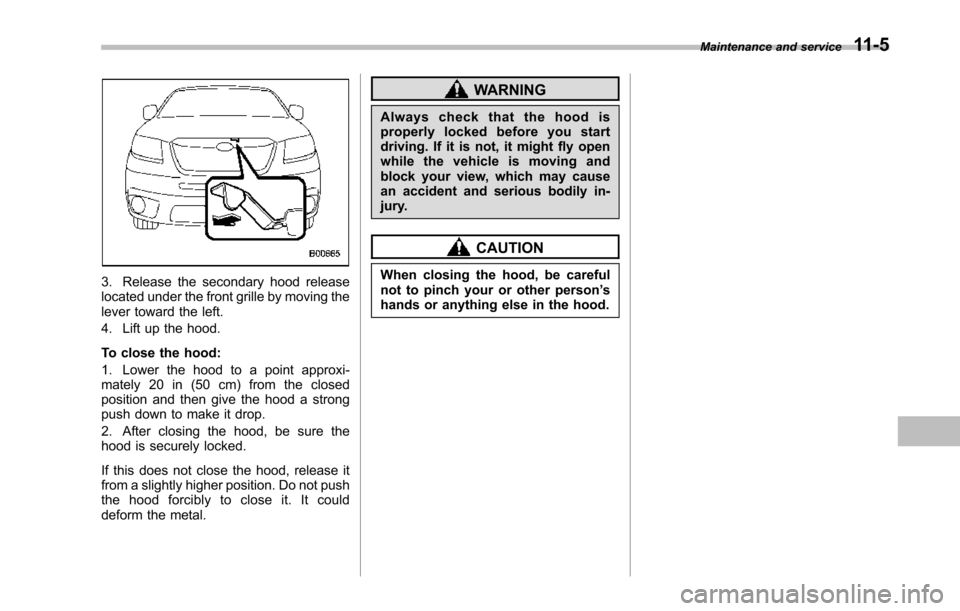
3. Release the secondary hood releaselocated under the front grille by moving thelever toward the left.
4. Lift up the hood.
To close the hood:
1. Lower the hood to a point approxi-mately 20 in (50 cm) from the closedposition and then give the hood a strongpush down to make it drop.
2. After closing the hood, be sure thehoodis securely locked.
If this does not close the hood, release itfrom a slightly higher position. Do not pushthe hood forcibly to close it. It coulddeform the metal.
WARNING
Always check that the hood isproperly locked before you startdriving. If it is not, it might fly openwhile the vehicle is moving andblock your view, which may causean accident and serious bodily in-jury.
CAUTION
When closing the hood, be carefulnot to pinch your or other person’shands or anything else in the hood.
Maintenance and service11-5
Page 347 of 426
11-14Maintenance and service
Automatic transmission fluid
&Checking the fluid level
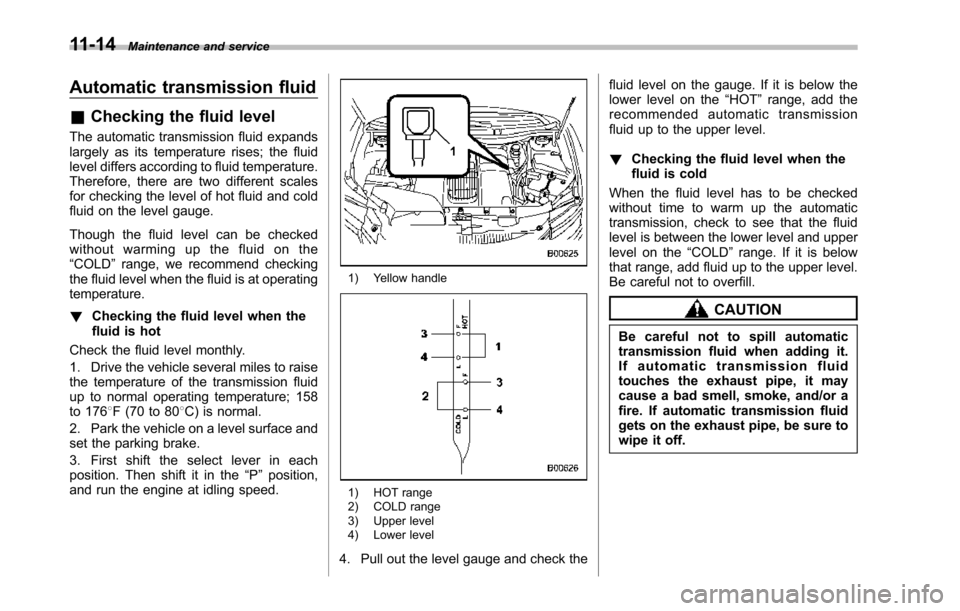
The automatic transmission fluid expandslargely as its temperature rises; the fluidlevel differs according to fluid temperature.Therefore, there are two different scalesfor checking the level of hot fluid and coldfluid on the level gauge.
Though the fluid level can be checkedwithout warming up the fluid on the“COLD”range, we recommend checkingthe fluid level when the fluid is at operatingtemperature.
!Checking the fluid level when thefluid is hot
Check the fluid level monthly.
1. Drive the vehicle several miles to raisethe temperature of the transmission fluidup to normal operating temperature; 158to 1768F (70 to 808C) is normal.
2. Park the vehicle on a level surface andset the parking brake.
3. First shift the select lever in eachposition. Then shift it in the“P”position,and run the engine at idling speed.
1) Yellow handle
1) HOT range2) COLD range3) Upper level4) Lower level
4. Pull out the level gauge and check the
fluid level on the gauge. If it is below thelower level on the“HOT”range, add therecommended automatic transmissionfluid up to the upper level.
!Checking the fluid level when thefluid is cold
When the fluid level has to be checkedwithout time to warm up the automatictransmission,check to see that the fluidlevel is between the lower level and upperlevel on the“COLD”range. If it is belowthat range, add fluid up to the upper level.Be careful not to overfill.
CAUTION
Be careful not to spill automatictransmission fluid when adding it.If automatic transmission fluidtouches the exhaust pipe, it maycause a bad smell, smoke, and/or afire. If automatic transmission fluidgets on the exhaust pipe, be sure towipe it off.
Page 364 of 426
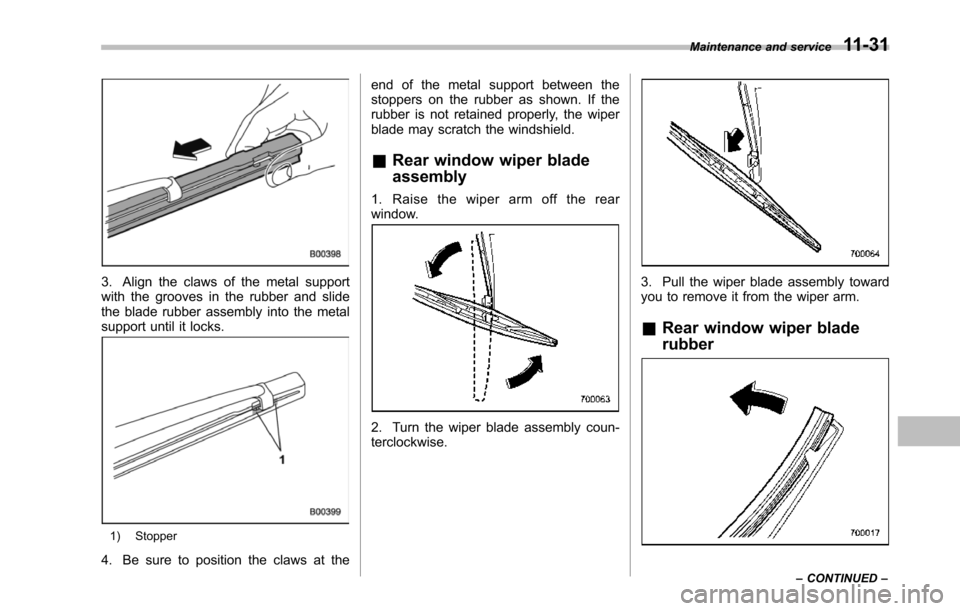
3. Align the claws of the metal supportwith the grooves in the rubber and slidethe blade rubber assembly into the metalsupport until it locks.
1) Stopper
4. Be sure to position the claws at the
end of the metal support between thestoppers on the rubber as shown. If therubber is not retained properly, the wiperblade may scratch the windshield.
&Rear window wiper blade
assembly
1. Raise the wiper arm off the rearwindow.
2. Turn the wiper blade assembly coun-terclockwise.
3. Pull the wiper blade assembly towardyou to remove it from the wiper arm.
&Rear window wiper blade
rubber
Maintenance and service11-31
–CONTINUED–
Page 367 of 426
11-34Maintenance and service
Fuses
CAUTION
Never replace a fuse with one hav-ing a higher rating or with materialother than a fuse because seriousdamage or a fire could result.
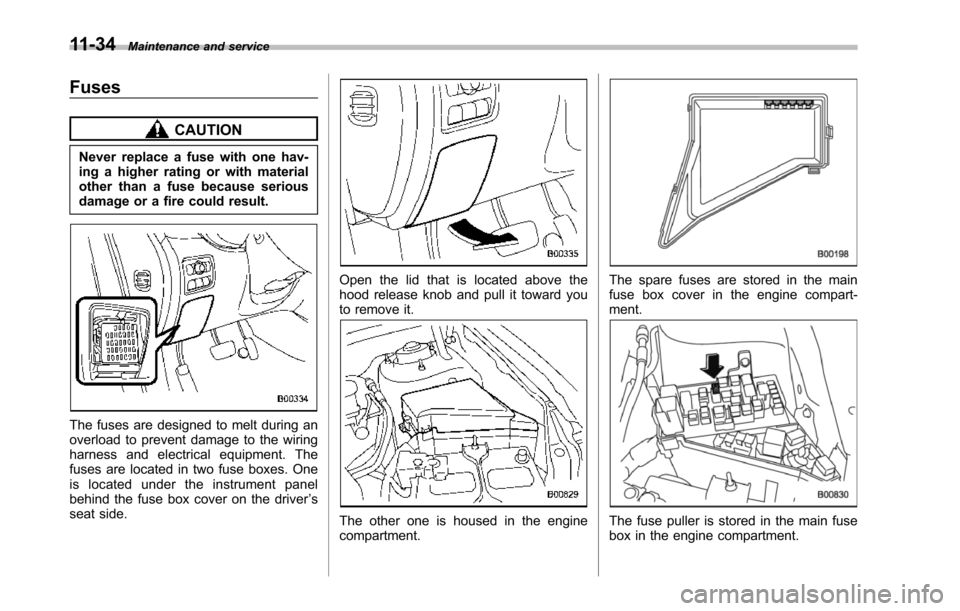
The fuses are designed to melt during anoverload to prevent damage to the wiringharness and electrical equipment. Thefuses are located in two fuse boxes. Oneis located under the instrument panelbehind the fuse box cover on the driver’sseat side.
Open the lid that is located above thehood release knob and pull it toward youto remove it.
The other one is housed in the enginecompartment.
The spare fuses are stored in the mainfuse box cover in the engine compart-ment.
The fuse puller is stored in the main fusebox in the engine compartment.
Page 403 of 426
13-10Consumer information and Reporting safety defects
.To maximize the life of each tire
and ensure that the tires wear
uniformly, it is best to rotate the
tires every 7,500 miles (12,000 km).
For information about the tire rota-
tion order, refer to“Tire rotation”
F11-26.Replace any damaged or
unevenly worn tires at the time of
rotation. After tire rotation, adjust
the tire pressures and make sure
the wheel nuts are correctly tigh-
tened. For information about the
tightening torque and tightening
sequence for the wheel nuts, refer
to“Flat tires”F9-6.
&Vehicle load limit–how to
determine
The load capacity of your vehicle is
determined by weight, not by avail-
able cargo space. The load limit of
your vehicle is shown on the
vehicle placard attached to the
driver’ssideB-pillar.Locatethe
statement“The combined weight
of occupants and cargo should
never exceed XXX kg or XXX lbs”
on your vehicle’s placard.
The vehicle placard also shows
seating capacity of your vehicle.
The total load capacity includes the
total weight of driver and all pas-
sengers and their belongings, any
cargo, any optional equipment such
as a trailer hitch, roof rack or bike
carrier, etc., and the tongue load of
a trailer. Therefore cargo capacity
can be calculated by the following
method.
Cargo capacity = Load limit!(total
weight of occupants + total weight
of optional equipment + tongue
load of a trailer (if applicable))
For information about vehicle load-
ing, refer to“Loading your vehicle”
F8-12.
For information about towing capa-
city and weight limits, refer to
“Trailer towing”F8-21.
!Calculating total and load ca-
pacities varying seating con-
figurations
Calculate the available load capa-
city as shown in the following
examples.
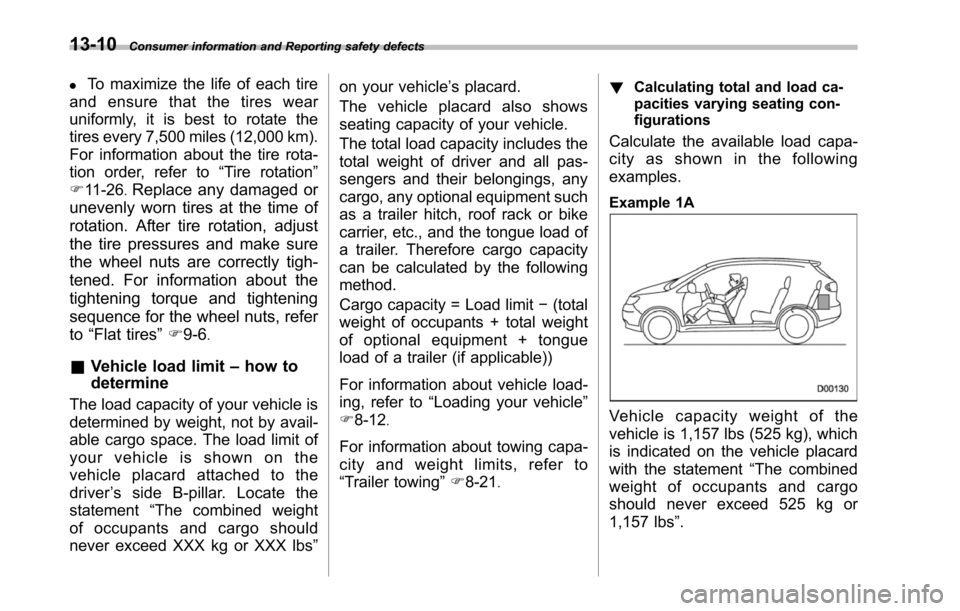
Example 1A
Vehicle capacity weight of the
vehicle is 1,157 lbs (525 kg), which
is indicated on the vehicle placard
with the statement“The combined
weight of occupants and cargo
should never exceed 525 kg or
1,157 lbs”.