2014 SUBARU TRIBECA door lock
[x] Cancel search: door lockPage 256 of 426
&Starting your vehicle
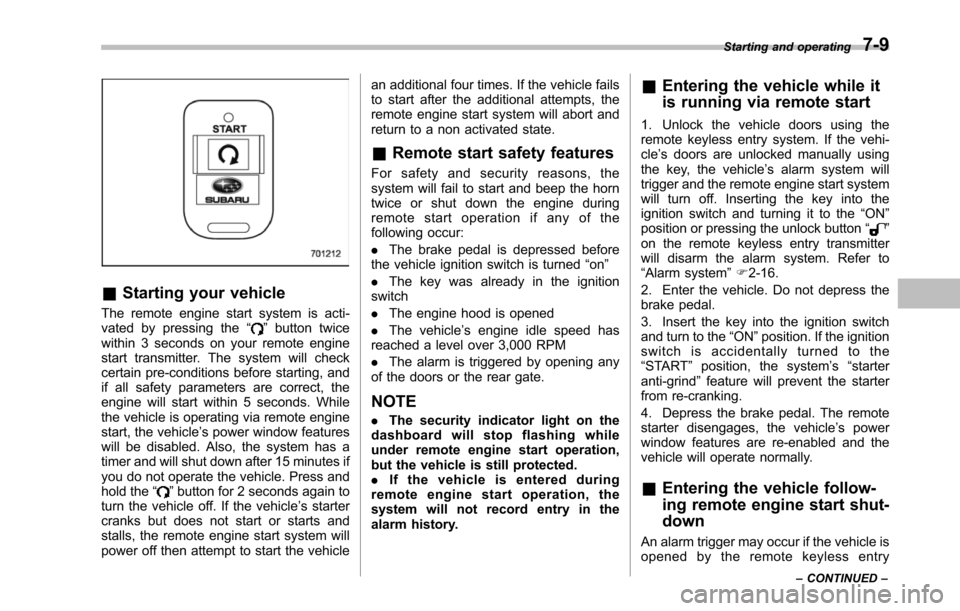
The remote engine start system is acti-vated by pressing the“”button twicewithin 3 seconds on your remote enginestart transmitter. The system will checkcertain pre-conditions before starting, andif all safety parameters are correct, theengine will start within 5 seconds. Whilethe vehicle is operating via remote enginestart, the vehicle’s power window featureswill be disabled. Also, the system has atimer and will shut down after 15 minutes ifyou do not operate the vehicle. Press andhold the“”button for 2 seconds again toturn the vehicle off. If the vehicle’s startercranks but does not start or starts andstalls, the remote engine start system willpower off then attempt to start the vehicle
an additional four times. If the vehicle failsto start after the additional attempts, theremote engine start system will abort andreturn to a non activated state.
&Remote start safety features
For safety and security reasons, thesystem will fail to start and beep the horntwice or shut down the engine duringremote start operation if any of thefollowing occur:
.The brake pedal is depressed beforethe vehicle ignition switch is turned“on”
.The key was already in the ignitionswitch
.The engine hood is opened
.The vehicle’s engine idle speed hasreached a level over 3,000 RPM
.The alarm is triggered by opening anyof the doors or the rear gate.
NOTE
.The security indicator light on thedashboard will stop flashing whileunder remote engine start operation,but the vehicle is still protected..If the vehicle is entered duringremote engine start operation, thesystem will not record entry in thealarm history.
&Entering the vehicle while it
is running via remote start
1. Unlock the vehicle doors using theremote keyless entry system. If the vehi-cle’s doors are unlocked manually usingthe key, the vehicle’s alarm system willtrigger and the remote engine start systemwill turn off. Inserting the key into theignition switch and turning it to the“ON”position or pressing the unlock button“”on the remote keyless entry transmitterwill disarm the alarm system. Refer to“Alarmsystem”F2-16.
2. Enter the vehicle. Do not depress thebrake pedal.
3. Insert the key into the ignition switchand turn to the“ON”position. If the ignitionswitch is accidentally turned to the“START”position, the system’s“starteranti-grind”feature will prevent the starterfrom re-cranking.
4. Depress the brake pedal. The remotestarter disengages, the vehicle’s powerwindow features are re-enabled and thevehicle will operate normally.
&Entering the vehicle follow-
ing remote engine start shut-
down
An alarm trigger may occur if the vehicle isopened by the remote keyless entry
Starting and operating7-9
–CONTINUED–
Page 287 of 426
8-8Driving tips
Winter driving
&Operation during cold
weather
Carry some emergency equipment, suchas a window scraper, a bag of sand,flares, a small shovel and jumper cables.
Check the battery and cables. Coldtemperatures reduce battery capacity.The battery must be in good condition toprovide enough power for cold winterstarts.
Use an engine oil of proper grade andviscosity for cold weather. Heavy summeroil will cause harder starting.
Keep the door locks from freezing bysquirting them with deicer or glycerin.
Forcing a frozen door open may damageor separate the rubber weather stripsaround the door. If the door is frozen,use hot water to melt the ice, and after-wards thoroughly wipe the water away.
Use a windshield washer fluid that con-tains an antifreeze solution. Do not useengine antifreeze or other substitutesbecause they may damage the paint ofthe vehicle.
SUBARU Windshield Washer Fluid con-tains 58.5% methyl alcohol and 41.5%surfactant, by volume. Its freezing tem-perature varies according to how much itis diluted, as indicated in the followingtable.
Washer Fluid Con-centrationFreezing Temperature
30% 10.48F(!128C)
50%!48F(!208C)
100%!498F(!458C)
In order to prevent freezing of washerfluid, check the freezing temperatures inthe table above when adjusting the fluidconcentration to the outside temperature.
If you fill the reservoir tank with a fluid witha different concentration from the oneused previously, purge the old fluid fromthe piping between the reservoir tank and
washer nozzles by operating the washerfor a certain period of time. Otherwise, ifthe concentration of the fluid remaining inthe piping is too low for the outsidetemperature, it may freeze and block thenozzles.
CAUTION
.Adjust the washer fluid concen-tration appropriately for the out-side temperature. If the concen-tration is inappropriate, sprayedwasher fluid may freeze on thewindshield and obstruct yourview, and the fluid may freeze inthe reservoir tank.
.State or local regulations onvolatile organic compounds mayrestrict the use of methanol, acommon windshield washer anti-freeze additive. Washer fluidscontaining non-methanol anti-freeze agents should be usedonly if they provide cold weatherprotection without damagingyour vehicle’s paint, wiper bladesor washer system.
!Before driving your vehicle
Before entering the vehicle, remove anysnow or ice from your shoes because that
Page 325 of 426
9-18In case of emergency
CAUTION
.If transmission failure occurs,transport your vehicle on a flat-bed truck.
.Do not run the engine while beingtowed using this method. Trans-mission damage could result ifthe vehicle is towed with theengine running.
.The traveling speed must belimited to less than 20 mph (30km/h) and the traveling distanceto less than 31 miles (50 km). Forgreater speeds and distances,transport your vehicle on a flat-bed truck.
1. Release the parking brake and put thetransmission in neutral.
2. The ignition switch should be in the“Acc”position whilethe vehicle is beingtowed.
3. Take up slack in the towline slowly toprevent damage to the vehicle.
Rear gate–if the rear gate
cannot be unlocked
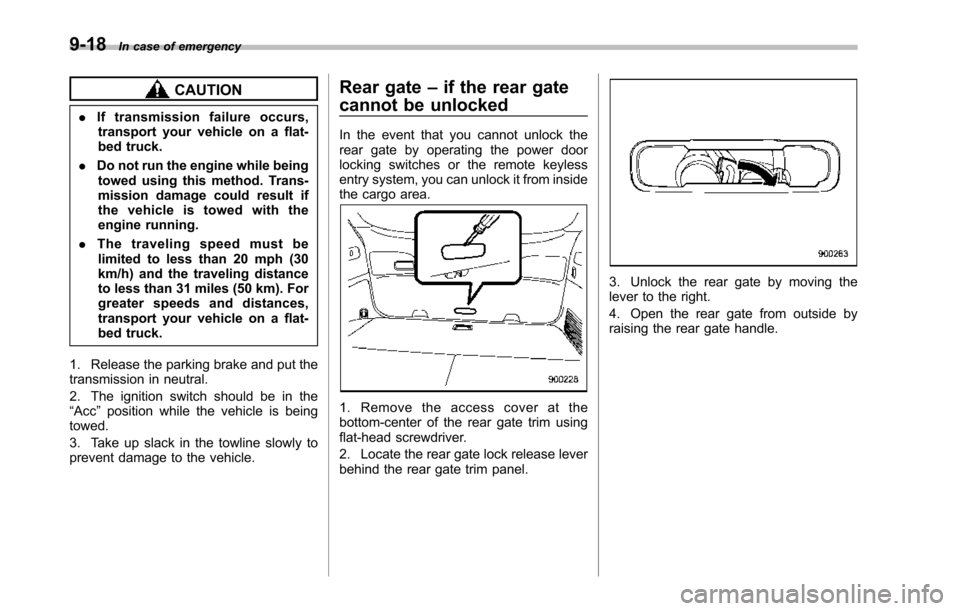
In the event that you cannot unlock therear gate by operating the power doorlocking switches or the remote keylessentry system, you can unlock it from insidethe cargo area.
1. Remove the access cover at thebottom-center of the rear gate trim usingflat-head screwdriver.
2. Locate the rear gate lock release leverbehind the reargate trim panel.
3. Unlock the rear gate by moving thelever to the right.
4. Open the rear gate from outside byraisingthe rear gate handle.
Page 331 of 426
10-4Appearance care
Corrosion protection
Your SUBARU has been designed andbuilt to resist corrosion. Special materialsand protective finishes have been used onmost parts of the vehicle to help maintainfine appearance, strength, and reliableoperation.
&Most common causes of
corrosion
The most common causes of corrosionare:
1. The accumulation of moisture retain-ing dirt and debris in body panel sections,cavities,and other areas.
2. Damage to paint and other protectivecoatings caused by gravel and stonechips or minor accidents.
Corrosion is accelerated on the vehiclewhen:
1. It is exposed to road salt or dustcontrol chemicals, or used in coastalareas where there is more salt in the air,or in areas where there is considerableindustrial pollution.
2. It is driven in areas of high humidity,especially when temperatures range justabove freezing.
3. Dampness in certain parts of thevehicle remainsfor a long time, even
though other parts of the vehicle may bedry.
4. High temperatures will cause corro-sion to parts of the vehicle which cannotdry quickly due to lack of proper ventila-tion.
&To help prevent corrosion
Wash the vehicle regularly to preventcorrosion of the body and suspensioncomponents. Also, wash the vehiclepromptly after driving on any of thefollowing surfaces.
.roads that have been salted to preventthem from freezing in winter
.mud, sand, or gravel
.coastal roads
After the winter has ended, it is recom-mended that the underbody be given avery thorough washing.
Before the beginning of winter, check thecondition of underbody components, suchas the exhaust system, fuel and brakelines, brake cables, suspension, steeringsystem, floor pan, and fenders. If any ofthem are found to be rusted, they shouldbe given an appropriate rust preventiontreatment or should be replaced. Contactyour SUBARU dealer to perform this kindof maintenance and treatment if you need
assistance.
Repair chips and scratches in the paint assoon as you find them.
Check the interior of the vehicle for waterand dirt accumulation under the floor matsbecause that could cause corrosion.Occasionally check under the mats tomake sure the area is dry.
Keep your garage dry. Do not park yourvehicle in a damp, poorly ventilatedgarage. In such a garage, corrosion canbe caused by dampness. If you wash thevehicle in the garage or put the vehicleinto the garage when wet or covered withsnow, that can cause dampness.
If your vehicle is operated in cold weatherand/or in areas where road salts and othercorrosive materials are used, the doorhinges and locks, and hood latch shouldbe inspected and lubricated periodically.
Page 386 of 426
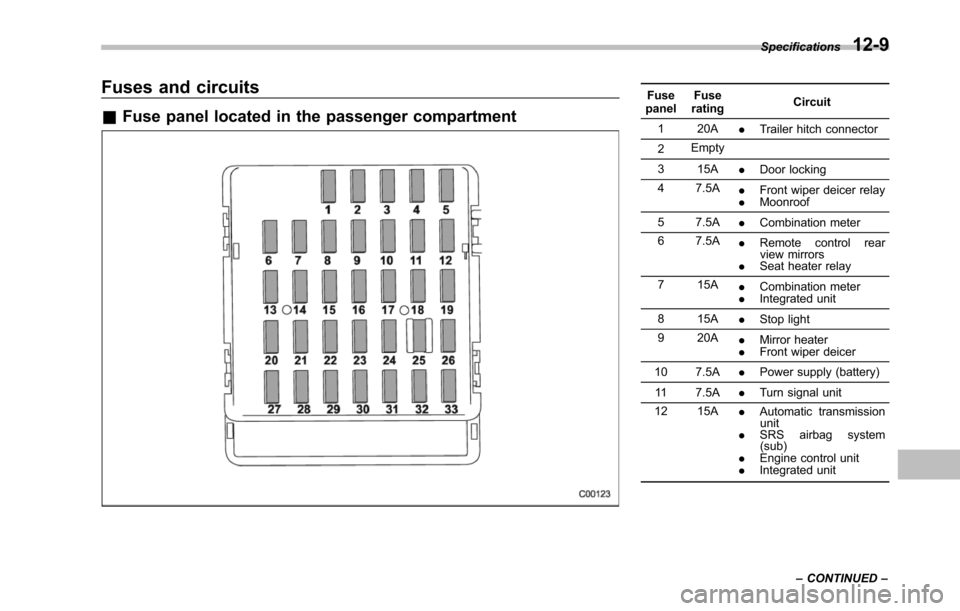
Fuses and circuits
&Fuse panel located in the passenger compartment
FusepanelFuseratingCircuit
1 20A.Trailer hitch connector
2Empty
3 15A.Door locking
4 7.5A.Front wiper deicer relay.Moonroof
5 7.5A.Combination meter
6 7.5A.Remote control rearview mirrors.Seat heater relay
7 15A.Combination meter.Integrated unit
8 15A.Stop light
9 20A.Mirror heater.Front wiper deicer
10 7.5A.Power supply (battery)
11 7.5A.Turn signal unit
12 15A.Automatic transmissionunit.SRS airbag system(sub).Engine control unit.Integrated unit
Specifications12-9
–CONTINUED–
Page 413 of 426
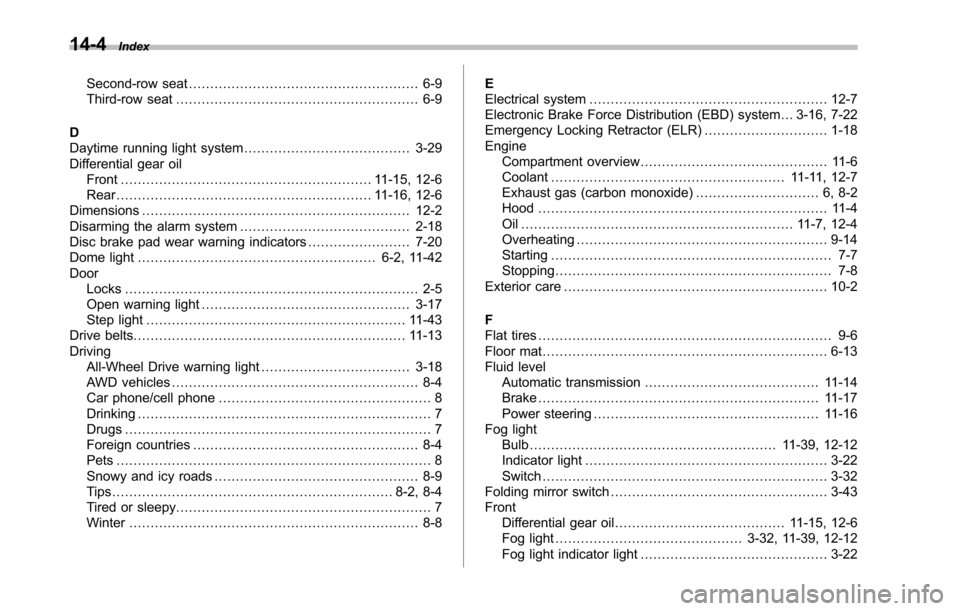
14-4Index
Second-row seat...................................................... 6-9Third-row seat......................................................... 6-9
DDaytime running light system....................................... 3-29Differential gear oilFront........................................................... 11-15, 12-6Rear............................................................ 11-16, 12-6Dimensions............................................................... 12-2Disarming the alarm system........................................ 2-18Disc brake pad wear warning indicators........................ 7-20Dome light........................................................ 6-2, 11-42DoorLocks..................................................................... 2-5Open warning light................................................. 3-17Step light............................................................. 11-43Drive belts................................................................ 11-13DrivingAll-Wheel Drive warning light................................... 3-18AWD vehicles.......................................................... 8-4Car phone/cell phone.................................................. 8Drinking..................................................................... 7Drugs........................................................................ 7Foreign countries..................................................... 8-4Pets.......................................................................... 8Snowy and icy roads................................................ 8-9Tips . . . . . . . . . . . . . . . . . . . . . . . . . . . . . . . . . . . . . . . . . . . . . . . . . . . . . . . . . . . . . . . . . . 8-2, 8-4Tired or sleepy............................................................ 7Winter.................................................................... 8-8
EElectrical system........................................................ 12-7Electronic Brake Force Distribution (EBD) system... 3-16, 7-22Emergency Locking Retractor (ELR)............................. 1-18EngineCompartment overview............................................ 11-6Coolant....................................................... 11-11, 12-7Exhaust gas (carbon monoxide)............................. 6, 8-2Hood.................................................................... 11-4Oil ................................................................ 11-7, 12-4Overheating........................................................... 9-14Starting.................................................................. 7-7Stopping................................................................. 7-8Exterior care.............................................................. 10-2
FFlat tires..................................................................... 9-6Floor mat................................................................... 6-13Fluid levelAutomatic transmission......................................... 11-14Brake.................................................................. 11-17Power steering..................................................... 11-16Fog lightBulb.......................................................... 11-39, 12-12Indicator light......................................................... 3-22Switch................................................................... 3-32Folding mirror switch................................................... 3-43FrontDifferential gear oil........................................ 11-15, 12-6Fog light............................................ 3-32, 11-39, 12-12Fog light indicator light............................................ 3-22
Page 416 of 426
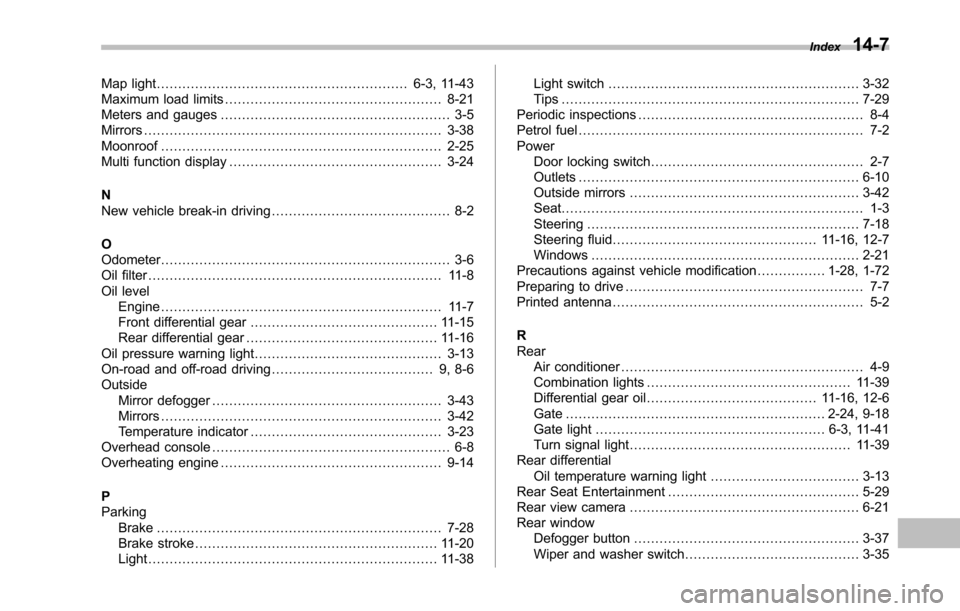
Map light........................................................... 6-3, 11-43Maximum load limits................................................... 8-21Meters and gauges...................................................... 3-5Mirrors...................................................................... 3-38Moonroof.................................................................. 2-25Multi function display.................................................. 3-24
NNew vehicle break-in driving.......................................... 8-2
OOdometer.................................................................... 3-6Oil filter..................................................................... 11-8Oil levelEngine.................................................................. 11-7Front differential gear............................................ 11-15Rear differential gear............................................. 11-16Oilpressure warning light............................................ 3-13On-road and off-road driving...................................... 9, 8-6OutsideMirror defogger...................................................... 3-43Mirrors.................................................................. 3-42Temperature indicator............................................. 3-23Overhead console........................................................ 6-8Overheating engine.................................................... 9-14
PParkingBrake................................................................... 7-28Brake stroke......................................................... 11-20Light.................................................................... 11-38
Light switch........................................................... 3-32Tips . . . . . . . . . . . . . . . . . . . . . . . . . . . . . . . . . . . . . . . . . . . . . . . . . . . . . . . . . . . . . . . . . . . . . . 7-29Periodic inspections..................................................... 8-4Petrol fuel................................................................... 7-2PowerDoor locking switch.................................................. 2-7Outlets.................................................................. 6-10Outside mirrors...................................................... 3-42Seat....................................................................... 1-3Steering................................................................ 7-18Steering fluid................................................ 11-16, 12-7Windows............................................................... 2-21Precautions against vehicle modification................ 1-28, 1-72Preparing to drive........................................................ 7-7Printed antenna........................................................... 5-2
RRearAir conditioner......................................................... 4-9Combination lights................................................ 11-39Differential gear oil........................................ 11-16, 12-6Gate............................................................. 2-24, 9-18Gate light...................................................... 6-3, 11-41Turn signal light.................................................... 11-39Rear differentialOil temperature warning light................................... 3-13Rear Seat Entertainment............................................. 5-29Rear view camera...................................................... 6-21Rear windowDefogger button..................................................... 3-37Wiper and washer switch......................................... 3-35
Index14-7