2014 SUBARU TRIBECA flat tire
[x] Cancel search: flat tirePage 399 of 426
13-6Consumer information and Reporting safety defects
sidewall rubber which, when in-
flated, bears the load.
.Chunking
The breaking away of pieces of the
tread or sidewall.
.Cold tire pressure
The pressure in a tire that has been
driven less than 1 mile or has been
standing for three hours or more.
.Cord
The strands forming the plies in the
tire.
.Cordseparation
The parting of cords from adjacent
rubber compounds.
.Cracking
Any parting within the tread, side-
wall, or inner liner of the tire
extending to cord material.
.Curb weight
The weight of a motor vehicle with
standard equipment including the
maximum capacity of fuel, oil and
coolant, and if so equipped, air
conditioning and additional weight
optional engine.
.Extra load tire
A tire designed to operate at higher
loads and higher inflation pressure
than the corresponding standard
tire.
.Groove
The space between two adjacent
tread ribs.
.Innerliner
The layer(s) forming the inside sur-
face of a tubeless tire that contains
the inflating medium within the tire.
.Innerliner separation
The parting of the innerliner from
cord material in the carcass.
.Intended outboard sidewall(1)The sidewall that contains a
whitewall, bears white lettering
or bears manufacturer, brand,
and/or model name molding that
is higher or deeper than the
same molding on the other side-
wall of the tire, or
(2)The outward facing sidewall
of an asymmetrical tire that has
a particular side that must al-
ways face outward when mount-
ing on a vehicle.
.Light truck (LT) tire
A tire designated by its manufac-
turer as primarily intended for use
on lightweight trucks or multipur-
pose passenger vehicles.
.Load rating
The maximum load that a tire is
rated to carry for a given inflation
pressure.
.Maximum inflation pressure
The maximum cold inflation pres-
sure to which a tire may be inflated.
.Maximum load rating
The load rating for a tire at the
maximum permissible inflation
pressure for that tire.
.Maximum loaded vehicle weight
The sum of:
(a)Curb weight(b)Accessory weight(c)Vehicle capacity weight(d)Production options weight.Maximum permissible inflation
pressure
The maximum cold inflation pres-
sure to which a tire may be inflated.
Page 400 of 426
.Measuring rim
The rim on which a tire is fitted for
physical dimension requirements.
.Normal occupant weight
150 lbs (68 kg) times the number of
occupants specified in the second
column of Table 1 that is appended
to the end of this section.
.Occupant distribution
Distribution of occupants in a vehi-
cle as specified in the third column
of Table 1 that is appended to the
end of this section.
.Open splice
Any parting at any junction of tread,
sidewall, or innerliner that extends
to cord material.
.Outer diameter
The overall diameter of an inflated
new tire.
.Overall width
The linear distance between the
exteriors of the sidewalls of an
inflated tire, including elevations
due to labeling, decorations, or
protective bands or ribs.
.Passenger car tire
A tire intended for use on passen-
ger cars, multipurpose passenger
vehicles, and trucks, that have a
gross vehicle weight rating (GVWR)
of 10,000 lbs (4,535 kg) or less.
.Ply
A layer of rubber-coated parallel
cords.
.Ply separation
Apartingofrubbercompound
between adjacent plies.
.Pneumatic tire
A mechanical device made of rub-
ber, chemicals, fabric and steel or
other materials, that, when
mounted on an automotive wheel,
provides the traction and contains
the gas or fluid that sustains the
load.
.Production options weight
The combined weight of those
installed regular production options
weighing over 5.1 lbs (2.3 kg) in
excess of those standard items
which they replace, not previously
considered in curb weight or acces-
sory weight, including heavy duty
brakes, ride levelers, roof rack,
heavy duty battery, and special
trim.
.Radial ply tire
A pneumatic tire in which the ply
cords that extend to the beads are
laid at substantially 90 degrees to
the centerline of the tread.
.Recommended inflation pres-
sure
The cold inflation pressure recom-
mended by a vehicle manufacturer.
.Reinforced tire
A tire designed to operate at higher
loads and at higher inflation pres-
sures than the corresponding stan-
dard tire.
.Rim
A metal support for a tire or a tire
and tube assembly upon which the
tire beads are seated.
.Rim diameter
Nominal diameter of the bead seat.
.Rim size designation
Rim diameter and width.
Consumer information and Reporting safety defects13-7
–CONTINUED–
Page 401 of 426
13-8Consumer information and Reporting safety defects
.Rim type designation
The industry of manufacturer’s des-
ignation for a rim by style or code.
.Rim width
Nominal distance between rim
flanges.
.Section width
The linear distance between the
exteriors of the sidewalls of an
inflated tire, excluding elevations
due to labeling, decoration, or
protective bands.
.Sidewall
That portion of a tire between the
tread and bead.
.Sidewall separation
The parting of the rubber com-
pound from the cord material in
the sidewall.
.Test rim
The rim on which a tire is fitted for
testing, and it may be any rim listed
as appropriate for use with that tire.
.Tread
That portion of a tire that comes
into contact with the road.
.Tread rib
A tread section running circumfer-
entially around a tire.
.Tread separation
Pulling away of the tread from the
tire carcass.
.Treadwear indicators (TWI)
The projections within the principal
grooves designed to give a visual
indication of the degrees of wear of
the tread.
.Vehicle capacity weight
The rated cargo and luggage load
plus 150 lbs (68 kg) times the
vehicle’s designated seating capa-
city.
.Vehicle maximum load on the
tire
Load on an individual tire that is
determined by distributing to each
axle its share of the maximum
loaded vehicle weight and dividing
by 2.
.Vehicle normal load on the tire
Load on an individual tire that is
determined by distributing to each
axle its share of the curb weight,
accessory weight, and normal oc-
cupant weight (distributed in accor-
dance with Table 1 that is ap-
pended to the end of this section)
and dividing by 2.
.Wheel-holding fixture
The fixture used to hold the wheel
and tire assembly securely during
testing.
Page 403 of 426
13-10Consumer information and Reporting safety defects
.To maximize the life of each tire
and ensure that the tires wear
uniformly, it is best to rotate the
tires every 7,500 miles (12,000 km).
For information about the tire rota-
tion order, refer to“Tire rotation”
F11-26.Replace any damaged or
unevenly worn tires at the time of
rotation. After tire rotation, adjust
the tire pressures and make sure
the wheel nuts are correctly tigh-
tened. For information about the
tightening torque and tightening
sequence for the wheel nuts, refer
to“Flat tires”F9-6.
&Vehicle load limit–how to
determine
The load capacity of your vehicle is
determined by weight, not by avail-
able cargo space. The load limit of
your vehicle is shown on the
vehicle placard attached to the
driver’ssideB-pillar.Locatethe
statement“The combined weight
of occupants and cargo should
never exceed XXX kg or XXX lbs”
on your vehicle’s placard.
The vehicle placard also shows
seating capacity of your vehicle.
The total load capacity includes the
total weight of driver and all pas-
sengers and their belongings, any
cargo, any optional equipment such
as a trailer hitch, roof rack or bike
carrier, etc., and the tongue load of
a trailer. Therefore cargo capacity
can be calculated by the following
method.
Cargo capacity = Load limit!(total
weight of occupants + total weight
of optional equipment + tongue
load of a trailer (if applicable))
For information about vehicle load-
ing, refer to“Loading your vehicle”
F8-12.
For information about towing capa-
city and weight limits, refer to
“Trailer towing”F8-21.
!Calculating total and load ca-
pacities varying seating con-
figurations
Calculate the available load capa-
city as shown in the following
examples.
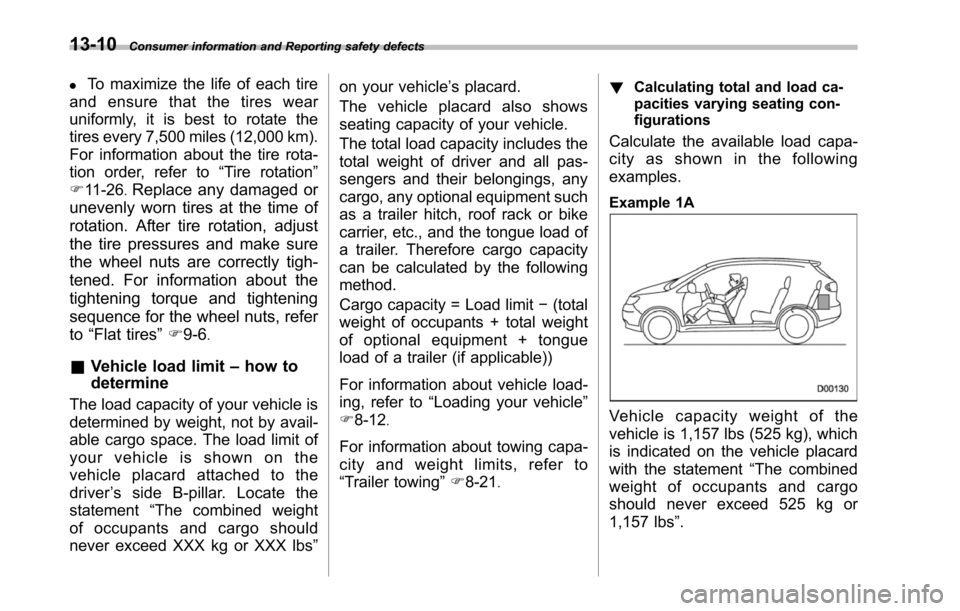
Example 1A
Vehicle capacity weight of the
vehicle is 1,157 lbs (525 kg), which
is indicated on the vehicle placard
with the statement“The combined
weight of occupants and cargo
should never exceed 525 kg or
1,157 lbs”.
Page 408 of 426
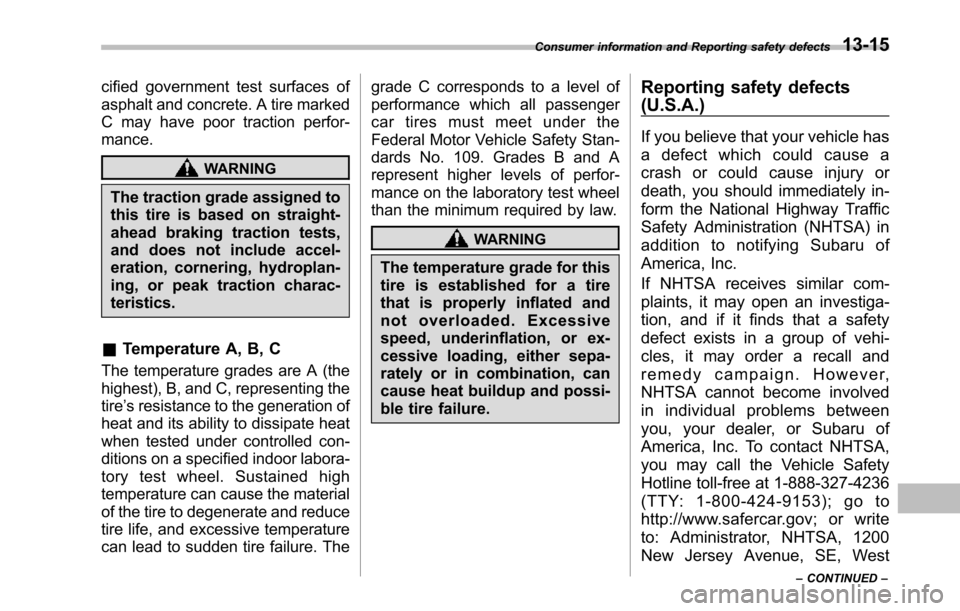
cified government test surfaces of
asphalt and concrete. A tire marked
C may have poor traction perfor-
mance.
WARNING
The traction grade assigned to
this tire is based on straight-
ahead braking traction tests,
and does not include accel-
eration, cornering, hydroplan-
ing, or peak traction charac-
teristics.
&Temperature A, B, C
The temperature grades are A (the
highest), B, and C, representing the
tire’s resistance to the generation of
heat and its ability to dissipate heat
when tested under controlled con-
ditions on a specified indoor labora-
tory test wheel. Sustained high
temperature can cause the material
of the tire to degenerate and reduce
tire life, and excessive temperature
can lead to sudden tire failure. The
grade C corresponds to a level of
performance which all passenger
car tires must meet under the
Federal Motor Vehicle Safety Stan-
dards No. 109. Grades B and A
represent higher levels of perfor-
mance on the laboratory test wheel
than the minimum required by law.
WARNING
The temperature grade for this
tire is established for a tire
that is properly inflated and
not overloaded. Excessive
speed, underinflation, or ex-
cessive loading, either sepa-
rately or in combination, can
cause heat buildup and possi-
ble tire failure.
Reporting safety defects
(U.S.A.)
If you believe that your vehicle has
adefectwhichcouldcausea
crash or could cause injury or
death, you should immediately in-
form the National Highway Traffic
Safety Administration (NHTSA) in
addition to notifying Subaru of
America, Inc.
If NHTSA receives similar com-
plaints, it may open an investiga-
tion, and if it finds that a safety
defect exists in a group of vehi-
cles, it may order a recall and
remedy campaign. However,
NHTSA cannot become involved
in individual problems between
you, your dealer, or Subaru of
America, Inc. To contact NHTSA,
you may call the Vehicle Safety
Hotline toll-free at 1-888-327-4236
(TTY: 1-800-424-9153); go to
http://www.safercar.gov; or write
to: Administrator, NHTSA, 1200
New Jersey Avenue, SE, West
Consumer information and Reporting safety defects13-15
–CONTINUED–
Page 412 of 426
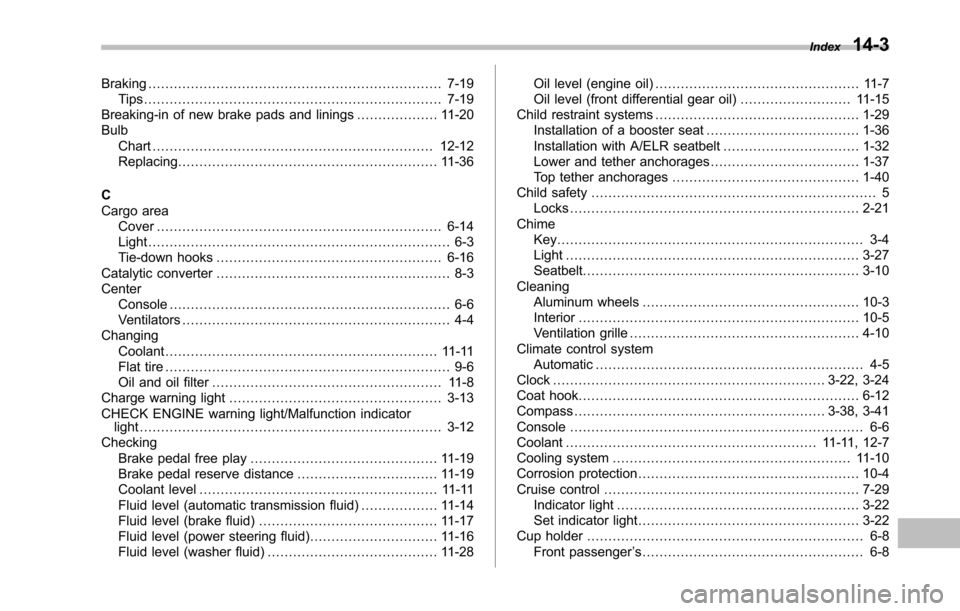
Braking..................................................................... 7-19Tips . . . . . . . . . . . . . . . . . . . . . . . . . . . . . . . . . . . . . . . . . . . . . . . . . . . . . . . . . . . . . . . . . . . . . . 7-19Breaking-in of new brake pads and linings................... 11-20BulbChart.................................................................. 12-12Replacing............................................................. 11-36
CCargo areaCover................................................................... 6-14Light....................................................................... 6-3Tie-down hooks..................................................... 6-16Catalytic converter....................................................... 8-3CenterConsole.................................................................. 6-6Ventilators............................................................... 4-4ChangingCoolant................................................................ 11-11Flat tire................................................................... 9-6Oil andoil filter...................................................... 11-8Charge warning light.................................................. 3-13CHECKENGINE warning light/Malfunction indicatorlight....................................................................... 3-12CheckingBrake pedal free play............................................ 11-19Brake pedal reserve distance................................. 11-19Coolant level........................................................ 11-11Fluid level (automatic transmission fluid).................. 11-14Fluid level (brake fluid).......................................... 11-17Fluidlevel (power steering fluid).............................. 11-16Fluid level (washer fluid)........................................ 11-28
Oil level (engine oil)................................................ 11-7Oil level (front differential gear oil).......................... 11-15Child restraint systems................................................ 1-29Installation of a booster seat.................................... 1-36Installation with A/ELR seatbelt ................................ 1-32Lower and tether anchorages................................... 1-37Top tether anchorages............................................ 1-40Child safety................................................................... 5Locks.................................................................... 2-21ChimeKey........................................................................ 3-4Light..................................................................... 3-27Seatbelt................................................................. 3-10CleaningAluminum wheels................................................... 10-3Interior.................................................................. 10-5Ventilation grille...................................................... 4-10Climate control systemAutomatic............................................................... 4-5Clock................................................................ 3-22, 3-24Coat hook.................................................................. 6-12Compass........................................................... 3-38, 3-41Console..................................................................... 6-6Coolant........................................................... 11-11, 12-7Cooling system........................................................ 11-10Corrosionprotection.................................................... 10-4Cruise control............................................................ 7-29Indicator light......................................................... 3-22Set indicator light.................................................... 3-22Cup holder................................................................. 6-8Front passenger’s.................................................... 6-8
Index14-3
Page 413 of 426
14-4Index
Second-row seat...................................................... 6-9Third-row seat......................................................... 6-9
DDaytime running light system....................................... 3-29Differential gear oilFront........................................................... 11-15, 12-6Rear............................................................ 11-16, 12-6Dimensions............................................................... 12-2Disarming the alarm system........................................ 2-18Disc brake pad wear warning indicators........................ 7-20Dome light........................................................ 6-2, 11-42DoorLocks..................................................................... 2-5Open warning light................................................. 3-17Step light............................................................. 11-43Drive belts................................................................ 11-13DrivingAll-Wheel Drive warning light................................... 3-18AWD vehicles.......................................................... 8-4Car phone/cell phone.................................................. 8Drinking..................................................................... 7Drugs........................................................................ 7Foreign countries..................................................... 8-4Pets.......................................................................... 8Snowy and icy roads................................................ 8-9Tips . . . . . . . . . . . . . . . . . . . . . . . . . . . . . . . . . . . . . . . . . . . . . . . . . . . . . . . . . . . . . . . . . . 8-2, 8-4Tired or sleepy............................................................ 7Winter.................................................................... 8-8
EElectrical system........................................................ 12-7Electronic Brake Force Distribution (EBD) system... 3-16, 7-22Emergency Locking Retractor (ELR)............................. 1-18EngineCompartment overview............................................ 11-6Coolant....................................................... 11-11, 12-7Exhaust gas (carbon monoxide)............................. 6, 8-2Hood.................................................................... 11-4Oil ................................................................ 11-7, 12-4Overheating........................................................... 9-14Starting.................................................................. 7-7Stopping................................................................. 7-8Exterior care.............................................................. 10-2
FFlat tires..................................................................... 9-6Floor mat................................................................... 6-13Fluid levelAutomatic transmission......................................... 11-14Brake.................................................................. 11-17Power steering..................................................... 11-16Fog lightBulb.......................................................... 11-39, 12-12Indicator light......................................................... 3-22Switch................................................................... 3-32Folding mirror switch................................................... 3-43FrontDifferential gear oil........................................ 11-15, 12-6Fog light............................................ 3-32, 11-39, 12-12Fog light indicator light............................................ 3-22
Page 419 of 426
14-10Index
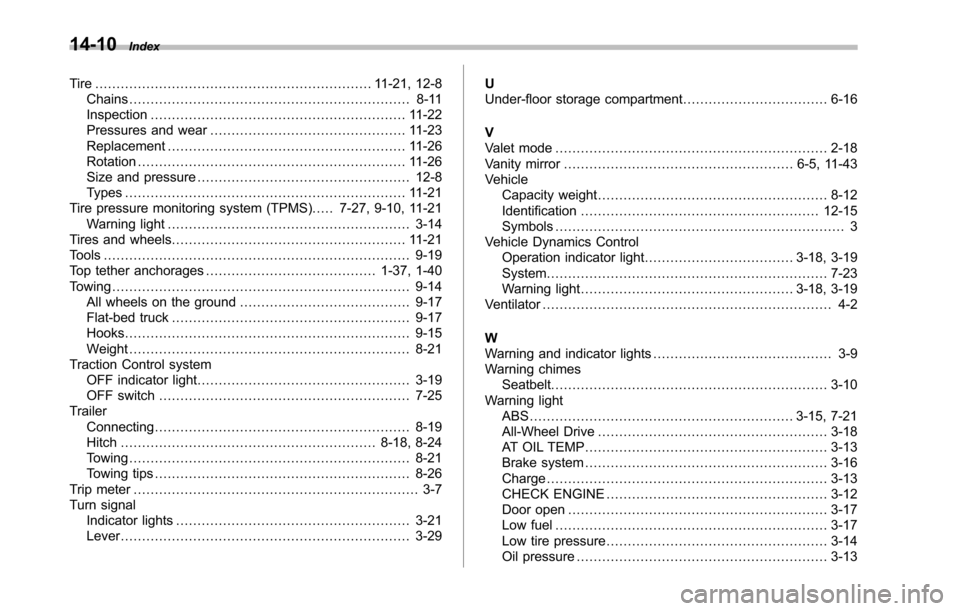
Tire . . . . . . . . . . . . . . . . . . . . . . . . . . . . . . . . . . . . . . . . . . . . . . . . . . . . . . . . . . . . . . . . . 11-21, 12-8Chains.................................................................. 8-11Inspection............................................................ 11-22Pressures and wear.............................................. 11-23Replacement........................................................ 11-26Rotation............................................................... 11-26Size and pressure.................................................. 12-8Types.................................................................. 11-21Tire pressure monitoring system (TPMS)..... 7-27, 9-10, 11-21Warning light......................................................... 3-14Tires and wheels....................................................... 11-21Tools........................................................................ 9-19Top tether anchorages........................................ 1-37, 1-40Towing...................................................................... 9-14All wheels on the ground........................................ 9-17Flat-bed truck........................................................ 9-17Hooks................................................................... 9-15Weight ..................................................................8-21Traction Control systemOFF indicator light.................................................. 3-19OFF switch........................................................... 7-25TrailerConnecting............................................................ 8-19Hitch............................................................ 8-18, 8-24Towing.................................................................. 8-21Towing tips............................................................ 8-26Trip meter................................................................... 3-7Turn signalIndicator lights....................................................... 3-21Lever.................................................................... 3-29
UUnder-floor storage compartment.................................. 6-16
VValet mode................................................................ 2-18Vanity mirror...................................................... 6-5, 11-43VehicleCapacity weight...................................................... 8-12Identification........................................................ 12-15Symbols.................................................................... 3Vehicle Dynamics ControlOperation indicator light................................... 3-18, 3-19System.................................................................. 7-23Warning light.................................................. 3-18, 3-19Ventilator.................................................................... 4-2
WWarning and indicator lights.......................................... 3-9Warning chimesSeatbelt................................................................. 3-10Warning lightABS .............................................................. 3-15, 7-21All-Wheel Drive...................................................... 3-18AT OIL TEMP......................................................... 3-13Brake system......................................................... 3-16Charge.................................................................. 3-13CHECK ENGINE.................................................... 3-12Door open............................................................. 3-17Low fuel................................................................ 3-17Low tire pressure.................................................... 3-14Oil pressure........................................................... 3-13