2014 SUBARU TRIBECA flat tire
[x] Cancel search: flat tirePage 355 of 426

11-22Maintenance and service
not be functioning normally. In this event,go to a SUBARU dealer to have thesystem inspected as soon as possible.
While the vehicle is driven, friction be-tween tires and the road surface causesthe tires to warm up. After illumination ofthe low tire pressure warning light, anyincrease in the tire pressures caused byan increase in the outside air temperatureor by an increase in the temperature in thetires can cause the low tire pressurewarning light to turn off.
System resetting is necessary when thewheels are changed (for example, aswitch to snow tires) and new TPMSvalves are installed on the newly fittedwheels. Have this work performed by aSUBARU dealer following wheel replace-ment.
It may not be possible to install TPMSvalves on certain wheels that are on themarket. Therefore, if you change thewheels (for example, a switch to snowtires), use wheels that have the same partnumber as the standard-equipmentwheels. Without four operational TPMSvalve/sensors on the wheels, the TPMSwill not fully function and the warning lightin the instrument panel will illuminatesteadily after blinking for approximatelyone minute.
When a tire is replaced, adjustments arenecessary to ensure continued normaloperation of the tire pressure monitoringsystem. As with wheel replacement, there-fore, you should have the work performedby a SUBARU dealer.
WARNING
If the low tire pressure warning lightdoes not illuminate briefly after theignition switch is turned ON or thelight illuminates steadily after blink-ing for approximately one minute,you shouldhave your Tire PressureMonitoring System checked at aSUBARU dealer as soon as possi-ble.
If this light illuminates while driving,never brake suddenly and keepdriving straight ahead while gradu-ally reducing speed. Then slowlypull off the road to a safe place.Otherwise an accident involvingserious vehicle damage and seriouspersonal injury could occur.
If this light still illuminates whiledriving after adjusting the tire pres-sure, a tire may have significantdamage and a fast leak that causesthe tire to lose air rapidly. If you havea flat tire, replace it with a spare tire
as soon as possible.
When a spare tire is mounted or awheel rim is replaced without theoriginal pressure sensor/transmitterbeing transferred, the low tire pres-sure warning light will illuminatesteadily after blinking for approxi-mately one minute. This indicatesthe TPMS is unable to monitor allfour road wheels. Contact yourSUBARU dealer as soon as possiblefor tire and sensor replacement and/or system resetting. If the lightilluminates steadily after blinkingfor approximately one minute,promptly contact a SUBARU dealerto have the system inspected.
&Tire inspection
Checkon a daily basis that the tires arefree from serious damage, nails, andstones. At the same time, check the tiresfor abnormal wear.
Contact your SUBARU dealer immedi-ately if you find any problem.
NOTE
.When the wheels and tires strikecurbs or are subjected to harsh treat-ment as when the vehicle is driven on arough surface, they can suffer damage
Page 360 of 426
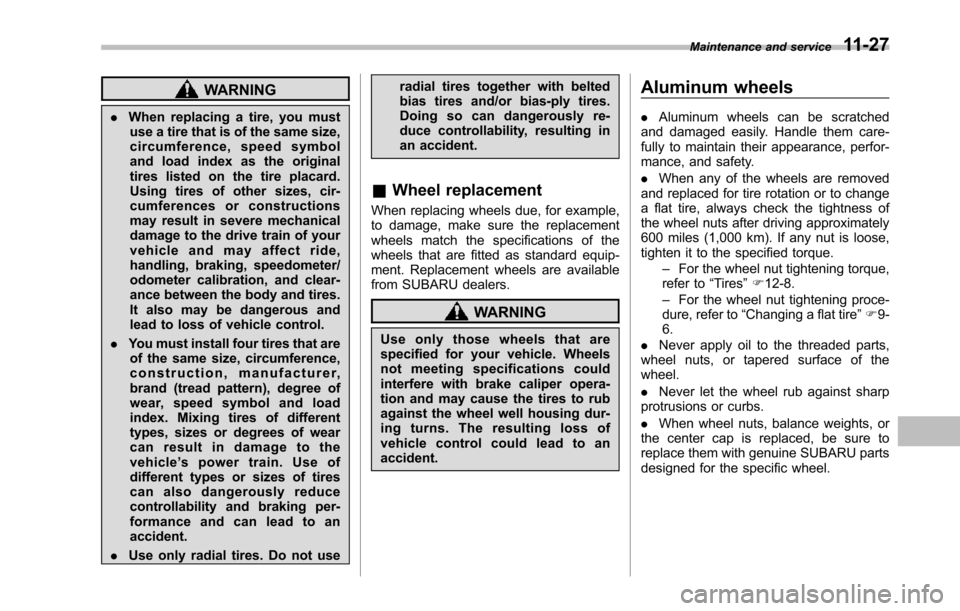
WARNING
.When replacing a tire, you mustuse a tire that is of the same size,circumference, speed symboland load index as the originaltires listed on the tire placard.Using tires of other sizes, cir-cumferences or constructionsmay result in severe mechanicaldamage to the drive train of yourvehicle and may affect ride,handling, braking, speedometer/odometer calibration, and clear-ance betweenthe body and tires.It also may be dangerous andlead to loss of vehicle control.
.You must install four tires that areof the same size, circumference,construction, manufacturer,brand(tread pattern), degree ofwear, speed symbol and loadindex. Mixing tires of differenttypes, sizes or degrees of wearcan result in damage to thevehicle’spowertrain.Useofdifferent types or sizes of tirescan also dangerously reducecontrollability and braking per-formance and can lead to anaccident.
.Use only radial tires. Do not use
radial tires together with beltedbias tires and/or bias-ply tires.Doing so can dangerously re-duce controllability, resulting inan accident.
&Wheel replacement
When replacing wheels due, for example,to damage, make sure the replacementwheels match the specifications of thewheels that are fitted as standard equip-ment. Replacement wheels are availablefrom SUBARUdealers.
WARNING
Use only those wheels that arespecified for your vehicle. Wheelsnot meeting specifications couldinterfere with brake caliper opera-tion and may cause the tires to rubagainst the wheel well housing dur-ing turns. The resulting loss ofvehicle control could lead to anaccident.
Aluminum wheels
.Aluminum wheels can be scratchedand damaged easily. Handle them care-fully to maintain their appearance, perfor-mance, and safety.
.When any of the wheels are removedand replaced for tire rotation or to changea flat tire, always check the tightness ofthe wheel nuts after driving approximately600 miles (1,000 km). If any nut is loose,tighten it to the specified torque.–For the wheel nut tightening torque,refer to“Tires”F12-8.–For the wheel nut tightening proce-dure, refer to“Changing a flat tire”F9-6..Never apply oil to the threaded parts,wheel nuts, or tapered surface of thewheel.
.Never let the wheel rub against sharpprotrusions or curbs.
.When wheel nuts, balance weights, orthe center cap is replaced, be sure toreplace them with genuine SUBARU partsdesigned for the specific wheel.
Maintenance and service11-27
Page 385 of 426
12-8Specifications
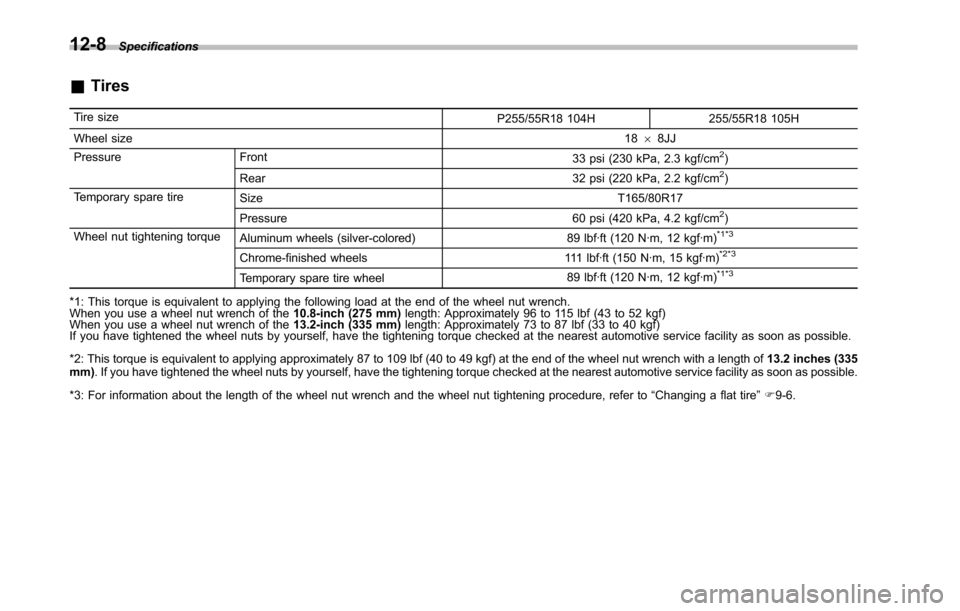
&Tires
Tire sizeP255/55R18 104H 255/55R18 105H
Wheel size1868JJ
Pressure Front33 psi (230 kPa, 2.3 kgf/cm2)
Rear 32 psi (220 kPa, 2.2 kgf/cm2)
Temporary spare tireSize T165/80R17
Pressure 60 psi (420 kPa, 4.2 kgf/cm2)
Wheel nut tightening torqueAluminum wheels (silver-colored) 89 lbf·ft (120 N·m, 12 kgf·m)*1*3
Chrome-finished wheels 111 lbf·ft (150 N·m, 15 kgf·m)*2*3
Temporary spare tire wheel89 lbf·ft (120 N·m, 12 kgf·m)*1*3
*1: This torque is equivalent to applying the following load at the end of the wheel nut wrench.When you use a wheel nut wrench of the10.8-inch (275 mm)length: Approximately 96 to 115 lbf (43 to 52 kgf)When you use a wheel nut wrench of the13.2-inch (335 mm)length: Approximately 73 to 87 lbf (33 to 40 kgf)If you have tightened the wheel nuts by yourself, have the tightening torque checked at the nearest automotive service facility as soon as possible.
*2: This torque is equivalent to applying approximately 87 to 109 lbf (40 to 49 kgf) at the end of the wheel nut wrench with a length of13.2 inches (335mm). If you have tightened the wheel nuts by yourself, have the tightening torque checked at the nearest automotive service facility as soon as possible.
*3: For informationabout the length of the wheelnut wrenchand the wheel nut tightening procedure, refer to“Changinga flat tire”F9-6.
Page 392 of 426
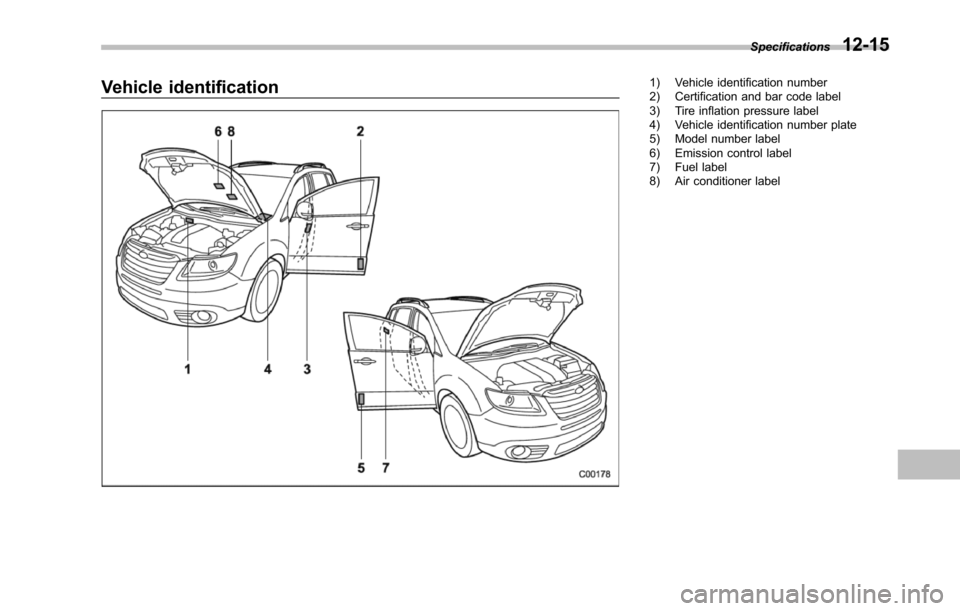
Vehicle identification1) Vehicle identification number2) Certification and bar code label3) Tire inflation pressure label4) Vehicle identification number plate5) Model number label6) Emission control label7) Fuel label8) Air conditioner label
Specifications12-15
Page 394 of 426
For U.S.A............................................................ 13-2
Tire information.................................................. 13-2Tire labeling....................................................... 13-2Recommended tire inflation pressure.................. 13-4Glossary of tire terminology............................... 13-5Tire care–maintenance and safety practices...... 13-9Vehicle load limit–how to determine................ 13-10Determining compatibility of tire and vehicleload capacities............................................... 13-13
Adverse safety consequences of overloadingon handling and stopping and on tires........... 13-13Steps for Determining Correct Load Limit......... 13-13
Uniform tire quality grading standards.......... 13-14Treadwear....................................................... 13-14Traction AA, A, B, C......................................... 13-14Temperature A, B, C......................................... 13-15
Reporting safety defects (U.S.A.)................... 13-15
Consumer information and Reporting safety defects
13
Page 396 of 426
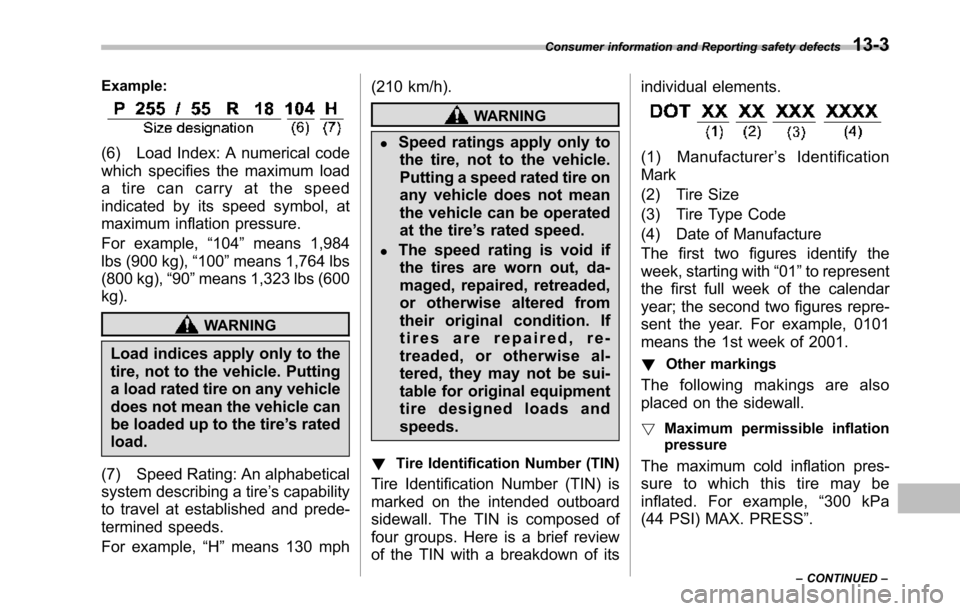
Example:
(6) Load Index: A numerical code
which specifies the maximum load
atirecancarryatthespeed
indicated by its speed symbol, at
maximum inflation pressure.
For example,“104”means 1,984
lbs (900 kg),“100”means 1,764 lbs
(800 kg),“90”means 1,323 lbs (600
kg).
WARNING
Load indices apply only to the
tire, not to the vehicle. Putting
a load rated tire on any vehicle
does not mean the vehicle can
be loaded up to the tire’s rated
load.
(7) Speed Rating: An alphabetical
system describing a tire’s capability
to travel at established and prede-
termined speeds.
For example,“H”means 130 mph
(210 km/h).
WARNING
.Speed ratings apply only to
the tire, not to the vehicle.
Putting a speed rated tire on
any vehicle does not mean
the vehicle can be operated
at the tire’s rated speed.
.The speed rating is void if
the tires are worn out, da-
maged, repaired, retreaded,
or otherwise altered from
their original condition. If
tires are repaired, re-
treaded, or otherwise al-
tered, they may not be sui-
table for original equipment
tire designed loads and
speeds.
!Tire Identification Number (TIN)
Tire Identification Number (TIN) is
marked on the intended outboard
sidewall. The TIN is composed of
four groups. Here is a brief review
of the TIN with a breakdown of its
individual elements.
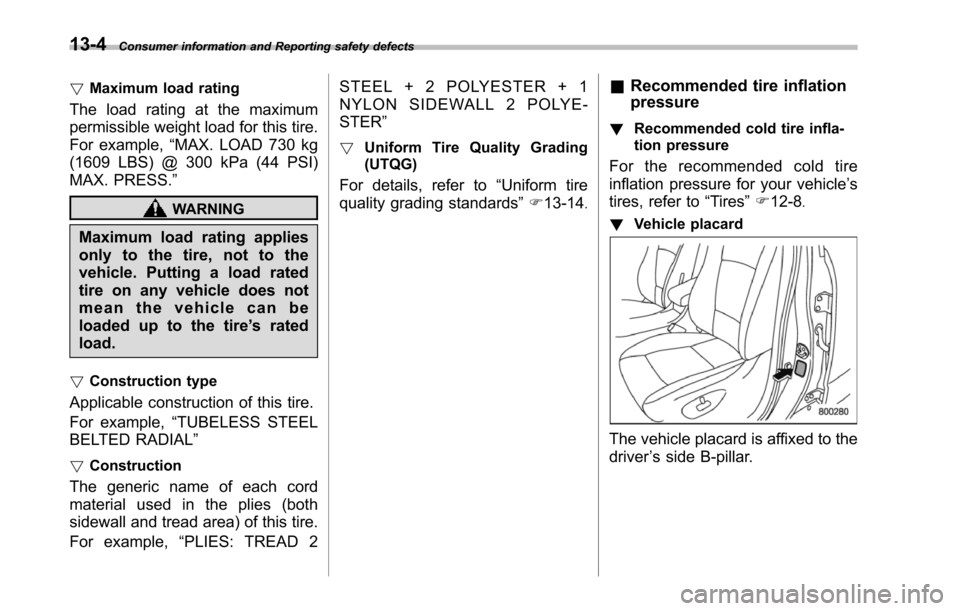
(1) Manufacturer’sIdentification
Mark
(2) Tire Size
(3) Tire Type Code
(4) Date of Manufacture
The first two figures identify the
week, starting with“01”to represent
the first full week of the calendar
year; the second two figures repre-
sent the year. For example, 0101
means the 1st week of 2001.
!Other markings
The following makings are also
placed on the sidewall.
!Maximum permissible inflation
pressure
The maximum cold inflation pres-
sure to which this tire may be
inflated. For example,“300 kPa
(44 PSI) MAX. PRESS”.
Consumer information and Reporting safety defects13-3
–CONTINUED–
Page 397 of 426
13-4Consumer information and Reporting safety defects
!Maximum load rating
The load rating at the maximum
permissible weight load for this tire.
For example,“MAX. LOAD 730 kg
(1609 LBS) @ 300 kPa (44 PSI)
MAX. PRESS.”
WARNING
Maximum load rating applies
only to the tire, not to the
vehicle. Putting a load rated
tire on any vehicle does not
mean the vehicle can be
loaded up to the tire’s rated
load.
!Construction type
Applicable construction of this tire.
For example,“TUBELESS STEEL
BELTED RADIAL”
!Construction
The generic name of each cord
material used in the plies (both
sidewall and tread area) of this tire.
For example,“PLIES: TREAD 2
STEEL + 2 POLYESTER + 1
NYLON SIDEWALL 2 POLYE-
STER”
!Uniform Tire Quality Grading
(UTQG)
For details, refer to“Uniform tire
quality grading standards”F13-14.
&Recommended tire inflation
pressure
!Recommended cold tire infla-
tion pressure
For the recommended cold tire
inflation pressure for your vehicle’s
tires, refer to“Tires”F12-8.
!Vehicle placard
The vehicle placard is affixed to the
driver’s side B-pillar.
Page 398 of 426
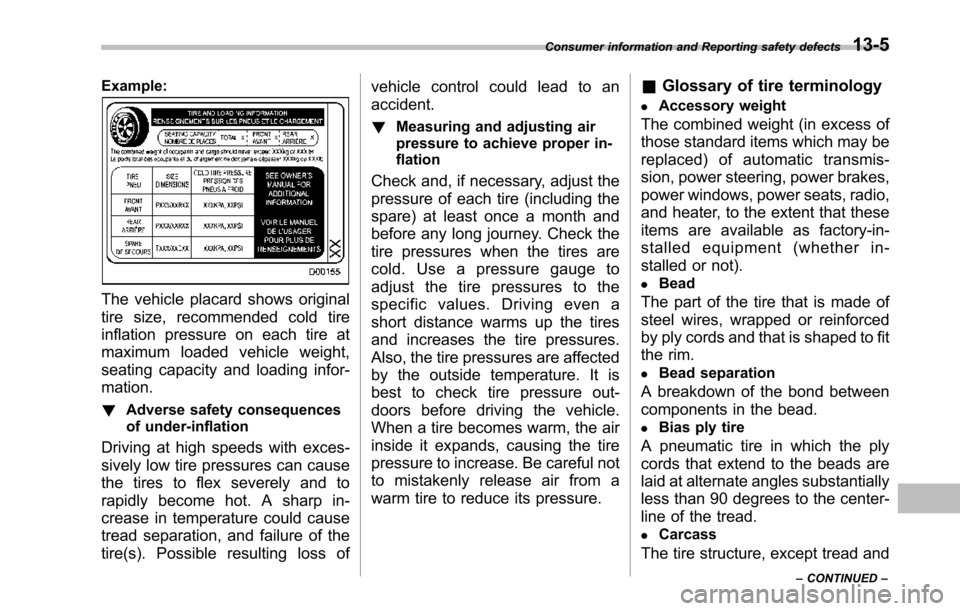
Example:
The vehicle placard shows original
tire size, recommended cold tire
inflation pressure on each tire at
maximum loaded vehicle weight,
seating capacity and loading infor-
mation.
!Adverse safety consequences
of under-inflation
Driving at high speeds with exces-
sively low tire pressures can cause
the tires to flex severely and to
rapidly become hot. A sharp in-
crease in temperature could cause
tread separation, and failure of the
tire(s). Possible resulting loss of
vehicle control could lead to an
accident.
!Measuring and adjusting air
pressure to achieve proper in-
flation
Check and, if necessary, adjust the
pressure of each tire (including the
spare) at least once a month and
before any long journey. Check the
tire pressures when the tires are
cold. Use a pressure gauge to
adjust the tire pressures to the
specific values. Driving even a
short distance warms up the tires
and increases the tire pressures.
Also, the tire pressures are affected
by the outside temperature. It is
best to check tire pressure out-
doors before driving the vehicle.
When a tire becomes warm, the air
inside it expands, causing the tire
pressure to increase. Be careful not
to mistakenly release air from a
warm tire to reduce its pressure.
&Glossary of tire terminology
.Accessory weight
The combined weight (in excess of
those standard items which may be
replaced) of automatic transmis-
sion, power steering, power brakes,
power windows, power seats, radio,
and heater, to the extent that these
items are available as factory-in-
stalled equipment (whether in-
stalled or not).
.Bead
The part of the tire that is made of
steel wires, wrapped or reinforced
by ply cords and that is shaped to fit
the rim.
.Bead separation
A breakdown of the bond between
components in the bead.
.Bias ply tire
A pneumatic tire in which the ply
cords that extend to the beads are
laid at alternate angles substantially
less than 90 degrees to the center-
line of the tread.
.Carcass
The tire structure, except tread and
Consumer information and Reporting safety defects13-5
–CONTINUED–